The Door That Closed Ten Years Ago
I was thrown out of my parents’ house at nineteen for refusing to abort my baby. For ten years, they believed I was a stubborn, reckless daughter who ruined her future. What they never knew was that I had a reason—a secret so serious that I warned them we would all regret it one day. A decade later, I returned to Ohio with my ten-year-old son, knocked on the same door that had been slammed in my face, and spoke a single sentence that turned the color from their faces. What happened next still haunts me.
My name is Emma, and I’ll never forget the day my life shattered.
I was nineteen, scared out of my mind, and only a few weeks pregnant when I sat across from my parents in our modest Ohio living room. My hands trembled as I held out the positive pregnancy test.
My mother stared at it like it was a bomb.
My father slowly leaned forward in his recliner.
“Who’s the father?” he asked.
I looked down.
“I can’t tell you.”
The silence that followed felt suffocating.
“What do you mean you can’t tell us?” my mother snapped. “Are you protecting someone? Is he married? Is he twice your age?”
“It’s complicated,” I whispered. “But I can’t end this pregnancy. I can’t. And if I do… it won’t just affect me. It’ll affect all of us.”
The second those words left my mouth, everything exploded.
My father shot to his feet.
“Don’t play games with us!”
“Dad, please,” I begged. “I can’t explain right now, but one day you’ll understand.”
“Either you get rid of that baby,” he yelled, pointing toward the door, “or you get out.”
“Please—”
“Get out. Now.”
An hour later, I stood on the porch with a duffel bag and nowhere to go.
My mother cried behind the screen door.
But she never stopped him.
I left Ohio soon after.
Changed my number.
Started over in another state.
And I kept my baby.
His name was Leo.
The next ten years tested me in ways I never imagined. I worked two jobs, attended community college classes, studied after midnight, and survived on determination and caffeine. There were nights I cried myself to sleep from exhaustion.
But every morning, Leo gave me a reason to keep fighting.
He was smart.
Funny.
Kind-hearted.
And far more observant than most kids his age.
As he got older, his questions became harder to answer.
“Mom,” he asked one evening, “why don’t we ever visit Grandma and Grandpa?”
I froze.
Because they chose pride over their daughter.
Because they never wanted you.
Because I wasn’t ready.
But I simply smiled and changed the subject.
Then, on his tenth birthday, he looked at me with those serious blue eyes and quietly said, “Can I meet them? Just once?”
Something inside me shifted.
Maybe he deserved the truth.
Maybe all of us did.
The next weekend, we packed an overnight bag and drove eight hours back to Ohio.
My parents had no idea we were coming.
When I stepped onto that familiar porch, memories hit me like a wave. The same peeling paint. The same porch swing.
The same front door.
I knocked.
A few seconds later, it opened.
My father stared at me.
His face went pale.
“Emma?”
My mother appeared behind him.
Then she noticed Leo.
Her hand flew to her mouth.
Nobody spoke.
Ten years of silence stood between us.
Finally, I took a deep breath.
“I need to tell you the truth.”
My father’s jaw tightened.
“The truth about Leo.”
My mother looked ready to collapse.
“And the real reason I couldn’t get rid of him.”
Both of them stared at my son.
The color drained from their faces.
Their eyes widened.
Then, for the first time since I arrived…
Their hands began to shake.
And when I finally revealed who Leo’s father really was, neither of them could even speak.
The Unspoken Echoes of the Past
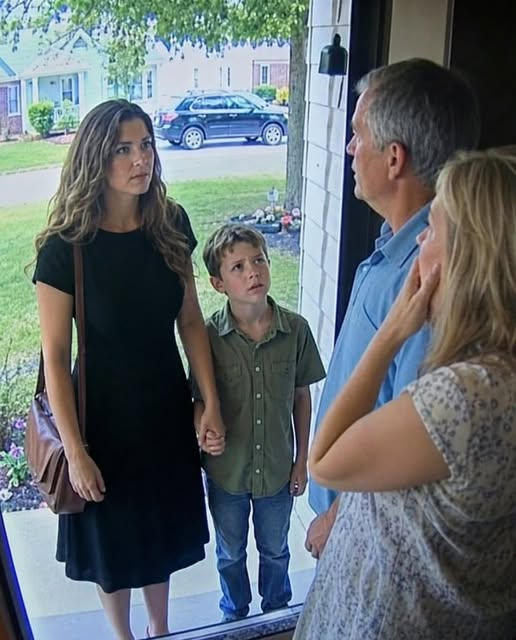
The silence on that front porch was heavy enough to crush a person’s chest. The humid Ohio summer air hung still around us, smelling faintly of cut grass and old timber. My father, Arthur, gripped the wood of the doorframe so tightly that his knuckles turned a chalky, bloodless white. My mother, Evelyn, stood half-step behind him, her right hand clamped over her trembling lips, her chest heaving as if she had forgotten how to draw breath.
Leo moved closer to my hip, his small fingers tucking instinctively into the back pocket of my jeans. He didn’t cry. He didn’t cower. He possessed an uncanny, adult-like composure that he had carried since he was a toddler—a quiet dignity that had carried both of us through lean winters, cold dinners, and tiny rented basement apartments.
“Emma…” Arthur’s voice sounded like stones grinding together. “What are you saying?”
“Let us inside, Dad,” I said quietly, my voice calm, steady, and utterly devoid of the desperation I had felt ten years ago. “It’s time to stop hiding behind your anger. You need to hear this, both of you.”
Evelyn’s eyes didn’t move from Leo’s face. She wasn’t just staring at him out of shock or maternal instincts long suppressed. She was looking at his features— the distinct arc of his brow, the square jawline, and most of all, those deep, piercing indigo-blue eyes. They weren’t my eyes. They weren’t Arthur’s. And they certainly didn’t belong to any casual boyfriend a nineteen-year-old college girl might have crossed paths with in a campus coffee shop.
Arthur hesitated, his chest rising and falling heavily, before he slowly stepped back, sweeping the door open. He didn’t offer a welcome. He didn’t open his arms. But he let us cross the threshold.
The living room looked preserved in amber. The same floral couch, the same mahogany clock ticking rhythmically on the mantlepiece, the same framed family portraits hanging on the hallway wall. But there was one gaping, undeniable void on that wall: every picture of me had been taken down. It was as if Emma Miller had ceased to exist the moment her duffel bag hit the gravel driveway in 2016.
“Sit down, Leo,” I murmured softly, pointing toward the armchair near the window.
Leo nodded, climbing onto the cushion, his small legs dangling, his intelligent eyes scanning the room with calm curiosity.
“Emma,” Evelyn whispered, her voice crackling like dry leaves. She took a step toward me, but stopped short, as if an invisible wall barred her from coming any closer. “Who is his father? Who did you protect all these years?”
“I wasn’t protecting a man, Mom,” I said, looking her dead in the eye. “I was protecting you. I was protecting Dad.”
Arthur snapped. “Don’t turn your shame onto us! You brought dishonor to this house! You refused to tell us who took advantage of you, you refused to listen to reason, and you walked out—”
“You threw me out!” I cut him off, my voice sharp as razor wire, ringing through the quiet house. “You gave me an ultimatum: kill my child or live on the street. And you never asked why I was holding on to him so fiercely.”
“Then tell us now!” Arthur bellowed, his fists clenched at his sides, though his chest trembled with an underlying dread he couldn’t quite master. “Who is he?”
I took a slow, deep breath, reaching into my purse. I pulled out an old, yellowed Manila folder—one I had carried across state lines, hidden beneath my mattress, and guarded with my very life for a decade. I placed it gently on the wooden coffee table between us.
“Ten years ago, a week before I discovered I was pregnant, I went to the university health clinic for a routine checkup,” I began, my tone turning deadly calm. “While I was there, the nursing student made a mistake. She ran an advanced genetic screening protocol that was supposed to be for a clinical trial patient with a family history of bone marrow failure.”
Evelyn gasped softly, her eyes flickering toward Arthur.
“When the results came back, the clinic panicked,” I continued. “Not because of the baby’s father… but because of what the genetic test revealed about my bloodline. About your bloodline, Dad.”
Arthur froze. “What are you talking about?”
“I found out that I carried a rare, lethal genetic marker—a recessive anomaly that meant if I ever needed an organ donor, or a marrow transplant, or specialized life-saving biological therapies, none of my parents or standard relatives would ever be a match. But the genetic counselor noticed something else in my profile. Something impossible.”
I unzipped the folder and laid out three laminated medical documents.
“The test showed that my biological structure possessed a rare double-helix marker—a signature that only occurs when two people with identical, hyper-specific ancestral blood variants reproduce. I wasn’t just pregnant with a random child. Leo was conceived through a micro-surrogacy procedure I secretly volunteered for at the University Research Hospital.”
Arthur dropped heavily into his recliner, his face flushed red with rising anger and confusion. “Surrogacy? You were a surrogate at nineteen?!”
“No, Dad,” I said, tears finally welling in my eyes, though my voice never faltered. “I was an emergency surrogate for a anonymous donor whose profile was flagged as an absolute 100% biological match to my missing brother.”
The Ghost in the Living Room
The room fell into an absolute, suffocating dead silence.
The air seemed to rush out of the room like a vacuum. Evelyn stumbled backward, her knees buckling until she slammed down onto the edge of the sofa. Arthur’s face went from pale to a terrifying, ghostly white.
“What… what did you just say?” Evelyn whispered, her voice barely audible over the ticking clock.
“My brother,” I repeated, each word heavy as lead. “Julian.”
Julian. The name hadn’t been spoken aloud in that house for fifteen years.
Julian was my older brother. When I was nine years old and he was fourteen, Julian vanished. He had walked out of middle school on a crisp October afternoon to catch the bus home and simply disappeared into thin air. The police searched for months. Desperate flyers covered every telephone pole in Ohio. My parents spent their savings, their sanity, and their happiness looking for him. But after five excruciating years, the authorities declared the case cold. By the time I turned nineteen, my parents had buried Julian in their minds, erecting a wall of bitter grief that eventually transformed into the rigid, unforgiving anger they took out on me.
“That’s impossible,” Arthur gasped, his hands shaking violently as he pointed a finger at me. “Julian is gone! He’s been gone for twenty-five years! You’re lying! You’re making up a sick, twisted fairytale to cover up your mistake!”
“Look at the paper, Dad!” I shouted, slamming my palm onto the coffee table. “LOOK AT IT!”
Arthur hesitated, his chest heaving, before his trembling hands reached for the top document.
“In 2016, a young man was brought into the Cleveland Medical Center under a john-doe alias,” I explained, tears streaming down my face as the decades of stored pain poured out. “He was in a comatose state, suffering from aggressive, end-stage acute leukemia. He had no ID, no memory records, and no family on file. But the medical research team harvested his stem cells and ran an emergency biological preservation protocol, searching the global registry for any compatible embryonic match that could carry his biological lineage forward or harvest compatible cord-blood stem cells to save his life.”
Evelyn pulled herself across the sofa on her knees, grabbing the second sheet of paper from Arthur’s hands. Her eyes scanned the medical jargon, the DNA sequence graphs, and the bold red stamp at the bottom of the lab results: 99.98% DIRECT MATERNAL/PATERNAL FAMILIAL MATCH — SUBJECT: JULIAN MILLER.
“When I went to that clinic,” I choked out, “they realized my DNA matched the emergency donor code. They didn’t tell me who he was at first. They just asked if I would consent to an emergency implantation procedure using a donor embryo created from his preserved cells to generate a matching cord-blood line. I didn’t understand it completely… until I saw the redacted intake photo of the patient.”
I reached into my bag and pulled out one final photograph. A faded, printed medical snapshot of a young man lying in a hospital bed, hooked up to life-support monitors. He had pale skin, dark hair, and a small, crescent-shaped scar above his left eyebrow— the exact same scar Julian got when he fell off his bicycle when he was ten years old.
Evelyn let out a horrific, shattering scream—a sound of pure, unadulterated grief and shock that had been buried in her soul for a quarter of a century. She pressed the photograph to her chest, weeping hysterically, her body convulsing with tears.
“Julian…” she sobbed, rocking back and forth. “My baby… my boy…”
Arthur stared at the photograph, the hard, unyielding armor he had worn for ten years crumbling into dust in a matter of seconds. Tears welled in his harsh eyes, spilling over his weathered cheeks.
“When you told me to abort him…” I whispered, looking at my father, “you were asking me to destroy the only living piece of Julian left on this earth. You were asking me to kill the only chance we ever had of keeping his memory alive.”
Arthur buried his face in his hands, his shoulders heaving as deep, agonizing sobs tore from his throat. The proud, arrogant man who had thrown his pregnant daughter out into the cold ten years ago was gone, replaced by a broken father crushed under the unbearable weight of his own terrible mistake.
“Why…” Arthur wept, looking up at me through bloodshot eyes. “Why didn’t you tell us then?! Why didn’t you say it was Julian?!”
“Because I was bound by a legal non-disclosure agreement while the hospital ran the trial,” I said softly. “And more than that… the clinic told me the truth about Julian’s condition. He was brain-dead, Dad. He passed away three days after the implantation was finalized. If I told you then—while you were screaming at me, while you were blinded by anger—you wouldn’t have believed me. You would have thought I was insane. I had to protect Leo. I had to make sure he was born healthy.”
I turned slowly to look at my son.
Leo sat quietly in the chair. He looked at my parents, then at the photograph lying on the table, and then at me.
“Mom?” Leo asked softly, his voice echoing in the quiet room. “Is that why you named me Leo?”
I smiled through my tears, nodding gently. “Leo was your uncle’s middle name, sweetheart. You carry his light.”
The Unbreakable Cord
Evelyn slowly pushed herself up from the sofa. She didn’t look at me first; her eyes drifted, wide and overflowing with tears, toward the boy sitting near the window.
She walked toward him slowly, as if approaching a miracle she was terrified might vanish if she moved too fast. She sank onto her knees in front of Leo’s chair, her trembling hands hovering just inches from his face.
“Look at his eyes, Arthur…” Evelyn sobbed softly, reaching out until her fingertips lightly brushed Leo’s cheek. “He has Julian’s eyes. Oh God… he has Julian’s exact eyes.”
Leo didn’t pull away. He looked at the weeping woman before him, then reached out his small hand and gently wiped a tear from her cheek.
“Are you my Grandma?” he asked quietly.
Evelyn broke down completely, burying her face in the boy’s small lap, weeping tears of twenty-five years of unresolved grief, regret, and sudden, overwhelming love. Leo looked up at me, and I gave him a small, reassuring nod. He hesitated for a second before wrapping his small arms around his grandmother’s shaking shoulders.
Arthur slowly got up from his chair. He looked at me, his eyes filled with a profound shame that no words could ever wash away. He stepped toward me, stopping just a foot away, his mouth opening and closing as he searched for words that simply didn’t exist in the human language to apologize for what he had done.
“Emma…” Arthur choked out, his voice cracking. “What have I done to you? How can you ever forgive me?”
“I didn’t come back here for an apology, Dad,” I said, my voice steady, though tears continued to spill down my cheeks. “I came back because Leo deserved to know where he came from. And because Julian deserved to have his family know that he didn’t just disappear into nothing. He left us a gift.”
Arthur fell to his knees right in front of me, grabbing my hands in his, pressing his forehead against my knuckles. “I’m sorry,” he wept bitterly. “I’m so sorry, Emma… I failed you. I failed my daughter…”
I stood there, looking down at my broken father, feeling the heavy burden of ten years of isolation, anger, and hurt slowly lift from my shoulders. The bitterness that had armored my heart for a decade began to melt away, replaced by a deep, unexpected sense of peace.
The Reveal That Changed Everything
“There’s one more thing,” I said quietly, pulling my hands gently from my father’s grip.
Arthur looked up, wiping his face, his eyes filled with confusion. Evelyn turned her tear-stained face from Leo, looking at me with apprehension.
“What do you mean, Emma?” Evelyn asked, her voice trembling.
I reached back into my bag and pulled out a second, sealed white envelope—one that had arrived at my apartment in Chicago just two weeks before Leo’s tenth birthday.
“When Julian passed away ten years ago,” I said, ” the medical center placed his biological profile into the National Genetic Health & Estate Registry under a rare protective trust reserved for unidentified patients whose samples led to live births. Because I carried Leo to term, the court established an automatic biological tracing monitor.”
I opened the envelope and pulled out a single sheet of official legal parchment stamped with the seal of the Ohio State Supreme Court.
“Two weeks ago, the registry completed a comprehensive family lineage audit,” I continued, looking between my mother and father. “When Julian was taken ten years ago as a John Doe, his medical file included a bio-bank deposit box that had been sealed under federal court order until his child—Leo—reached the age of ten.”
Arthur frowned, standing up slowly. “A deposit box? From Julian? But he was fourteen when he went missing… he didn’t have anything…”
“He didn’t put it there when he was fourteen, Dad,” I said, my voice trembling with an emotion so intense it made my knees weak. “Julian was found by a specialized rescue unit in 2015. He had been living under witness protection for years after escaping an illegal trafficking ring when he was a teenager. He couldn’t contact us without putting our lives in danger.”
Evelyn gasped, clutching her chest. “He was alive all those years?!”
“He lived for ten years under an assumed name, working as a civil engineer,” I explained, tears streaming down my face. “He spent those years quietly building a life, constantly monitoring us from afar, unable to come home because of the threats against his identity. Before he fell ill with leukemia, he placed his entire estate—a multi-million dollar technological patent trust he developed—into a closed family fund.”
I held up the legal document.
“Julian didn’t just leave us his DNA, Mom. He left a legal testament.”
I opened the paper and read the bolded excerpt at the bottom:
“To my family, if this ever reaches you: If you are reading this, it means my biological continuation has reached his tenth year. The total assets of the Miller Innovation Trust—valued at $14.2 million—are hereby unlocked. Fifty percent is designated for the care and education of my child and my sister Emma, who bore the weight of my legacy. The remaining fifty percent is to be placed into an unconditional family trust for my parents, Arthur and Evelyn Miller, to ensure they never suffer another day of hardship.”
The room went completely, utterly silent.
Arthur stared at the paper in absolute disbelief. Evelyn pulled her hands to her mouth, fresh tears pouring down her face—not of grief, but of a profound, shattering awe.
“He never forgot us…” Evelyn whispered, her voice breaking into a cry of sheer, overwhelming love. “Our boy never forgot us…”
“And he made sure,” I added softly, looking directly at my father, “that the sister who was thrown away would be the one to bring his family back together.”
Arthur dropped his head, sobbing uncontrollably. The weight of his past cruelty, combined with the impossible mercy left behind by the son he thought he had lost forever, completely broke his spirit. He looked at me, his eyes pleading for a redemption he knew he didn’t deserve.
“Emma…” Arthur wept. “I don’t deserve your forgiveness. I don’t deserve to even look at you or this boy.”
I looked at my father—older, grey-haired, crushed by years of regret—and then at my mother, who was holding Leo’s hands as if he were the most precious treasure in the universe.
I took a step forward, reached down, and took my father’s hand, pulling him up from the floor.
“You don’t have to earn forgiveness in a day, Dad,” I said gently, offering him a small, sincere smile. “We have the rest of our lives to rebuild.”
A New Dawn
That evening, the sun set over the small Ohio town, casting a warm, golden glow through the living room windows of the house I had been banished from a decade ago.
For the first time in twenty-five years, the dark cloud that had hovered over the Miller household was gone. The kitchen was filled with the rich aroma of a home-cooked dinner. Evelyn sat at the dining table, showing Leo old photo albums of his uncle Julian, laughing through tears as she pointed out the striking similarities in their smiles.
Arthur sat on the porch swing outside—the very swing where he had sat ten years ago when he watched me walk away with a duffel bag.
I walked out onto the porch, carrying two mugs of warm tea. I sat down beside him, handing him a mug.
Arthur took it quietly, looking out at the yard where Julian and I used to play tag when we were children.
“I spent ten years hating myself, Emma,” Arthur said softly, his voice rough. “Every single day after you left, I looked at that driveway and wished I had run after you. Pride is a terrible, poisonous thing.”
“It is,” I agreed, taking a sip of my tea. “But love is stronger.”
Arthur turned to me, his eyes clear and full of a quiet, profound peace. He reached out and wrapped his arm around my shoulders, pulling me close—a gesture I hadn’t felt since I was a little girl.
“Thank you for coming back, Emma,” he whispered. “Thank you for bringing our family home.”
From inside the house, I heard Leo’s bright, infectious laugh echo through the hallway as Evelyn told him a story about his uncle.
I leaned my head against my father’s shoulder, watching the first stars appear in the evening sky. The painful journey that had begun with a locked door and a tear-stained face ten years ago had finally come to an end. We hadn’t just survived the dark—we had found our way back to the light, together.
