Chapter 1: The Storm on Highland Park
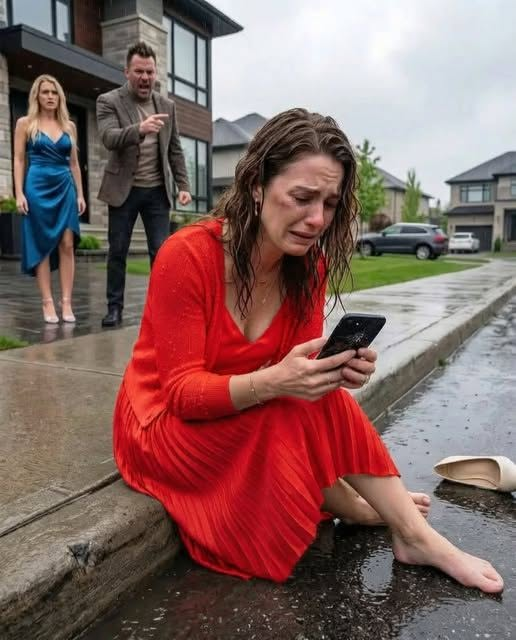
He slapped me six times in front of his mistress, threw me out into the rain, and left me broken on the street. I called my father with one request: show him no mercy. By the next morning, the powerful life my husband built began collapsing piece by piece.
Rainwater ran down my face, mixing with the blood at the corner of my mouth.
Six slaps.
I counted every one.
The first came when I asked why his mistress, Vanessa Cole, was sitting at our dining table wearing my pearl earrings. The second came when I told her to take them off. The third, fourth, and fifth came when my husband, Grant Whitmore, shouted that everything in that house belonged to him. The sixth knocked me against the marble console by the door.
Then he opened the front door and threw my overnight bag into the storm.
“Get out, Claire,” he said, breathing hard, his gold wedding band shining under the chandelier. “You should have learned your place.”
Vanessa stood behind him in my silk robe, smiling like she had won a prize.
I did not cry in front of them.
I stepped outside barefoot, my cheek burning, my ribs aching, and the rain swallowing the sound of my breath. Grant slammed the door so hard the brass knocker rattled. A second later, the security gate opened, and I stumbled onto the sidewalk of our quiet street in Highland Park, Dallas.
Cars passed. No one stopped.
I sat on the curb beneath the streetlight, shaking from cold and humiliation. My phone screen was cracked, but it still worked. Grant had always said my father’s name with contempt, as if Arthur Vance was only an old man with money and not the founder of one of the most powerful logistics companies in the United States.
I called him.
He answered on the second ring. “Claire?”
I swallowed blood. “Dad.”
His voice changed immediately. “What happened?”
I looked back at the house where Grant and Vanessa were probably pouring wine from my mother’s crystal glasses.
“He slapped me,” I said. “Six times. For her. Then he threw me into the rain.”
Silence.
Not shock. Not confusion.
A terrible, controlled silence.
Then my father asked, “Are you safe?”
“No.”
“Send me your location.”
I did.
His next words were colder than the rain.
“Listen carefully, Claire. Do not go back inside. Do not speak to him. Do not answer him if he calls. I am sending security and a doctor.”
I closed my eyes. “Dad…”
“Yes?”
“Show no mercy.”
For the first time that night, my father did not sound like a father.
He sounded like a judge delivering a sentence.
“Then mercy is over.”
Forty minutes later, two black SUVs stopped beside me. By sunrise, Grant Whitmore’s bank accounts were frozen, his largest investor had withdrawn, his company’s board had scheduled an emergency meeting, and every secret he had buried under expensive suits was being pulled into daylight.
Chapter 2: The Architecture of Illusion
Grant Whitmore had always lived in a world of manufactured illusions. When I met him six years ago at a charity gala in downtown Dallas, he was a handsome, hyper-ambitious vice president at a mid-sized asset management firm. He spoke with the effortless cadence of a man born for victory, exuding a sharp, predatory charm that could disarm an entire room in minutes.
To the rest of the world—and to me, at twenty-three—Grant was the quintessential rising star. What I did not realize until long after I wore his ring was that Grant’s success was built on a foundation of smoke and mirrors.
When we married, my father, Arthur Vance, had been hesitant. Arthur was a man who had built Vance Global Logistics from a single flatbed truck into a ten-billion-dollar international shipping empire through sheer grit, ruthless pragmatism, and unyielding discipline. Arthur saw through Grant’s polished veneer instantly. But because he loved me—because I was his only child, born after my mother’s long, agonizing battle with cancer—he had conceded.
He hadn’t just conceded; he had paved Grant’s path.
Arthur quietly underwrote Grant’s breakaway venture, Whitmore Capital. He made discrete calls to institutional investors, backed credit lines with Vance Global’s formidable balance sheet, and allowed Grant to use the prestige of the Vance name as an invisible armor. Within four years, Whitmore Capital was managing nearly nine hundred million dollars in portfolio assets.
Grant genuinely believed he had done it all himself.
He convinced himself that he was a financial genius, that my father was merely an aging dinosaur sitting on an old-money throne, and that I was a quiet, docile trophy wife whose only function was to look elegant at dinner parties and keep his Bel-Air-style Dallas estate running smoothly.
Then came Vanessa Cole.
Vanessa was twenty-six, an ambitious, sharp-tongued marketing consultant Grant had hired to manage Whitmore Capital’s public relations. Over six months, subtle changes began creeping into my home. A bottle of perfume I didn’t own left on a bathroom counter. Strange mileage spikes on Grant’s car. Late-night “emergency strategy sessions” that left him smelling of dark gin and expensive leather.
I had tried to confront him quietly two weeks earlier, offering him a peaceful exit—a quiet divorce, a clean split, a chance to walk away without a scandal.
Grant had laughed in my face. He told me I was delusional, paranoid, and insecure. He told me that without him, I was nothing more than an heiress who didn’t know how the real world worked.
He had forgotten one fundamental truth: I didn’t need to know how the real world worked because my father owned a massive piece of it.
Chapter 3: The First Rays of Dawn
The private medical suite at the Vance Estate in North Dallas was quiet, sterile, and bathed in the soft gray light of dawn.
A high-profile forensic physician, Dr. Harrison, worked silently, photographing every dark purple bruise forming along my jawline, my shattered lip, and the deep, angry contusions across my ribs where Grant’s heavy gold signet ring had bitten into my skin.
My father sat in a leather armchair by the window, a cup of untasted black coffee cooling on the table beside him. Arthur Vance was sixty-two years old, with hair the color of brushed steel, a face carved from granite, and eyes that held the chilling stillness of an arctic sky.
Beside him stood Thomas Sterling, the chief legal counsel for Vance Global, holding a thick leather binder.
“The medical records, high-resolution photography, and initial police report have been filed directly under seal with the District Attorney,” Dr. Harrison said quietly, packing his instruments into a black leather bag. “The tissue damage is extensive, Mr. Vance. Mrs. Whitmore suffered a mild concussion and two cracked ribs. It was a severe, sustained assault.”
Arthur did not blink. He kept his eyes fixed on the rain washing down the tall glass window.
“Thank you, Doctor,” Arthur said, his voice terrifyingly quiet. “Thomas will double your usual retainer. Please ensure the official documentation is delivered to the presiding judge at eight o’clock sharp.”
Dr. Harrison bowed his head respectfully and exited the room.
Arthur turned his head slowly to look at me. I was sitting on the edge of the examination bed, wrapped in a plush cashmere robe, holding an ice pack against my swollen cheek.
“He laid his hands on my daughter,” Arthur said softly, as if speaking a sentence to himself. “He took my mother’s pearls… and he laid his hands on my daughter.”
“Dad,” I murmured, my jaw aching as I forced the words past my bruised lips. “He thinks he’s untouchable. He thinks because he holds the primary GP shares in Whitmore Capital, he can’t be pushed out.”
Thomas Sterling stepped forward, opening the leather binder on the bedside table. A thin, grim smile touched the senior attorney’s lips.
“Mr. Whitmore is under a fatal delusion, Mrs. Whitmore,” Sterling said calmly. “He forgot who drafted the original partnership agreements six years ago. When Vance Global underwrote his initial twenty-million-dollar liquidity line, your father insisted on a standard ‘Morality and Character’ forfeiture rider. It was buried on page ninety-four of the secondary debt covenant.”
I looked at Sterling. “A morality clause?”
“Precisely,” Sterling replied, sliding a yellow highlighter down a dense paragraph of legal prose. “In the event that the Managing Partner is formally indicted for a crime of moral turpitude or severe domestic violence, all voting shares, executive privileges, and management fees automatically revert to the primary guarantor.”
Arthur stood up from his chair. He walked over to the bed, setting his large, warm hand gently on my uninjured shoulder.
“At nine o’clock this morning, the markets open,” Arthur said, his voice flat, heavy, and absolute. “By noon, Grant Whitmore will realize that the sun did not rise for him today.”
Chapter 4: The Boardroom Abattoir
At 8:45 AM, the rain in downtown Dallas had cleared, leaving the glass skyscrapers gleaming under a harsh, pale sky.
Inside the penthouse suite of Whitmore Capital, Grant Whitmore was sitting at his mahogany desk, sipping an espresso, wearing an Italian navy suit that cost seven thousand dollars. His hair was slicked back flawlessly. Beside him, leaning against the edge of the desk in a tight cream dress, was Vanessa Cole, swirling a glass of sparkling water.
“Did she call back?” Vanessa asked, her red lips curling into a cruel, dismissive smile. “Or is she still crying to her daddy?”
Grant let out a arrogant, low laugh, adjusting his gold cufflinks—the very cufflinks I had given him for our third anniversary.
“Claire won’t do anything,” Grant said smoothly, leaning back in his leather chair. “Arthur Vance is a dinosaur. He knows that if this gets out, it ruins the family name. They’ll swallow it. They always do. Claire will sign a quiet separation agreement by the end of the month, I’ll keep the house, and we’ll take the fifty-million-dollar public offering next quarter.”
He picked up his espresso cup. “Women like Claire are built to obey, Vanessa. They don’t have the stomach for a war.”
Suddenly, the heavy double doors of his private office burst open!
Grant’s executive secretary, a middle-aged woman named Sarah, stumbled into the room, her face completely drained of color. Her hands were shaking so violently she dropped the tablet she was holding.
“Grant…” Sarah gasped, her voice shrill with blind panic. “You… you need to turn on the news. Right now.”
Grant frowned, his brows knitting together in irritation. “Sarah, how many times have I told you never to interrupt me without knocking? Get out!”
“Grant, look at the screen!” Sarah shrieked, pointing a trembling finger toward the wall-mounted television.
Grant grabbed his remote control and hit the power button.
The giant 85-inch screen flickered to life, tuned directly to CNBC’s Morning Squawk Box.
Across the bottom of the screen ran a neon-red news ticker that made Grant’s heart stop cold:
[BREAKING NEWS]: VANCE GLOBAL LOGISTICS TERMINATES ALL FINANCIAL COVENANTS WITH WHITMORE CAPITAL… SEC LAUNCHES FORENSIC AUDIT… DALLAS POLICE EXECUTE FELONY ASSAULT ARREST WARRANT FOR CEO GRANT WHITMORE…
Grant’s espresso cup slipped from his fingers, shattering against the hardwood floor, dark liquid splashing across his polished leather shoes.
“What…” Grant stammered, his eyes wide as saucers as he stared at the screen. “What the hell is this?!”
Before he could process the shock, the television cut directly to a live press conference outside the Dallas County Courthouse.
Standing behind a bank of microphones was Thomas Sterling, flanked by three senior prosecutors from the District Attorney’s office.
“As of six o’clock this morning,” Sterling’s voice echoed through the office speakers with razor-sharp clarity, “Vance Global Logistics has exercised its full legal rights under the 2020 Partnership Covenant. Due to severe, documented criminal acts committed by Mr. Grant Whitmore against Mrs. Claire Vance-Whitmore, all primary credit lines have been permanently revoked. Furthermore, Mr. Whitmore’s voting shares have been seized, his corporate accounts frozen, and an emergency receiver has been appointed to liquidate Whitmore Capital’s underlying assets.”
Vanessa let out a sharp, hysterical gasp, dropping her sparkling water glass. “Grant… Grant, what is he talking about?! Frozen accounts?!”
Grant jumped up from his desk, his breathing coming in ragged, terrified gasps. He grabbed his desk phone and dialed his chief financial officer.
“Mark! What the hell is happening on the trading floor?!” Grant screamed into the receiver.
“Grant, it’s a bloodbath!” his CFO sobbed over the speaker. “Arthur Vance’s legal team pulled twenty-five institutional liquidity providers out of our clearing funds five minutes ago! Our major investors are pulling their capital out in droves! The SEC just froze our primary operational accounts! We’re insolvent, Grant! We’re completely bankrupt!”
The line went dead.
Grant stood frozen, sweat instantly plastering his hair to his forehead.
Then came the sound of heavy, rhythmic footsteps echoing down the marble hallway outside his office.
The heavy glass doors of the executive suite swung open. Four uniformed officers from the Dallas Police Department, led by a tall, stern-faced detective, stepped into the room.
“Grant Whitmore?” Detective Miller asked, pulling a pair of heavy steel handcuffs from his tactical belt.
“This is a mistake!” Grant shrieked, backing away toward the floor-to-ceiling windows, his polished voice cracking into a high-pitched, pathetic whine. “Do you know who I am?! I run this firm! Call my lawyer! Call Preston Carroway!”
“Preston Carroway was just served with a federal subpoena for assisting you in offshore asset concealment, Mr. Whitmore,” Detective Miller said coldly, stepping forward and grabbing Grant by his lapels. “You’re under arrest for felony aggravated domestic assault, grand larceny, and corporate fraud. You have the right to remain silent.”
CLICK.
The cold steel cuffed his right wrist.
CLICK.
The left wrist was pinned behind his back.
Vanessa screamed, trying to slip past the officers toward the exit, but a female officer stepped in front of her, raising a hand.
“Vanessa Cole?” the female officer asked. “You’re being detained for questioning regarding stolen personal property—specifically, an uninsured eighty-thousand-dollar pearl necklace belonging to the Vance estate.”
Vanessa’s hands flew to her throat, her face turning as white as paper as she realized she was still wearing my mother’s pearls.
Chapter 5: The Glass Castle Crumbles
By three o’clock that afternoon, the rain had returned to Dallas, washing over the bleak gray walls of the Lew Sterrett Justice Center.
Inside the high-security visitation room, Grant Whitmore sat behind a thick sheet of bulletproof glass, wearing an orange jumpsuit that smelled of bleach and industrial detergent. His hair was messy, his eyes bloodshot and rimmed with red, his expensive demeanor completely erased.
Across from him sat Thomas Sterling.
Grant slammed his hands against the glass, his voice echoing through the metal speaker cone. “Where is Claire?! Tell her to come here! Tell her I want to speak to my wife!”
Sterling did not flinch. He slowly adjusted his wire-rimmed glasses, pulling a stack of legal documents from his leather briefcase and sliding them into the transfer slot beneath the glass.
“Mrs. Vance-Whitmore has no interest in seeing you, Mr. Whitmore,” Sterling said calmly. “These are your formal divorce papers, alongside a full surrender agreement for the Highland Park estate, your personal vehicles, and your remaining private holdings.”
Grant let out a harsh, desperate laugh. “Surrender agreement?! Are you insane?! That house is in my name! I bought that house!”
“You bought that house with a mortgage underwritten by Vance Global,” Sterling corrected smoothly. “A mortgage that went into default at noon today when your primary accounts were liquidated to satisfy your thirty-million-dollar margin call. The bank executed an expedited foreclosure three hours ago. The estate now belongs entirely to Arthur Vance.”
Grant grabbed the transfer slot, his knuckles turning white. “I’ll fight this! I’ll go to the media! I’ll tell them Arthur Vance used his political power to ruin me!”
Sterling leaned forward, his voice dropping into an icy, lethal whisper.
“I wouldn’t advise that, Mr. Whitmore,” Sterling said. “Because if you force this to trial, we will introduce the complete financial records from your offshore accounts in Saint Kitts. We will introduce the wire transfers you made to Miss Cole’s shell accounts using Whitmore Capital’s pension reserves. And we will introduce the medical photographs of your wife’s face taken four hours after you struck her.”
Sterling tilted his head, looking at Grant as if he were a bug pinned to a board.
“The prosecutor is currently offering a plea deal: twelve years in state prison. If you refuse to sign these papers, we will ensure that sentence is upgraded to twenty-five years without the possibility of parole.”
Grant stared at the documents in the slot.
The reality of his destruction finally hit him like a physical blow. The money was gone. The firm was gone. The luxury suit, the prestige, the social status, the friends who had laughed at his jokes—all of it had been an illusion sustained by the very family he had abused.
His hands began to shake violently. He reached into the slot, pulled out a cheap plastic pen, and, with tears of utter defeat streaming down his face, signed his name on the bottom line.
Chapter 6: The Unbroken Dawn
Six months later.
The Texas morning sun broke over the rolling green hills of the Vance Estate in North Dallas, painting the sky in brilliant shades of gold, amber, and deep violet.
I stood on the wide stone terrace, holding a warm cup of Earl Grey tea, breathing in the crisp, sweet air.
My ribs had healed. The bruises on my face had long since faded, leaving behind no physical trace of that terrible night. But more than my body, my soul had transformed. The quiet, timid woman who had let a charismatic predator isolate her in a golden cage was gone forever.
In her place stood a woman who knew her worth, her power, and her name.
Behind me, the glass french doors slid open softly.
My father walked out onto the terrace, wearing a comfortable gray cardigan, holding the morning newspaper. He looked relaxed, his shoulders unburdened by the heavy fury he had carried six months ago.
“How are you feeling today, Claire?” Arthur asked, setting a hand gently on my arm.
“I feel free, Dad,” I smiled, looking out over the gardens. “Truly free.”
He nodded slowly, picking up his coffee cup. “Whitmore’s plea bargain was finalized yesterday afternoon. He began his twelve-year sentence at the Huntsville Unit this morning.”
I took a slow sip of my tea, feeling no wave of anger, no desire for vengeance, and no lingering pain. Grant Whitmore was no longer a nightmare; he was merely a footnote in a story that had moved far beyond him.
“And Vanessa Cole?” I asked quietly.
“She reached a civil settlement with our legal team,” Arthur replied, a subtle, cold smile touching his lips. “She surrendered the pearls, paid full restitution for the corporate funds she accepted, and has been permanently barred from working in financial communications in the state of Texas. She’s currently working as an assistant at an auto-repair shop in San Antonio.”
I let out a soft, genuine laugh—a sound that felt light, joyous, and entirely unburdened.
My phone chimed on the patio table.
I picked it up. A notification from the Vance Global Logistics board flashed across the screen:
[CONFIRMED]: CLAIRE VANCE APPOINTED CHIEF OPERATING OFFICER OF VANCE GLOBAL LOGISTICS, EFFECTIVE IMMEDIATELY.
My father looked at the screen, then turned to look at me, his eyes shining with profound, deep pride.
“Your mother would be so proud of you, Claire,” Arthur said softly, his voice thick with emotion. “You didn’t just survive the storm. You became the storm.”
I looked down at the gold signet ring resting on my middle finger—a ring my father had given me on my thirtieth birthday, engraved with the Vance family crest: a phoenix rising from the ashes.
I looked out at the bright, endless horizon, feeling the warm sun bathing my face in light.
The darkness had passed. The shadows had fled.
And for the first time in my life… the sun was mine.
Chapter 7: The Unseen Thread
One year later.
The Grand Ballroom of the Ritz-Carlton in downtown Dallas was filled with light, music, and the low, sophisticated murmur of three hundred guests. The annual Vance Global Charity Gala was in full swing, raising millions for domestic violence shelters across North Texas.
I stood near the main stage, wearing an elegant, midnight-blue silk gown, my dark hair styled in soft waves, conversing with the Mayor of Dallas and two senior federal judges.
As the Mayor stepped away to greet another guest, a man in a sharp tuxedo approached me.
He was tall, in his late thirties, with intelligent hazel eyes, a warm, genuine smile, and an air of quiet, effortless confidence that required no posture or arrogance to prove itself.
His name was Julian Mercer—a brilliant, highly respected civil rights attorney who had spent the last decade fighting human trafficking rings across the Southwest.
“Mrs. Vance,” Julian smiled, holding two glasses of sparkling mineral water. “I believe I promised you a toast if we raised over five million dollars tonight.”
I took a glass from his hand, smiling brightly. “We just cleared six million, Julian.”
“Then a double toast is in order,” he laughed softly, his eyes meeting mine with a warmth that felt as comfortable and natural as a summer afternoon.
We clinked our glasses together, the crystal ringing clearly over the soft jazz playing in the background.
For the past eight months, Julian had worked closely with my foundation, helping us build legal defense networks for women who had no resources to fight abusive, powerful partners. He had never asked about my past out of morbid curiosity. He had never treated me like a victim. He had treated me as an equal, a leader, and a woman worthy of absolute respect.
“I received a letter this morning, Claire,” Julian said gently, his tone shifting into something soft and thoughtful.
“A letter?”
“From the state parole board,” Julian explained. “Grant Whitmore filed an early petition for supervised release, claiming hardship and good behavior.”
I didn’t flinch. My hand remained perfectly steady around my glass.
“And?” I asked smoothly.
“The board reviewed the victim impact statement you submitted six months ago,” Julian smiled, his eyes holding mine with fierce, protective devotion. “The petition was denied instantly. He won’t be eligible for review again until 2034.”
I looked out across the grand room—at my father laughing with old friends near the balcony, at the hundreds of supporters who had gathered to help women rebuild their lives, and finally back at the kind, honorable man standing beside me.
Grant Whitmore had tried to destroy me in the dark of a rain-soaked street, believing that power belonged only to those who used cruelty as a sword.
He had been wrong.
Real power was not a slap, a title, or a stolen pearl.
Real power was the quiet, unbreakable dignity of a woman who picked herself up off the curb, wiped the blood from her lip, and rebuilt her world higher than the clouds.
“Thank you, Julian,” I whispered, stepping closer to him, taking his arm as we turned to face the cheering room together.
“For what?” he asked softly.
I looked up into his eyes, a bright, beautiful, permanent smile spreading across my face as the cameras flashed around us.
“For reminding me how good it feels to walk in the light.”
