My mother-in-law s:lapp:ed me in front of 40 guests because I had given birth to three daughters and shouted, “You should be grateful I didn’t send them to an orphanage.”
I simply held my girls close, but the billionaire who witnessed everything stood up and said, “You’re coming with me.”
None of us realized that decision would expose a three-million-dollar fraud.
“You should be thankful I didn’t send them to an orphanage! Three girls are useless when it comes to carrying on the family name.”
My mother-in-law said those words before sl:appi:ng me across the face in front of forty guests.
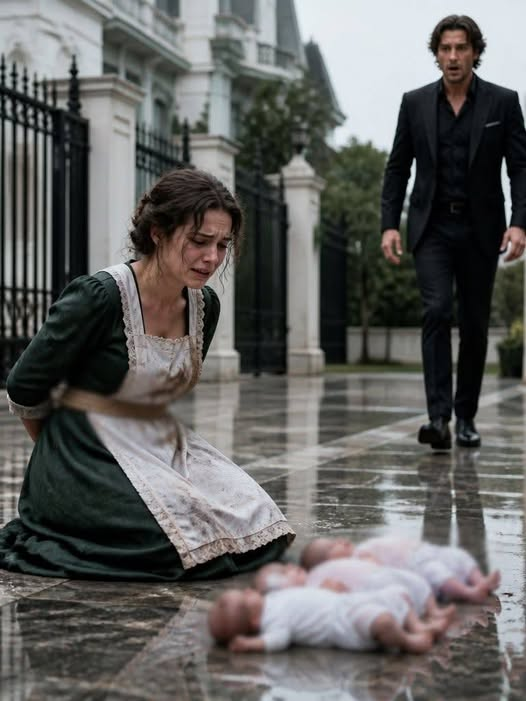
I was carrying a tray of coffee into the main dining room of her mansion in Palm Springs, California. The cups rattled together, one sh:atter:ed against the marble floor, and silence swept through the gathering of the Crestview Charitable Foundation.
No one moved.
No one except the man seated at the far end of the table.
My name is Gabrielle Shields. I’m thirty-two years old, and for the past six years I had lived as little more than a servant in the home of my late husband’s family.
When David d:ie:d in a car ac:cident on the highway to San Jose, his mother, Agatha Shields, claimed he had left behind debts that I was responsible for paying.
She took our apartment.
She collected the life insurance money.
She even kept the jewelry my mother had left me.
In return, she allowed my daughters and me to stay in a tiny room beside the laundry area.
Olivia was eight, Erica was six, and Holly had just turned four.
Agatha called them “the three burdens.”
She insisted I had ruined her son’s life by failing to give him a boy.
That morning, I had gotten up at four-thirty to prepare breakfast, clean two floors, and arrange the reception hall for a gathering of wealthy business leaders who donated millions to “protect vulnerable women.”
The irony hurt more than the blows ever did.
Among the guests was Bruce Hall, the owner of a chain of private hospitals and the foundation’s largest donor.
Newspapers described him as cold, unreachable, and obsessed with work. He had never been publicly linked to anyone, and people said that after his mother’s death, he had sworn never to have a family of his own.
When Agatha st:ruck me, Bruce slowly set his glass on the table.
“Is that what you call discipline?” he asked.
My mother-in-law smiled as though nothing had happened.
“Gabrielle is family, but she needs firm boundaries. She’s always been manipulative.”
“I’m not family when you’re forcing me to work without pay,” I said quietly.
Agatha raised her hand to hi:t me again, but Bruce stepped between us.
“My funding ends today.”
The color drained from Agatha’s face.
“You can’t destr0y years of work because of one bitter maid.”
Bruce looked at my split lip, then at the long sleeves hiding the b:ruis:es on my arms.
“I’m not destr0ying your work. I’m simply refusing to fund your hypocrisy.”
Agatha ordered the security guards to throw me out for being disrespectful.
My thoughts immediately turned to my daughters, who had been locked upstairs so the guests wouldn’t see them.
Before I could run to them, Bruce spoke words that froze the entire room.
“You and your daughters are coming with me.”
We went upstairs to get Olivia, Erica, and Holly while Agatha screamed that I was a thief, a gold digger, and that she would never let me take “her son’s granddaughters.”
Outside, heavy rain poured from the sky.
Bruce covered us with his jacket and drove us to his home in San Diego.
I thought the worst was finally over.
That same night, Agatha called the police and accused me of stealing three million dollars from the foundation.
But what frightened me even more was what she said next.
She demanded immediate custody of my daughters and claimed I had used my children to seduce the richest man in the state.
The police arrived at Bruce’s estate shortly after sunrise.
Three patrol cars rolled through the iron gates while my daughters sat huddled together on a cream-colored sofa, still wearing the borrowed pajamas Bruce’s housekeeper had found for them.
Olivia stood when she saw the officers through the window.
“Are they taking us back?”
Her voice trembled.
I pulled her close.
“No one is taking you anywhere.”
But I wasn’t sure.
For six years, Agatha had controlled every part of my life. She had taken my documents, monitored my phone, intercepted my mail, and told everyone that I was mentally unstable after David’s death.
What proof did I have that anything I said was true?
Bruce walked into the room wearing the same white shirt from the night before, its sleeves rolled to his elbows.
He had not slept.
Neither had I.
“Mrs. Shields,” one officer said, “your mother-in-law alleges that you transferred three million dollars from Crestview Charitable Foundation accounts into several private accounts.”
I stared at him.
“I’ve never had access to the foundation’s accounts.”
“She provided financial documents bearing your signature.”
“That’s impossible.”
The second officer opened a folder and placed several photocopies on the table.
There it was.
My name.
My signature.
My old driver’s license number.
Even the address of the apartment David and I had once shared.
The documents showed that I had approved payments to three consulting companies over a period of four years.
Together, the transfers totaled $3,047,800.
My knees weakened.
Bruce caught my arm before I fell.
“That isn’t my signature,” I whispered.
The officer studied me carefully.
“Mrs. Shields, do you have any way to prove that?”
I stared at the papers.
The signature looked almost perfect.
Almost.
David used to tease me because I always ended the last letter of my surname with a small upward line.
The forged signature curved downward.
It was a tiny difference.
But it was mine.
“I do,” I said.
Agatha’s lawyer arrived less than an hour later with an emergency custody petition.
According to the petition, I was unemployed, homeless, emotionally unstable, and under investigation for financial crimes.
Agatha described herself as the only responsible adult capable of caring for the girls.
She even claimed that Bruce had exploited my desperation and removed the children without legal authority.
By noon, reporters had gathered outside the gates.
The headlines appeared almost immediately.
BILLIONAIRE HOSPITAL OWNER SHELTERS WOMAN ACCUSED OF STEALING CHARITY FUNDS.
WIDOW USES CHILDREN TO MANIPULATE WEALTHY DONOR.
CRESTVIEW FOUNDATION MISSING $3 MILLION.
Bruce read the articles without changing expression.
“I’m sorry,” I said.
“For what?”
“For bringing this into your home.”
He put his phone down.
“You didn’t bring it here. Agatha did.”
“You don’t know me.”
“I know what I saw.”
“One moment doesn’t tell you who a person is.”
“No,” he replied. “But sometimes one moment reveals who everyone else is.”
That afternoon, Bruce called the head of legal affairs for his hospital network.
Her name was Elena Morris, a sharp-eyed woman in her forties who arrived carrying two laptops, three phones, and enough folders to fill half the dining table.
She asked me to tell her everything.
So I did.
I told her how Agatha had taken control of David’s estate.
How she claimed his life insurance had been used to pay debts.
How she made me sign blank pages after telling me they were school or medical forms.
How she kept my identification in a locked desk.
How she sometimes placed documents in front of me late at night, covered the upper half with another sheet of paper, and ordered me to sign at the bottom.
Elena stopped writing.
“How many times?”
“I don’t know. Maybe twenty. Maybe more.”
“Did you ever receive copies?”
“No.”
“Did David leave a will?”
“Agatha said he didn’t.”
“Did you ever speak directly to the insurance company?”
“She told me spouses weren’t allowed to discuss claims without the executor.”
Elena’s expression hardened.
“That is completely false.”
Bruce stood near the window, his jaw tense.
“What about the apartment?” he asked.
“It was in David’s name,” I said. “Agatha told me the bank seized it.”
“Did you see a foreclosure notice?”
“No.”
Elena leaned back.
“Gabrielle, I don’t think Agatha merely accused you of fraud.”
She looked at the financial documents again.
“I think she built the fraud using your identity.”
The custody hearing was scheduled for the following morning.
Agatha entered the courthouse dressed in black, accompanied by two attorneys and several foundation board members.
She looked like a grieving grandmother.
I looked like what the newspapers had already decided I was—a frightened widow staying in a billionaire’s mansion.
Her lawyer told the judge that I had exposed the children to instability.
He said I had no income, no residence of my own, and no reliable support system.
Then he turned toward Bruce.
“Mr. Hall has known Mrs. Shields for less than twenty-four hours. His involvement raises serious concerns.”
Bruce’s attorney rose.
“Mr. Hall is not seeking custody. He is providing temporary shelter to a woman and three children who were removed from an abusive environment.”
Agatha dabbed her eyes with a handkerchief.
“I loved Gabrielle like a daughter,” she said. “But after my son died, she became unpredictable. I tried to protect the children.”
The judge looked at me.
“Mrs. Shields, do you have evidence that your children were mistreated?”
My mouth went dry.
Agatha had never struck the girls where marks could easily be seen.
She preferred words.
Cold rooms.
Missed meals.
Locked doors.
Punishments no photograph could capture.
Then Olivia stood.
She was not supposed to speak.
She was only eight years old, wearing a blue dress Elena had bought for her that morning.
But she stepped away from me and faced the judge.
“Grandma made us stay upstairs when rich people came.”
The courtroom fell silent.
“She said people didn’t donate money to look at unwanted girls. She locked the door from outside.”
Agatha’s lawyer objected.
The judge raised a hand.
“Let the child finish.”
Olivia swallowed.
“She made Mom sleep on the floor when Holly was sick because the bed sheets got dirty. She told us our father would still be alive if Mom had given him a son.”
Erica began crying beside me.
Holly buried her face in my coat.
Then Olivia said the sentence that changed everything.
“Grandma also made Mom practice her signature.”
Agatha stopped moving.
The judge looked at Olivia.
“What do you mean?”
“She gave Mom papers and told her to write her name again and again. Sometimes Grandma’s assistant took the papers away.”
Elena turned to me.
“Did you remember that?”
I shook my head slowly.
Then I did.
It had happened after David’s death, when I was barely eating or sleeping.
Agatha told me my signature had to match the one on David’s insurance documents.
She made me write it dozens of times.
I had thought she was helping me.
She had been studying me.
The judge denied Agatha’s emergency custody request and ordered that the girls remain with me while the investigation continued.
It was our first victory.
But it did not last.
When we returned to Bruce’s estate, one of his security guards met us at the front entrance.
“Sir, there’s been a break-in.”
Bruce’s private office had been searched.
Drawers were open.
A cabinet had been forced apart.
Nothing valuable appeared to be missing.
Then Bruce noticed the empty space beside his computer.
A small leather folder was gone.
“What was inside?” Elena asked.
Bruce’s face changed.
“My mother’s foundation records.”
Years earlier, Bruce’s mother, Eleanor Hall, had helped establish Crestview.
Before her death, she had told him that she suspected money was disappearing from programs intended to support widows and children.
Bruce had never found proof.
That was why he had attended Agatha’s gathering.
He was already questioning the foundation’s accounts before he ever saw her strike me.
“I thought the old records might show when the theft began,” he said.
Elena looked toward the broken cabinet.
“Now Agatha knows we’re investigating.”
That night, Bruce doubled the security around the house.
My daughters slept together in one bedroom.
I sat beside them until their breathing became slow and peaceful.
When I entered the hallway, I found Bruce standing near the window.
“Why are you doing all of this?” I asked.
He did not answer immediately.
Then he pulled a folded photograph from his wallet.
It showed a smiling woman with dark hair, holding a little girl.
“My mother and my sister,” he said.
I had never heard that Bruce Hall had a sister.
“Her name was Claire. She was seven years younger than me.”
“What happened to her?”
“She married a man my mother distrusted. He isolated her from us. When Claire tried to leave, she had nowhere to go. She called me once.”
His voice dropped.
“I was in Tokyo negotiating a hospital merger. I told her I would call back after the meeting.”
He stared at the photograph.
“I never got the chance.”
I did not ask for details.
I understood enough.
“My mother created Crestview because of Claire,” he continued. “She wanted women with children to have somewhere safe to go.”
“And Agatha turned it into a machine for stealing money.”
“Yes.”
He looked toward the room where my daughters slept.
“When I saw you in that dining room, I thought of the call I didn’t answer.”
“You couldn’t have known.”
“That doesn’t make the regret disappear.”
I placed the photograph back in his hand.
“You helped us.”
“I should have helped someone years ago.”
“Maybe this is how you begin forgiving yourself.”
For the first time since I had met him, the coldness left his face.
The investigation moved quickly.
Elena’s forensic accountants discovered that the three consulting companies paid by Crestview had no employees and no real offices.
One was registered to a vacant storefront.
Another used the address of a storage facility.
The third belonged to a man named Victor Crane.
I recognized the name.
Victor had been David’s closest friend.
He had also been the last person to see David alive.
According to the police report, David had left a business dinner shortly before midnight and lost control of his car during heavy rain.
Victor told investigators that David had been drinking.
I had never believed it.
David rarely touched alcohol.
Elena requested the original toxicology report.
It showed no alcohol in his system.
The public report had been altered.
The case was no longer only about fraud.
Two detectives drove to Victor’s home in Riverside, but he had disappeared.
His closets were empty.
His accounts had been drained.
Someone had warned him.
Three days later, I received a message from an unknown number.
ASK BRUCE WHAT HIS MOTHER KNEW ABOUT DAVID.
Attached was a photograph of David standing beside Eleanor Hall.
The image had been taken inside Bruce’s hospital headquarters.
My hands began shaking.
Bruce stared at the photograph for a long time.
“I’ve never seen this.”
“You said you didn’t know David.”
“I didn’t.”
“Then why was he meeting your mother?”
Bruce contacted his mother’s former assistant, a retired woman named Margaret Ellis.
She arrived the next morning carrying a sealed envelope.
“I promised Eleanor I would give this to Bruce if anything ever happened to someone named David Shields,” she said.
Bruce opened it.
Inside was a letter written by his mother.
David had contacted Eleanor two weeks before his death.
He had discovered unusual transfers from Crestview’s accounts and suspected his mother was involved.
At first, he intended to confront Agatha privately.
But after tracing the shell companies, he realized the fraud involved Victor and at least one foundation accountant.
David had collected evidence and given a copy to Eleanor.
The original documents were hidden somewhere Agatha would never think to search.
Eleanor’s letter ended with four words.
ASK GABRIELLE ABOUT PARIS.
“Paris?” Elena asked.
“I’ve never been to Paris.”
Then Holly, who had been coloring at the end of the table, looked up.
“Daddy went to Paris.”
I turned toward her.
“What?”
She ran upstairs and returned carrying an old stuffed rabbit.
It had once belonged to David.
He had called it Paris because he bought it at an airport gift shop during a layover in France before Olivia was born.
After his death, Holly refused to sleep without it.
My heart pounded as I examined the toy.
One seam along its back had been stitched with a darker thread.
Elena carefully opened it.
Inside was a small flash drive wrapped in plastic.
The drive contained copies of bank transfers, emails, board approvals, recordings, and photographs of signed documents.
David had gathered everything.
One audio file contained Agatha’s voice.
“We’ll move the money through Gabrielle’s identity,” she said. “If anyone discovers it, the grieving widow takes the fall.”
Victor responded, “And David?”
There was a pause.
Then Agatha said, “My son has always been too soft. If he refuses to protect this family, we’ll handle him too.”
The recording did not prove that Agatha had caused the crash.
But it proved she had considered David a threat.
The final document on the drive was David’s will.
He had left the apartment, the insurance payment, and every other asset to me and our daughters.
Agatha had lied about everything.
The life insurance policy alone was worth $1.8 million.
The apartment had never been seized.
It had been sold by Agatha using a forged power of attorney.
The money had gone into one of the shell companies.
David had also written a letter to me.
Gabrielle,
If you are reading this, I failed to tell you the truth in time.
I know my mother has always blamed you for giving us daughters, but Olivia, Erica, and Holly are the greatest gifts of my life.
There is nothing missing from our family.
There never was.
I am sorry I allowed my fear of my mother to become your prison.
Protect our girls.
And when they are old enough, tell them their father never wanted a son.
He only wanted more time with them.
I pressed the letter against my chest and cried until I could no longer see the page.
For six years, Agatha had told my daughters their father had been ashamed of them.
Now I had his words.
The federal investigation began the following day.
Agatha was arrested during another Crestview fundraising dinner.
This time, there were more than forty guests.
Cameras captured the moment investigators entered the mansion and escorted her away.
She did not look frightened.
She looked furious.
As she passed me, she leaned close enough to whisper.
“You think you won?”
I met her eyes.
“No.”
I looked at my daughters standing beside Bruce.
“They did.”
Victor Crane was arrested at a private airfield near the Mexican border.
Faced with charges for fraud, identity theft, obstruction, and conspiracy, he agreed to cooperate.
He admitted that Agatha had ordered him to alter financial records and frame me.
He also confessed that on the night David died, he had followed David from the restaurant.
Agatha had instructed him to retrieve the evidence.
Victor forced David’s car toward the shoulder during the storm.
He claimed he never meant to cause a crash.
But when David’s car left the highway, Victor did not call for help.
He searched the vehicle, failed to find the flash drive, and left David there.
Agatha was charged with conspiracy connected to David’s death, in addition to the financial crimes.
The foundation’s missing money was traced to offshore accounts, luxury properties, and payments made to board members who had helped her hide the theft.
Almost all of it was recovered.
At sentencing, Agatha asked to speak.
She stood before the court in a gray suit, her silver hair perfectly arranged.
She said she had built Crestview from nothing.
She said powerful families sometimes had to make difficult decisions.
Then she looked at me.
“Gabrielle was weak. My son was weak. I did what was necessary to preserve what belonged to us.”
The judge’s expression remained cold.
“What belonged to you, Mrs. Shields?”
“My family’s legacy.”
Olivia squeezed my hand.
The judge sentenced Agatha to decades in federal prison.
Victor received a reduced sentence for cooperating, but he would still spend many years behind bars.
The foundation board was dissolved.
Its remaining assets were placed under independent control.
After the trial, Bruce asked me to walk with him through the garden outside the courthouse.
My daughters ran ahead, laughing around a fountain.
“What will you do now?” he asked.
“For the first time in years, I can decide.”
David’s estate had been restored to me.
The insurance company paid the original benefit with interest.
The sale of the apartment was reversed through a civil settlement.
I had enough money to raise my daughters safely.
But money was not the thing I wanted most.
“I want to finish nursing school,” I said. “I left during my first pregnancy.”
Bruce smiled.
“My hospitals occasionally need nurses.”
“Are you offering me a job?”
“I’m offering you an interview after you earn it.”
“That sounds fair.”
He hesitated.
“There is something else.”
He told me he planned to rebuild Crestview under a new name.
The organization would provide emergency housing, legal support, childcare, and employment training for women escaping abusive homes.
He wanted me to help design the program.
“Why me?”
“Because experts understand policies,” he said. “But survivors understand what people are too afraid to ask for.”
The new organization opened eighteen months later.
We named it The Three Lanterns Foundation.
One lantern for each of my daughters.
Olivia designed the logo.
Erica chose the colors.
Holly insisted every shelter room needed a stuffed rabbit.
Bruce kept his promise and gave me no special treatment.
I completed my nursing degree, passed my examinations, and interviewed like every other applicant.
When I was hired at Hall Children’s Hospital, he sent me a one-line message.
You earned this.
Over time, the man newspapers called cold became the person my daughters trusted most.
He taught Olivia to play chess.
He attended Erica’s school performances even when she only had one line.
He sat through Holly’s endless tea parties without checking his phone.
One evening, almost three years after the day he took us away from Agatha’s mansion, we returned home from the foundation’s annual dinner.
The girls ran upstairs.
Bruce and I remained in the quiet entryway.
“You know,” I said, “the first time I saw you, I thought you were terrifying.”
“I was trying to look intimidating.”
“You succeeded.”
“And now?”
I looked at the man who had once believed he was incapable of having a family.
Now there were glitter stickers on his expensive briefcase and a child’s drawing taped inside his car.
“Now I think you’re surrounded.”
He laughed.
Then his expression became serious.
“I don’t want to rescue you, Gabrielle.”
“I know.”
“I don’t want gratitude to be confused with something else.”
“It isn’t.”
“I need you to know that before I say this.”
My heart began beating faster.
He took my hand.
“I love you. And I love those three girls more than I believed I could love anyone.”
I felt tears gathering in my eyes.
“I spent years being told my daughters made me worthless,” I whispered. “You were the first person who looked at us and saw a family worth protecting.”
“No,” he said gently. “You protected them long before I arrived. I only opened a door.”
A year later, we married in the garden of The Three Lanterns Foundation.
There were no newspaper photographers.
No business leaders.
No forty-person audience waiting to judge me.
Only friends, foundation staff, children from the shelters, and three girls wearing yellow dresses.
Before the ceremony, Olivia handed Bruce a folded paper.
It was a list.
He read it aloud.
“Rule one: Never call us burdens.”
He looked offended.
“I would never.”
“Rule two: Attend every birthday.”
“I accept.”
“Rule three: Mom gets the biggest bedroom.”
He glanced at me.
“She already does.”
The girls giggled.
Then Holly added one final rule.
“You have to stay.”
Bruce knelt so he was level with her.
“I will.”
Years later, people still asked why a billionaire had stood up in a crowded dining room for a woman he did not know.
Bruce always gave the same answer.
“I didn’t save Gabrielle.”
He would look at me, then at our daughters.
“I simply believed her when everyone else had decided not to.”
But I knew the complete truth.
That day, he had opened a door for us.
And we had opened one for him.
Agatha believed daughters could not carry on a family name.
She was wrong.
Olivia became a lawyer advocating for children trapped in abusive homes.
Erica became a forensic accountant and helped charities detect fraud before money could disappear.
Holly became a pediatric nurse at the same hospital where I worked.
Each of them carried David’s name.
Not because they were boys.
Not because they inherited his property.
They carried his name through their courage, kindness, and refusal to remain silent.
The woman who called them useless disappeared behind prison walls.
The girls she tried to hide grew up changing thousands of lives.
And the three-million-dollar fraud that was supposed to destroy me became the evidence that finally set us free.
My mother-in-law once told me I should be grateful she had not sent my daughters away.
She never understood that they were not the burden in that house.
They were the light.
And when Bruce Hall said, “You’re coming with me,” he did not take us away from our family.
He helped us discover who our family had been all along.
