The very first thing my mother did when I reached toward the buttons of her coat was scream.
The next thing she did was beg me not to let my brother know I had seen her fear.
I had driven six hours to surprise her for her seventy-eighth birthday. The house looked tidier than ever, yet something felt terribly wrong. Every curtain was closed against the bright afternoon sun, and the silence inside was unsettling. My brother Julian’s wife, Chloe, greeted me at the door wearing expensive jewelry and an impatient smile.
“You should’ve called first,” she said. “Your mother gets confused.”
A moment later, my mother appeared behind her. She looked much thinner than she had only three months earlier, still wearing a thick wool coat despite the warm house.
“Mom?” I whispered.
Her eyes instantly filled with tears, but she didn’t embrace me until Chloe walked away.
Later that afternoon, Julian insisted that he and Chloe had “given up everything” to take care of her. He proudly showed me grocery receipts, medication bottles, and legal paperwork that supposedly authorized him to manage all of her finances.
“She’s fortunate we put up with her moods,” Chloe added coldly. “You disappeared into your career. Don’t come back pretending to be the devoted daughter.”
They expected guilt to keep me quiet. It had fooled plenty of people who believed Julian’s polished version of the truth.
I simply smiled.
“You’re right. I should help while I’m here.”
That evening, I offered to help Mom bathe.
She recoiled so violently that the drinking glass slipped from her hands.
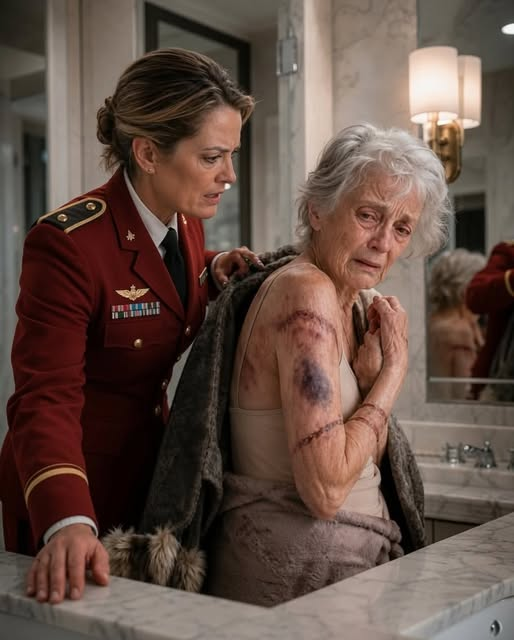
“Please,” she whispered. “Don’t take off my coat.”
I locked the bathroom door, turned on the shower to drown out our voices, and carefully eased the coat from her shoulders.
Dark bruises covered her ribs and shoulders.
Deep red rope marks circled both wrists.
Older yellow bruises lay beneath fresh purple ones across her back.
I stopped breathing.
“Who did this to you?”
Her lips quivered.
“Julian ties me to the bed whenever I ask about my bank account. Chloe hits me when I refuse to sign their papers. They keep saying no one will believe an old woman who forgets things.”
Then she confessed they had sold her lake cabin, drained two investment accounts, and forced her to sign a new will leaving everything to Julian.
She had tried calling me twice, but Julian smashed her phone and insisted I was too busy to care.
Chloe warned she would have Mom committed to a locked facility if she ever told anyone.
In that instant, fear turned into absolute resolve.
I wanted to storm downstairs and knock every smug smile off Julian’s face.
Instead, I wrapped my mother in a towel, photographed every injury with timestamps, and carefully recorded her statement, asking clear questions and documenting every answer.
Then I picked up my phone.
“Judge Thorne,” I said quietly, “this is Assistant Attorney General Elena Vance. I need an emergency protective order tonight.”
There was no hesitation.
“Where are you?”
“At my mother’s house.”
“Is she in immediate danger?”
“Yes.”
“I’ll have an emergency judge available within thirty minutes. Stay where you are. Officers are already on their way.”
I ended the call and looked at my mother.
“They’re not going to hurt you again.”
She grabbed my hand with surprising strength.
“They’ll know you called.”
“I hope they do.”
Ten minutes later, I walked downstairs carrying nothing but my phone.
Julian looked up from the living room.
“Everything okay?”
“Perfectly.”
He smirked.
“Mom finally cooperate?”
“She told me everything.”
His smile froze for only a fraction of a second before returning.
“She gets confused after sunset.”
“So that’s your explanation?”
“It happens with elderly people.”
Chloe folded her arms.
“You’re an attorney. Surely you know memory disorders exist.”
“I do.”
I also knew trauma.
Fear.
Coercion.
And I knew exactly how victims sounded when they believed no one would save them.
The front doorbell rang.
Julian frowned.
“We’re not expecting anyone.”
Three uniformed sheriff’s deputies entered, followed by two investigators from Adult Protective Services.
Behind them came a county forensic nurse carrying a medical examination kit.
Julian immediately stood.
“There must be some mistake.”
The lead deputy unfolded a document.
“Emergency protective order issued by Judge Rebecca Thorne.”
Chloe laughed nervously.
“You can’t just invade our home.”
“We can,” the deputy replied, “when there’s probable cause to believe an elderly adult is being abused.”
Julian turned toward me.
“You called them?”
“Yes.”
“You stupid—”
“Finish that sentence,” I said calmly.
He stopped.
The deputy noticed.
“Sir, remain where you are.”
The forensic nurse quietly went upstairs with another deputy.
Twenty minutes later she returned carrying my mother’s damaged coat sealed inside an evidence bag.
She spoke directly to the investigators.
“Multiple injuries in different stages of healing. Rope abrasions consistent with prolonged restraint. Immediate hospital evaluation recommended.”
Julian shook his head.
“She falls constantly.”
The nurse looked at him.
“People don’t accidentally fall into matching ligature marks.”
The investigators searched the downstairs office.
Inside a locked filing cabinet they found property deeds, notarized financial documents, unsigned powers of attorney, and my mother’s destroyed cell phone.
Its screen was shattered.
The SIM card had been removed.
Then one investigator called out.
“Deputy, you should see this.”
Hidden behind tax folders was a notebook.
Every page contained my mother’s signature.
Dozens.
Hundreds.
Over and over.
The same name written repeatedly.
The investigator turned another page.
“She was being forced to practice.”
Exactly like a child learning handwriting.
Or an elderly woman being trained so someone could copy her signature perfectly.
Julian’s face lost all color.
The financial crimes unit arrived before midnight.
One detective examined recent transfers from my mother’s accounts.
“Two million three hundred thousand dollars,” he said.
“Gone where?”
“Three shell companies.”
The addresses belonged to empty storefronts.
Each company listed Chloe as corporate secretary under a slightly different spelling of her maiden name.
Chloe whispered,
“I don’t know anything about those.”
The detective raised an eyebrow.
“Then perhaps you’ll explain why your driver’s license appears in all three incorporation files.”
She said nothing.
My mother was taken to the regional trauma center that night.
Doctors confirmed fractured ribs that had healed without treatment.
Untreated shoulder injuries.
Malnutrition.
Severe dehydration.
And evidence that she had been physically restrained repeatedly over many months.
By sunrise the district attorney had approved criminal charges.
Julian was arrested for aggravated elder abuse, unlawful restraint, financial exploitation, forgery, and witness intimidation.
Chloe faced nearly identical charges.
Television cameras surrounded the courthouse.
Neighbors who had admired Julian’s devotion now watched him led inside wearing handcuffs.
Reporters asked whether I intended to make a statement.
“I have only one.”
I stepped toward the microphones.
“Never confuse a clean house with a safe home.”
The investigation expanded quickly.
The supposed power of attorney Julian had proudly shown me was forged.
The attorney whose name appeared on the document had retired four years earlier.
His notary seal had been stolen after his office closed.
The revised will leaving everything to Julian contained a signature copied almost perfectly.
Almost.
Except my mother had been left-handed all her life.
The forged signature slanted in the opposite direction.
A forensic handwriting expert called it one of the easiest fraud cases she had ever examined.
The lake cabin sale was reversed.
The buyers had unknowingly purchased stolen property.
Both investment accounts were frozen before the remaining money disappeared offshore.
Nearly ninety percent of my mother’s assets were recovered.
Three months later I brought her home.
Not to Julian’s house.
To mine.
The first thing she asked was whether she could open the curtains.
“All of them?”
“All of them.”
Sunlight flooded the living room.
She stood there smiling quietly.
“I forgot the house could be this bright.”
We planted flowers together that spring.
She started painting again.
She laughed without first looking over her shoulder.
One afternoon she handed me a small wooden box I had never seen before.
“I hid this years ago,” she said.
Inside were birthday cards I had mailed her that Julian claimed had never arrived.
School photographs.
Letters.
Every Mother’s Day card I had ever written.
She had protected them the only way she could.
By hiding them where Julian never thought to look.
At Julian’s sentencing hearing, the courtroom was full.
Friends.
Neighbors.
Former coworkers.
Many couldn’t believe the respected accountant they knew had abused his own mother.
Julian asked to address the court.
He blamed stress.
Debt.
Caregiver burnout.
He even suggested my career had forced him to shoulder responsibilities alone.
The judge interrupted him.
“You restrained a seventy-eight-year-old woman with rope.”
Silence.
“You isolated her.”
Silence.
“You stole from her.”
Silence.
“You destroyed her ability to trust her own family.”
Then Judge Thorne looked toward my mother.
“Mrs. Vance, would you like to say anything?”
My mother stood slowly.
For months after her rescue she had spoken softly, almost apologetically.
Not anymore.
“My son kept telling me nobody would believe me.”
She looked directly at Julian.
“You were wrong.”
The courtroom remained silent.
“My daughter believed me before she even had proof.”
Judge Thorne sentenced Julian to decades in state prison.
Chloe received a lengthy sentence after being convicted alongside him.
As we left the courthouse, reporters surrounded us again.
One asked my mother what justice meant to her now.
She smiled.
“Justice is waking up without being afraid.”
A year later we celebrated her seventy-ninth birthday.
The dining room was filled with friends, grandchildren, neighbors, and the nurses who had cared for her.
No locked doors.
No closed curtains.
No heavy coat hiding bruises.
Before cutting the cake, my mother stood and raised her glass.
“This birthday,” she said, “is the first one where I truly feel free.”
Then she looked at me.
“When you reached for my coat, I thought you were about to uncover my shame.”
She gently squeezed my hand.
“Instead, you uncovered theirs.”
Everyone stood and applauded.
Sometimes people ask how I remained so calm after hearing what Julian had done.
The answer is simple.
Anger would have satisfied me for one night.
Evidence protected my mother for the rest of her life.
And when I made that single phone call, I didn’t just rescue the woman who raised me.
I made certain no one would ever again convince her that silence was safer than the truth.
