Jonah’s expression changed the moment I told him where I worked.
Not completely.
He was too arrogant to surrender that quickly.
But the hand holding his bourbon glass stopped moving.
My mother noticed too.
“What does your job have to do with this?” she asked.
“Potentially everything.”
I stepped closer to the refrigerator without touching it.
The scene had already been disturbed before I arrived, but enough remained.
A damaged crutch lay near the kitchen table.
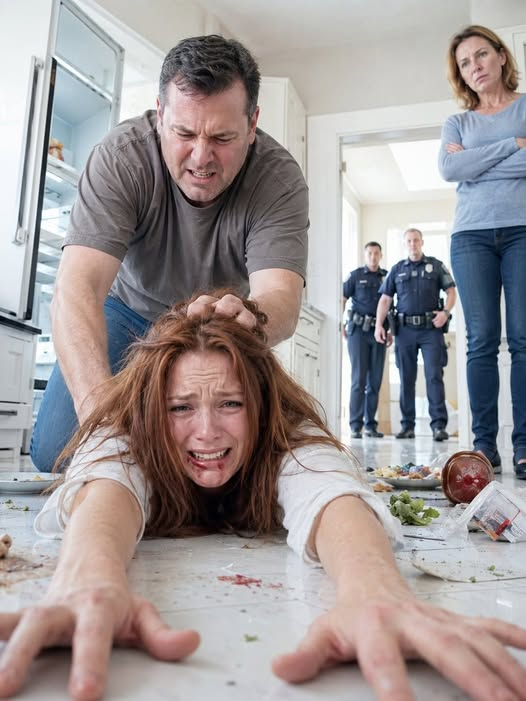
A streak across the floor marked where Chloe had dragged herself toward the hallway.
One of the cabinet doors was hanging open.
Near the baseboard, I noticed a tiny piece of dark fabric.
I photographed it.
Jonah scoffed.
“You think taking pictures makes you important?”
“No.”
“The evidence does.”
My mother crossed her arms.
“Chloe fell.”
“That’s interesting.”
I looked at Jonah.
“Because he said he caught her.”
Neither answered.
I continued calmly.
“If Jonah caught her, why did her head strike the refrigerator?”
“She slipped from my hands,” he replied.
“Which hand?”
His eyes narrowed.
“What?”
“You said you tried to catch her.”
“Which hand did you use?”
“My right.”
I looked toward the refrigerator.
The impact mark was positioned in a way that did not match the direction he described.
“And where was her crutch?”
“On the floor.”
“Before or after she fell?”
He hesitated.
My mother stepped in.
“Why are you interrogating us?”
“Because your stories don’t match.”
Her voice rose.
“This is our home.”
“And Chloe is a protected vulnerable adult receiving publicly funded care.”
The room went quiet.
Jonah placed the bourbon glass on the counter.
“So?”
“So any suspected abuse, neglect, falsified care record, or misuse of benefits can trigger a state investigation.”
My mother stared at me.
“What misuse?”
I watched her carefully.
“I didn’t accuse you of financial misuse.”
The color left her face.
She had answered too quickly.
That was when I understood the violence might not be the only secret inside that house.
For years, my mother had claimed Chloe needed constant supervision.
She repeatedly told the state that she could not work because she was providing daily care.
She had also complained that the disability allowance barely covered expenses.
Yet the kitchen had new granite counters.
Jonah drove a new truck.
My mother wore jewelry that had not been there during my previous visit.
Meanwhile, Chloe’s crutches were damaged, her clothes were old, and her bedroom furniture had not been replaced since she was a teenager.
I looked toward the hallway.
“Where are Chloe’s care records?”
My mother’s eyes hardened.
“That is none of your concern.”
“It became my concern tonight.”
Jonah stepped toward me.
“You need to leave.”
I did not move.
“Touch me, and you will give the deputies another reason to stay.”
As if summoned by the words, headlights swept across the kitchen walls.
A patrol vehicle pulled into the driveway.
Then another.
Jonah looked toward the front window.
“You called more police?”
“I called the sheriff while I was still five hours away.”
My mother turned on me.
“You would have your own family arrested?”
“I would protect my sister.”
The front door opened.
Deputy Ramirez entered first, rain dripping from his jacket.
A second officer followed him.
“Ms. Bennett?” Ramirez asked.
“That’s me.”
“You reported a possible assault involving a vulnerable adult?”
“Yes.”
Jonah immediately lifted both hands.
“This is a misunderstanding.”
Deputy Ramirez looked at the refrigerator.
Then the damaged crutch.
Then the marks across the floor.
“Doesn’t look minor.”
My mother tried to laugh.
“She bruises easily.”
“Where is she now?”
“At County General.”
“Who went with her?”
Neither of them answered.
Ramirez frowned.
“Your disabled daughter was transported to the hospital alone?”
My mother’s silence finally sounded like what it was.
Abandonment.
The second deputy began photographing the room.
Jonah stepped between him and the refrigerator.
“Do you have a warrant?”
Deputy Ramirez answered calmly.
“We have a report of serious domestic violence and a scene containing visible evidence.”
He pointed toward the living room.
“Sit down.”
Jonah did not.
“I said sit down.”
For the first time that evening, Jonah obeyed someone.
My mother lowered herself onto the sofa beside him.
They looked less powerful sitting together beneath the harsh ceiling light.
Just two frightened people discovering that the version of events they had rehearsed was collapsing.
I told Deputy Ramirez exactly what I had heard during Chloe’s call.
Her voice.
Jonah shouting.
The crash.
The connection ending.
Ramirez asked whether the call had been recorded.
“No.”
Then I remembered something.
Chloe’s phone automatically backed up certain accessibility features to a cloud account I had helped her create years earlier.
Because she sometimes struggled to type quickly, we had enabled voice-command history.
If the phone had been active during the attack, part of the audio might have been stored.
I took out my phone and logged into her account.
My hands remained steady until I saw the final entry.
Emergency voice activity saved: 8:46 p.m.
I pressed play.
Chloe’s frightened breathing filled the room.
Then Jonah’s voice.
Clear.
Angry.
“You think your sister is going to save you?”
A crash followed.
My mother could be heard saying, “Jonah, not so hard.”
Not stop.
Not leave her alone.
Not call for help.
Only not so hard.
The recording ended with Chloe trying to activate an emergency call.
Nobody spoke when it finished.
Deputy Ramirez looked toward my mother.
“You said she fell.”
She began crying immediately.
“I was afraid.”
“Of him?”
She looked at Jonah.
Then lowered her head.
Jonah stood abruptly.
“She’s lying too!”
The deputies moved at once.
“Sit down!”
“She caused all of this!”
He pointed at my mother.
“She told me Chloe was ruining our lives!”
My mother stared at him in horror.
“Jonah!”
“You said we’d lose the payments if she moved out!”
There it was.
The real reason.
Not only cruelty.
Money.
Deputy Ramirez exchanged a look with his partner.
“What payments?”
Jonah realized too late what he had revealed.
My mother rushed to answer.
“He doesn’t know what he’s saying.”
I stepped closer.
“How much of Chloe’s care funding have you been keeping?”
My mother’s face collapsed.
“We use it for the household.”
“For her household needs?”
“She lives here.”
“That isn’t what I asked.”
Jonah laughed bitterly.
“She hasn’t seen most of that money in years.”
My mother slapped his arm.
“Be quiet!”
He shoved her hand away.
“You’re the one who filed the forms.”
The deputies separated them immediately.
I stood there listening as the truth came apart in pieces.
My mother had been claiming reimbursement for care hours she did not provide.
Jonah had signed attendance logs.
They had reported purchasing mobility equipment that Chloe never received.
They had also prevented her from applying for supported housing because her benefits helped pay their mortgage.
She had not merely been trapped emotionally.
They had turned her disability into a source of income.
Deputy Ramirez placed Jonah in handcuffs.
The click of metal sounded almost gentle compared with everything else that had happened that night.
“You are being detained pending investigation for aggravated assault and abuse of a vulnerable adult.”
My mother stood.
“What about me?”
Ramirez looked at her.
“You’ll be speaking with investigators too.”
Her eyes found mine.
“Karina, please.”
That word nearly broke me.
Please.
The same woman who had called Chloe’s injuries a minor scratch was now begging because consequences had finally reached her.
I picked up my coat.
“I’m going to the hospital.”
“You can’t leave me here.”
I looked at her.
“You left Chloe alone in an ambulance.”
Then I walked out.
The storm had begun to weaken by the time I reached County General.
Chloe lay beneath white blankets with bandages across her face and one arm secured in a brace.
Her eyes filled with tears when she saw me.
“You came.”
I sat beside her.
“I will always come.”
She looked toward the door.
“Did Mom tell you I fell?”
“Yes.”
“She always says that.”
“I know.”
“Did Jonah get away?”
“No.”
Her breathing changed.
For the first time, she seemed able to take a complete breath.
I held her hand carefully.
“You’re not going back there.”
She looked frightened.
“Where will I go?”
“Anywhere you choose.”
“I have no money.”
“Yes, you do.”
She frowned.
I explained what Jonah had admitted.
The care payments.
The false records.
The benefits that had been hidden from her.
The possibility of restitution and supported housing.
Chloe closed her eyes.
“They said I cost them everything.”
“No.”
“They were profiting from keeping you dependent.”
A tear slipped toward her temple.
“I should have told you sooner.”
“You told me when you could.”
The door opened.
A woman in a dark suit entered carrying a state identification wallet and a thick file.
I recognized her immediately.
Director Evelyn Shaw.
The number I had called before entering the storm belonged to her.
Six years earlier, she had supervised me during my first major vulnerable-adults investigation.
She approached Chloe’s bed.
“Ms. Bennett, I’m with the State Attorney General’s Office.”
Chloe looked at me nervously.
I squeezed her hand.
Evelyn placed the folder on the table.
“We conducted an emergency review of your benefits while you were in treatment.”
She opened the file.
Inside were years of payment records.
Forged signatures.
False invoices.
Invented equipment purchases.
The total at the bottom made my stomach turn.
More than two hundred thousand dollars had been taken in Chloe’s name.
Evelyn’s expression hardened.
“This is no longer only an assault investigation.”
She looked directly at me.
“We believe your mother and stepfather were part of a larger fraud network involving multiple vulnerable adults.”
Chloe stared at her.
“Multiple?”
Evelyn nodded.
“Your case may be the one that finally proves it.”
Then she removed a photograph recovered from Jonah’s phone.
It showed five adults seated around a table covered with benefit applications and blank medical forms.
My mother sat among them.
Beside her was a man I recognized from the state office.
A senior caseworker with access to hundreds of vulnerable clients.
Evelyn lowered her voice.
“Karina, this goes much higher than your family.”
I looked at Chloe.
Then at the photograph.
The assault that had nearly taken my sister’s life had exposed something larger than either of us had imagined.
And by sunrise, the people who had dismissed her pain as a minor scratch were no longer facing only one investigation.
They were standing at the center of a statewide criminal conspiracy.
