The silence that followed was more unsettling than the shouting.
Bradley Vance remained beside the counsel table, gripping his wrist and trying to recover the dignity he had lost in front of the entire courtroom.
But Judge Henderson was no longer looking at him.
Her eyes remained fixed on Toby’s sleeve.
My brother had shrunk into his chair, clutching the fabric so tightly that his knuckles had turned white.
“Toby,” the judge said with carefully controlled calm, “I want you to come forward.”
My mother immediately rose.
“Your Honor, my son is emotionally distressed because of Cassandra’s violent display.”
“Sit down, Mrs. Sterling.”
“But she just attacked our attorney.”
The second strike of the gavel made the water glasses tremble.
“I said sit down.”
My mother slowly obeyed.
My father’s satisfied smile disappeared.
Toby stood.
He walked toward the bench in small, cautious steps, refusing to look at our parents.
I recognized that way of moving.
I had seen it in young soldiers after an ambush—shoulders tight, breathing shallow, eyes tracking every sudden movement.
That was not shyness.
It was learned fear.
“Can you pull up your sleeve?” the judge asked.
Toby shook his head.
“It’s all right,” I said softly. “I’m here.”
My father released a dry laugh.
“That is exactly what she wants him to believe.”
Toby flinched at the sound of his voice.
The judge noticed.
Everyone noticed.
A family-services caseworker approached slowly and knelt in front of him.
“No one will touch you without your permission,” she assured him. “You can show only me.”
Toby studied her for several seconds.
Then, with trembling fingers, he pulled up his sleeve.
I heard someone sharply inhale.
Several dark marks circled his arm.
Some were fresh.
Others appeared older.
They were not injuries from an accidental fall.
The judge’s expression hardened.
“Who did that to you?”
Toby immediately pulled his sleeve down.
“I can’t say.”
“Why not?”
He looked toward the table where our parents were sitting.
My mother’s lips were pressed into a thin line.
My father leaned forward, perfectly still, watching him with an expression I knew too well.
He never needed to threaten us aloud.
He had never needed to.
“Because everything will get worse,” Toby whispered.
Something cold pierced my chest.
Bradley seized the opportunity.
“Your Honor, those marks could have come from any normal teenage activity. Sports, roughhousing, perhaps a school fight. Lieutenant Commander Sterling is manipulating the minor to create a false narrative of abuse.”
I turned toward him.
“I had not seen those marks before entering this courtroom.”
“Yet you knew exactly where to look.”
“Because he has spent the last twenty minutes hiding his arm.”
Bradley smiled.
“How convenient.”
“That is enough,” the judge ordered. “Mr. Vance, return to your seat.”
My father stood.
“I want to speak with my son privately.”
Toby retreated so quickly that his back struck the railing beside the witness stand.
That single reaction shattered the appearance of a perfect family.
Judge Henderson rose.
“No one will speak with the minor privately.”
“I am his father.”
“And you are currently being evaluated as a possible source of his unexplained injuries.”
My father’s face darkened.
“You are making a mistake.”
He did not say it like a protest.
He said it like a warning.
Two deputies moved closer to him.
My mother covered her mouth, pretending to be shocked.
I had watched that performance throughout my childhood.
She never gave the orders.
She merely closed the curtains afterward.
The judge called for a recess and ordered Toby to be taken to a private room with the caseworker.
As he passed me, his fingers brushed against my glove.
“Don’t let them take the box,” he whispered.
I froze.
“What box?”
But they were already leading him away.
Bradley hurried toward my parents, and the three of them began speaking in low voices.
My mother glanced toward the side exit.
Then she discreetly touched her handbag.
That gesture activated every instinct I possessed.
I approached the court clerk.
“I need to know whether any of Toby’s personal belongings were submitted as evidence.”
She checked a list.
“There is a backpack, a laptop, and a blue metal box. They were delivered from his parents’ residence this morning.”
The box.
“Where is it?”
“In the temporary evidence room.”
I looked back toward my parents’ table.
My mother was gone.
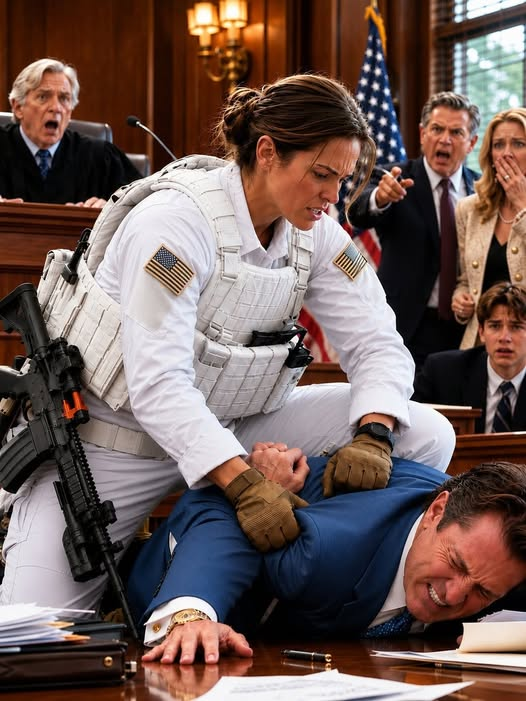
I moved through the side aisle, but Bradley stepped into my path once again.
This time, he wisely kept his hands away from me.
“You cannot wander through the courthouse as though you are leading a military operation.”
“Move.”
“Your behavior proves exactly why you should not receive custody.”
“I am not asking for your permission.”
“No,” he replied, lowering his voice. “You never do. That is why your family erased you.”
The words struck with unexpected precision.
For eleven years, my parents had told everyone the same story.
That I had abandoned the family.
That I had chosen the Navy over Toby.
That I had never called.
The truth was different.
Every letter I sent had been returned.
Every gift had disappeared.
Every request to visit Toby had ended with a legal threat.
Bradley knew far too much.
“How long have you really been working for my father?” I asked.
His smile faltered.
Only for a second.
But it was enough.
I pushed a chair out of my way and continued toward the corridor.
When I rounded the corner, I saw my mother standing outside the evidence room.
A courthouse employee sat against the wall, dazed, while she held the blue metal box against her chest.
“Stop!” I shouted.
She looked at me.
For the first time, there was no embarrassment or false sorrow on her face.
Only terror.
She ran toward the emergency stairwell.
Two deputies appeared behind me.
“Mrs. Sterling, put the box on the floor!”
My mother opened the metal door and disappeared.
The alarm began to scream.
I ran after her.
We descended two floors beneath flashing red lights and the thunder of footsteps.
When I reached the lower landing, I found her trapped beside a narrow window.
She clutched the box against her chest.
“Give it to me,” I ordered.
“You don’t know what is inside.”
“Toby does.”
Her expression cracked.
“That boy was never supposed to find it.”
The deputies raised their hands and instructed her to remain still.
My mother looked at the window.
Then she looked at me.
“Your grandfather did not leave that money to Toby.”
“The trust carries his name.”
“The name means nothing.”
She reached into her handbag and removed a small silver lighter.
That was when I realized she was not trying to steal the box.
She was trying to destroy its contents.
I lunged toward her just as she opened the lid.
Inside were photographs, banking documents, and a digital memory drive.
But resting on top of everything was an aged yellow envelope with my name written across it.
The handwriting belonged to my grandfather.
My mother ignited the flame.
“No!” I shouted.
Before I could reach her, a voice echoed from the top of the stairs.
“Cassandra, do not read that letter.”
I looked up.
My father was standing there.
Behind him was Toby, restrained by Bradley Vance.
The attorney had one hand pressed against my brother’s injured shoulder.
“Give me the box,” my father said, “or you will finally discover why your family did everything in its power to make sure you never came home.”
