The second line read:
I am your father.
For several seconds, the words made no sense.
I read them again.
Then a third time.
The attorney bent down beside me.
“Ms. Parker?”
I could not answer.
My father had died when I was four years old.
At least, that was what my mother had always told me.
She said he had been killed in a car accident on a rainy highway outside Chicago. There were no photographs of him in our house, no letters, and no relatives who ever came looking for me.
Whenever I asked questions, my mother’s face would harden.
“He left us with nothing worth remembering.”
Now a man I had married ten days before his death was claiming he had known me my entire life.
Claiming he was the father I had mourned without ever truly knowing.
I forced myself to keep reading.
Your mother told you I died because that was easier than admitting she had taken you away from me.
My vision blurred.
I spent years trying to find you. By the time I did, you were fourteen, and your mother had already convinced you that your father had been cruel, unstable, and dangerous.
My hands began shaking.
Memories surfaced.
When I was fourteen, a man had appeared outside my school several times.
He never approached me.
He only stood across the road, watching from a distance.
My mother had called the police and told me he was a disturbed stranger.
After that, I never saw him again.
Until hospice assigned me to Carl.
I looked at the attorney.
“Did he arrange for me to be assigned to him?”
The man hesitated.
“Yes.”
A wave of nausea rolled through me.
“He manipulated the hospice program?”
“No. He donated to the organization and requested you specifically after learning that you volunteered there. The administration believed you had met through a previous charity event.”
“So our friendship was based on a lie.”
The attorney’s expression softened.
“The way you met was planned.”
“But what happened afterward wasn’t.”
I turned back to the letter.
I know you may hate me for not telling you immediately. I wanted to. Every time you made tea, every time you laughed after beating me at chess, I wanted to say, “I’m your father.”
But I was afraid you would walk away before you had the chance to know me as a person instead of the monster your mother created.
Tears fell onto the page.
Carl had always watched me with a strange tenderness.
He remembered how I took my coffee after hearing it once.
He asked questions about my childhood and listened as though every detail mattered.
When I mentioned that I had spent my ninth birthday alone because my mother was working, Carl had turned toward the window and remained silent for a long time.
I thought he had been tired.
Now I understood.
He had been grieving a birthday he had missed.
The attorney helped me to the couch.
“There is more,” he said.
I stared at him.
“What else could there possibly be?”
He placed a leather folder on my coffee table.
“Carl’s full name was not Carl Mason.”
I slowly opened the folder.
Inside was an old photograph.
Carl stood beside a much younger version of my mother.
His hair was thick and dark. His arm rested around her shoulders.
She was smiling.
A real smile.
Written on the back were four words:
Carlisle James Whitmore. 1993.
I recognized the last name immediately.
Whitmore Biomedical.
One of the largest privately owned medical research companies in the country.
Its founder, Carlisle Whitmore, had vanished from public life nearly two decades earlier after a bitter corporate scandal.
News articles claimed he had become reclusive.
No one knew where he lived.
I stared at the attorney.
“Carl was Carlisle Whitmore?”
He nodded.
“He founded the company with your mother.”
“My mother?”
“She was a research scientist. Brilliant, ambitious, and deeply involved in the company’s early years.”
I shook my head.
“My mother worked as a laboratory technician.”
“That was after she left him.”
The attorney opened another document.
It was a court filing from twenty-seven years earlier.
My mother had accused Carl of financial misconduct and emotional instability. She had requested sole custody and a restraining order.
But the case had never reached trial.
“Why not?”
“Because your mother disappeared with you before the hearing.”
My breathing became shallow.
“She changed your surname, moved between three states, and told everyone Carl was dead.”
“Why didn’t he go to the police?”
“He did.”
The attorney slid a stack of reports toward me.
Missing-child notices.
Private investigator invoices.
Court petitions.
Returned letters.
For sixteen years, Carl had searched for me.
Then, when he finally found us, my mother threatened to expose confidential documents from the company and accuse him of abducting me if he tried to make contact.
“He was wealthy,” I whispered. “He could have fought her.”
“He was also terrified she would disappear with you again.”
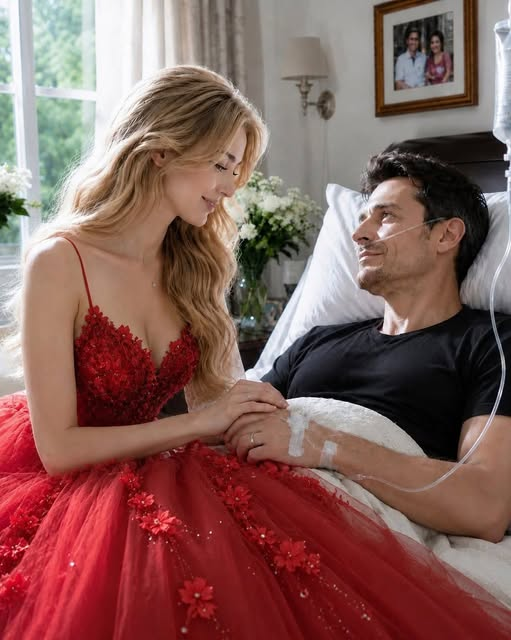
I looked down at the wedding ring still on my finger.
“Then why ask me to marry him?”
The attorney’s face became grave.
“Because he discovered your mother was trying to find him.”
My head snapped up.
“For what?”
“His estate.”
The attorney removed the final packet.
“Carl had no spouse, no other children, and no close relatives. If he died without changing his estate plan, your mother intended to challenge the will by claiming she was still his legal partner in Whitmore Biomedical.”
“That makes no sense. They hadn’t been together for decades.”
“She still owned documents from the company’s founding. Enough to create years of litigation.”
He glanced at my ring.
“By legally marrying you and naming you his sole beneficiary, Carl made his intentions almost impossible to dispute.”
I stood so quickly that dizziness forced me to grab the couch.
“He married his own daughter?”
The attorney immediately shook his head.
“The marriage was never legally registered.”
I froze.
“What?”
“The priest was Carl’s longtime friend. The ceremony gave Carl peace, but no license was filed.”
Relief collided with anger.
“So it was all an act?”
“No.”
The attorney’s voice softened.
“He did not want you as a wife.”
“He wanted to experience one moment in which he could call you family and hear you say that you would not leave him alone.”
I covered my face.
Carl had known he was dying.
He had known he would never attend my graduation, walk me down an aisle, or watch me build a family of my own.
So he created one small ceremony where he could stand beside the daughter he had lost and pretend, for a few minutes, that he had been part of her life.
The attorney allowed me to cry before handing me one final envelope.
“This is the estate summary.”
I opened it.
The figures made my breath catch.
Carl had left me his controlling shares in Whitmore Biomedical, several properties, a charitable foundation, and a trust worth more money than I could understand.
But beneath the financial documents was another letter.
None of this is payment for your kindness.
You owed me nothing, and you still gave me the happiest months of my life.
The company belongs to you because it was built with ideas from both your parents. Your mother will come for it. When she does, do not believe the story she tells first.
At the bottom, Carl had written:
Ask her what happened in Laboratory Seven.
That evening, I drove to my mother’s house.
She opened the door wearing a black dress from the funeral.
Her face changed the moment she saw the leather folder in my hand.
“You met the attorney.”
It was not a question.
“You knew Carl was alive.”
She gripped the edge of the door.
“I can explain.”
“You told me he died.”
“He was dangerous.”
“He searched for me for sixteen years.”
“You don’t know what kind of man he was.”
I held up the letter.
“Then tell me about Laboratory Seven.”
Every trace of color disappeared from her face.
For the first time in my life, my mother looked afraid of me.
“Where did you hear that?”
“Carl.”
She stepped backward.
“That man spent his entire life rewriting the truth.”
“Then give me your version.”
My mother looked past me toward the empty street.
“He left you the company, didn’t he?”
There it was.
Not grief.
Not shock that the man she once loved was dead.
The company.
“You came to the funeral because you wanted his estate.”
Her jaw tightened.
“I helped build Whitmore Biomedical. Half of everything should have been mine.”
“What happened in Laboratory Seven?”
She remained silent.
I reached for my phone.
“I’ll ask the board.”
Her hand shot out and caught my wrist.
“No.”
The panic in her voice startled both of us.
Then headlights appeared at the end of the driveway.
A black sedan stopped behind my car.
The attorney stepped out with two federal investigators.
My mother released me immediately.
One of the investigators approached the porch.
“Dr. Evelyn Parker?”
My mother tried to close the door.
He placed one hand against it.
“We have a warrant concerning the disappearance of research samples and the death of a Whitmore Biomedical employee twenty-seven years ago.”
My mother stared at me with hatred.
“You did this.”
I shook my head.
“No.”
“Carl did.”
The attorney handed me a small silver key.
“Your father instructed me to give you this only after she mentioned the company.”
“What does it open?”
“A private evidence vault beneath Laboratory Seven.”
My mother lunged toward the key.
The investigators stopped her.
As they placed her in handcuffs, she screamed that Carl had framed her, that everything belonged to her, and that I was an ungrateful daughter.
I did not argue.
I simply watched as the woman who had erased my father from my childhood was taken away.
Three weeks later, the vault was opened.
Inside were original research records, financial ledgers, and a video confession Carl had recorded before his death.
The evidence proved that my mother had stolen a medical formula, transferred it to a competitor, and blamed Carl when a laboratory assistant discovered her actions.
The employee’s death had been ruled accidental.
It was now reopened as a criminal investigation.
My mother had not taken me away to protect me.
She had used me to force Carl into silence.
Months later, I stood inside Whitmore Biomedical’s main research center beneath a photograph of its founder.
I did not feel like an heiress.
I felt like a daughter who had finally met her father only to lose him ten days later.
I renamed Carl’s foundation and directed its funding toward hospice care and assistance for families separated by illness.
On the anniversary of his death, I returned to his small house.
The chessboard remained beside the window.
His favorite teacup was still in the cabinet.
I placed my wedding ring beside the white king and unfolded his final letter one last time.
Meeting you was never an accident.
He was right.
But neither was loving him.
I had agreed to marry a dying stranger because I could not bear the thought of him leaving the world alone.
Only later did I discover the truth.
He had not been alone.
He had finally found his daughter.
