“Tell them it was an accident,” Richard ordered.
I remained on the kitchen floor, one arm hanging uselessly beside me.
The pain in my shoulder had become a deep, burning pressure. Every breath scraped against my ribs, and the room kept narrowing at the edges.
Richard crouched and reached for the phone.
I pulled it against my chest.
He grabbed my wrist.
“Give it to me.”
“No.”
His expression twisted.
For years, he had relied on fear arriving before resistance.
As a child, I had learned to lower my eyes before he raised his hand. I learned to hear danger in the way he set down a glass or closed a cabinet. I learned that arguing made things worse and silence made them last longer.
But I was no longer trapped in his house.
This was my home.
And help was coming.
Richard tightened his fingers around my injured arm.
“You think that uniform makes you important?”
My voice was barely audible.
“No.”
“Then why are you smiling?”
“Because you heard the signal too.”
He released me and stood.
For several seconds, he paced between the kitchen and the shattered doorway.
His anger had become panic.
He looked outside.
Then he grabbed a dish towel and began wiping the broken door handle.
Even half-conscious, I understood what he was doing.
He was trying to change the scene.
“Stop,” I whispered.
He ignored me.
He picked up an overturned chair and placed it upright. Then he kicked my phone beneath the table and dragged me by the ankle toward the living room.
Pain ripped through my chest.
I screamed.
“Quiet.”
He pulled harder.
My head struck the floor.
The ceiling lights blurred.
Richard knelt beside me and lowered his voice.
“When they arrive, you will tell them you fell.”
I tasted blood again.
“And the door?”
“You attacked me. I forced my way inside because you were unstable.”
The lie appeared quickly.
It always did.
When I was thirteen, he broke my bedroom lock and told my mother I had barricaded myself inside.
When I was sixteen, he bruised my arm and said I had fallen during an argument.
When I finally left for college, he told relatives I had become arrogant and abandoned the family.
He never denied the damage.
He only changed who caused it.
“You’re drunk,” I said.
“I came because your mother is sick.”
The words cut through the fog.
“What?”
“She’s in the hospital.”
I stared at him.
For one dangerous second, I believed him.
He saw it.
His face softened instantly.
That was another skill he had perfected.
“She asked for you,” he continued. “She’s been calling for days.”
“My mother has my number.”
“She was afraid you wouldn’t answer.”
“Which hospital?”
He hesitated.
Only briefly.
But it was enough.
“You’re lying.”
His face hardened again.
“You always were ungrateful.”
A distant siren rose through the night.
Richard turned toward the doorway.
The sound grew louder.
Then another siren joined it.
Blue light flashed against the apartment walls.
Richard grabbed my phone from beneath the table.
He tried to switch it off.
The emergency screen displayed a locked message:
DISTRESS SIGNAL ACTIVE. LOCATION CONFIRMED.
He threw the phone across the room.
It struck the wall and fell near the couch.
“Get up,” he said.
“I can’t.”
He pulled me by the front of my shirt.
“You’re coming with me.”
My injured shoulder moved.
A cry tore out of me.
Headlights swept across the broken doorway.
A voice boomed from outside.
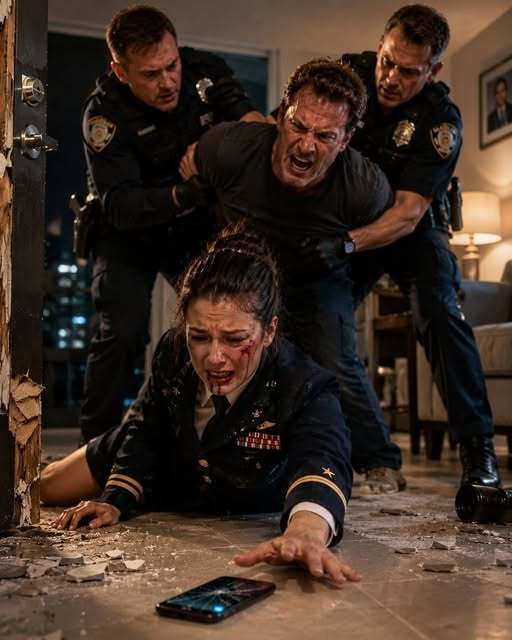
“Naval Security! Step away from Lieutenant Reynolds!”
Richard froze.
Red targeting lights appeared across his chest.
Three military police officers stood beyond the entrance with weapons raised. Behind them were local police and two emergency medical technicians.
Richard slowly released my shirt.
“She attacked me,” he said immediately.
No one lowered a weapon.
“Show us your hands.”
“This is a family misunderstanding.”
“Hands where we can see them.”
He raised them.
Then he pointed toward me.
“She’s mentally unstable. She called you because she was drunk.”
One of the officers entered carefully.
He looked at the shattered deadbolt, the blood on the tile, and my shoulder hanging at an unnatural angle.
His expression changed.
“Lieutenant Reynolds, can you hear me?”
“Yes.”
“Did this man attack you?”
Richard looked down at me.
The warning in his eyes was familiar.
But for the first time, he had no control over what happened after I answered.
“Yes.”
The officers moved immediately.
Richard resisted when they reached for his wrists.
He shouted that I was his daughter.
That he had the right to enter.
That he had only been trying to help.
The more he spoke, the tighter the handcuffs closed around him.
As they escorted him outside, he turned his head toward me.
“This is your fault.”
I watched him disappear through the doorway.
“No,” I whispered.
But I was no longer sure he heard me.
The medical team stabilized my shoulder and placed an oxygen mask over my face.
A Navy corpsman knelt beside me.
“Lieutenant, stay awake.”
“I’m trying.”
“What is your full name?”
“Ava Marie Reynolds.”
“Rank?”
“Lieutenant.”
“Duty station?”
I answered.
He kept asking questions while they placed me on a stretcher.
Before they carried me out, I looked at the apartment.
The broken door.
The blood.
My uniform hanging beside the closet.
I had spent years making every room orderly because disorder reminded me of childhood.
Now Richard had entered my home and recreated the chaos I had escaped.
But this time, the evidence remained.
The door recorded forced entry through the housing security system.
The distress protocol preserved audio from the moment I activated it.
The neighbors had heard the shouting.
And Richard had been arrested inside the apartment with my blood on his clothes.
He could still lie.
He simply could not make the facts disappear.
At the naval hospital, doctors confirmed that my shoulder was dislocated.
Two ribs were fractured.
I had a concussion, extensive bruising, and difficulty breathing from swelling around my chest.
They admitted me before sunrise.
Commander Elise Grant arrived while I was still being examined.
She was my commanding officer.
She entered wearing civilian clothes beneath a Navy coat, her hair tied back hurriedly.
“Ava.”
I tried to sit up.
She placed one hand on my uninjured shoulder.
“Don’t.”
“I’m scheduled for inspection at seven.”
“You are not attending.”
“My unit—”
“Will function.”
Her tone softened.
“You sent the signal. That was the correct action.”
I looked away.
“I should have stopped him before he entered.”
“The reinforced deadbolt failed.”
“I should have called earlier.”
“You were asleep.”
“I should have—”
“Ava.”
I looked at her.
“You survived an assault,” she said. “You are not responsible for making his crime easier to prevent.”
The words settled somewhere inside me, but I did not fully believe them yet.
Richard had spent my childhood teaching me that whatever he did was a response to something I caused.
I knew intellectually that he was wrong.
My body had not learned it as quickly as my mind.
A hospital investigator entered with two local detectives.
Commander Grant stayed beside me while I gave my statement.
I described the pounding.
The forced entry.
His accusations.
The attack.
The false story about my mother being hospitalized.
One detective exchanged a glance with the other.
“Your mother is not in the hospital,” she said.
“You checked?”
“She was contacted thirty minutes ago.”
My chest tightened.
“Where is she?”
“At home.”
“Did she know he was coming here?”
The detective did not answer immediately.
That silence frightened me more than a direct response.
“She says she did not know he intended to enter your apartment.”
“That wasn’t my question.”
The detective nodded.
“She knew he was traveling to Norfolk.”
I closed my eyes.
Of course she knew.
My mother had spent twenty years claiming she could not control Richard.
But she warned him when I moved.
She gave him relatives’ phone numbers.
She defended him when I stopped answering.
Three years earlier, after my final conversation with her, I had changed my address and limited contact.
Somehow, he still found me.
“How did he get my address?” I asked.
“We are investigating that.”
Commander Grant’s expression became colder.
My apartment was not classified, but details connected to military housing were protected.
Richard should not have had the exact unit number.
The answer arrived later that morning.
My mother had mailed him a photograph I sent her six months earlier.
In the background, barely visible, was part of a housing document attached to my refrigerator.
Richard enlarged the image and found enough information to identify the complex.
Then he called the leasing office pretending to be an emergency contact.
The employee refused to confirm my unit.
So he followed another officer’s car through the gate and searched the buildings until he found my name on a package near the mailroom.
Nothing about the attack had been impulsive.
He had planned the trip.
He brought tools for the door.
He carried printed copies of old messages between my mother and me.
He intended to confront me, frighten me, and force me to call her.
The police also found a handwritten list inside his car.
My address.
My duty schedule.
The name of my commanding officer.
A note beside Friday’s date:
Make her come home.
That note changed the investigation.
Richard had not merely arrived drunk and angry.
He had stalked me.
He had gathered information.
And he had crossed state lines to carry out a threat.
By noon, the story had already reached local news.
A civilian had broken into military housing and assaulted a Navy officer after allegedly stalking her across state lines.
The Navy did not release my medical information or details from my childhood.
But Richard’s arrest photograph appeared on television.
The image spread quickly.
By evening, national outlets had picked it up.
Not because I was famous.
Because the distress signal had triggered an unusually rapid response, and security footage showed military police arriving minutes after the alert.
The media called it a dramatic rescue.
It did not feel dramatic from the hospital bed.
It felt painful.
Private.
Exhausting.
Reporters gathered outside the naval station.
Strangers found my social media accounts.
Some called me brave.
Others asked why a trained officer had not fought back more effectively.
Those comments hurt in ways I did not expect.
People imagined military training erased fear.
It did not.
Training helped me send the signal.
It helped me protect my breathing and remain conscious.
But Richard was stronger, intoxicated, and attacking inside a narrow apartment while I had just awakened.
Survival was not failure because it looked different from a movie.
Commander Grant requested that the Navy issue a statement.
It said only:
Lieutenant Reynolds followed emergency protocol under extreme conditions. Her actions enabled a rapid response and prevented further harm.
I read it three times.
Her actions.
Not her weakness.
Not her failure.
Her actions.
My mother called that afternoon.
I did not answer.
She left six messages.
The first was tearful.
“Ava, I’m so sorry.”
The second defended him.
“Richard had been drinking and was not himself.”
The third blamed me.
“You know how he gets when he feels ignored.”
By the final message, she was angry.
“You have destroyed his life. Call the prosecutor and explain that this was a family argument.”
I saved every recording.
Then I gave them to the detectives.
Richard’s attorney contacted me the next day.
He wanted an informal resolution.
Richard would plead guilty to property damage if I supported dropping the assault and stalking charges.
In return, he promised never to contact me again.
The attorney described it as a chance for everyone to heal privately.
I looked at the bruises across my chest.
I remembered the broken door.
I remembered Richard ordering me to lie while I could barely breathe.
He had relied on privacy for decades.
Privacy was where my mother covered bruises with makeup.
Privacy was where relatives said he had a temper but a good heart.
Privacy was where I learned to forgive before anyone apologized.
“No,” I said.
The attorney sighed.
“A public trial will be difficult.”
“For him?”
“For everyone.”
“It was already difficult for me.”
I ended the call.
The preliminary hearing took place six weeks later.
My shoulder remained in a brace.
The bruises had faded, but the ribs still hurt when I sat too long.
Richard entered the courtroom in a dark suit.
He looked smaller than he did inside my apartment.
His attorney argued that he had traveled to Norfolk because he was concerned about my relationship with my mother.
He said the broken door was an act of panic.
He said my injuries resulted from a struggle after I attacked him with a lamp.
Then prosecutors played the audio captured by the distress protocol.
Richard’s voice filled the courtroom.
Cancel it.
Then:
Tell them it was an accident.
The recording captured him dragging me.
It captured my scream.
It captured him saying:
You’re coming with me.
His version collapsed in less than three minutes.
The prosecutor displayed photographs of the tools found in his car.
A pry bar.
Gloves.
Plastic restraints.
My stomach turned when I saw them.
I had not known about the restraints.
Neither had the public.
The judge denied bail.
Richard’s face finally changed.
Until that moment, he had believed he would return home.
My mother stood behind him in the gallery.
She looked at me with horror.
Not because of what he had planned.
Because I had allowed the court to reveal it.
After the hearing, she followed me into the corridor.
“Ava.”
Commander Grant and a victim advocate stepped between us.
My mother began crying.
“I didn’t know about the restraints.”
“You knew he was coming.”
“I thought he would talk to you.”
“He broke down my door at two in the morning.”
“He said you would refuse to see him.”
“That was my right.”
“He is still family.”
I looked at her.
“No. He was your husband. You made him my danger.”
Her face crumpled.
“I was afraid of him too.”
I believed her.
That was the most painful part.
My mother had been afraid.
But when given a choice, she protected the person she feared instead of the daughter he harmed.
“You could have warned me,” I said.
“He told me not to interfere.”
“And you listened.”
“I didn’t think he would go that far.”
“You never did.”
She reached toward me.
I stepped back.
“I love you,” she whispered.
“Love should have included a warning.”
I walked away.
The trial began five months later.
Prosecutors charged Richard with aggravated assault, burglary, stalking, unlawful restraint, and related offenses.
The evidence was overwhelming.
Housing cameras recorded his arrival.
The door showed forced entry.
His fingerprints were on the tools.
His blood alcohol level was high, but not enough to prevent him from forming intent.
The written note showed planning.
The distress recording captured his threats.
Three neighbors testified that they heard him shouting before the door broke.
One testified that Richard had watched the building from his car for almost an hour.
My mother was called as a witness.
Under oath, she admitted that Richard had demanded my address for months.
She admitted showing him the photograph.
She admitted knowing he intended to drive to Virginia.
Then the prosecutor asked whether Richard had been violent before.
My mother looked at me.
For twenty years, she had lied.
That day, she finally said yes.
She described broken furniture.
Threats.
Bruises.
The night he locked me in a laundry room when I was twelve.
The time he shoved me down the stairs at fifteen and told the doctor I tripped.
Her testimony did not erase her silence.
But it ended his.
Richard stared at her as if she had betrayed him.
That look told me everything.
He believed loyalty meant protecting him from truth.
The jury convicted him on every major charge.
Before sentencing, I was allowed to speak.
I stood in my Navy uniform.
Not because the uniform made me stronger.
Because I wanted him to see that he had not taken my career, my home, or my future.
“My stepfather believed arriving at night would return me to the child I used to be,” I said.
Richard would not look at me.
“He believed fear had been waiting inside me all these years, unchanged.”
I paused.
“He was partly right. I was afraid.”
The courtroom remained still.
“But courage is not the absence of fear. That night, courage was three taps, one hold, and a signal sent before I lost consciousness.”
Richard finally raised his eyes.
“You taught me to survive you,” I said. “The Navy taught me that survival could also become action.”
He received a lengthy prison sentence.
The stalking and planning evidence increased the penalty.
The judge also issued a permanent protective order prohibiting all contact.
My mother filed for divorce two weeks after his conviction.
She moved into a small apartment and began counseling.
She wrote to me several times.
I did not respond immediately.
A year later, I agreed to meet her in a therapist’s office.
She apologized without using the word misunderstanding.
She named what she had done.
She admitted that she sacrificed my safety to avoid Richard’s anger.
It was the first real apology she had ever given me.
I did not forgive everything that day.
But I listened.
Healing was not a dramatic reunion.
It was a slow decision to allow carefully measured contact while keeping the right to leave.
I moved out of the damaged apartment after the trial.
The Navy offered another unit, but I chose a small townhouse farther from the gate.
For the first few weeks, every sound after midnight woke me.
I checked the locks repeatedly.
I slept with lights on.
Then the nightmares became less frequent.
The door remained closed.
No one broke through it.
I returned to duty.
At first, people treated me carefully.
Some avoided mentioning the case.
Others called me heroic.
I disliked both reactions.
I wanted to be Lieutenant Reynolds again.
Not the woman from the national news.
Commander Grant understood.
She gave me work.
Real work.
Responsibility.
Expectations.
Six months later, I led a training session on emergency response protocols.
At the end, a young officer raised her hand.
“Did you ever think sending the signal might make him angrier?”
“Yes.”
“Then why did you do it?”
“Because he was already dangerous.”
I looked across the room.
“Sometimes people delay asking for help because they are afraid the request will escalate the situation. But silence does not make a violent person safe. It only leaves you alone with them.”
The Navy later expanded awareness training around stalking and family violence affecting service members.
The distress protocol was updated to begin automatic audio preservation immediately after activation.
My case was cited during the review.
I did not become famous.
The headlines moved on.
The country found new stories.
But Richard’s name remained in court records, security reports, and training materials.
Not because I wanted revenge.
Because documentation prevented him from rewriting what happened.
Two years after the attack, I stood outside my new home at two in the morning.
A summer storm moved across the distance.
The street was quiet.
I used to believe silence meant danger was waiting.
That night, it was only silence.
My phone rested in my hand.
The emergency shortcut remained active.
I hoped I would never need it again.
But knowing it was there no longer made me feel weak.
It reminded me that asking for help had not saved me because I was helpless.
It saved me because I acted while injured, terrified, and nearly unconscious.
Richard believed no one would come before dawn.
He believed he had enough time to hurt me, create a story, and leave before anyone questioned him.
He was wrong.
The signal reached Naval Security in seconds.
The officers arrived in minutes.
The evidence followed him into court.
And by sunrise, the man who had hidden behind closed doors for most of my life could no longer hide behind the word family.
He came to my apartment expecting to find the frightened girl he had once controlled.
Instead, he found a Navy officer who had learned that even one small signal could summon the truth.
