Richard’s next humiliation arrived less than a week after he left.
I was sitting on the edge of my bed, trying to feed Ethan while holding a cold compress against my C-section incision, when someone knocked on the front door.
A process server stood outside.
He handed me a thick envelope.
Richard had filed for divorce.
That was not the cruelest part.
Inside the petition, he claimed that I had pressured him into becoming a father and that my “advanced maternal age” had created an unstable home.
He requested that I assume full responsibility for Ethan’s care.
He did not ask for visitation.
He did not ask for photographs.
He did not even call our son by name.
The document referred to him only as the minor child.
Then I reached the final page.
Richard was asking the court to sell our house immediately.
The home had been purchased partly with money my parents left me, but Richard’s name was also on the deed. He wanted his share in cash so he could begin a new life with Madison.
I read the papers twice.
Then I placed them beside the stack of unpaid hospital bills and cried so quietly that Ethan never woke.
The next morning, I called the attorney whose number a nurse had given me.
Her name was Joanne Mercer.
She arrived at my house wearing an inexpensive navy suit and carrying a briefcase covered in scratches.
She was nearly sixty, spoke without wasting words, and had the unsettling ability to recognize a lie before someone finished telling it.
Joanne read Richard’s petition.
Then she looked around the nursery.
At the diapers stacked beneath the changing table.
At my medications.
At the untouched food neighbors had left in the kitchen.
“When did he last contribute money?” she asked.
“Before Ethan was born.”
“Has he contacted the child?”
“No.”
“Do you know where he is staying?”
I handed her Madison’s social media page.
Richard and Madison were already living in a luxury hotel.
They posted photographs beside a rooftop pool.
Champagne.
Designer shopping bags.
A caption under one photograph read:
Starting our real life.
Joanne studied the screen.
“He says he cannot afford temporary support,” she said.
“That is what the filing claims.”
She looked at the photographs again.
“Then he has made his first mistake.”
Richard made many more.
He tried to hide his annual bonus by having it paid into a new account.
He transferred money from our savings to a consulting company created by one of his friends.
He claimed his expensive dinners with Madison were business meetings.
Joanne uncovered all of it.
The divorce lasted eleven months.
During that time, Richard saw Ethan twice.
The first visit lasted less than twenty minutes.
He held the baby awkwardly while Madison stood near the doorway scrolling through her phone.
When Ethan began crying, Richard gave him back to me.
“He doesn’t like me,” he said.
“He’s six months old.”
Richard frowned as though the explanation offended him.
The second visit occurred because his attorney warned that refusing contact would look bad in court.
Richard brought a photographer.
He held Ethan long enough to take several pictures, then left before the scheduled hour was over.
That evening, he posted one of the photographs online.
A father always protects his son.
I stared at the caption until my hands began to shake.
Then I closed the application.
I could not control the story Richard told strangers.
I could only control the life Ethan experienced.
The judge awarded me primary custody.
Richard received monthly visitation and was ordered to pay child support.
He protested the amount.
He said supporting Ethan would interfere with his plans to start a new company.
The judge looked at him over the edge of her glasses.
“Parenthood is not an expense you may cancel because it interferes with your lifestyle.”
Richard paid only when threatened with penalties.
He married Madison six months after our divorce became final.
She wore a white designer dress.
The wedding photographs appeared in a lifestyle magazine because Richard had recently launched a technology investment firm.
The article described him as a self-made entrepreneur beginning a new chapter with his young bride.
It never mentioned the newborn son he had abandoned.
For years, Richard’s life seemed to improve.
His company grew.
He appeared at conferences.
He purchased a large house outside Boston.
He and Madison traveled constantly.
Whenever someone asked about Ethan, Richard said the same thing:
“His mother made it difficult.”
That was easier than admitting he rarely called.
Ethan grew without him.
Not without questions.
When he was four, he asked why other children had fathers at school events.
When he was six, he asked whether Richard disliked children.
When he was eight, he found the old photograph from the forced visitation.
“Is this my dad?”
“Yes.”
“Why doesn’t he come?”
I had promised myself I would never poison my son against his father.
But protecting a child did not require creating a kinder version of someone who repeatedly chose absence.
“He was not ready to be the father you deserved,” I said.
“Will he be ready later?”
“I don’t know.”
Ethan nodded and returned the photograph.
He never asked the question in the same way again.
Our life was modest.
I returned to work when Ethan was eighteen months old.
Before my pregnancy, I had been a laboratory technician at a small medical research center. I began part-time, then moved into administrative work because the schedule allowed me to pick Ethan up from school.
Money remained tight.
There were years when I delayed replacing my car.
Years when vacations meant a weekend at my mother’s old cabin.
Years when I counted grocery items before reaching the register.
But Ethan never lacked books.
He never lacked warmth.
And he never went to sleep wondering whether he was loved.
From the beginning, he had an unusual fascination with machines.
At three, he disassembled a broken alarm clock and arranged the pieces in careful rows.
At five, he asked why wheelchairs could not climb stairs.
At seven, he built a small motorized ramp from toy parts after seeing an elderly neighbor struggle outside the library.
The device barely worked.
But the idea stayed with him.
When Ethan was nine, my mother’s health deteriorated.
Arthritis made walking difficult, and eventually she needed a wheelchair.
Our apartment building had three front steps.
Every visit required someone to help lift her chair.
Ethan hated watching it.
“There should be a better way,” he said.
“There are portable ramps.”
“They’re heavy.”
“Then invent something lighter.”
I intended it as encouragement.
Ethan treated it as an assignment.
For the next two years, our dining table disappeared beneath wires, batteries, aluminum strips, tiny motors, and pages covered in sketches.
He built one failed prototype after another.
Some collapsed.
One nearly sent a flowerpot through the window.
Another made so much noise that our downstairs neighbor came upstairs wearing pajamas and carrying a broom.
Ethan apologized.
Then he asked whether she wanted to test the next version.
By thirteen, he had created a compact stair-assist attachment that could be fitted temporarily to several types of manual wheelchairs.
It was not ready for public use.
But it worked well enough to carry my mother safely over the three steps outside our building.
She cried the first time she used it.
“So much for achieving nothing,” she whispered.
I knew exactly whose words she remembered.
I had never told Ethan what Richard said after his birth.
My mother had heard it through the kitchen doorway that day.
She never forgot.
Ethan entered his design in a regional youth engineering competition.
He won second place.
The first-place project was a solar-powered irrigation system built by three students from an expensive private academy.
Ethan did not complain.
He asked the judges for their criticism and filled six pages with notes.
The following year, he redesigned everything.
He replaced the motor.
Reduced the weight.
Added a safety lock.
Created a sensor that stopped movement if the chair shifted unexpectedly.
At fifteen, he qualified for the National Young Innovators Summit.
The event would be held in Boston.
The same city where Richard’s company had recently become one of the summit’s major sponsors.
I discovered that fact when the invitation arrived.
At the bottom of the letter was the name:
Whitman Future Technologies Award.
Richard’s firm had funded the competition category Ethan had entered.
The irony was almost unbearable.
Ethan saw my expression.
“What’s wrong?”
I handed him the page.
He read the company name.
“Is that his business?”
“Yes.”
“Does he know I entered?”
“I doubt it.”
He studied the invitation for a long time.
Then he folded it carefully.
“I still want to go.”
“You should.”
“Will you be uncomfortable?”
“This is your achievement. It has nothing to do with him.”
At least, that was what I told myself.
The summit filled a convention center with students, engineers, investors, educators, and journalists.
Ethan wore a borrowed suit beneath his graduation-style competition gown.
He had grown tall, though his face still softened whenever he became nervous.
I adjusted his collar backstage.
“Your grandmother would be proud.”
“She said she’d haunt me if I forgot to thank her.”
“She probably meant it.”
He smiled.
Then an event coordinator approached.
“Ethan Carter?”
“Yes.”
“You’ll present third. The primary sponsor will be sitting in the front row.”
I looked through the curtain.
Richard was seated beside Madison.
He was fifty-seven now.
His hair had silver at the temples, but he still wore the same expression of polished confidence.
Madison was thirty-three.
Their marriage had lasted far longer than anyone predicted.
They had no children.
Richard once told a magazine that he had delayed fatherhood because he wanted to build something meaningful first.
The statement had been printed beside a photograph of him standing in his company headquarters.
He had apparently erased Ethan so completely that he could describe himself as childless without hesitation.
Richard did not recognize me at first.
Fifteen years had changed my face.
My hair was shorter.
There were lines around my eyes.
But when his gaze finally met mine, his smile disappeared.
He leaned toward Madison and whispered something.
Her head turned immediately.
Then she looked toward Ethan’s name displayed on the screen.
ETHAN CARTER — ACCESSIBILITY ENGINEERING
Richard sat straighter.
He had not heard our son’s voice in nearly twelve years.
The first two students presented their projects.
Then Ethan’s name was called.
He walked onto the stage.
Applause filled the hall.
Richard watched him with an expression I could not read.
Ethan stood behind the microphone.
“My project began because my grandmother could not enter our apartment without assistance,” he said. “I wanted to design a portable system that gave wheelchair users more independence without requiring permanent construction.”
His voice was calm.
He demonstrated the newest prototype.
The compact attachment unfolded beneath a wheelchair, adjusted to the first step, and moved upward with slow, controlled precision.
A woman from the accessibility panel tested it.
The device carried her safely onto the platform.
The audience stood.
The applause was louder this time.
Richard’s company executives exchanged excited looks.
I saw one of them lean toward him.
Richard nodded, but his face remained rigid.
The judging panel asked technical questions.
Ethan answered each one.
Then the chairperson said, “Your application mentions that you developed this independently over six years.”
“With help from teachers, my grandmother, and my mother,” Ethan replied.
“Was either of your parents an engineer?”
“No.”
Richard shifted in his seat.
The chairperson smiled.
“What inspired your persistence?”
Ethan looked toward me.
“My mother.”
My eyes filled with tears.
“She taught me that being underestimated does not determine your value. Sometimes it only gives you more time to work quietly.”
A murmur passed through the audience.
Richard lowered his gaze.
The presentations continued.
After the final student finished, the judges left to deliberate.
During the break, Richard approached us.
He moved through the crowd with two executives behind him.
“Claire.”
His voice sounded almost surprised.
“Richard.”
He looked at Ethan.
For a few seconds, he said nothing.
Then he smiled as though they were old acquaintances.
“You’ve grown.”
Ethan’s expression remained neutral.
“That usually happens in fifteen years.”
One executive coughed to hide a reaction.
Richard’s smile tightened.
“I’ve followed the competition closely. Your project is impressive.”
“Thank you.”
“You have the Whitman talent for innovation.”
I felt Ethan become still beside me.
Richard had contributed nothing to the project.
Nothing to Ethan’s education.
Nothing to the years of failure, rebuilding, or doubt.
Yet within minutes of witnessing success, he had found a way to claim it.
Ethan looked directly at him.
“My last name is Carter.”
“I know, but biologically—”
“Biologically, you’re the man who left.”
Madison glanced around.
People nearby had begun listening.
Richard lowered his voice.
“This is not the place.”
“You came to us.”
“I’m trying to congratulate you.”
“Then say congratulations.”
His face hardened.
“Your mother clearly told you a very one-sided story.”
I stepped forward, but Ethan lifted one hand slightly.
He did not need me to speak for him.
“You had fifteen years to tell me your side,” he said. “You never called.”
Richard’s executives looked uncomfortable.
He glanced toward them.
“There were custody complications.”
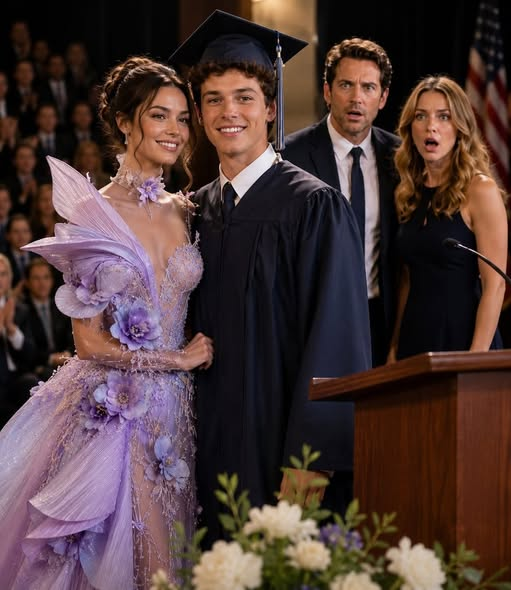
“No,” I said. “There were scheduled visits you chose not to attend.”
Richard ignored me.
He focused on Ethan.
“I can help you develop this properly.”
“My team already has advisers.”
“None with my resources.”
It was the first honest thing he said.
Richard did not want a son.
He wanted the invention.
His company had struggled during the previous year after two failed investments. Their accessibility division had produced nothing competitive.
Ethan’s device could restore credibility.
Richard reached into his jacket and handed him a business card.
“We should discuss a licensing agreement.”
Ethan looked at the card.
Then he handed it back.
“No.”
Richard blinked.
“You haven’t heard the offer.”
“I don’t need to.”
“Don’t be childish.”
The old cruelty appeared so naturally that I knew he had not changed.
Ethan noticed too.
He smiled faintly.
“That is probably what you said to my mother when she expected you to behave like a father.”
Richard’s face reddened.
The coordinator called everyone back into the hall before he could respond.
We returned to our seats.
Richard walked toward the front row with his jaw tight.
The chairperson took the stage carrying the results.
“The judges were unanimous,” she announced.
“The winner of this year’s Whitman Future Technologies Award is Ethan Carter.”
The hall erupted.
I covered my mouth.
Ethan stood frozen for one second.
Then he hugged me.
“You did it,” I whispered.
“We did it.”
He walked onto the stage.
Richard was expected to present the award because his company sponsored it.
He climbed the steps wearing a public smile and carrying a glass trophy engraved with his own company’s name.
The photograph should have been perfect.
The successful businessman honoring a brilliant young inventor.
But as Richard handed Ethan the award, the master of ceremonies spoke.
“Mr. Carter has also received a development grant of five hundred thousand dollars from the National Accessibility Research Council.”
Richard’s smile disappeared.
The grant meant Ethan did not need him.
Then came the second announcement.
“Additionally, Carter Mobility Systems has entered a protected research partnership with the Massachusetts Institute for Human Engineering.”
Richard turned toward the judges.
He had clearly not known.
Ethan had already established a legal entity.
His teachers helped him file provisional patents.
The research council had reviewed his work privately before the summit.
There would be no licensing agreement for Richard to control.
The audience applauded again.
The master of ceremonies handed Ethan the microphone.
He thanked his teachers.
The engineers.
The doctors who tested the device.
Then he looked toward me.
“And I want to thank my mother, Claire Carter.”
I stood slowly.
“She raised me alone after my father left twenty-six days after I was born.”
The applause faded.
Richard’s face became motionless.
Ethan continued.
“She worked full-time, took care of my grandmother, and spent every spare dollar helping me build prototypes that usually failed.”
A few people laughed gently.
“My father once said that a child born to an old woman would never achieve anything important.”
The room fell silent.
Richard’s executives turned toward him.
Madison stared straight ahead.
Ethan did not sound angry.
That made the words more powerful.
“He was wrong about my mother before he was wrong about me.”
My tears spilled freely.
“She was forty-one when I was born. People treated her age like a weakness. But her patience, experience, and courage are the reasons I am standing here.”
The audience rose.
Not because he asked them to.
Because they understood.
Ethan lifted the trophy.
“So I am donating the sponsor’s award money attached to this prize to a program supporting older mothers returning to education and employment.”
Richard’s company had funded that portion of the prize.
The son he dismissed was redirecting his money to honor women like the mother he abandoned.
The applause became thunderous.
Richard remained standing because everyone else had stood.
But his expression had collapsed.
The video of Ethan’s speech spread online before the ceremony ended.
Someone connected Richard’s name to old divorce records.
Journalists found the interview in which he claimed he had postponed fatherhood.
Then they found the photographs from his brief court-ordered visits with Ethan.
By the next morning, the story was everywhere.
TECH CEO PRESENTS AWARD TO SON HE ABANDONED
YOUNG INVENTOR HONORS 56-YEAR-OLD MOTHER WHO RAISED HIM ALONE
WHITMAN FUTURE TECHNOLOGIES FACES QUESTIONS AFTER FOUNDER’S FAMILY HISTORY EMERGES
Richard initially issued a statement.
He said the relationship had been complicated.
He claimed he always supported Ethan privately.
That lie lasted less than a day.
My attorney still had fifteen years of child-support records.
Late payments.
Missed payments.
Unanswered notices.
Every request for reduced support.
Every abandoned visitation.
Richard’s own documents revealed the truth.
Then the business problems began.
One of his largest investors had been preparing to finance a new accessibility division.
After the summit, they reviewed the company’s claims.
They discovered Richard had suggested to shareholders that Ethan’s project might soon become part of Whitman Future Technologies.
There was no agreement.
No negotiation.
No permission.
The statement had inflated interest in the company based on technology Richard did not own.
The board opened an internal investigation.
Richard blamed a communications employee.
Emails showed he had approved the presentation himself.
Within three weeks, he was removed as chief executive.
The board said the decision concerned misleading disclosures and leadership failures.
The public understood the rest.
Madison left him six months later.
Not because she suddenly developed sympathy for me.
Richard’s company had collapsed in value, and their relationship had been built around the life he promised her.
When that life disappeared, so did she.
I did not celebrate their divorce.
I had stopped needing Richard to suffer.
His downfall was not revenge.
It was simply what happened when a man who built his identity on appearance finally lost control of the story.
Ethan’s project became successful.
But not overnight.
The research process lasted years.
Safety testing revealed flaws.
Manufacturing was difficult.
Insurance approvals took longer than expected.
Ethan finished high school, then studied biomedical engineering.
He refused offers from companies that wanted to make the device too expensive for most families.
At twenty-two, he launched the commercial version.
It was lighter, safer, and partially subsidized through hospital and disability programs.
My mother lived long enough to use the first approved model.
Ethan installed it outside her new apartment.
She placed one hand on his cheek.
“You proved him wrong.”
Ethan shook his head.
“I wasn’t building it for him.”
That was when I realized how fully my son had healed.
For years, I believed Richard’s insult might become a shadow over Ethan’s life.
Instead, Ethan refused to make his father the center of his success.
He worked because he cared about people like his grandmother.
He stood on that stage because he had an idea worth sharing.
Richard was only the man sitting in the audience when the truth became visible.
Years later, Richard requested a meeting.
By then, he lived in a modest condominium and worked as a consultant.
He no longer appeared in magazines.
Ethan agreed to meet him once.
I did not attend.
When he returned, I asked only one question.
“Are you all right?”
“Yes.”
“What did he want?”
“To apologize.”
“Did he?”
“He said he was sorry that things happened the way they did.”
I understood immediately.
Not a real apology.
A regret without responsibility.
Ethan sat beside me.
“He also said he was proud of me.”
“How did that feel?”
“Strange.”
He thought for a moment.
“Like someone arriving after the building is finished and saying he always believed in the architect.”
I smiled.
“That sounds accurate.”
“He asked if we could start over.”
“What did you say?”
“I told him we could speak occasionally, but I wasn’t going to pretend he raised me.”
I touched his hand.
“That was your choice to make.”
Richard and Ethan exchanged a few messages after that.
They never became close.
Some relationships cannot be rebuilt because there was never a foundation beneath them.
But Ethan carried no hatred.
He also carried no obligation.
On my seventy-first birthday, he took me to the National Design Museum.
One of his earliest prototypes was displayed in an exhibition about young inventors.
Beside it was a photograph from the graduation summit.
Ethan in his gown.
The trophy in his hand.
Me standing in the audience.
Richard appeared only at the far edge of the photograph, almost hidden behind other guests.
The exhibit description read:
Developed by Ethan Carter, inspired by his grandmother and supported by his mother, Claire Carter.
That was the legacy that remained.
Not Richard’s insult.
Not Madison’s photograph.
Not the years of abandonment.
The work.
The love.
The people who stayed.
Richard left me at forty-one believing age had made me disposable.
He looked at our newborn son and saw only a burden attached to a woman he no longer wanted.
Fifteen years later, he stood on a stage and handed that same child an award for an invention his company desperately needed.
He thought the humiliation came from Ethan revealing the past.
It did not.
The real humiliation was that our son had become extraordinary without ever needing him.
I used to believe revenge would mean watching Richard lose everything.
But the best part of the story was never his downfall.
It was the life Ethan and I built after he walked away.
Richard said a child born to an old woman would never achieve anything important.
Fifteen years later, that child stood beneath his father’s company logo and proved that the only useless thing in his life had been Richard’s opinion.
