I looked straight at Sarah and said:
“Take your hands off my daughter’s life.”
No one moved.
Brad’s arms slipped away from Sarah’s waist as though he had suddenly realized they were burning him.
A woman beside the counter dropped her glass. It struck the tile and shattered, but nobody looked down.
Sarah stared at me with her mouth open.
For a few seconds, she seemed unable to decide whether I was real.
Then her eyes moved to Lily.
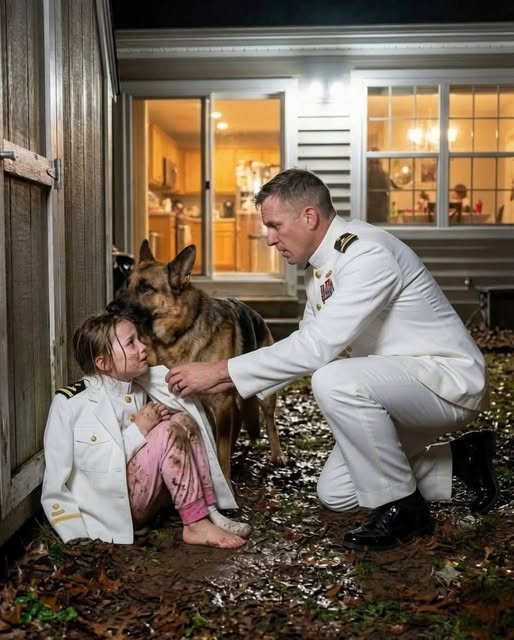
To the mud on her pajamas.
To my jacket wrapped around her trembling body.
To Buster standing beside me with his teeth faintly visible.
“Daniel?” she whispered.
My name sounded wrong in her mouth.
Like she had not expected to use it again.
Lily buried her face against my chest.
Sarah took one careful step forward.
“Oh my God. You’re alive.”
I did not answer.
She tried to smile.
It was the kind of smile people use when they believe appearing relieved will erase everything that happened before the door opened.
“We were told your unit had lost communication,” she said quickly. “There were rumors. I thought—”
“You told Lily I was dead.”
Her expression changed.
“I was trying to prepare her.”
“For what?”
She looked toward the guests.
Everyone was listening.
“For the possibility that you weren’t coming home.”
“So you told a five-year-old that bad men made her father disappear?”
Sarah’s face tightened.
“You don’t understand what it was like here.”
I looked down at Lily.
Her bare foot was cold against my arm.
“I understand enough.”
Brad finally spoke.
“This is getting out of control.”
I turned toward him.
He had always been loud when I was thousands of miles away.
Now his voice sounded smaller.
“You put my daughter outside.”
He raised both hands.
“She was having a tantrum.”
“She is five.”
“She kept screaming and upsetting everyone.”
“You put her in the mud.”
“It was only supposed to be for a few minutes.”
Lily’s fingers tightened around my collar.
“I was there a long time,” she whispered.
Every person in the kitchen heard her.
Brad looked away.
Sarah rushed to explain.
“I didn’t know he had locked the door.”
That sentence froze the room.
“You didn’t know?” I asked.
She hesitated.
Then she made another mistake.
“I thought Buster was with her.”
I stared at her.
She had just admitted she knew Lily was outside.
Not how long.
Not whether the door was locked.
But she knew.
The rage inside me sharpened.
I wanted to shout.
Instead, I reached into my pocket and placed my phone on the kitchen counter.
The camera was still recording.
“I photographed her where I found her,” I said. “I also recorded what she told me.”
Sarah’s eyes dropped toward the phone.
Brad stepped forward.
“You can’t record people without permission.”
I almost laughed.
“You should worry less about the recording and more about what is on it.”
One of the guests, a young man I vaguely recognized from Sarah’s office, picked up his coat.
“I’m leaving.”
Another guest followed.
Then another.
Sarah looked around in panic.
“No one needs to leave. This is a misunderstanding.”
A woman near the dining table shook her head.
“I saw Lily crying earlier.”
Sarah turned toward her.
“You said she was tired.”
“You told me she was in bed.”
The woman looked at me.
“I didn’t know she was outside.”
Brad pointed toward the door.
“Everyone should go.”
I shifted Lily higher against my chest.
“No. Nobody leaves yet.”
Brad frowned.
“You don’t control these people.”
“No. But police may want witness statements.”
Sarah’s face went white.
“Police?”
I took out my phone again.
“I called base security before I opened the door.”
The truth was I had sent my location and a brief message to the duty officer while kneeling beside Lily.
Child found outdoors in dangerous conditions.
Possible neglect.
Unidentified adults in residence.
Request civilian police and medical assistance.
I had learned long ago that entering an unstable situation alone was foolish, even when the house belonged to me.
Especially when my daughter was involved.
Sarah’s voice dropped.
“Daniel, don’t do this.”
“Do what?”
“Destroy our family over one terrible night.”
I looked at the facedown deployment photograph on the wall.
“Our family was already being destroyed. I just arrived early enough to see it.”
Sirens became audible in the distance.
Brad moved toward the hallway.
Buster blocked him.
The dog did not lunge.
He simply stood there.
Brad stopped.
“Control your animal.”
“He is under control.”
More than anyone else in that house.
Sarah reached toward Lily.
“Baby, come to Mommy.”
Lily recoiled so hard that I felt it through my chest.
“No.”
The single word came out small but clear.
Sarah’s hand froze.
“Lily, sweetheart, Mommy is sorry.”
“No.”
Tears began running down my daughter’s face.
“You said Daddy was dead.”
“I thought he was.”
“You said ghosts would take me.”
Sarah looked at me.
“That was not what I meant.”
Lily continued.
“You said if I told Grandma about Brad, he would go away and it would be my fault.”
The room became silent again.
I looked toward Brad.
“What did she have to tell Grandma?”
He did not answer.
Sarah spoke quickly.
“She misunderstood.”
“Then let Lily explain.”
“She is exhausted.”
“So was she outside because she was exhausted?”
Sarah’s eyes filled with tears.
“You’re twisting everything.”
“No. I am repeating it.”
The first police car stopped in front of the house.
Red and blue lights moved across the walls.
Lily covered her ears.
I carried her into the living room and sat on the sofa, keeping her wrapped in my coat.
Buster remained beside us.
Two officers entered through the back door, followed by a paramedic team and a military police liaison.
The older civilian officer looked around the kitchen.
“Who is the child’s parent?”
“I am her father.”
Sarah raised her hand.
“I’m her mother.”
The officer looked at Lily’s condition.
“What happened?”
Sarah answered first.
“She wandered outside during the party.”
“No,” Lily whispered.
The officer heard her.
He crouched several feet away, careful not to approach too quickly.
“What’s your name?”
“Lily.”
“How old are you?”
“Five.”
“Did you go outside by yourself?”
She looked at Brad.
Then at Sarah.
Finally, she pressed her face into my chest.
“Uncle Brad made me.”
Brad stepped forward.
“I am not her uncle, and I did not make her do anything.”
The officer stood.
“Sir, remain where you are.”
“It was discipline. She refused to calm down.”
“You placed a five-year-old outdoors in freezing rain as discipline?”
“The dog was with her.”
The officer’s expression hardened.
“That does not improve the situation.”
The paramedics examined Lily in the living room.
Her temperature was low, though not critically.
She had scratches on one leg, probably from crawling near the shed, and early signs of cold exposure.
They recommended taking her to the hospital.
“I’m going with her,” I said.
Sarah moved forward.
“So am I.”
Lily began crying.
“No, no, no.”
The paramedic looked at the officer.
He nodded.
“Mrs. Morgan, you need to remain here while we take statements.”
Sarah stared at him.
“I’m her mother.”
“And this residence is part of an active child-neglect investigation.”
“That is ridiculous.”
The officer looked toward the crowded kitchen, open bottles, broken glass, and wet mud across my uniform.
“No, ma’am. It is not.”
Brad tried to leave through the front.
An officer stopped him.
He became angry.
“I have done nothing illegal.”
“You admitted placing the child outside.”
“For a few minutes.”
“How many?”
Brad looked toward Sarah.
She did not help him.
“I don’t know.”
The officer glanced at the clock.
“Witnesses say the party began around eight. When was the child sent outside?”
Nobody answered.
A woman near the door began crying.
“She was asking for her father before dinner,” she said. “Brad told her to stop ruining the mood.”
Brad turned toward her.
“Stay out of this.”
The officer stepped between them.
“Do not address the witness.”
Another guest spoke.
“I saw him take Lily through the laundry room.”
Then another.
“Sarah said she needed to learn not to interrupt adults.”
Every statement peeled away another layer of the lie.
By the time the ambulance left, police had separated the guests and begun collecting names.
Sarah stood on the porch watching us.
Her party dress looked absurd beneath the flashing lights.
“Daniel,” she called. “Please don’t take her away from me.”
I looked at Lily beneath the warming blanket.
“I’m taking her somewhere safe.”
At the hospital, doctors confirmed that she would recover physically.
They asked me to step outside while a child specialist spoke with her.
I did not want to leave.
But I did.
Protecting her meant allowing professionals to ask questions without my fear shaping her answers.
The military liaison stayed with me in the hallway.
His name was Chief Petty Officer Aaron Bell.
He had been one of the first people to receive my return notice that evening.
“You weren’t listed as deceased,” he said.
“I know.”
“Your family was notified that your unit had a temporary communications blackout. Nothing more.”
“So Sarah lied deliberately.”
“It appears so.”
I sat down.
The exhaustion from travel finally reached me.
For months, I had dreamed about coming home.
I imagined Lily running through the terminal.
Sarah crying.
Buster knocking me backward with excitement.
Instead, I found my child sleeping in mud because she believed I was a ghost.
“What happens now?” I asked.
“Civilian authorities handle the child-safety case. Your command will support with deployment records and return documentation.”
“My rank?”
“Doesn’t change the custody process.”
“Good.”
I did not want influence.
I wanted facts.
The child specialist emerged nearly an hour later.
Her expression was composed, but troubled.
“Lieutenant Morgan, Lily described more than tonight.”
My stomach tightened.
“What else?”
“She says Mr. Bradley often stays overnight.”
Bradley.
Brad’s full name was Brad Keller.
“She says he sleeps in your bedroom.”
I stared at the floor.
That revelation hurt.
But it did not surprise me.
The image through the kitchen window had already answered that question.
The specialist continued.
“Lily also reports being placed in a dark closet when she cries, having meals withheld as punishment, and being told that you chose not to come home.”
My hands closed into fists.
“Did Sarah participate?”
“Lily says her mother sometimes stopped Mr. Keller. Other times she told Lily to obey him.”
“Did he hurt her physically?”
“We found no immediate evidence of serious physical injury. She described being grabbed, shouted at, and isolated.”
I forced myself to breathe.
The specialist placed one hand on the chair across from me.
“She needs safety, routine, and careful follow-up. She also needs to know none of this was her fault.”
“I can give her that.”
“I believe you.”
Before dawn, a judge approved an emergency temporary custody order placing Lily with me.
Sarah was prohibited from unsupervised contact pending investigation.
Brad was ordered to remain away from Lily completely.
The police searched the house.
They found my personal office emptied.
Several locked military storage cases had been forced open.
Nothing classified was stored there, but my documents had been searched.
Bank statements showed Sarah had redirected part of my deployment pay into an account controlled jointly with Brad.
She had also filed an application for survivor-related benefits.
The application had not been approved because no death certificate existed.
But she had submitted a forged letter claiming I was missing and presumed dead.
That was the reason she told Lily I had died.
Not confusion.
Not grief.
Preparation.
She had been building a widow’s story before I came home.
The investigators found drafts of social media posts announcing my death.
One included a photograph of Sarah dressed in black beside my uniform.
Another described Brad as “the friend who helped us survive the unimaginable.”
I read only part of it before closing the file.
The betrayal was no longer merely personal.
It was documented.
Planned.
Financial.
Three days later, Sarah requested to meet me through her attorney.
I agreed at the police station with lawyers present.
She looked tired.
Without party makeup and expensive clothes, she seemed younger.
For one dangerous moment, I remembered the woman I married.
Then she spoke.
“You came home without warning.”
I stared at her.
“That is your explanation?”
“If you had told me, none of this would have happened.”
“If I had told you, Lily would have been inside when I arrived.”
Her eyes lowered.
“It got out of control.”
“You told our daughter I was dead.”
“I needed a reason for your silence.”
“I was deployed.”
“She didn’t understand that.”
“So you told her I disappeared in the sand?”
Sarah’s hands trembled.
“Brad said children process clear explanations better.”
I looked at her.
“You allowed that man to teach my daughter how to grieve me while I was alive.”
“He was helping.”
“He locked her outside.”
Sarah began crying.
“I didn’t know how cold it had become.”
“You knew she was there.”
“I thought it would be ten minutes.”
“How long was she outside?”
“I don’t know.”
The answer destroyed any sympathy I had left.
She did not know.
She had continued drinking, laughing, and holding Brad while her daughter lay behind the shed.
Her attorney leaned toward her.
Sarah ignored him.
“I was lonely.”
I almost laughed.
“Then ask for a divorce.”
“You were never here.”
“I was serving.”
“You chose the military every time.”
“I sent money. I called. I recorded stories for Lily. I came home whenever leave was approved.”
“You liked being needed by everyone except me.”
That accusation might once have started a long argument.
Now it sounded like an excuse built from resentment.
“You could have left honestly.”
“And lost the house?”
There it was.
She realized too late that she had said it aloud.
The house had been purchased before our marriage with my inheritance from my grandfather.
Sarah knew she had limited claim to it.
If she divorced while I was alive, she would have to negotiate.
If she became a military widow, she believed benefits, sympathy, and control of the property would follow.
Her lawyer closed his eyes.
I looked at her.
“Was that why you filed the survivor application?”
She began shaking her head.
“It was Brad’s idea.”
“Did you sign it?”
“He said we needed protection.”
“Did you forge the letter?”
“No.”
“Did you submit it?”
She said nothing.
I stood.
The meeting was over.
Sarah reached for me.
“I still love you.”
I stepped away.
“You loved the life my absence allowed you to build.”
The criminal investigation lasted months.
Brad was charged with child endangerment, unlawful confinement, financial fraud, and involvement in the forged benefit application.
Several guests testified that he regularly behaved as though the house belonged to him.
One admitted Brad had joked that Sarah would soon become a wealthy widow.
Sarah initially blamed him for everything.
Then investigators recovered messages between them.
In one, Sarah wrote:
Once the official notice comes, we can stop pretending.
Brad replied:
And Lily?
Sarah wrote:
She’ll adjust. She already believes Daniel isn’t coming back.
The official notice never came.
Because I was alive.
The messages proved she had knowingly lied to our daughter.
They also showed that she helped plan the financial fraud.
Sarah accepted a plea agreement involving fraud and child-endangerment charges.
She avoided a long prison sentence but received probation, mandatory treatment, restitution requirements, and strict supervised contact rules.
Brad received a custodial sentence because of his direct actions toward Lily and his larger role in the financial scheme.
The court also prohibited him from contacting her permanently.
Our divorce moved quickly after that.
I received full legal and physical custody.
Sarah was allowed supervised visits after completing parenting programs and psychological treatment.
The first visit lasted twenty minutes.
Lily refused to leave my side.
Sarah brought a stuffed bear.
Lily did not touch it.
Her mother cried.
The supervisor reminded her not to pressure the child.
Healing could not be demanded simply because guilt had arrived.
For months after I came home, Lily slept with Buster beside her bed.
She asked whether sand could swallow people.
She asked whether deployment meant death.
She asked if mothers were allowed to lie when fathers went away.
I answered each question carefully.
“No, baby.”
“No one is allowed to make you afraid so they can control you.”
“Adults can make terrible choices, but those choices are never your fault.”
She began therapy.
At first, she drew our house surrounded by black rain.
Buster was always the largest figure.
I was small and far away.
Over time, the drawings changed.
The rain stopped.
The back door opened.
Then one day, she drew herself between me and Buster beneath a bright yellow sun.
Sarah was not in the picture.
I did not ask her to add anyone.
Children should not be forced to create happy family portraits for adults.
A year later, I transferred to a shore-based assignment.
Some people told me not to sacrifice my career out of guilt.
They were right that guilt should not decide my life.
But this was not punishment.
It was a choice.
Lily needed stability.
I wanted to be present.
I could serve and still come home most nights.
Buster adjusted immediately.
He followed Lily from room to room and slept outside her bedroom door whenever she had nightmares.
The veterinarian estimated he had remained beside her in the rain for nearly three hours.
He had scratched at the back door until his paws bled.
No one inside responded.
At a small ceremony, the local police department honored him for protecting a child.
Lily placed a blue ribbon around his collar.
“He knew Daddy wasn’t dead,” she told everyone.
I knelt beside her.
“How?”
“Because dogs know the truth.”
Maybe they did.
Or maybe Buster simply knew that when a child was alone in the cold, loyalty meant staying.
Two years after the party, Sarah wrote me a letter.
Not through her attorney.
Not asking for custody.
She admitted she resented my deployments.
She admitted enjoying the attention she received when people believed she was grieving.
She admitted that Brad made the lie feel easier because he turned every moral choice into a practical one.
She wrote:
I told myself Lily was too young to remember. I understand now that children remember fear even when they forget the words.
It was the first honest thing she had said.
I showed the letter to Lily’s therapist.
We did not show it to Lily yet.
An apology should serve the harmed person, not relieve the person who caused harm.
Sarah gradually earned longer supervised visits.
Lily remained cautious.
I did not teach her to hate her mother.
I also did not teach her to ignore her own fear.
Trust returned only where behavior supported it.
Some wounds were not repaired by returning to the way things had been.
They healed by building something different.
Five years later, Lily stood onstage in a school play.
She played a sailor searching for home.
When she spotted me in the audience, she smiled so brightly that I felt the entire room disappear.
Afterward, she ran into my arms.
“You came.”
“Of course.”
“You always say that.”
“Because I always mean it.”
Buster was old by then.
He waited in the car with the windows cracked and a blanket beneath him.
Lily climbed into the back seat and showed him her costume.
He licked her hand.
The night I found her in the mud never left either of us completely.
Cold rain still made her quiet.
Loud parties made her uncomfortable.
For years, she checked whether the back door was unlocked before bed.
But the fear no longer controlled her life.
It became part of a story whose ending she helped write.
Sarah and I never reconciled.
She eventually rebuilt a smaller life and continued therapy.
Her relationship with Lily remained limited but stable.
Brad disappeared from our world after his sentence and protective order.
The house was sold.
I could not ask Lily to grow up beside the shed where she believed her father had become a ghost.
We moved to a modest home near the water.
It had a fenced yard, warm porch lights, and a back door Lily could open from the inside.
On the wall of her room hung a framed photograph of Buster wearing his blue ribbon.
Years later, she asked me what I had planned to say when I entered the party.
“I don’t remember.”
“That’s not true.”
I smiled.
She knew me too well.
I had walked through the door carrying more anger than I had ever felt.
But when I saw all those faces, one sentence became clear.
So I told her.
“I said, ‘The dead man is home. Now someone is going to explain why his daughter was sleeping outside.’”
Lily laughed.
Then her expression became serious.
“Were you really angry?”
“Yes.”
“Did you want to hurt Brad?”
I answered honestly.
“For a moment.”
“Why didn’t you?”
“Because you needed a father more than I needed revenge.”
She leaned against me.
That was the truth I carried from that night.
People often imagined strength as the moment I kicked open the door.
But the door was already unlocked.
The difficult part was everything that came after.
Taking photographs instead of destroying the room.
Calling police instead of making threats.
Going to the hospital instead of chasing Brad.
Following the law when rage offered faster answers.
Sarah and Brad believed my deployment made me powerless inside my own home.
They believed distance had erased me.
They believed a five-year-old could be frightened into accepting any story adults repeated often enough.
They were wrong.
Lily remembered.
Buster stayed.
The evidence survived.
And I came home.
Sarah told my daughter I had died in the sand because she needed me gone from their new life.
But the moment I carried Lily through that back door, the only thing that truly died was the lie they had built in my absence.
