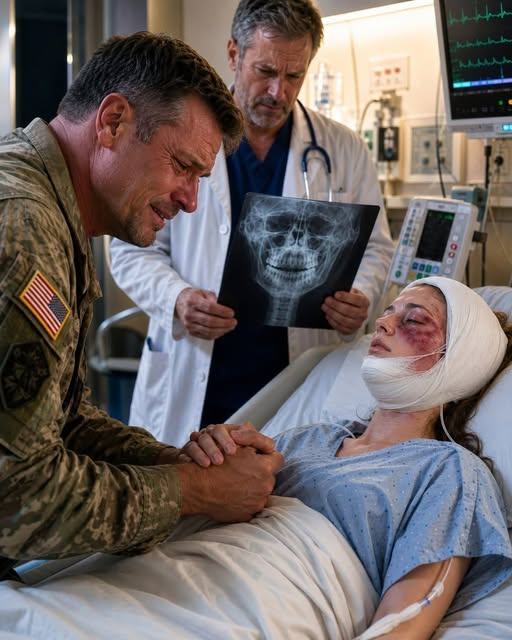
The doctor left the X-rays illuminated for several seconds.
Six fractures.
Every pale line across Lily’s jaw felt like a sentence I could not understand.
I sat beside her bed and held her hand carefully.
Her fingers curled weakly around mine.
“You don’t have to explain anything tonight,” I whispered. “You’re safe. I’m here.”
Her open eye moved toward the door.
Fear flashed across her face.
Not confusion.
Recognition.
She was afraid someone might enter.
I stood immediately and closed the door.
A nurse noticed.
“Mr. Mercer?”
“She keeps looking outside.”
The nurse glanced at Lily, then lowered her voice.
“Campus police have already asked to speak with her.”
“She cannot speak.”
“They said they only need her to identify a photograph.”
“Not tonight.”
The nurse hesitated.
“They seemed anxious to obtain a statement.”
That word troubled me.
Anxious.
Not concerned.
Not careful.
Anxious.
“Who is leading the investigation?” I asked.
“Officer Trent Holloway from campus security.”
I wrote the name down.
Old habits returned quickly.
In the military, confusion could kill people. When the situation made no sense, you stopped accepting summaries and built a timeline.
11:02 p.m.—Lily left the library.
11:18—Her roommate received a message saying Lily was walking toward the science building.
11:31—Campus security claimed she was found unconscious.
11:47—The hospital called me.
Less than thirty minutes separated a normal message from catastrophic injuries.
Someone knew what happened inside that window.
At 1:06 a.m., Officer Holloway entered the hospital room.
He was in his early forties, broad-shouldered, with a campus badge clipped to his belt. A younger university administrator followed him carrying a tablet.
Holloway gave Lily a sympathetic look that never reached his eyes.
“Mr. Mercer, I’m sorry about your daughter.”
“What have you found?”
“We believe this may have been a random assault.”
“Based on what?”
“There were reports of an unfamiliar man near campus.”
“What reports?”
“We’re still gathering information.”
“Did a camera record him?”
He looked toward the administrator.
“Several cameras were undergoing maintenance.”
“How many?”
“The ones near the science complex.”
“All of them?”
“There was a network issue.”
I had worked around enough institutions to recognize language designed to sound specific while revealing nothing.
“When did the issue begin?”
“We don’t have the technical report yet.”
“Then how do you know there was an issue?”
His expression tightened.
“Mr. Mercer, we’re doing everything possible.”
I looked at Lily.
Her eye was fixed on Holloway.
The monitor beside her began beeping faster.
He followed my gaze.
“Lily,” he said gently, “I only need you to look at something.”
He took out his phone.
Her fingers crushed mine.
“No,” I said.
“It may help identify the attacker.”
“She is terrified of you.”
Holloway’s face changed.
Only for a second.
Then the sympathy returned.
“She’s traumatized.”
“Leave.”
The administrator stepped forward.
“Mr. Mercer, cooperating quickly gives us the best chance—”
“Leave the room.”
A nurse entered after hearing the raised voices.
I asked her to remove them.
Holloway slipped his phone back into his pocket.
“We’ll continue this later.”
“No,” I said. “The police will.”
His jaw tightened.
“We are the investigating authority on university property.”
“You are campus security. An aggravated assault that nearly killed a student belongs with city police.”
He stared at me for a long moment.
Then he and the administrator left.
Lily’s pulse slowly settled.
That reaction told me more than Holloway had.
She knew him.
Or she knew what he represented.
At 2:20 a.m., Lily underwent the first procedure to stabilize her jaw.
While she was in surgery, I called Peoria police directly.
Detective Maya Chen arrived before dawn.
She wore no dramatic expression and made no promises she could not keep.
I trusted her immediately.
I gave her the timeline, described Holloway’s visit, and told her about Lily’s reaction.
Chen wrote everything down.
“Campus security reported this as an isolated robbery attempt,” she said.
“Was anything stolen?”
“Her wallet was still inside the hoodie. Phone too.”
“Then why call it robbery?”
“That’s one of my questions.”
She opened an evidence photograph.
Lily’s backpack had been found twenty yards from her body.
Its contents were scattered.
Laptop.
Textbooks.
A laboratory notebook.
A broken flash drive.
Chen pointed toward the notebook.
“Do you know what she was studying?”
“Biochemistry.”
“Was she working on a research project?”
I nodded.
Lily had recently joined a laboratory led by Professor Howard Vale, a celebrated researcher developing a low-cost blood-screening system.
She was proud of being selected.
Three days earlier, however, she called me sounding unsettled.
She said some research numbers did not match.
I assumed she meant a normal academic error.
Now I remembered her exact words.
Dad, what happens if a mistake isn’t really a mistake?
At the time, I told her to document everything and speak to her professor.
“What was on the flash drive?” Chen asked.
“I don’t know.”
“We found evidence that it was deliberately snapped.”
A cold pressure formed in my chest.
“Someone searched her bag.”
“That appears likely.”
I told Chen about the research call.
She immediately requested preservation of laboratory records and campus security footage.
At 6:40 a.m., the university issued a public statement.
It said Lily had been injured during “an apparent late-night altercation near campus.”
Altercation.
The word suggested participation.
A fight.
Mutual aggression.
My daughter lay in surgery with her jaw shattered, and the university was already softening the truth.
I called the communications office.
A woman named Melissa Grant answered.
“Who approved the statement?”
“Our crisis-response team.”
“Why did you describe it as an altercation?”
“That was the preliminary information provided.”
“By Holloway?”
She became cautious.
“I cannot discuss internal sources.”
“You have no evidence Lily fought anyone.”
“The wording may be updated as facts emerge.”
“Then update it now.”
“We follow established procedure.”
Institutions often called self-protection procedure.
By eight, reporters were outside the hospital.
Someone had leaked Lily’s name.
Online rumors appeared almost immediately.
A student claimed she had been drinking.
Another said she argued with a professor.
An anonymous account suggested she had tried to steal research data and was injured while fleeing.
The lie was moving faster than the investigation.
Then Lily’s roommate arrived.
Her name was Sofia Ramirez.
She entered the waiting area crying and carrying Lily’s tablet.
“I should have come sooner,” she said.
“What do you know?”
Sofia looked toward the police officer outside Lily’s room.
“Can we speak privately?”
Detective Chen joined us in a small consultation room.
Sofia placed the tablet on the table.
“Lily asked me to keep this yesterday.”
“Why?” Chen asked.
“She said someone entered her dorm room while we were in class.”
“Was anything taken?”
“Not that she could see. But her laptop had been moved.”
Sofia unlocked the tablet.
A folder contained photographs of laboratory results.
Rows of test numbers.
Internal emails.
Invoices.
Lily had preserved them all.
Sofia explained that Professor Vale’s laboratory received millions in federal funding to test a diagnostic system.
The published results showed extraordinary accuracy.
But Lily discovered that failed tests were being removed from the dataset.
Some patient samples were counted twice.
Others had been relabeled.
“She thought a graduate researcher made a mistake,” Sofia said. “Then she found emails from Professor Vale telling them which results to exclude.”
Chen scrolled through the files.
“Did Lily report this?”
“She scheduled a meeting with the university research-integrity officer.”
“When?”
“Yesterday afternoon.”
“What happened?”
“The officer canceled.”
“Why?”
Sofia looked frightened.
“The email said the matter had already been resolved internally.”
“By whom?”
“Dean Charles Holloway.”
The surname landed heavily.
“Related to Officer Trent Holloway?” I asked.
Sofia nodded.
“Brothers.”
The pieces began connecting.
A famous research program.
Manipulated results.
Federal money.
A student who preserved evidence.
A dean with reason to stop her.
A campus officer controlling the first investigation.
Chen immediately called for a warrant request.
But before she finished, a hospital staff member entered.
“Mr. Mercer, your daughter is awake.”
Lily could not speak because her jaw had been stabilized.
A nurse gave her a communication board and marker.
I sat beside her.
“You’re safe,” I told her. “Detective Chen is here. Sofia brought the tablet.”
Her eye widened.
Then tears came.
She wrote slowly.
THEY KNOW.
“Who?”
Her hand shook.
VALE. DEAN HOLLOWAY. TRENT.
Chen stepped closer but kept her voice gentle.
“Did one of them attack you?”
Lily stared at the board.
Then she wrote:
NOT VALE. STUDENT. MADE HIM.
“What student?” I asked.
She wrote a name.
MASON KELLER.
I recognized it.
Mason was a graduate assistant in Vale’s laboratory.
Lily mentioned him several times.
He supervised younger students and controlled access to raw data.
Chen asked, “Was Mason alone?”
Lily shook her head.
Then wrote:
TRENT WATCHED.
The room became silent.
Campus security had not failed to witness the attack.
Its lead officer had watched.
Lily began trembling.
I took the marker from her hand.
“That’s enough.”
She caught my wrist and pulled the board back.
One final message appeared.
CAMERA DID WORK. BACKUP SERVER.
Chen’s eyes sharpened.
“What backup server?”
Lily pointed toward the tablet.
Sofia opened another folder.
Inside was a photograph of a maintenance diagram showing the security system.
Main campus cameras transmitted to a central network.
But several science-building units also stored twenty-four hours of footage locally before deletion.
The university had claimed a network failure.
That did not erase local copies.
Unless someone reached them first.
Chen stood.
“We need to move now.”
City police arrived at campus with warrants less than an hour later.
The university delayed access.
Administrators demanded legal review.
Professor Vale claimed research confidentiality.
Dean Holloway insisted the institution should complete its internal investigation before police disrupted operations.
That resistance ended when federal agents arrived.
The manipulated research involved federal grants.
Destroying evidence could carry consequences far beyond university discipline.
Investigators recovered the local camera unit from a locked maintenance cabinet.
Someone had tried to wipe it.
But the deletion was incomplete.
The video had no sound.
It did not need any.
At 11:21 p.m., Lily entered the side courtyard beside the science building.
Mason followed.
They argued.
Lily attempted to walk away.
Mason grabbed her backpack.
She resisted.
Then Officer Trent Holloway appeared.
Not to stop him.
To block the exit.
The footage showed Mason striking Lily repeatedly while Holloway stood several feet away.
At one point, Lily fell.
Mason continued.
Holloway looked toward the security camera.
Then deliberately turned it away.
The final minutes came from another unit across the courtyard.
Mason searched Lily’s bag, found the flash drive, and broke it.
Holloway used his radio.
Only after they left did another security employee discover Lily.
The attack had not happened without witnesses.
It had happened with protection.
Mason was arrested that afternoon.
Holloway was taken into custody shortly afterward.
News of the video spread rapidly.
The university changed its statement.
Now it expressed “deep concern” and promised full cooperation.
I read the words from Lily’s bedside.
“They knew enough to call it an altercation,” I said.
Detective Chen nodded.
“They were building distance.”
“From what?”
“From liability. From the research scandal. Perhaps from criminal involvement.”
Investigators searched Professor Vale’s laboratory.
They discovered altered datasets, hidden correspondence, and a second set of authentic test results.
The diagnostic system did not perform nearly as well as claimed.
Vale had submitted manipulated findings to secure additional grants and attract a pharmaceutical partnership worth hundreds of millions.
Dean Holloway knew.
He had approved internal reviews that never occurred.
When Lily requested a formal meeting, the dean notified Vale.
Vale contacted Mason.
The exact order became a major question.
Mason initially claimed he only wanted to frighten Lily and recover stolen data.
The data was not stolen.
Lily had authorized access as a research assistant and preserved evidence of misconduct.
Text messages later revealed more.
Vale wrote to Mason:
Make sure she understands what happens if she takes this outside.
Dean Holloway wrote:
Trent will handle the cameras. No permanent damage.
Mason replied:
Understood.
No permanent damage.
Six fractures.
Multiple surgeries.
Months of recovery.
Men who considered a young woman’s face an acceptable warning had discussed it like a scheduling problem.
The university suspended Vale and both Holloway brothers.
Then more students came forward.
A former researcher said she had been threatened after questioning data.
Another said Mason locked her in a storage room and demanded she delete files.
A technician admitted Dean Holloway ordered him to revise laboratory audit records.
Lily had not discovered a single act of fraud.
She had uncovered a system protected by prestige, money, and fear.
Her recovery was slow.
The first surgery lasted nearly eight hours.
For weeks, she communicated through writing and a tablet.
She could not eat normally.
Sleep came in fragments.
Every unfamiliar man entering the hospital made her pulse rise.
I remained beside her.
At first, I tried to solve everything.
I asked doctors for schedules.
Detectives for updates.
Attorneys for timelines.
Then Lily wrote something on her board.
DAD, STOP LOOKING LIKE YOU’RE GOING TO WAR.
I almost smiled.
“What should I look like?”
She wrote:
MY DAD.
So I learned to sit quietly.
I read her old mystery novels.
I brought terrible coffee and pretended it was good.
I helped wash her hair when she could finally stand.
I stopped asking about the case unless she brought it up.
Protecting her did not mean turning her recovery into another operation.
The criminal proceedings began six months later.
Mason accepted a plea only after prosecutors showed him the restored video and messages.
He admitted attacking Lily to stop her from reporting the research fraud.
His cooperation implicated Professor Vale and the Holloway brothers.
Officer Holloway claimed he feared for his job.
The jury did not accept that explanation.
He had carried a badge.
He had watched a student nearly beaten to death.
Then he manipulated the scene, spread a false robbery theory, and attempted to question her while she lay terrified in a hospital bed.
He was convicted of conspiracy, obstruction, evidence tampering, and offenses connected to the assault.
Dean Holloway was convicted of conspiracy, fraud, retaliation, and obstruction.
Professor Vale faced federal charges for research fraud, misuse of grant funding, conspiracy, and directing intimidation.
His defense argued that his message to “make sure she understands” referred only to academic consequences.
Mason’s testimony and the surrounding messages destroyed that claim.
Vale was convicted.
The pharmaceutical partnership collapsed.
The university returned grant money, paid substantial penalties, and faced civil suits from patients, researchers, and donors.
Several senior administrators resigned after investigators found they had ignored earlier complaints to protect the university’s reputation.
Lily filed a civil case.
She did not want a secret settlement.
The university offered one anyway.
A large payment.
Confidentiality.
No admission of wrongdoing.
She read the proposal slowly, her jaw still stiff from surgery.
Then she typed:
They tried silence once.
She rejected it.
The final settlement required public acknowledgment that the university failed to protect her, attempted to mischaracterize the attack, and delayed cooperation.
It also funded an independent research-integrity office that reported outside the university administration.
Graduate students received secure reporting channels.
Security footage could no longer be controlled by one department.
The reforms did not undo what happened.
But Lily insisted the case should leave behind more than money.
A year after the attack, she returned to campus for the first time.
I offered to go with her.
She said yes.
We walked toward the science building on a clear autumn morning.
Students crossed the courtyard carrying coffee and backpacks.
The place looked ordinary.
That disturbed me.
Terrible events often leave no permanent mark on the ground.
Lily stopped near the wall where she had been found.
Her breathing changed.
I waited.
After a while, she reached for my hand.
“I thought I was going to die here,” she said.
Her speech remained slightly uneven after reconstruction, but every word was clear.
“I know.”
“I remember Trent looking at me.”
I said nothing.
“He acted bored.”
Her fingers tightened around mine.
“As if I was paperwork.”
“You weren’t.”
“I know that now.”
We stood there until she was ready to leave.
Lily did not return to Vale’s field of research.
For a while, she considered abandoning science completely.
Then she transferred to another university and studied medical data ethics.
She wanted to understand how institutions turned numbers into authority—and how those numbers could be challenged before people were harmed.
Three years later, she addressed a national conference on research integrity.
I sat in the back row.
She walked onto the stage with faint surgical scars along her jaw.
She did not hide them.
“My first major contribution to science was not an experiment,” she told the audience. “It was refusing to delete one.”
The room stood at the end.
I remained seated for one extra second because tears had blurred my vision.
Then I stood too.
Afterward, a journalist asked whether my military background had helped expose the conspiracy.
“No,” I said.
“It helped me stay organized when I was afraid. The people who solved the case were my daughter, her roommate, investigators who followed evidence, and witnesses who finally spoke.”
The reporter asked what I did.
“I believed her.”
That was the most important thing.
Not my service.
Not my anger.
Not the contacts people assumed I had.
I did not threaten the university.
I did not hunt anyone down.
I did not become the kind of man who answered violence with violence.
I stayed beside my daughter while the truth moved through proper channels.
Lily’s face required six fractures to be repaired.
Her trust in the world took longer.
But neither remained permanently broken.
Years later, she showed me the original tablet folder she had preserved.
The photographs.
The emails.
The altered test results.
At the bottom was a note she had written the day before the attack.
If they try to make me doubt what I saw, remember: the numbers were changed. I was not confused.
She had written it for herself.
The institution had already begun making her question whether the discrepancies mattered.
Mason believed force would finish what intimidation started.
Officer Holloway believed a badge could control the story.
Professor Vale believed reputation would outweigh evidence.
The university believed the words apparent altercation would create enough uncertainty to protect it.
They were all wrong.
The attack nearly took Lily’s voice.
But before anyone could erase the truth, she had copied it, dated it, and placed it beyond their control.
The X-ray showed me six places where my daughter’s jaw had been broken.
The investigation revealed something even more dangerous: an entire institution willing to break the truth to protect powerful men.
They failed.
Because Lily survived.
The evidence survived.
And this time, silence did not.
