I was thirty-two now.
And my mother still believed she could erase me by pointing toward the kitchen.
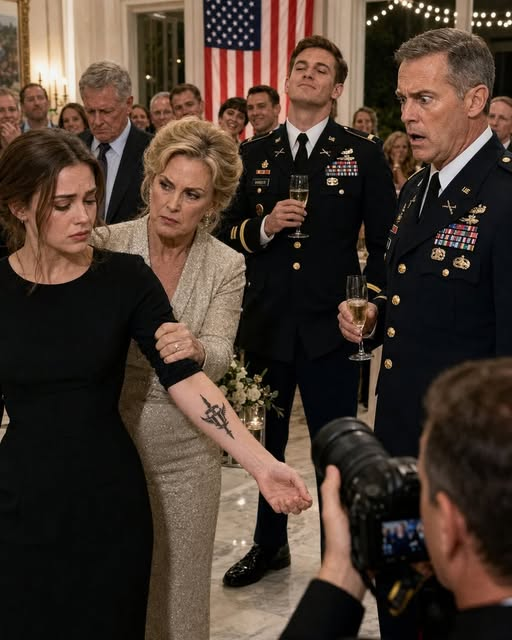
She tightened her grip on my wrist.
“Move.”
My sleeve slid upward.
Only two inches.
That was enough.
The tattoo appeared along the inside of my forearm: a black compass crossed by a narrow blade, surrounded by a broken circle. Beneath it were four small numbers.
Nothing about it looked dramatic.
To most people, it probably seemed like an old unit tattoo or some impulsive decision from my twenties.
Colonel Ethan Graves knew better.
The glass in his hand stopped halfway to his mouth.
His face went completely still.
I watched his eyes move from the ink to my face.
Then back again.
“Where did you get that?” he asked.
His voice was not loud.
It did not need to be.
The men closest to him stopped speaking immediately.
My mother released my wrist.
Ryan’s smile remained in place, but uncertainty entered his eyes.
I pulled my sleeve down.
“It’s nothing.”
Colonel Graves took one step toward me.
“No,” he said. “It isn’t.”
My father gave an awkward laugh.
“Claire had a difficult phase. We don’t encourage her to discuss it.”
Graves did not look at him.
“What do the numbers mean?”
I stayed silent.
He already knew.
The final four digits referred to a date no public report contained.
A date buried inside sealed operational records.
A date when fourteen people entered a hostile city under false names and only six came home under their own.
Ryan lowered his glass.
“Colonel, do you know my sister?”
Graves finally looked at him.
“Do you?”
The room changed.
My brother’s expression tightened.
“Of course I know her.”
Graves glanced toward the tray of empty glasses in my hand.
“You let her serve drinks at your welcome-home party?”
My mother stepped between us.
“Claire insisted on helping.”
“No, I didn’t,” I said.
The words left my mouth before caution could stop them.
My mother turned sharply.
“Excuse me?”
“You told the catering staff I was family labor and removed one server from the schedule.”
Several guests looked toward her.
She forced a smile.
“This is not the time for one of Claire’s resentments.”
Graves kept his attention on me.
“May I see your arm?”
“No.”
I said it calmly.
He nodded once.
He understood refusal.
Ryan did not.
“Claire, stop acting mysterious.”
He laughed toward the officers around him.
“She likes people thinking she has secrets. She worked some private security jobs after college and came home with a superiority complex.”
Colonel Graves looked at him for several seconds.
Then he asked, “Is that what your family told you?”
Ryan frowned.
“That’s what happened.”
A man near the flag display shifted uncomfortably.
He was older than the other guests, wearing civilian clothes but standing with the posture of someone who had spent decades in uniform.
I recognized him.
Major General Samuel Holt.
Retired.
Former director of a joint intelligence command.
He had been in one of the rooms where my name stopped officially existing.
Holt looked at the tattoo.
Then at me.
“Specter Three,” he said quietly.
The tray slipped from my fingers.
It struck the marble floor.
Glasses shattered.
Nobody laughed this time.
My mother jumped backward.
Ryan stared at Holt.
“What did you call her?”
General Holt approached slowly.
Age had changed him, but not his eyes.
“Claire Whitaker.”
He studied my face.
“We were told you were dead.”
The backyard seemed to tilt beneath my feet.
Colonel Graves inhaled sharply.
My father looked from Holt to me.
“Dead?”
I bent down automatically to gather the broken glass.
Graves caught my wrist before my fingers reached it.
“Leave it.”
The command was gentle.
That almost made it worse.
For years, no one in my family had asked why I sometimes woke screaming.
Why I never sat with my back to a door.
Why I disappeared for months and returned with injuries I called accidents.
They preferred the version where I was unstable, disappointing, and useless.
That version required nothing from them.
Ryan stepped forward.
“General Holt, there must be some mistake.”
“There isn’t.”
Holt faced the room.
“That symbol belonged to a classified recovery unit attached to Joint Task Group Meridian.”
A few senior officers went silent.
The younger soldiers looked confused.
The name had never appeared in newspapers.
Officially, Meridian had not existed.
Unofficially, it recovered people and information from places conventional units could not enter without creating international crises.
Graves looked at my covered arm.
“The broken circle represented compromised extraction.”
I said nothing.
He continued.
“The compass meant autonomous navigation. The blade meant denied-area recovery.”
Ryan laughed nervously.
“You’re saying Claire was special operations?”
“No,” Holt said. “I’m saying she worked in places where even special operations teams required someone to find them.”
My mother’s face lost color.
“That’s impossible.”
General Holt looked at her.
“Why?”
“Claire couldn’t finish military training.”
The sentence struck harder than she intended.
Because she believed it.
When I was twenty-two, I told my parents I had withdrawn from an officer program.
That was the cover story.
They never questioned it because failure fit comfortably into what they already believed about me.
Holt’s expression hardened.
“She finished every program she was assigned.”
My father spoke for the first time.
“What exactly did she do?”
I looked at Holt.
“Don’t.”
He stopped immediately.
That obedience disturbed the room more than any explanation could have.
A retired general had followed one word from the daughter my family ordered to refill champagne.
Ryan stared at me.
“If this is true, why didn’t you tell us?”
I looked at him.
“When would I have told you?”
His mouth tightened.
“Any time.”
“At your West Point graduation, when Mom introduced me as your unemployed sister?”
My mother flinched.
“At Dad’s retirement dinner, when he told everyone I lacked discipline?”
My father looked down.
“Or after I returned from surgery and all of you decided the scars were proof I had made bad choices?”
The room became painfully quiet.
My aunt, who had mocked me minutes earlier, set down her drink.
My mother folded her arms.
“You encouraged us to believe those things.”
“I signed secrecy agreements.”
“You could have said you were doing important work.”
“I said I worked for the government.”
“You said consulting.”
“That was the authorized explanation.”
Ryan shook his head.
“This makes no sense. If you were so important, there would be records.”
“There are records,” Graves said. “You just don’t have clearance to see them.”
The words wounded Ryan’s pride immediately.
He had spent the evening surrounded by people celebrating his access, his deployments, his status.
Now his commander was explaining that his “useless” sister had entered rooms he was not authorized to know existed.
Madison, his wife, looked at me differently.
Not warmly.
Calculatingly.
“What happened on the date in the tattoo?” she asked.
I pulled my sleeve lower.
“That is not a family story.”
General Holt’s jaw tightened.
“No. It is not.”
Graves turned toward him.
“You were involved?”
“I authorized the mission.”
He looked older when he said it.
The operation had begun with a compromised intelligence team trapped inside a coastal city during a government collapse.
Communications were down.
Air access had been denied.
Local militias controlled the roads.
The trapped unit included American analysts, allied officers, and one undercover source whose identity could have triggered a diplomatic disaster if captured.
My team was sent to locate them and establish an extraction corridor.
We found them.
But the route had been betrayed.
The convoy was hit before dawn.
The mission report stated that the remaining personnel were recovered by allied forces.
It did not mention the six hours we spent moving wounded people through flooded tunnels.
It did not mention the teammate who died keeping a security door open.
It did not mention that I stayed behind to destroy sensitive material after the last extraction vehicle departed.
For forty-seven hours, command believed I had been killed.
I was captured.
Then I escaped.
That was the simple version.
The only version I could survive saying aloud.
Graves had been a young major on the extraction force.
He had seen the corridor after my signal returned.
He had seen the people my team delivered.
But we had never met face-to-face.
Until that night.
He looked at me with a mixture of recognition and disbelief.
“You transmitted the final beacon.”
“Yes.”
“You were injured.”
“Yes.”
“We searched for two days.”
“I know.”
“We found blood near the communications room.”
My mother’s hand rose to her mouth.
I felt the walls closing around me.
“Enough.”
Graves stopped.
Ryan did not.
“So what?” he asked.
The question shocked everyone.
His face had hardened.
“This is my welcome-home party. Why are we suddenly turning Claire into some legend?”
Colonel Graves stared at him.
Ryan continued.
“She hid everything. She let our parents worry. She disappeared whenever she wanted and never explained. Now she shows up at my party and somehow becomes the center of attention again.”
Again.
As if I had ever been allowed to occupy the center.
My father said quietly, “Ryan.”
But he was already angry.
“Did you even serve officially?” he asked me. “Or were you some contractor who got lucky?”
Graves placed his glass on the nearest table.
“Captain Whitaker.”
Ryan’s posture changed automatically.
“Sir.”
“You will stop speaking.”
The command cut through the yard.
Ryan’s face reddened.
Graves stepped closer to him.
“You came home from a deployment supported by intelligence routes, local contacts, and recovery frameworks built by people whose names you will never know.”
Ryan remained silent.
Graves pointed toward me.
“One of those people is standing in front of you.”
My mother forced herself to recover.
“This is all very impressive, but it does not change how Claire treats this family.”
I looked at her.
“How do I treat you?”
“You disappear.”
“I was deployed.”
“You refuse holidays.”
“I spent years unable to travel publicly.”
“You never contributed.”
That accusation almost made me laugh.
My father looked toward her.
“Margaret.”
She continued anyway.
“You lived irresponsibly. You never built a stable career. You showed up whenever you wanted and expected us to accept your moods.”
I reached into the pocket of my dress.
My hands were steady now.
I opened my banking application and turned the screen toward her.
“You mean I never contributed visibly.”
She frowned.
The monthly transfer was displayed clearly.
Five thousand dollars.
Sent to my parents’ mortgage account for the last seven years.
My father leaned closer.
“What is that?”
“The reason this house was not foreclosed on after your investment losses.”
His face drained of color.
My mother grabbed the phone.
“That money came from Ryan.”
“No.”
She looked toward him.
Ryan avoided her eyes.
I continued.
“His military salary was never enough to cover the mortgage, your medical bills, and Madison’s wedding.”
Madison’s expression sharpened.
“My wedding?”
“I paid the remaining balance after Ryan called me.”
Ryan looked furious.
“You promised not to mention that.”
“You just called me useless.”
General Holt looked from my brother to my parents.
The disappointment in his face was unmistakable.
I opened another record.
“Dad’s cardiac rehabilitation.”
Another.
“Mom’s surgery.”
Another.
“Property taxes.”
Another.
“Ryan’s first legal fees after the accident at twenty-three.”
My father sat down.
For years, my family had praised Ryan for helping them.
He often accepted thanks for money I transferred through him because I could not explain the accounts attached to my government work.
At first, it seemed easier.
Then he started behaving as though the money actually came from him.
“Why would you let us believe it was Ryan?” my father asked.
“Because when I tried sending it directly, Mom returned it.”
My mother stared at me.
“You said it came from consulting.”
“It did.”
“I thought it was dirty money.”
The casual cruelty of that answer surprised even her.
My aunt looked away.
Ryan stepped toward me.
“You’re making me look like a liar.”
“You were a liar.”
“I never said the money was mine.”
“You stood beside Mom while she thanked you.”
“I didn’t correct her.”
“That is what lying becomes when it is useful.”
Madison removed her hand from his arm.
“How much of our wedding did she pay for?”
Ryan’s silence answered.
The family photograph was forgotten now.
The photographer had lowered his camera entirely.
The champagne remained untouched.
I looked around at the house.
The flags.
The polished floors.
The framed portraits that excluded me.
All of it had been preserved partly by the person they sent to the kitchen.
My father stood slowly.
“Claire, why didn’t you tell me about the mission?”
I looked at him.
“Because I couldn’t.”
“Afterward?”
“I tried.”
He frowned.
“When?”
“The hospital.”
His face changed.
The memory returned.
I had come home at twenty-six with stitches beneath my ribs and damage to my shoulder.
My father visited for eleven minutes.
He spent most of them discussing Ryan’s promotion.
When I said I had been hurt overseas, he told me that reckless work was not the same as service.
Then he left.
“I didn’t understand,” he whispered.
“You didn’t ask.”
My mother’s eyes filled with tears.
I had seen those tears many times.
They appeared whenever reality threatened her version of the family.
“We thought you were lost,” she said.
“No. You thought I was disappointing.”
“That isn’t fair.”
“Neither was removing me from every family photograph.”
She looked toward the unfinished group near the flag.
“We can take another.”
I almost smiled.
The solution was so small in her mind.
Put me in the picture.
Erase thirty years.
Colonel Graves turned toward me.
“Why are you here tonight?”
The question was not accusatory.
He understood something no one else did.
People trained to vanish did not walk voluntarily into rooms where they expected humiliation unless there was a reason.
I looked at Ryan.
“He asked me to come.”
My brother’s expression changed.
“Because I’m family.”
“No.”
I reached into my pocket again and removed a sealed envelope.
“You asked me to come because you wanted help with the inquiry.”
The officers near him became still.
Graves looked sharply at Ryan.
“What inquiry?”
Ryan’s face reddened.
“Claire.”
“You called me three weeks ago.”
“Not here.”
“You said your unit’s expense records had been questioned.”
Graves stared at him.
Ryan lowered his voice.
“It’s an administrative misunderstanding.”
I handed the envelope to Graves.
“I reviewed what he sent.”
My mother stepped forward.
“Claire, stop.”
I did not look at her.
“The invoices contain repeated payments to a logistics company registered to Madison’s brother.”
Madison went pale.
Ryan’s jaw tightened.
“That company provided services.”
“Not on the dates listed.”
Colonel Graves opened the envelope.
Inside were summaries, public records, and transaction comparisons.
Nothing classified.
Nothing obtained illegally.
Ryan had sent me the documents himself because he believed his useless sister’s financial contacts might quietly fix the problem.
He did not know I had spent years tracing covert funding networks.
Graves read the first page.
“How much?” he asked.
“Just over nine hundred thousand dollars in questionable charges.”
The silence became absolute.
Ryan stepped closer.
“You said you would help me.”
“I said I would review the records.”
“You promised family came first.”
“No. You said family came first when you needed me.”
His face twisted.
“You’re handing this to my commander at my party?”
“I planned to speak with you privately.”
“Then why didn’t you?”
I looked toward the family-photo area.
“Mom grabbed my wrist.”
Graves continued reading.
His expression grew colder.
“Captain Whitaker, did you disclose this relationship?”
Ryan said nothing.
Madison spoke quickly.
“My brother’s company is legitimate.”
“Then an audit will confirm that,” I said.
She glared at me.
“You have always hated us.”
“No. I kept paying for you.”
Colonel Graves closed the folder.
“This celebration is over.”
Ryan stared at him.
“Sir, please.”
“You will report to headquarters at 0700 with counsel.”
“Sir, these documents are incomplete.”
“Then bring complete ones.”
The command was final.
Ryan’s heroic return ended without another toast.
The special operations guests left quietly.
Some shook my hand.
Most did not ask questions.
They understood that recognition could become another kind of exposure.
General Holt remained near the doorway.
“I owe you an apology,” he said.
“For what?”
“We classified too much. Then we left people like you to carry the silence alone.”
I looked toward my family.
“The classification was not the main problem.”
He understood.
My father approached me after most guests left.
“Stay.”
It was the first time he had asked.
“No.”
“We should talk.”
“We should have talked years ago.”
His eyes filled with regret.
“We didn’t know.”
“You knew enough to be kind.”
That stopped him.
My mother stood beside the ruined photograph arrangement.
“You’re really going to leave after destroying your brother’s career?”
“I did not create those invoices.”
“You exposed him.”
“He used military funds to benefit family.”
“You don’t know that.”
“I know enough to require an investigation.”
She shook her head.
“You always wanted to punish us.”
I looked at the marble floors I helped save.
At the mother whose medical bills I paid.
At the father whose rehabilitation I financed.
At the brother whose wedding and legal problems I covered.
“If I wanted to punish you, I would have stopped helping years ago.”
Then I left.
Colonel Graves walked with me to the driveway.
The night air felt cooler away from the lights.
“Are you still active?” he asked.
“No.”
“Completely?”
I looked at him.
He smiled faintly.
“Fair enough.”
He glanced toward my arm.
“I carried the recovery report from Meridian for years.”
“You wrote that report?”
“The first draft.”
“It contained errors.”
His smile grew.
“I assumed it did.”
For the first time that night, I almost laughed.
Then his expression became serious.
“What happened after you escaped?”
“I came home.”
“That isn’t what I asked.”
“It is all I can answer.”
He nodded.
“Your brother is a capable officer.”
“I know.”
“That does not excuse misconduct.”
“I know.”
“If the charges are false, the investigation will show it.”
“And if they are true?”
“Then he answers for them.”
That was the difference between loyalty and corruption.
Loyalty did not require protecting someone from the truth.
It required believing they were responsible enough to face it.
The audit lasted six months.
The questionable invoices were real.
Ryan had approved contracts for Madison’s brother without disclosing the relationship.
Some services had been provided.
Others had been inflated or duplicated.
Investigators found emails showing Ryan pressured a logistics officer to approve payments before verification.
He claimed he was trying to accelerate urgent support.
But part of the money returned through accounts used for personal expenses.
Ryan was removed from command.
He faced administrative and criminal proceedings.
Because he cooperated, returned funds, and provided evidence against others involved, he avoided the most severe sentence.
But his career in special operations ended.
He retained his rank at a reduced level for a period, then separated from service under circumstances far less glorious than his welcome-home party had promised.
Madison left him before the final hearing.
Her brother was charged separately.
My mother blamed me for the divorce.
Then the investigation uncovered messages showing Madison had planned to leave if Ryan lost command.
My father stopped defending her after that.
For several months, none of them contacted me.
The monthly transfers stopped the morning after the party.
Not out of revenge.
Because the expenses were no longer mine.
My parents sold the Arlington house.
They moved into a smaller property they could afford.
My mother described the move as another humiliation I had caused.
My father called it overdue reality.
They nearly separated.
Years of financial denial had been hidden beneath the home’s polished surface.
Without my money or Ryan’s status, they finally had to discuss the life they actually lived.
My father began therapy through a veterans’ family program.
He wrote to me six months later.
The letter contained no excuses.
I was proud of the child who reflected me and dismissive of the one I did not understand.
I read that sentence several times.
I mistook secrecy for failure because I believed achievement must be visible to matter.
He apologized for the hospital.
The photographs.
The comparisons.
The money he accepted without asking where it came from.
I did not answer immediately.
An honest apology deserved consideration.
It did not demand access.
My mother’s first letter was different.
She wrote that families sometimes said hurtful things.
She said I should remember everything she sacrificed while raising me.
She asked whether I could resume paying for her medical plan.
I returned it unopened.
Her second letter arrived a year later.
It was shorter.
I called you useless because your life made me feel useless. I understood Ryan’s achievements. I could display them. I could not control yours.
That was the beginning of truth.
Not reconciliation.
But truth.
Ryan contacted me after leaving the Army.
We met in a quiet café outside Richmond.
Without the uniform, he looked younger and older at the same time.
He sat across from me and said nothing for several minutes.
Then he placed the old wedding invoice on the table.
“You paid this.”
“Yes.”
“And the lawyer.”
“Yes.”
“And Mom’s surgery.”
“Yes.”
He looked down.
“Why?”
“Because you asked.”
“I never thanked you.”
“No.”
“I let them think it was me.”
“Yes.”
His face tightened.
“I hated you.”
I was not surprised.
“Why?”
“Because every time you disappeared, Dad became angrier. Mom became obsessed with proving I was successful. I thought if you would just act normal, they would stop.”
“So you helped them make me the problem.”
“Yes.”
The honesty hurt less than another lie would have.
He continued.
“Then, when I learned some of what you had done, I hated you more.”
“Why?”
“Because I realized I was not the bravest person in the family.”
I looked at him.
“This was never a competition.”
“It was to us.”
He rubbed his hands together.
“I did manipulate those contracts.”
“I know.”
“I told myself the company was family and the unit needed faster support.”
“And the personal transfers?”
“I deserved them.”
The answer was ugly.
But it was honest.
“I spent my whole life being told I was the hero,” he said. “Eventually, I believed rules were for people who had not sacrificed as much.”
“That belief ruins people.”
“It ruined me.”
“No. It exposed you.”
He nodded.
“Do you forgive me?”
“No.”
He looked up.
“Not yet,” I added.
That was all I could offer.
Over time, Ryan rebuilt a smaller life.
He worked in emergency logistics for a nonprofit after completing his sentence and restitution requirements.
No command staff.
No family name opening doors.
No champagne parties.
He became useful in ways that never appeared in photographs.
Years later, I visited one of the organization’s disaster-relief warehouses.
Ryan was unloading water pallets in work gloves.
He saw me and froze.
Then he smiled.
Not the lazy smile he used when he wanted me small.
A careful one.
“Claire.”
“Ryan.”
He glanced at my sleeve.
I no longer hid the tattoo.
“Colonel Graves told me what the symbol meant,” he said.
“He should not have.”
“He only told me enough.”
“That still sounds like him.”
Ryan looked toward the volunteers.
“I used to think honor was something people recognized.”
“And now?”
“It is what remains when nobody is watching.”
I nodded.
He had finally learned.
My relationship with my parents never returned to what it had been.
That was not a tragedy.
What we had before was built on comparison, silence, and dependence.
My father and I developed something quieter.
He asked questions.
He accepted when I could not answer.
My mother remained difficult.
But she learned that insults ended conversations and financial demands received no response.
Boundaries changed what love looked like.
Sometimes they revealed there had never been much love beneath the access.
The tattoo remained on my arm.
For years, I kept it covered because recognition felt dangerous.
After the party, I stopped treating the truth like something shameful.
I still did not discuss classified missions.
I did not seek medals or public attention.
But I allowed myself to exist openly.
When people asked what I did, I said:
“I helped bring people home.”
That was enough.
My family called me useless because they only valued service when it wore a visible uniform and stood at the center of a photograph.
They saw Ryan’s rank.
They saw his medals.
They saw the applause.
They never saw the accounts I kept alive, the people I recovered, or the injuries hidden beneath my dress.
Colonel Graves recognized one small piece of ink and understood more about me in three seconds than my family had tried to understand in thirty-two years.
But the tattoo did not save me.
His recognition did not give me worth.
It only interrupted the lie long enough for everyone else to see what had always been true.
My mother tried to remove me from the family photograph because she thought I had accomplished nothing.
By the end of the night, the photograph was gone, my brother was under investigation, and the daughter they had hidden in the kitchen was the only person in the room who had never needed applause to prove she had served.
