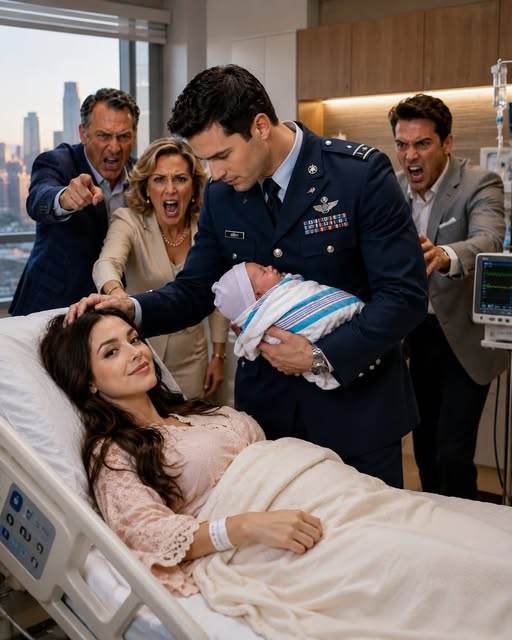
The hospital room fell into a silence so complete that I could hear Noah breathing against my husband’s chest.
My father continued staring at the military identification card on the table.
MAJOR GENERAL EMILY CARTER.
His lips moved, but no sound came out.
My mother looked from the card to the officers standing at attention, then finally to me.
“This is impossible,” she whispered.
I adjusted the blanket over my legs.
“No. It was classified.”
Colonel Daniel Carter, my husband, held Noah carefully in one arm and stepped closer to the bed.
“You were told Emily worked for the government,” he said. “That was the truth.”
My father shook his head.
“You expect me to believe she is a general?”
The deputy director of the hospital answered before I could.
“Major General Carter oversees military medical logistics and emergency response operations across several commands.”
He paused.
“She is also the senior authority responsible for this facility’s strategic readiness program.”
My mother’s face lost what little color remained.
“You run this hospital?”
“I supervise the command structure connected to it,” I replied.
“But you never said anything.”
“You never asked what I did.”
“That is not true.”
I looked at her.
“You asked whether I had found a real job.”
She flinched.
My father finally pulled his attention away from my identification.
“What about the company?”
There it was.
Not an apology.
Not concern for the baby he had refused to hold.
The company.
His eyes dropped toward the folder containing the share-transfer documents.
“You still own twelve percent,” he said.
“Yes.”
“And you must sign those shares over to Brandon.”
“No.”
His jaw tightened.
“This family business was built by your grandfather.”
“And Brandon has been stealing from it.”
My mother gave a dismissive laugh.
“We are not discussing those ridiculous accusations again.”
The military attorney nearest the door opened his briefcase.
“Actually, we are.”
He removed several sealed documents and placed them beside my identification card.
My father’s expression changed.
“What is that?”
“A preservation order,” the attorney replied. “A federal court has authorized the seizure of company records connected to fraudulent government contracts.”
My mother gripped the back of a chair.
“Federal court?”
The second attorney stepped forward.
“The construction company has received more than eighty million dollars in military infrastructure contracts during the past six years.”
My father looked at me.
“You investigated your own family?”
“No.”
I held his gaze.
“I reported evidence of financial crimes. Independent investigators decided what happened next.”
Colonel Carter’s voice became colder.
“The government does not ignore fraud simply because the suspects are related to a general.”
My father picked up the first page.
His eyes moved rapidly across the text.
“This says our accounts are frozen.”
“Selected corporate accounts,” the attorney corrected.
“For how long?”
“Until investigators determine how much money was diverted through shell companies.”
My mother stepped forward.
“This is revenge.”
I almost laughed.
For two years, I had imagined this moment.
I thought I would feel triumphant when the truth finally reached them.
Instead, I felt exhausted.
“Revenge would have been destroying the evidence and letting Brandon take the entire company down.”
I looked toward the folder she had brought.
“I protected the business you accused me of trying to steal.”
The recovery-room door opened again.
This time, four federal agents entered.
The lead investigator wore a dark suit and carried another warrant.
“Mr. and Mrs. Bennett?”
My parents turned.
“I am Special Agent Marcus Reed with the Defense Criminal Investigative Service.”
My father’s voice became unsteady.
“This is a hospital. My daughter just had a baby.”
The agent glanced toward me.
“Major General Carter requested that any questioning wait until she was medically stable.”
My mother’s eyes widened.
“You arranged this?”
“I delayed it.”
I leaned back against the pillows.
“Had I not intervened, agents would have visited your home yesterday.”
The investigator continued.
“We are executing warrants related to Bennett Construction Group, Brandon Bennett, and multiple associated companies.”
My father stared at him.
“What exactly are you accusing my son of?”
“Conspiracy to defraud the United States government, wire fraud, falsification of safety certifications, money laundering, and bribery.”
My mother gasped.
“No.”
The agent remained calm.
“Mr. Brandon Bennett was taken into custody forty minutes ago.”
The pen my father had placed beside the transfer documents rolled off the table and struck the floor.
No one moved to pick it up.
My mother looked at me as if I had personally placed the handcuffs around Brandon’s wrists.
“You had your own brother arrested?”
“Brandon had himself arrested.”
“He is your family!”
“So is Noah.”
I looked toward my son.
“You rejected him before you knew anything about him.”
My voice remained quiet.
“You came into my recovery room while I was still bleeding from childbirth and tried to force me to surrender millions of dollars in ownership.”
My father opened his mouth.
I did not let him speak.
“You threatened to abandon me if I refused.”
“You were never abandoned,” he said quickly. “We were teaching you responsibility.”
Colonel Carter’s expression hardened.
“She was responsible for thousands of soldiers while you told people she filed paperwork.”
My father turned toward him.
“And who exactly are you?”
“Her husband.”
“I understand that.”
“No,” Daniel replied. “You understand my uniform. You still do not understand your daughter.”
He looked down at Noah.
“You judged this child because you assumed his father had disappeared.”
Then his eyes returned to my parents.
“I was deployed.”
My mother blinked.
“Deployed?”
“Emily’s pregnancy coincided with a classified medical assignment overseas. For security reasons, neither of us could explain my absence.”
He gently rocked Noah.
“I returned as soon as command released me.”
My mother’s voice softened immediately.
“We didn’t know.”
The same excuse.
Again.
Always.
“You did not need to know his father’s rank to treat your grandson like a human being,” I said.
She looked down.
For the first time since entering the room, shame appeared on her face.
But my father still focused on the legal documents.
“What happens to the company now?”
The attorney answered.
“The board will appoint temporary management.”
“And the shares?”
“Major General Carter’s ownership remains protected.”
My father glanced at the transfer forms he had demanded I sign.
The lead agent picked them up.
“Were you attempting to transfer her shares today?”
My mother’s head snapped up.
“That is a private family matter.”
“It may be evidence.”
She reached for the folder.
The agent moved it out of her reach.
My father’s voice rose.
“You cannot take those.”
“They were presented to a hospitalized shareholder under threat of financial and familial abandonment.”
The agent looked at me.
“General, did you consent to this transfer?”
“No.”
“Were you pressured to sign?”
“Yes.”
My father turned on me.
“Emily!”
The officers in the room stiffened.
Daniel stepped between him and the bed.
“You will lower your voice.”
For the first time in my life, my father obeyed immediately.
The investigator placed the documents inside an evidence envelope.
“We will review whether this attempted transfer was intended to conceal ownership or obstruct the investigation.”
My mother sank into the chair.
“We only wanted Brandon to control the company.”
“That is the problem,” I said.
“You wanted control to remain with him even after I showed you proof that he was stealing.”
My father shook his head.
“I thought you were jealous.”
“You always thought that.”
I studied his face.
“When I graduated first in my class, you said I wanted attention.”
“When I joined the Army, you said I was avoiding responsibility.”
“When Brandon took credit for my work, you told me to be supportive.”
“And when I found evidence that he was committing crimes, you called me bitter.”
He looked away.
My mother began crying.
“We made mistakes.”
“No.”
My voice stayed calm.
“You made choices.”
Daniel looked at me.
He knew I needed rest, but he also knew I had waited years to say these words.
I continued.
“You chose the child who reflected the life you wanted.”
“You dismissed the one who built a life you could not control.”
“You did not lose me today.”
“You lost me slowly, every time you decided that Brandon’s comfort mattered more than my truth.”
Noah stirred in Daniel’s arms.
His tiny face tightened, and a soft cry escaped him.
Immediately, I reached out.
Daniel brought him to me.
The moment Noah settled against my chest, the entire room seemed to disappear.
My mother watched us.
“May I hold him?” she asked.
The question came so quietly I almost did not hear it.
I looked at the woman who, less than twenty minutes earlier, had said she would never acknowledge him.
“No.”
Her tears fell faster.
“Emily, please.”
“You do not get to reject a child and then change your mind because his parents have impressive titles.”
“I was angry.”
“At a newborn?”
She covered her mouth.
My father stepped closer, but the federal agent blocked him.
“We are still family,” he said.
I looked up.
“Biology is not permission.”
His face hardened briefly, then collapsed.
For once, he had no power in the room.
No employee to intimidate.
No family reputation to protect him.
No golden son standing beside him.
Only evidence.
Witnesses.
And the daughter he had spent years underestimating.
The federal agents asked my parents to accompany them for formal interviews.
My mother looked back several times as she left.
My father did not.
He kept his eyes fixed on the floor.
The door closed behind them.
Every officer except Daniel and the deputy director left shortly afterward.
The room became quiet again.
Daniel sat beside me.
“Are you all right?”
“No.”
He took my hand.
“But I will be.”
For the first time that day, I allowed myself to cry.
Not because my parents had rejected Noah.
Not because they had tried to take my shares.
I cried because some part of me had still hoped that seeing my son would change them.
I had imagined my mother looking into his eyes and forgetting every cruel judgment she had made.
I had imagined my father holding his grandson and finally understanding that family was more than inheritance and control.
But truth did not always transform people instantly.
Sometimes it simply removed their ability to keep lying.
The investigation into Bennett Construction lasted nearly a year.
Brandon had created seven shell companies and diverted more than twenty-three million dollars through false invoices.
He approved substandard materials for military housing projects and paid inspectors to overlook safety failures.
The evidence I preserved became central to the prosecution.
My father was not charged with participating directly in the theft, but investigators proved he had ignored repeated warnings and destroyed one internal audit.
He lost his position as chief executive.
My mother had used family accounts to cover several of Brandon’s debts. She claimed she did not know where the money went, but the court ordered the recovery of assets purchased with stolen funds.
The company entered federal oversight.
Because I still owned twelve percent and had documented the fraud before the investigation began, the board asked me to become interim chair.
I refused.
I had no interest in controlling the empire my parents used to measure everyone’s worth.
Instead, I appointed an independent restructuring team and required the company to repay every stolen dollar.
Unsafe military housing was rebuilt at no cost to the families living there.
Employees who had been fired for questioning Brandon were rehired with compensation.
Brandon pleaded guilty after his financial manager agreed to testify.
He received fourteen years in federal prison.
At sentencing, he looked toward me.
“You always wanted everything I had,” he said.
I shook my head.
“I wanted you to stop taking what belonged to everyone else.”
My father sat behind him in the courtroom.
He looked twenty years older.
Afterward, he approached me outside.
“I should have believed you.”
“Yes.”
“I was trying to protect the family.”
“You were protecting Brandon.”
He lowered his head.
“I don’t know how to fix this.”
“You can begin by admitting that some things cannot be fixed.”
He looked toward Daniel, who stood several feet away holding Noah.
Our son was almost one year old.
Healthy.
Curious.
Unaware that the people nearby had once debated whether he deserved to belong.
“Will you ever let us meet him?” my father asked.
“Not now.”
“Never?”
“I don’t know.”
He nodded slowly.
For the first time, he accepted an answer he did not control.
My mother wrote letters every month.
At first, every letter contained an excuse.
She blamed fear.
Tradition.
Brandon.
My father.
Eventually, the excuses stopped.
She began writing about what she had done instead of why she believed she had done it.
I did not answer for almost two years.
Then, one afternoon, I sent a single photograph.
Noah standing in the backyard wearing Daniel’s oversized military cap.
No address.
No invitation.
Just proof that he was growing without them.
My mother replied with four words:
Thank you for showing me.
That was the first message from her that asked for nothing.
Years passed before I allowed supervised visits.
Not because my parents suddenly deserved forgiveness.
Because they had spent years in counseling, made financial restitution, and learned that access to Noah was a privilege controlled by his safety.
The first time my mother finally held him, he was four years old.
She cried.
Noah looked confused and patted her cheek.
“Why are you sad?”
She swallowed.
“Because I should have loved you sooner.”
He did not understand.
Children should not have to carry the full weight of adult failures.
I never told him the cruel words she spoke on the day he was born.
That truth belonged to me, not to him.
As for my career, I remained in command for another six years.
Then I accepted a national position overseeing military family health and hospital readiness.
Daniel became director of a trauma research program.
We raised Noah far from the expectations that had shaped my childhood.
He was never told he had to become extraordinary to earn affection.
He did not need medals.
Rank.
Money.
Or ownership.
He only needed to be kind, honest, and brave enough to tell the truth.
On the day I retired from active service, hundreds of officers gathered inside the same military hospital where Noah had been born.
The chief of staff presented me with my final commendation.
Daniel stood in the front row.
Noah, now old enough to understand the ceremony, stood beside him.
My parents sat in the back.
Not because I had hidden them there.
Because they understood that the day was not about them.
After the ceremony, Noah ran toward me.
“Mom, were you really in charge of all those people?”
I smiled.
“Sometimes.”
He considered that carefully.
Then he asked, “Were you scared?”
“Yes.”
“Did you still do your job?”
“Yes.”
He grinned.
“Then you were brave.”
I looked across the room at my parents.
Years earlier, they believed courage looked like Brandon taking control of a company.
They believed success meant inheritance, power, and a family name engraved on buildings.
They could not understand the quiet daughter who kept secrets, gathered evidence, and refused to surrender what she had earned.
But I no longer needed them to understand.
The day Noah was born, they walked into my hospital room expecting to erase me from the company and shame me into obedience.
Instead, they discovered that the daughter they considered powerless had already protected the business, exposed the fraud, commanded the hospital, and built a family without their approval.
They rejected my son because they believed he had no father.
They rejected me because they believed I had no future.
They were wrong about both of us.
Noah had a father who crossed an ocean to hold him.
And I had never been the disappointing daughter.
I was simply the one they could not control.
By the time the truth entered that hospital room, I had already stopped needing their permission to exist.
Everything that followed—the investigation, the convictions, the recovery of the company—only made their mistake visible.
My greatest victory was not watching them lose power.
It was raising my son in a home where love was never something he had to earn.
