The execution chamber remained frozen.
No one spoke.
The clock above the observation window continued counting down as if nothing had changed.
Seven minutes remained.
Seven minutes before the state was scheduled to end my mother’s life.
The warden turned sharply toward the correctional officers.
“Remove the prisoner from the chamber.”
One of the officials hesitated.
“Sir, the warrant—”
“I said remove her.”
His voice shook the room.
My mother’s knees weakened as the guards unlocked the restraints securing her to the chair. For six years, every legal appeal had failed. Every court had rejected her claim of innocence.
Now the frightened words of an eight-year-old child had stopped the machinery of death.
Uncle Ray backed toward the door.
“This is insanity,” he said. “You’re trusting a traumatized boy over physical evidence?”
Two guards immediately blocked his path.
“You are not leaving,” the warden told him.
Ray looked at me.
“Emily, tell them.”
I stared at the man who had attended my military promotions, mailed birthday gifts during my deployments, and claimed he had protected Matthew while I served overseas.
For years, I had called him when guilt became unbearable.
He had always answered.
He had always said the same thing.
Your mother made her choice. You need to live with yours.
Now I understood why he had worked so hard to keep me from questioning the conviction.
“You threatened my brother,” I said.
Ray shook his head.
“He is confused.”
Matthew clutched my uniform with both hands.
“He came into my room after Dad died,” he whispered. “He said bad people would hurt you if I talked.”
Ray’s voice rose.
“He was two years old!”
“Three,” Matthew corrected through his tears. “I was three.”
The detail seemed to strike Ray harder than any accusation.
He had relied on Matthew being too young to remember.
But children did not always forget terror.
Sometimes they simply lacked the words to explain it.
I crouched beside my brother.
“Why didn’t you tell me before today?”
His lower lip trembled.
“Uncle Ray said you would die.”
My chest tightened.
“Did he say how?”
Matthew nodded.
“He said soldiers get hurt far away, and nobody would know he did it.”
Every officer in the room turned toward Ray.
His expression hardened.
For one brief second, the frightened uncle disappeared.
Something colder took his place.
“You have no idea what your father was involved in,” he said.
The warden stepped forward.
“That sounds like a statement you should make with an attorney present.”
Ray looked around the room, calculating distances.
The door.
The guards.
The observation window.
Then his hand moved inside his jacket.
I reacted before anyone else.
Years of training took over.
I pulled Matthew behind me and caught Ray’s wrist as he drew a small pistol.
The guards surged forward.
Ray struck me with his shoulder, but I twisted his arm downward and forced the weapon from his hand.
It hit the floor and slid beneath a metal chair.
Three officers drove him against the wall.
Matthew screamed.
My mother called my name from the corridor.
Within seconds, Ray was handcuffed.
His face pressed against the concrete, he looked toward me with hatred.
“You should have stayed away.”
I stood between him and my brother.
“That was your mistake.”
My voice remained calm.
“You believed distance made me weak.”
The execution was formally suspended.
My mother was returned to a secure holding cell while the district attorney requested an emergency court hearing.
I expected immediate relief.
Instead, the officials warned us that stopping an execution was not the same as overturning a conviction.
The original evidence still existed.
The weapon had been found beneath my mother’s bed.
Her robe carried my father’s blood.
Her fingerprints were on the handle.
A child’s statement and a hidden drawer might reopen the case, but we still needed to prove how everything had been staged.
The brass key became the beginning.
Investigators searched my parents’ old bedroom inside the house Ray had inherited.
The key opened a narrow steel compartment built into the back of the wardrobe.
Inside were financial ledgers, photographs, encrypted drives, and three small recording devices.
There was also a sealed letter addressed to me.
I recognized my father’s handwriting immediately.
My hands shook as I opened it.
Emily,
If you are reading this, then I was right to be afraid.
I stopped.
The room around me disappeared.
For six years, my memories of my father had been reduced to one terrible night.
His body on the kitchen floor.
My mother crying.
Ray holding me while police carried evidence from the house.
Now his voice returned through ink.
Ray has been using our family construction company to move money for men connected to city contracts. I discovered false invoices, bribed inspectors, and payments tied to unsafe public buildings.
My father explained that he planned to report everything to federal investigators.
Ray had discovered his intentions.
The local businessman in the photograph was Councilman Victor Dane, a powerful official who controlled public development contracts throughout the county.
My father believed Dane and Ray had diverted millions from school and hospital construction projects.
Several buildings had been completed with substandard materials.
If exposed, the scandal would destroy careers, companies, and political futures.
The letter continued:
Your mother knows only that I am frightened. I kept the details from her to protect her. If something happens to me, do not trust the evidence that appears too easily.
My vision blurred.
The murder weapon had appeared too easily.
The bloodstained robe had been sitting in plain sight.
Ray had guided the police directly to both.
I read the final paragraph.
You have always believed strength means standing alone. It does not. Trust your mother. Protect Matthew. And remember that the truth sometimes survives only because one person refuses to stop looking.
I folded the letter against my chest.
My father had trusted me.
But when the time came, I had trusted Ray instead.
The guilt nearly crushed me.
Then my mother’s attorney placed a hand on my shoulder.
“Regret can wait,” she said. “Right now, we need evidence.”
The first breakthrough came from the recordings.
One device contained my father’s final conversation with Ray.
The voices were faint, but unmistakable.
My father accused him of falsifying contracts and endangering lives.
Ray ordered him to destroy the files.
My father refused.
Then another voice entered the room.
Councilman Dane.
He told my father that men who confused morality with courage often left their families unprotected.
The recording ended before the murder.
But it proved Ray had lied during the original investigation.
He had testified under oath that he had not visited our home that night.
The second breakthrough came from the bloodstained robe.
Modern testing revealed that most of the blood had not soaked naturally into the fabric.
It had been transferred after beginning to clot.
Someone had pressed the robe against my father’s body after he was already dead.
The third breakthrough was the knife.
A new examination found trace material inside the handle where the original investigators had never tested.
The DNA did not belong to my mother.
It belonged to Ray.
My mother’s fingerprints had been placed on the outside because the knife came from our kitchen.
She had used it dozens of times before.
The prosecution had presented that fact as proof of guilt.
In reality, it meant almost nothing.
Within forty-eight hours, the governor issued a temporary reprieve.
A judge ordered an evidentiary hearing.
Ray remained in custody for threatening Matthew and attempting to draw a weapon inside the prison.
Councilman Dane publicly denied knowing anything about the murder.
He called my father’s recordings fabricated.
Then federal investigators searched his office.
They found copies of the same fraudulent contracts hidden inside a private safe.
One document listed payments made to Ray two days after my father’s death.
The amount was exactly equal to the remaining mortgage on our family home.
Ray had not inherited the house because my father wanted him to have it.
He had taken it as payment.
At the hearing, the courtroom was packed.
Reporters filled every bench.
My mother entered wearing prison clothing and shackles.
She looked thinner than she had on execution morning.
But for the first time in six years, hope existed in her eyes.
I sat behind her with Matthew beside me.
Ray entered through another door wearing an orange jail uniform.
He avoided looking at us.
The state’s original prosecutor testified first.
He admitted that Ray had repeatedly contacted investigators and directed them toward my mother.
He described her as jealous, unstable, and angry about my father’s work.
None of those claims had been independently verified.
The defense then presented the new DNA analysis, the audio recordings, and my father’s letter.
Finally, Matthew testified by video from a private room.
A child psychologist sat beside him.
He held his stuffed bear in his lap.
The attorney spoke gently.
“Matthew, do you remember the night your father died?”
“Yes.”
“Did you see Uncle Ray?”
Matthew nodded.
“He came out of Mom’s room.”
“What was he carrying?”
“A knife and her robe.”
The courtroom became completely still.
“What did he do?”
“He put the knife under the bed.”
“Did he say anything to you?”
Matthew’s hands tightened around the bear.
“He said Mom was going away and Emily would die if I told.”
Ray suddenly stood.
“He is lying!”
The judge struck the bench with her gavel.
“Sit down.”
Ray ignored his attorney.
“He doesn’t remember anything! Emily taught him what to say!”
I rose before I realized I was moving.
“No one taught him to fear you.”
The judge ordered me to sit.
Ray was restrained by deputies.
Matthew began crying on the screen.
My mother twisted in her chair, desperate to reach him.
The judge called a recess.
When court resumed, Ray’s former accountant entered the room.
She had contacted investigators after seeing news of the halted execution.
For years, she had kept copies of private ledgers because she feared Ray would eventually blame her for his crimes.
Those records showed payments to two police officers involved in the original case.
One officer had altered the crime-scene timeline.
The other had removed security footage from a neighboring house showing Ray’s vehicle arriving before my father’s death.
Both men were arrested that afternoon.
Councilman Dane was taken into custody the following morning.
The conspiracy was no longer a theory.
It was a structure.
Ray arranged the murder.
Dane financed the cover-up.
Corrupt officers manipulated the investigation.
And my mother became the perfect suspect because every piece of planted evidence pointed toward the grieving wife.
At the end of the hearing, the judge looked toward my mother.
“The state’s case was not merely unreliable,” she said. “It was corrupted at its foundation.”
My mother gripped the edge of the table.
The judge continued.
“This court vacates the conviction of Sarah Bennett and orders her immediate release.”
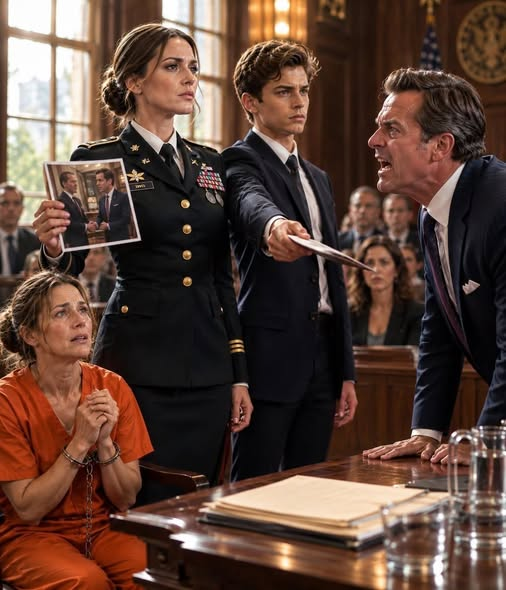
For several seconds, no one moved.
Then my mother covered her face.
I was across the courtroom before anyone could stop me.
The deputies removed her restraints.
I wrapped my arms around her.
“Mom.”
She held me so tightly I could barely breathe.
“I knew you would come back,” she whispered.
Her forgiveness hurt more than anger would have.
“I stopped believing you.”
“You were seventeen.”
“I should have answered your letters.”
“You are here now.”
Matthew ran toward us.
The three of us collapsed into each other in the center of the courtroom while cameras flashed from the gallery.
My mother had spent six years waiting for someone to believe her.
When freedom finally arrived, she did not ask for revenge.
She asked whether Matthew had eaten breakfast.
That was who she had always been.
Ray’s trial began six months later.
The evidence established that he entered our home after learning my father intended to meet federal investigators the next morning.
He confronted him in the kitchen.
When my father refused to surrender the files, Ray killed him.
Dane helped plan the cover-up.
Ray planted the weapon beneath my mother’s bed and used her robe to create false evidence.
He called the police, acted devastated, and guided investigators toward the exact story he wanted them to believe.
Then he threatened Matthew and spent years shaping my memories.
Ray was convicted of murder, conspiracy, witness intimidation, attempted assault, and multiple financial crimes.
He received life in prison without parole.
Councilman Dane received forty-three years.
The corrupt officers were also convicted.
But no sentence could return the six years stolen from my mother.
The state issued a formal apology and awarded her compensation for wrongful imprisonment.
She used most of the money to establish the Sarah Bennett Innocence Foundation, which helped families obtain independent forensic reviews in questionable convictions.
At first, I tried to manage everything for her.
Housing.
Doctors.
Security.
Legal meetings.
I approached her freedom like a military operation.
One evening, she took my hands and said, “Emily, I survived six years of people controlling every minute of my life. Please don’t love me by controlling the rest.”
I immediately understood.
She did not need a commander.
She needed a daughter.
So I learned to sit with her.
To listen when she woke from nightmares.
To let silence exist without trying to repair it.
To accept that freedom did not erase fear.
Matthew also began therapy.
For years, he had carried a secret no child should have been forced to keep.
He believed our father died because he failed to speak.
My mother told him the truth again and again.
“The guilt belongs to the person who threatened you.”
Eventually, he began believing her.
My own healing came more slowly.
The Army had taught me to assess evidence, identify threats, and protect those under my command.
Yet I had failed to question the case against my mother.
I considered resigning.
My commanding general refused to accept the paperwork.
“You were a child when this began,” he said.
“I abandoned her.”
“You believed a system designed to appear certain.”
“I should have known.”
“No one earns wisdom by pretending they were never deceived.”
He placed the resignation back on my desk.
“Use what happened.”
So I did.
I joined a military justice reform task force focused on evidence preservation, investigative bias, and wrongful convictions involving service members and their families.
For the first time, my rank felt connected to something more personal than achievement.
Three years after my mother’s release, we returned to the prison.
Not for an execution.
For a hearing on reforms to death-penalty procedures.
My mother stood before lawmakers and spoke without notes.
She described the sound of guards preparing the chamber.
The final meal she could not eat.
The moment she said goodbye to her children.
Then she looked directly at the committee.
“If my son had waited seven more minutes to speak, I would be dead.”
No one interrupted.
“No justice system should depend on a frightened child finding courage at the final moment.”
Her testimony led to new requirements for independent review when previously undisclosed evidence emerged in capital cases.
It could not change what happened to her.
But it could protect someone else.
After the hearing, we walked outside together.
Matthew, now eleven, ran ahead toward the car.
My mother watched him with a smile.
“He looks like your father when he runs.”
I swallowed.
“I’m sorry, Mom.”
She looked at me.
I had apologized hundreds of times.
But the words still came.
“I should have believed you.”
She touched my cheek.
“And I wish I had seen what Ray was sooner.”
“That wasn’t your fault.”
“Then perhaps one day you will understand the same is true for you.”
I looked toward the prison walls.
For years, I believed my greatest shame was that my mother had been sentenced to death.
Then I believed it was that I had doubted her.
Eventually, I understood shame belonged elsewhere.
It belonged to Ray.
To Dane.
To the officers who sold the truth.
To every person who saw uncertainty and buried it because certainty was more convenient.
My mother never asked me to pretend I had not failed her.
She asked me to stop letting that failure decide the rest of my life.
On the anniversary of her release, we visited my father’s grave.
Matthew placed his stuffed bear beside the headstone for a moment before picking it up again.
My mother laid down white flowers.
I placed my father’s letter beneath a small stone.
Then we stood together in silence.
Six years earlier, my family had been destroyed by one man’s greed and another system’s refusal to question an easy answer.
But we were still there.
Not unchanged.
Not completely healed.
Still together.
My mother had been minutes from execution when Matthew spoke seven words:
“I know who hid the knife.”
Those words stopped the clock.
They reopened the case.
They brought down a network of corruption.
But the truth did something even greater.
It gave us the chance to become a family again.
Not the family we had been before my father died.
That family was gone.
We became something more honest.
A mother who survived.
A son who finally spoke.
And a daughter who learned that defending justice meant more than wearing a uniform.
It meant having the courage to question what everyone else had already decided was true.
