The military police locked the glass doors.
The metallic click echoed through the visitor center.
Every soldier in the lobby stopped moving.
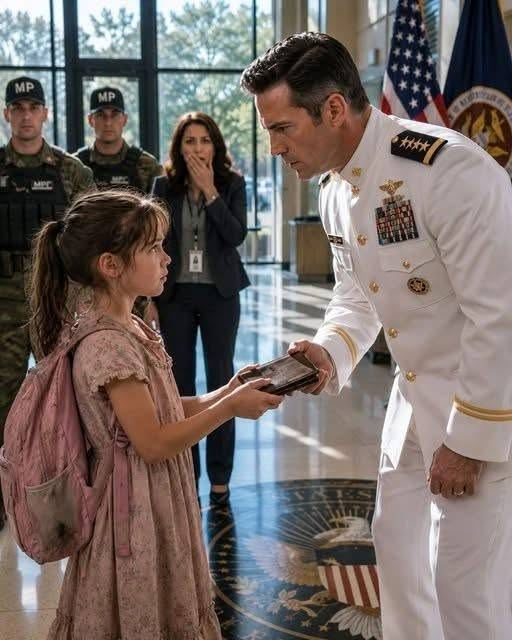
I stood beneath the enormous Army seal, clutching General Graves’s wallet against my chest, certain I had done something wrong.
The receptionist who had threatened to call security suddenly looked frightened.
General Nathaniel Graves walked toward me slowly.
His eyes were not on the wallet anymore.
They were fixed on the pink notice sticking out of my backpack.
“May I see that paper?” he asked.
I pulled the eviction notice free and handed it to him.
His hands began to shake before he even finished reading.
The notice was addressed to my mother:
ELENA MORGAN
1427 ALDRIDGE STREET
FINAL EVICTION ORDER
General Graves stared at her name.
“Elena Morgan,” he whispered.
“Is that your mother?”
I nodded.
“Yes, sir.”
“How old are you?”
“Eight.”
He closed his eyes.
When he opened them again, they were wet.
“What is your full name?”
“Ruby Elena Morgan.”
The wallet slipped from my hands and landed on the polished floor.
No one moved to pick it up.
The general crouched in front of me.
“Ruby, what is your birthday?”
“November seventeenth.”
His face turned even paler.
The senior military police officer stepped closer.
“General, is something wrong?”
Nathaniel did not answer immediately.
Instead, he reached inside his uniform jacket and removed a worn photograph.
It showed a young woman standing beside him near a military hospital.
She had long dark hair, tired eyes, and the same small dimple I saw whenever my mother smiled.
It was Mom.
I pointed at the picture.
“That’s her.”
The general’s breath broke.
Behind them stood another soldier.
Younger than General Graves.
He wore a captain’s uniform and had one hand resting protectively on my mother’s shoulder.
His name was stitched above his pocket.
MORGAN.
I looked up.
“Who is that man?”
General Graves swallowed.
“His name was Captain Daniel Morgan.”
He paused.
“He was my son.”
The lobby became silent.
I looked at the photograph again.
My mother had always told me my father died before I was born.
She never said his name.
Whenever I asked, she became quiet and told me some memories hurt too much to carry into the light.
I studied the captain’s face.
He had my dark eyes.
My crooked smile.
Even the slight tilt of his head looked familiar.
“Was he my father?” I asked.
The general covered his mouth.
“Yes.”
The answer was barely audible.
“Daniel was your father.”
I did not understand everything those words meant.
But I understood enough to know that the powerful general kneeling before me was my grandfather.
He reached toward me, then stopped before touching my shoulder.
“Does your mother know you came here?”
“No, sir.”
“She thinks I’m at school.”
“Why weren’t you at school?”
I looked down.
“We had to leave our apartment this morning.”
The general unfolded the eviction notice again.
“Where is your mother now?”
“At the laundromat. She’s trying to call shelters.”
His jaw tightened.
“Why didn’t she contact me?”
“I don’t think she knows you.”
Pain moved across his face.
“She knew me.”
He stood and turned toward one of his aides.
“Prepare a vehicle.”
Then he looked at the military police.
“No one discusses what happened here until I understand the situation.”
The receptionist nervously stepped forward.
“General, I was only following procedure.”
Nathaniel looked at her.
“Procedure does not require threatening a hungry child who is trying to return property.”
Her face reddened.
“I’m sorry, sir.”
He picked up the wallet and counted the money.
Every dollar was still there.
“You spent your lunch money to bring this to me, didn’t you?”
I nodded.
“How much do you have left?”
I opened my palm.
Two coins.
He stared at them for several seconds.
Then he looked toward the officers around us.
“This child carried nine hundred dollars across the city while her family faced eviction.”
His voice became firm.
“She returned every cent.”
Several soldiers lowered their eyes.
The general turned back to me.
“You are not in trouble, Ruby.”
“Then why did you lock the doors?”
“Because the paper in your backpack told me someone had hidden something from both of us.”
He led me to a private conference room while his staff located my mother.
A woman brought me a sandwich, juice, and fruit.
I ate too quickly and became embarrassed.
General Graves pretended not to notice.
He sat across from me with the photograph on the table.
“Did your mother ever tell you about Captain Morgan?”
“Only that my dad was brave.”
“He was.”
“Did he die in a war?”
Nathaniel looked toward the window.
“No.”
His answer came carefully.
“He died here, twelve years ago.”
“But I’m eight.”
“I know.”
He touched the edge of the photograph.
“Your parents knew each other before his death. Your mother was very young when she discovered she was pregnant.”
That did not make sense.
“Then why didn’t she tell you about me?”
“I don’t know.”
The door opened before he could say more.
My mother rushed inside.
Her hair was wet from the rain, and she wore the same faded green coat she had owned for years.
“Ruby!”
She ran toward me and pulled me into her arms.
“What happened? The school said you never arrived.”
“I found a wallet.”
“You crossed the city alone?”
Her hands moved over my face and shoulders, checking for injuries.
Then she saw General Graves.
All the color disappeared from her face.
Nathaniel stood.
“Elena.”
Mom immediately moved between us.
“Stay away from my daughter.”
The general’s expression tightened.
“She is my granddaughter.”
“You lost the right to use that word.”
I looked from one to the other.
“Mom, you know him?”
She closed her eyes.
“Yes.”
“Why didn’t you tell me?”
Her face crumpled.
“Because I wanted you safe.”
General Graves stepped forward.
“Safe from me?”
“From your family.”
His voice became colder.
“What does that mean?”
Mom looked toward the officers near the door.
“This is not a conversation for an audience.”
The general dismissed everyone except a military attorney named Colonel Rebecca Shaw.
Mom refused to sit.
She kept one hand on my shoulder as though someone might take me away.
Nathaniel placed the old photograph in front of her.
“I believed you left after Daniel died.”
“I did.”
“You disappeared.”
“I was forced out.”
The general stared at her.
“By whom?”
“Your wife.”
His expression changed.
My mother continued.
“Twelve years ago, Margaret Graves came to the hospital after Daniel’s death.”
Nathaniel slowly sat down.
“She told me you blamed me for the accident.”
“I never said that.”
“I know that now.”
Her voice trembled.
“But I was nineteen years old. Daniel was dead, and your wife arrived with attorneys, military officials, and documents.”
“What documents?”
“She said Daniel had been transporting classified information when his vehicle crashed.”
Colonel Shaw looked sharply toward the general.
Nathaniel frowned.
“That was never true.”
Mom opened her worn handbag and removed a folded envelope.
“I kept this.”
The paper was old and creased.
At the top was the official seal of the United States Army.
It stated that Elena Morgan was prohibited from contacting the Graves family because she posed a security risk connected to Captain Daniel Morgan’s death.
Nathaniel read the letter.
His face hardened.
“This signature is forged.”
Colonel Shaw examined it.
“The authorization number is also invalid.”
Mom gave a bitter laugh.
“I didn’t know that.”
“She threatened you with this?”
“She said if I contacted you, I would be arrested.”
Nathaniel’s hands curled into fists.
“Why would Margaret do that?”
“Because I was pregnant.”
The room went still.
My mother looked down at me.
“I had just discovered it.”
Nathaniel stared at her.
“She knew about Ruby?”
“Yes.”
“And she never told me.”
“No.”
Mom sat beside me.
“Margaret said Daniel had embarrassed the family by planning to marry someone like me.”
Nathaniel’s voice shook.
“He had already bought a ring.”
Mom looked surprised.
“I never knew.”
“He intended to propose the weekend he died.”
For the first time, my mother began crying.
She covered her face, but the tears continued falling.
“Twelve years,” she whispered.
Nathaniel looked older than he had in the lobby.
“What else did Margaret do?”
“She gave me five thousand dollars and a bus ticket.”
Mom’s voice became harder.
“She told me to disappear.”
“Did you take it?”
“Yes.”
The general looked hurt.
My mother lifted her chin.
“I was pregnant, terrified, and had nowhere to sleep. I used the money for rent and medical care.”
“You should have come to me.”
“I believed you hated me.”
“I searched for you.”
She stared at him.
“No one ever came.”
Nathaniel looked toward Colonel Shaw.
“Open an investigation into the letter, the hospital records, and every payment made from my family accounts after Daniel’s death.”
The attorney nodded.
Mom immediately stood.
“No.”
The general looked at her.
“No investigation?”
“No turning Ruby into a military scandal.”
“This concerns my son’s death.”
“It concerns my daughter’s life.”
I gripped Mom’s hand.
The adults were speaking about me as if I were a secret file instead of a person.
I pulled on her sleeve.
“Why did Dad die?”
My mother became silent.
General Graves answered.
“His car went off a bridge during a storm.”
“Was it an accident?”
He looked toward the forged document.
“I always believed it was.”
The investigation began that afternoon.
General Graves arranged a hotel room for us, but Mom refused anything luxurious.
She accepted only temporary military family housing because we had nowhere else to go.
She also made him sign a document stating that accepting help did not give him custody rights over me.
Nathaniel signed without arguing.
Over the next several weeks, investigators reconstructed the final days of Captain Daniel Morgan’s life.
The official report said he had been driving too fast during severe weather.
But the recovered maintenance records told another story.
His military vehicle had been serviced two days before the crash.
The brake line had been replaced.
The mechanic who signed the inspection had disappeared shortly afterward.
Colonel Shaw found him living under another name in Nevada.
When questioned, he admitted someone had paid him to damage the replacement line.
The payment came from a private account controlled by Margaret Graves.
My grandmother.
I had never met her.
General Graves had divorced her five years earlier after discovering she had secretly sold family property and hidden the money.
He believed financial dishonesty was the worst thing she had done.
He was wrong.
Margaret was arrested at her home in Virginia.
At first, she denied everything.
Then investigators showed her the bank transfer, the forged letter, and the mechanic’s statement.
She blamed Daniel.
She claimed he planned to marry beneath the family’s status and ruin Nathaniel’s reputation.
General Graves listened to the recorded interrogation with a face like stone.
“My son died because she wanted to protect our name,” he said.
Mom shook her head.
“No. He died because she wanted control.”
There was one final secret.
Daniel had discovered Margaret was stealing money from a charitable fund established for military families.
He planned to report her.
The fund had lost more than two million dollars.
She arranged the crash before he could expose her.
Afterward, she sent my mother away and created the false security document to ensure no one discovered Daniel had left behind a child.
If Mom returned with me, questions about Daniel’s final days might reopen the investigation.
Margaret had not erased us because she was ashamed.
She erased us because we were evidence.
Her trial took place ten months later.
The courtroom was filled with reporters.
I sat between Mom and General Graves.
Margaret looked at me only once.
There was no love in her expression.
Only resentment.
The prosecutor presented the damaged brake records, financial transfers, forged military letter, and stolen charity money.
The mechanic testified that Margaret paid him to make Daniel’s vehicle appear safe while ensuring the brakes would eventually fail.
She was convicted of murder, fraud, forgery, and witness intimidation.
The judge sentenced her to life in prison.
Afterward, General Graves stood alone outside the courthouse.
Mom approached him carefully.
“You didn’t know.”
“I should have.”
“You trusted your wife.”
“And doubted a frightened young woman I barely tried to find.”
He looked toward me.
“My granddaughter grew up hungry because I failed to question an easy story.”
Mom’s expression softened slightly.
“You cannot change those years.”
“No.”
He nodded.
“But I can take responsibility for what happens next.”
He did not ask us to move into his mansion.
He did not attempt to buy my affection.
He began with small things.
He drove me to school.
He learned that I hated peas but loved strawberries.
He attended parent-teacher meetings only when Mom invited him.
He listened when I talked about books, cartoons, and the girl who kept stealing my pencils.
The first birthday gift he gave me was not expensive.
It was a new pink backpack.
Inside was the same amount of money I had returned in his wallet.
Nine hundred dollars.
But the money was deposited into a savings account under my name.
Attached was a note:
Honesty should never make you hungry.
Mom found steady work with the military family-support office after completing a professional training program.
She refused direct payments from Nathaniel, but she accepted the money recovered from Daniel’s estate.
General Graves also repaid every dollar Margaret had stolen from the military charity, using his personal assets.
Then he created the Captain Daniel Morgan Family Integrity Fund.
It provided emergency housing to military families facing eviction.
The pink notice that had been sticking out of my backpack became the fund’s symbol.
Not because poverty was shameful.
Because no child should have to choose between honesty and survival.
Three years later, I stood beside General Graves at a ceremony opening the fund’s first housing center.
Mom was in the front row.
Nathaniel handed me the microphone.
I was eleven then.
Still nervous in front of crowds.
I looked at the soldiers, families, and children gathered beneath the large white tent.
“When I found my grandfather’s wallet,” I said, “I almost kept the money.”
The crowd became quiet.
“My family needed it.”
I glanced at Mom.
“But she taught me that doing the right thing matters when nobody is watching.”
Then I looked at General Graves.
“I thought returning it was only about giving back money.”
“It wasn’t.”
“It gave my family back the truth.”
Nathaniel lowered his head.
After the ceremony, he walked with me toward the parking lot.
“Ruby,” he said, “there is something I want you to have.”
He handed me the old photograph of my parents standing beside him.
It had been restored and placed inside a silver frame.
On the back, he had written:
Your father was brave. Your mother was braver.
I held the frame against my chest.
“Do you think Dad would like me?”
Nathaniel stopped walking.
“He would be proud of you.”
“How do you know?”
“Because you did something difficult when no one could have blamed you for choosing otherwise.”
He smiled.
“That is the kind of courage he respected most.”
Years later, people still told the story of the little girl who returned a general’s wallet.
They focused on the money.
The military base.
The locked doors.
The powerful officer who discovered he had a granddaughter.
But the wallet was never the most important thing I carried into Fort Aldridge.
The pink eviction notice was.
That small piece of paper exposed a forged military order, a stolen charity, a murdered captain, and a child deliberately erased from her own family history.
My grandmother had spent twelve years believing the truth was buried with my father.
She did not expect an eight-year-old girl in worn sneakers to walk through the gates carrying the one name she could not erase.
Morgan.
I had gone to the base believing I was returning something that belonged to General Graves.
Instead, he gave something back to me.
My father’s name.
My family’s history.
And the truth about why my mother had spent twelve years running from people she thought could destroy us.
I returned nine hundred dollars that day.
What I received in return could not be counted.
A grandfather.
A future.
And proof that doing the right thing may not solve every problem immediately.
But sometimes, it opens the door to a truth powerful enough to change everything.
