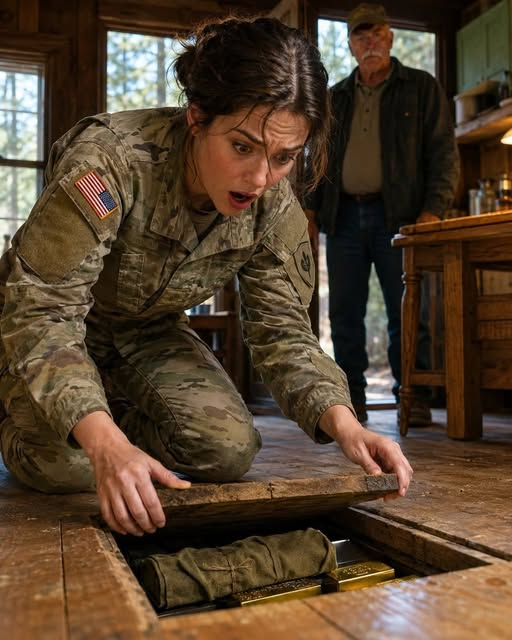
The oilcloth bundle was heavier than I expected.
I lifted it carefully from the narrow compartment beneath the floor and placed it on the kitchen table.
For several seconds, I only stared at it.
Outside, wind moved through the Ozark pines.
Inside, the cabin seemed to hold its breath.
I unwrapped the first layer.
Then the second.
Metal appeared underneath.
Not gold.
Not jewelry.
A steel document case.
Military grade.
The kind designed to survive fire, water, and rough handling.
My pulse quickened.
There was a small brass combination lock on the front.
Taped beneath it was a folded piece of paper.
My name was written across it.
EMILY.
I opened the note.
The handwriting was unmistakably my father’s.
If Madison is standing beside you, close this box and walk away.
Despite everything, I almost laughed.
Dad had known us too well.
I unfolded the rest.
If you are alone, use the date you first came home in uniform.
I knew it immediately.
The day I graduated from officer training.
The day Dad stood in the rain outside the ceremony because he had arrived late but refused to miss the salute.
I entered the numbers.
The lock opened.
Inside were four leather folders.
A stack of old photographs.
Several deeds.
A flash drive.
And one sealed envelope marked:
READ THIS LAST.
I opened the first folder.
The title made me sit down.
ADELAIDE CARTER LAND TRUST
My grandmother’s name.
I turned the page.
Then another.
The cabin did not sit on two hundred ordinary acres.
The land had been held inside a family trust for nearly eighty years.
And my father had never truly owned it outright.
He had been trustee.
I was the new trustee and sole beneficiary.
I read faster.
The trust included timber rights.
Water rights.
Mineral rights.
Access rights to a mountain corridor.
And ownership stakes in several parcels extending far beyond what appeared on the inheritance summary.
The appraised value on the most recent report was not half a million.
Not one million.
It was more than forty-eight million dollars.
My hands went cold.
I checked the date.
The valuation had been completed seven months earlier.
Dad had known.
Madison had laughed because she believed she inherited the better property.
She had no idea the “worthless” mountain land was worth more than ten times her Nashville apartment.
But money was not the real secret.
The second folder was labeled:
FAMILY HISTORY
Inside were birth certificates, military records, letters, photographs, and newspaper clippings dating back generations.
Adelaide Carter had not been simply my father’s grandmother.
She had been the founder of a regional timber company that eventually supplied construction materials to military installations across several states.
During World War II, she converted part of the property into a rehabilitation retreat for wounded service members.
Later, she created scholarships for military families.
My father had inherited stewardship of the trust at twenty-eight.
He had never told us.
A handwritten note explained why.
I wanted my daughters to grow up without knowing they were heirs. Money reveals character most clearly when people believe none is coming.
I stared at the sentence for a long time.
Then I thought about Madison.
Her insults.
Her obsession with the Nashville apartment.
Her insistence that she should “manage” my land.
Dad had not divided the inheritance carelessly.
He had tested us.
The third folder changed everything again.
It was labeled:
NASHVILLE PROPERTY — FINANCIAL DISCLOSURES
I opened it.
The apartment Madison inherited was indeed worth several million dollars.
But it was not debt-free.
There were liens.
Tax obligations.
A private loan.
And a balloon payment due in eight months.
My father had purchased it years earlier as part of an investment partnership.
The property’s market value looked spectacular.
Its net equity was far smaller.
And attached to the inheritance was responsibility for the outstanding debt.
Dad had written another note:
Madison always wanted the appearance of wealth. I hope responsibility teaches her what appearances cost.
I leaned back.
This was not revenge.
Dad had not left her nothing.
Even after the debt, the apartment still held significant value.
But she would need discipline to keep it.
She would have to budget.
Work.
Make decisions.
For once, no one could rescue her without consequence.
Then I opened the fourth folder.
My stomach tightened.
The label read:
CARTER FAMILY HOLDINGS — INTERNAL REVIEW
Inside were bank statements.
Corporate records.
Contracts.
Transfers.
Madison’s name appeared repeatedly.
So did my mother’s.
For three years, Madison had been withdrawing money from accounts connected to Dad’s businesses.
At first, the amounts were small.
Then larger.
Twenty thousand.
Fifty thousand.
One hundred thousand.
Some transfers were marked as “consulting expenses.”
Others went through a company I had never heard of.
MHC Lifestyle Management.
The registered owner was Madison.
But the mailing address belonged to my mother.
I kept reading.
Designer purchases.
Luxury vacations.
Private club fees.
A vehicle lease.
All paid indirectly from accounts Dad controlled.
He had discovered it eighteen months before his death.
Why had he not confronted them?
The answer was clipped to the final page.
Emily, if you are reading this, I waited because I needed to know whether your mother was being manipulated or participating willingly. I have my answer.
A USB drive rested inside the folder.
I inserted it into my laptop.
There were recordings.
The first was my father speaking with Madison.
His voice sounded tired.
“You took eighty thousand dollars without authorization.”
Madison laughed.
“It’s family money.”
“It is company money.”
“Same difference.”
“No.”
“Dad, Emily doesn’t need anything. She has the Army. I’m the one who stayed.”
“You stayed near the accounts.”
Silence.
Then Madison’s voice hardened.
“You owe me.”
“For what?”
“For choosing her.”
Dad replied quietly.
“I never chose Emily over you.”
“Yes, you did. You always respected her more.”
“She earned my respect.”
The recording ended.
I played the next one.
My mother’s voice.
“Just let Madison have the Nashville property and be done with it.”
Dad answered.
“She has already taken enough.”
“She needs stability.”
“She needs consequences.”
“You know she can’t handle pressure like Emily.”
“That is because everyone keeps removing pressure before she learns.”
My mother sighed.
“Emily is strong.”
Dad’s response came immediately.
“That does not make her disposable.”
I stopped the recording.
For years, that had been the pattern.
Madison needed help because she was fragile.
Emily could handle disappointment because she was strong.
Dad had seen it.
I had not realized how clearly.
There was one final audio file.
Recorded a week before his death.
His voice was weaker.
“If you are hearing this, Emily, then I probably ran out of time.”
I froze.
“I need you to understand something.”
The cabin creaked around me.
“I did not leave you the mountains because you loved them more.”
“I left them to you because stewardship is different from ownership.”
“Madison wants things.”
“You protect them.”
“You understand that value is not the same as price.”
My eyes blurred.
“I also know this gift may make your mother and sister angry.”
“Do not let guilt make you surrender it.”
“This land does not belong only to you.”
“It belongs to the families whose scholarships it funds.”
“The veterans who use the retreat.”
“The workers whose livelihoods depend on the timber leases.”
“And the generations after you.”
I covered my mouth.
There was a retreat?
Scholarships?
I searched the documents again.
There it was.
A trust distribution schedule.
Every year, income from the land funded dozens of military-family scholarships and rehabilitation programs.
Dad had hidden an entire legacy inside the mountains.
Then my phone rang.
Madison.
I stared at her name.
I almost ignored it.
Instead, I answered.
“Emily.”
Her voice was sharp.
“Where are you?”
“At the cabin.”
“Good. I need you to sign something.”
Of course.
“What?”
“I spoke with a developer.”
My body became still.
“What developer?”
“They want part of your land.”
“How much?”
“About sixty acres near the southern ridge.”
“And why would I sell?”
She laughed.
“Because the cabin is worthless and the land is just sitting there.”
I looked at the forty-eight-million-dollar valuation.
“How much did they offer?”
“Three hundred thousand.”
I almost laughed.
Three hundred thousand.
For acreage containing commercial timber, protected spring access, and a corridor already under review for a major infrastructure project.
“Who contacted you?”
“Does it matter?”
“Yes.”
A pause.
“Coleman Ridge Development.”
I searched the records.
The company appeared in Dad’s internal review.
My pulse changed.
Coleman Ridge had attempted to purchase trust land twice.
Dad rejected them both times.
Attached to the file was a warning:
Do not negotiate. Company principals connected to questionable land acquisitions.
Madison continued.
“I already told them you’re inexperienced and that I can handle the transaction.”
“You told them what?”
“You don’t understand real estate.”
“And you do?”
“I own a multimillion-dollar apartment.”
The arrogance in her voice was almost impressive.
I closed the folder.
“Madison, do not sign anything.”
“I’m trying to help you.”
“No. You’re trying to control property that isn’t yours.”
She went quiet.
Then her tone changed.
“Mom was right.”
“About what?”
“You always thought you were better than us.”
“I never said that.”
“You don’t have to.”
She hung up.
Ten minutes later, Hank returned.
This time he was not carrying food.
He carried another folder.
“You opened the box.”
“Yes.”
His eyes softened.
“Then you know.”
“Some of it.”
I showed him the developer’s name.
His expression hardened immediately.
“Coleman Ridge.”
“You know them?”
“Your father hated them.”
“Why?”
“They tried to pressure Adelaide before him.”
My skin prickled.
“Before Dad?”
Hank sat across from me.
“This land has a spring system underneath part of the southern ridge.”
“What kind?”
“One of the largest private freshwater sources in the region.”
I stared at him.
“That isn’t in the appraisal.”
“No.”
“Why?”
“Because it was kept confidential.”
He pointed toward the old map inside the trust documents.
“The Carter family never commercially exploited it. Adelaide believed water should remain protected.”
“So Coleman Ridge wants the spring.”
“They want the water rights.”
My phone buzzed.
A text from Mom.
Please don’t fight with Madison. She is only trying to help.
Then another.
Your father would want you to share.
I stared at the screen.
No.
Dad had specifically told me not to surrender the land from guilt.
I called the attorney listed in the trust documents.
Her name was Margaret Sloan.
She answered immediately.
“I was wondering when you would call.”
“You knew?”
“Your father instructed me to wait until you entered the cabin.”
“Why all the secrecy?”
“Because he suspected Madison had been sharing financial information with outside developers.”
My stomach dropped.
“You think she was working with Coleman Ridge?”
“We did not have proof.”
“Dad had recordings of her taking money.”
“From family accounts, yes. Not from developers.”
“What happens if she signs something?”
“She has no authority.”
Margaret paused.
“But if she misrepresents herself as your agent, we need to stop it immediately.”
I forwarded every message.
Then she asked a question that changed the entire situation.
“Emily, has anyone else been inside the cabin?”
“Hank.”
“Anyone from your family?”
“No.”
“Keep it that way.”
“Why?”
“Because the original trust charter is there.”
I looked toward the steel box.
“So?”
“If someone destroys the paper charter, we still have copies.”
Her voice became serious.
“But your father added a handwritten codicil shortly before his death.”
“What does it say?”
“I don’t know.”
I looked at the sealed envelope still inside the case.
READ THIS LAST.
My pulse quickened.
“Maybe I do.”
I opened it.
Inside was my father’s final letter.
And one legal document.
I read the first paragraph.
Then I stopped breathing.
Dad had amended the trust.
If any beneficiary attempted to pressure, deceive, or fraudulently transfer trust property, that person would permanently lose all future distributions from the Carter estate.
Madison had not merely risked my land.
She had risked everything Dad might still have left for her.
Then I reached the final page.
My mother’s name appeared too.
Not as beneficiary.
As temporary trustee if I refused the inheritance.
And beneath it was my father’s handwritten note:
If your mother asks you to give the land to Madison, she already made her choice.
I sat completely still.
He had anticipated everything.
That evening, I drove back to Tennessee.
I did not warn anyone.
When I arrived at Mom’s house, three vehicles were parked outside.
One belonged to Madison.
One belonged to a lawyer.
The third carried the logo of Coleman Ridge Development.
Through the dining-room window, I saw documents spread across the same table where Dad’s will had been read.
Madison was smiling.
Mom sat beside her.
A man in an expensive suit pointed toward a property map.
They were not waiting for me.
They were preparing to move without me.
I opened the door.
Everyone froze.
Madison recovered first.
“There you are.”
She smiled sweetly.
“We were just trying to save you from making a mistake.”
I looked at the developer.
“Leave.”
His smile disappeared.
“Ms. Carter, perhaps we should discuss—”
“No.”
I placed my father’s trust documents on the table.
“You have no authorization to negotiate this property.”
The lawyer beside him frowned.
“Your sister represented herself as family administrator.”
“She lied.”
Madison slammed her hand on the table.
“I am trying to help this family!”
“No.”
I looked directly at her.
“You are trying to sell land you don’t own for a fraction of its value.”
Mom stood.
“Emily, please.”
I turned toward her.
“You knew?”
Her eyes filled with worry.
“Knew what?”
“That Dad did not want the land sold.”
Silence.
Enough.
I pulled out the recordings.
Dad’s voice filled the dining room.
This land does not belong only to you.
Mom sat down slowly.
Madison went pale.
Then I played the recording about the missing company money.
Madison lunged toward my phone.
I pulled it away.
“You recorded Dad?”
“He recorded you.”
Her face changed.
“You have no right.”
“He was protecting his estate.”
I placed copies of the bank records on the table.
“You stole more than six hundred thousand dollars from his companies.”
Mom whispered, “Emily…”
“You knew.”
She began crying.
“I was going to make her pay it back.”
“When?”
No answer.
Madison shouted.
“He gave you forty-eight million dollars!”
The developer looked sharply toward me.
There it was.
She had known the valuation.
I stared at her.
“How did you know?”
She froze.
The room became silent.
The developer looked away.
I understood.
“You already saw the appraisal.”
Madison said nothing.
“You have been inside the trust records.”
Mom covered her face.
Then the truth emerged.
Madison had found references to the mountain trust months before Dad died.
She contacted Coleman Ridge hoping to negotiate a private payment in exchange for helping them acquire the land after his death.
They promised her a multimillion-yuan—or dollar-equivalent—commission if the transfer succeeded.
She had not expected Dad to leave the property directly to me.
The Nashville apartment was never enough for her.
It had only made her believe she deserved more.
My attorney arrived twenty minutes later with two investigators.
Coleman Ridge’s representative immediately requested counsel.
Madison began blaming Mom.
Mom blamed the developer.
The same family that had remained silent while Madison insulted me now erupted in accusations.
I stood beside Dad’s chair and listened.
For once, I did not fix anything.
The investigation lasted nearly a year.
Coleman Ridge was found to have used illegal payments and false representations in multiple land acquisitions.
Several executives were charged with fraud and conspiracy.
Madison faced charges for theft from Dad’s businesses, attempted fraud, and falsifying authorization documents.
She avoided prison through a plea agreement but received probation, restitution orders, and civil penalties.
The Nashville apartment had to be sold.
The proceeds covered the debts attached to the property and most of the money she had taken.
The glamorous inheritance she had mocked me with disappeared within months.
Mom was not criminally charged, but the estate court found that she knowingly concealed Madison’s withdrawals.
Under Dad’s codicil, she lost any authority over the Carter trust.
That consequence hurt her more than money.
For the first time, she could not protect Madison from what came next.
I kept the cabin.
I kept the land.
But I did not treat the forty-eight million valuation like a lottery ticket.
That would have betrayed the entire purpose of Dad’s gift.
I worked with Hank, Margaret Sloan, conservation experts, and veterans’ organizations to restructure the trust.
We restored the old rehabilitation lodge Adelaide had founded.
We expanded scholarships for military families.
We protected the freshwater system permanently through a conservation agreement.
Sustainable timber leases funded the trust without destroying the forest.
The cabin remained almost unchanged.
I repaired the roof.
Reinforced the porch.
Replaced a few windows.
But the kitchen floor stayed exactly as it had been.
Even the loose board.
Especially the loose board.
Two years after Dad died, I sat there with a cup of coffee while snow covered the mountains.
A truck stopped outside.
Madison stepped out.
She looked different.
No designer coat.
No luxury bag.
She had spent the previous year working to repay what she owed.
I opened the door but did not invite her in immediately.
“I came to apologize,” she said.
“For what?”
She looked down.
“For calling you worthless.”
“That was the smallest thing you did.”
She nodded.
“I know.”
“For stealing from Dad?”
“Yes.”
“For trying to sell the land?”
“Yes.”
“For using Mom?”
Her eyes filled with tears.
“Yes.”
I studied her.
“Why now?”
“Because nobody is fixing my life anymore.”
That answer was more honest than an apology.
She looked toward the cabin.
“Dad knew exactly what he was doing, didn’t he?”
“Yes.”
“He gave me what I wanted.”
“A glamorous property.”
“And gave you what you could protect.”
I said nothing.
She laughed sadly.
“I hated him for that.”
“Do you still?”
“No.”
She looked toward the mountains.
“I think he knew me better than I knew myself.”
I eventually allowed her inside.
Not because everything was forgiven.
Because consequences had finally taught her something love never could.
We did not become close overnight.
Maybe we never would.
But she stopped asking me for money.
Stopped demanding access to the trust.
Stopped treating my boundaries like betrayal.
Mom changed more slowly.
For years, she had believed protecting Madison was the same as loving her.
After losing control of the estate, she began therapy.
The first real apology she gave me came three years later.
“I punished you for being strong,” she said.
I looked at her.
“What do you mean?”
“I always assumed you would survive disappointment.”
“And Madison wouldn’t.”
She nodded.
“So I gave her everything.”
“Yes.”
“And expected you to understand.”
“Yes.”
Tears filled her eyes.
“You should never have had to be strong enough for everyone.”
That was the first time I believed she understood.
Five years after the will was read, the Carter Mountain Veterans Center officially opened on the northern edge of the property.
Families came from across the country.
Wounded veterans hiked rehabilitated trails.
Children attended summer programs funded by the trust.
A scholarship wall inside the main lodge carried hundreds of names.
At the center was a photograph of Adelaide Carter standing in front of the old cabin.
Beside it hung one of my father.
Below them was a simple plaque:
VALUE IS WHAT YOU PROTECT, NOT WHAT YOU DISPLAY.
Hank stood beside me during the opening ceremony.
“Your dad would like this.”
“I hope so.”
“He knew you’d figure it out.”
“He could have told me.”
Hank smiled.
“Would you have believed him?”
I looked toward the cabin in the distance.
Probably not.
At the time, I still measured inheritance by price.
Madison had received the luxury apartment.
I had received rotten boards and mountain roads.
At least that was what everyone believed.
Dad understood something the rest of us did not.
An inheritance was not only something you received.
It was a responsibility revealing who you were after the person who loved you was gone.
Madison’s apartment exposed her appetite.
The cabin revealed my father’s history.
The land revealed his trust.
And the loose floorboard revealed the final lesson he had left specifically for me.
Months after the veterans center opened, I finally framed his last letter.
The final lines hung above the cabin fireplace:
Emily, if they laugh when you receive this place, let them.
People who understand only price will always underestimate value.
I am not leaving you the smaller inheritance.
I am leaving you the one I trust you not to waste.
The day the will was read, I thought my father had chosen Madison over me one final time.
I could not have been more wrong.
He gave her the thing she wanted.
He gave me the thing he loved.
And beneath one loose floorboard in a forgotten cabin, he left enough truth to make sure I finally understood the difference.
