The heading on the first page read:
REVOCATION OF PROPERTY TRANSFER AND BENEFICIARY RIGHTS
Lucas stared at the words.
Jennifer’s face changed instantly.
“What is that?” she asked.
I finally looked at her.
“A wedding gift.”
Her mother stepped closer to the stage.
“Robert, perhaps this is not the appropriate time for legal paperwork.”
“It became appropriate the moment your daughter humiliated my wife for entertainment.”
Lucas reached for the document.
“Dad, what did you revoke?”
I handed it to him.
For years, Mary and I had planned to transfer our lake house, a rental property, and a significant investment account to Lucas after his marriage.
He knew about the properties.
He had already spoken about renovating the lake house.
Jennifer had discussed turning it into a luxury vacation rental.
They both assumed the transfer was inevitable.
It was not.
Six months earlier, after Mary’s diagnosis, I began paying closer attention to the way Lucas treated her.
At first, I told myself he was busy.
Then came the canceled hospital visits.
The unanswered calls.
The dinner where Jennifer joked that chemotherapy made Mary “look ancient.”
Lucas heard it.
He said nothing.
Later, he told Mary to stop being sensitive because Jennifer “didn’t mean anything by it.”
That sentence told me everything.
So I met with our attorney.
Every promised transfer was canceled.
The lake house remained ours.
The investment account was removed from Lucas’s future control.
The rental property was placed into a trust dedicated entirely to Mary’s medical care and long-term security.
If anything happened to me, Lucas would have no authority over her finances.
Not one dollar.
Not one signature.
Not one decision.
Jennifer snatched the second page.
Her eyes raced across it.
Then she looked at Lucas.
“You told me the lake house was already yours.”
The ballroom erupted in whispers.
Lucas’s face reddened.
“I said it would be.”
“That is not the same thing!”
Jennifer’s mother stepped toward me.
“You cannot punish newlyweds because of one unfortunate joke.”
Mary flinched beside me.
I felt anger rise again, but I kept my voice controlled.
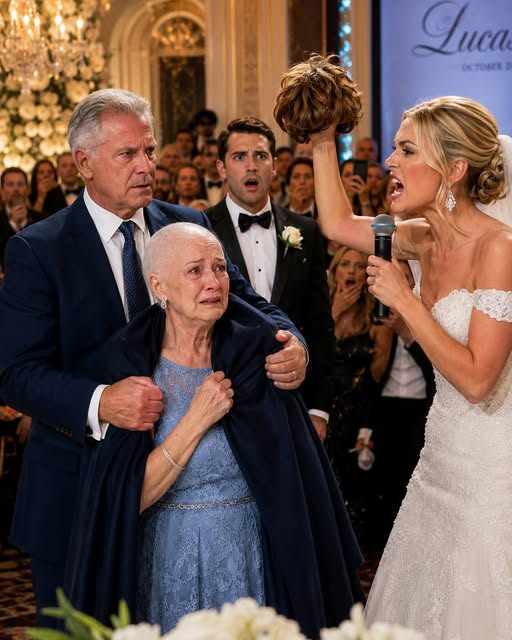
“Removing a sick woman’s wig is not a joke.”
Jennifer rolled her eyes.
“She’s wearing another one tomorrow.”
The room went dead silent.
Even Lucas looked at her.
“What did you just say?”
Jennifer turned toward him.
“Oh, please. Everyone is acting like I attacked her.”
“You pulled Mom’s wig off in front of two hundred people.”
“She embarrassed me first.”
Mary finally spoke.
Her voice was quiet.
“How?”
Jennifer looked annoyed.
“You kept touching your head during the photographs. You were distracting everyone.”
Lucas stared at his wife.
For the first time that night, I saw something break in his expression.
Not enough to excuse him.
But enough for reality to begin reaching him.
Mary whispered, “I was afraid the adhesive was coming loose.”
Jennifer laughed once.
“Well, apparently it was.”
A woman in the front row stood up.
It was Dr. Elaine Foster, Mary’s oncologist.
She had been invited because over the past months she had become more than a physician to us.
She looked directly at Jennifer.
“Do you know why the skin on Mrs. Bennett’s scalp is so sensitive?”
Jennifer frowned.
“No.”
“Because months of treatment have left it vulnerable.”
Dr. Foster’s voice hardened.
“Pulling adhesive from that skin can cause injury.”
Jennifer’s smile vanished.
“I didn’t know.”
“You did know she was receiving cancer treatment.”
“That doesn’t mean I knew about wigs.”
“No,” Dr. Foster replied. “It means a decent person would have asked before touching her.”
Applause began somewhere in the back.
Not loud.
Then another person joined.
Within seconds, half the ballroom was clapping.
Jennifer turned crimson.
“This is my wedding!”
I looked at her.
“Yes.”
“And this is the way you chose to be remembered during it.”
Lucas suddenly reached for Mary’s wig, still lying on the stage floor.
He picked it up carefully.
Then he approached his mother.
“Mom…”
Mary looked at him.
I saw hope flicker in her eyes.
That made what came next even harder.
Lucas whispered, “Can we just finish tonight and discuss this tomorrow?”
Mary’s hope disappeared.
He still did not understand.
He wanted the room comfortable again.
He wanted photographs.
Cake.
Speeches.
He wanted consequences postponed until after the party.
I stepped between them.
“No.”
Lucas looked at me.
“Dad.”
“You watched your mother be humiliated.”
“I froze.”
“No.”
I shook my head.
“You made a decision.”
“I didn’t know what to do.”
“You knew enough to turn away.”
His face tightened.
“What do you want from me?”
“Nothing.”
That answer shocked him.
I continued.
“For years, your mother wanted your calls.”
“Your visits.”
“Your time.”
“She wanted you sitting beside her during treatment.”
“She wanted you to ask how she was feeling instead of asking whether she would still attend your wedding.”
“But she does not need to beg for those things anymore.”
Mary touched my arm.
“Robert.”
I looked at her.
Tears rolled down her cheeks, but her voice was steady.
“I want to say something.”
I gave her the microphone.
She removed my jacket from her head.
For a moment, I reached to stop her.
She gently shook her head.
Then she stood beneath the lights exactly as she was.
No wig.
No hiding.
The room became perfectly quiet.
Mary looked at Jennifer.
“You wanted everyone to see me without my wig.”
Jennifer’s eyes dropped.
“So look.”
Mary straightened.
“This is what cancer treatment looks like.”
“Sometimes hair falls out.”
“Sometimes skin changes.”
“Sometimes you become tired before dinner is finished.”
Her voice trembled.
“But none of those things are shameful.”
She looked toward the guests who had laughed earlier.
“What is shameful is believing illness gives you permission to humiliate someone.”
No one moved.
One of the men who had laughed looked down at the floor.
Mary then faced Lucas.
My son’s eyes filled with tears.
“I gave birth to you after twenty-one hours of labor.”
She smiled faintly.
“I remember every minute.”
“I stayed beside your hospital bed when you broke your arm.”
“I worked extra shifts when you wanted to study abroad.”
“I saved every drawing you made because I thought everything you touched mattered.”
Lucas began crying.
Mary continued.
“When I got sick, I did not need you to cure me.”
“I only needed my son.”
His face collapsed.
“I’m sorry.”
“I know.”
He stepped toward her.
She raised one hand.
“Not tonight.”
He stopped.
That was the first boundary Mary had ever placed between herself and our son.
And I knew how much it cost her.
Jennifer’s mother suddenly approached the microphone.
“This has gone far enough. Everyone is emotional.”
I turned toward her.
“No.”
I removed another document from the envelope.
“We are not finished.”
Jennifer’s eyes widened.
“What else is there?”
The third document was not about inheritance.
It was an invoice.
Several, actually.
Wedding deposits.
Venue fees.
Catering.
Flowers.
Luxury transportation.
The honeymoon.
Nearly all of it had been charged to a family account Mary and I controlled.
Lucas had asked for help.
We agreed because he was our son.
Then, two months earlier, I discovered Jennifer had quietly increased almost every budget.
The intimate ceremony became a ballroom wedding.
The simple floral package became imported arrangements.
The honeymoon became three weeks in Europe.
I had planned to pay anyway.
Until that evening.
I held up the payment authorization.
“This wedding has been paid through today.”
Jennifer stared at me.
“What does that mean?”
“It means the remaining honeymoon balance, private jet deposit, and post-wedding reception are no longer being funded by us.”
Her mouth fell open.
“You can’t cancel the honeymoon.”
“I just did.”
“You promised!”
“I promised my son help with his wedding.”
I looked around the ballroom.
“The wedding occurred.”
Jennifer looked at Lucas.
“Do something.”
Those words again.
He stared at her.
Then at his mother.
Then at the wig in his hands.
“No.”
Jennifer froze.
“What?”
“I said no.”
It was the first time I had heard my son say that to her.
She laughed nervously.
“You’re upset.”
“I watched you hurt my mother.”
“It was an accident!”
“You held the microphone while doing it.”
Silence.
Lucas looked at the wig.
“You wanted everyone to laugh.”
Jennifer’s face hardened.
“So now you’re choosing her over your wife?”
Mary closed her eyes.
I expected Lucas to retreat.
For years, avoiding conflict had been his greatest weakness.
Instead, he looked at Jennifer.
“I should have chosen what was right before anyone had to ask.”
She slapped him.
Gasps filled the room.
Lucas did not respond.
Jennifer’s mother grabbed her daughter’s arm.
“We’re leaving.”
But before they reached the stairs, the venue manager approached.
“Mrs. Parker?”
Jennifer’s mother turned.
“Yes?”
“There is an outstanding charge on the bridal suite and several unauthorized additions to tonight’s service package.”
Jennifer looked at me.
I raised my hands.
“Personal boundaries.”
A few guests laughed.
Not at Mary this time.
Jennifer stormed from the ballroom.
Her mother followed.
Half of the bridal party went with them.
The wedding ended before the cake was cut.
Lucas remained standing onstage holding his mother’s wig.
Finally, he sank into a chair and covered his face.
Mary watched him.
I expected her to comfort him.
She didn’t.
Instead, she took my hand.
“Take me home.”
So I did.
Three days later, Lucas came to our house alone.
He looked exhausted.
Jennifer had moved into her parents’ home.
The honeymoon was canceled.
Their marriage certificate had been filed, but she was already threatening annulment unless Lucas convinced us to restore the financial gifts.
He sat across from Mary in our kitchen.
No cameras.
No guests.
No tuxedo.
Just a son facing his mother.
“I failed you.”
Mary did not answer immediately.
“Yes.”
His eyes filled with tears.
“I thought keeping Jennifer happy would keep everything peaceful.”
“And did it?”
“No.”
“Peace that requires one person to accept humiliation is not peace.”
Lucas nodded.
“I know.”
“No.”
Mary’s voice remained gentle.
“You are beginning to know.”
That distinction mattered.
Real change was not one apology.
It was what came afterward.
Lucas asked whether she could forgive him.
Mary answered honestly.
“I love you.”
He waited.
“That wasn’t the question.”
She nodded.
“I know.”
His face crumpled.
“I cannot forgive you today.”
Lucas lowered his head.
“But maybe one day?”
“Maybe.”
She reached across the table.
“But if that day comes, it will be because you changed, not because I got tired of being angry.”
Lucas squeezed her hand.
For once, he accepted the condition.
Jennifer filed for divorce two months later.
The financial dispute became ugly.
During discovery, something unexpected surfaced.
Jennifer had been discussing my estate with her mother before the wedding.
Messages showed them estimating how much Lucas would inherit after Mary and I died.
One message from Jennifer read:
Once the lake house transfers, I’ll convince Lucas to sell it. His parents don’t need that much property at their age.
Another said:
His mother being sick might actually simplify things.
When Lucas read that line, whatever remained of his marriage disappeared.
He did not contest the divorce.
Jennifer received only what she legally owned.
No lake house.
No trust.
No family investments.
No luxury future funded by people she considered obstacles.
But I did not celebrate.
Money had exposed her character.
It had also exposed how badly I had prepared Lucas for adulthood.
Mary and I had solved too many problems for him.
We called it love.
Sometimes it was.
Sometimes it prevented him from learning courage.
So we changed too.
Lucas moved into a small apartment and began supporting himself without family money.
He attended counseling.
He came to every one of Mary’s appointments after that.
At first, I distrusted his sudden attention.
Mary did too.
But weeks became months.
Months became a year.
He learned the names of her medications.
He knew which days treatment left her exhausted.
He stopped bringing flowers she could not smell without nausea and started bringing audiobooks instead.
Most importantly, he stopped expecting praise.
One afternoon, Mary fell asleep during treatment with her head resting against his shoulder.
Lucas looked at me.
His eyes filled with tears.
“I almost lost this.”
“Yes.”
“I don’t mean Mom.”
I frowned.
“What do you mean?”
“My chance to become someone she could trust.”
That was when I knew the change might be real.
Mary’s cancer went into remission eighteen months after the wedding.
The day her oncologist gave us the news, she cried harder than she had during treatment.
Lucas cried too.
I simply held them both.
A year later, Mary’s hair had begun growing back.
Short.
Silver.
Beautiful.
She never wore the brown wig again.
She donated it to a nonprofit that provided wigs to patients who could not afford them.
But before giving it away, she placed it on the kitchen table and took a photograph.
Not because she wanted to remember the humiliation.
Because she wanted to remember surviving it.
The property trust remained exactly as we had amended it.
Lucas was not restored automatically as beneficiary.
Instead, Mary and I created new terms.
A portion of our estate would eventually go to him.
Another portion funded cancer-support services, transportation for patients, and emergency assistance for families losing income during treatment.
The lake house became part of that foundation.
Every summer, families dealing with serious illness could stay there without charge.
When Lucas learned what we had done, he smiled.
“That’s better than selling it.”
I looked at him.
“Jennifer wanted you to sell it.”
“I know.”
“Does that still hurt?”
He thought for a moment.
“No.”
Then he looked at Mary.
“What hurts is knowing I once became the kind of man who might have listened.”
Five years after that wedding, we returned to the same ballroom.
Not for another marriage.
For a fundraising dinner benefiting families facing cancer treatment.
Mary walked onto the stage wearing a pale blue dress.
The same color she had worn at Lucas’s wedding.
This time, there was no wig.
Her silver hair reached just below her ears.
When she took the microphone, the entire room stood.
Lucas was in the front row.
He applauded first.
After her speech, he joined us backstage.
“Mom.”
“Yes?”
“You look beautiful.”
Mary smiled.
“You told me that about blue once.”
“I remember.”
Then he hugged her.
She hugged him back.
Forgiveness had arrived quietly sometime during those years.
There had been no dramatic announcement.
No moment when the past disappeared.
It simply stopped controlling every conversation.
As we prepared to leave, Lucas asked me about the black wedding envelope.
“Do you still have it?”
“Yes.”
“What did you do with it?”
“I keep it in the safe.”
“Why?”
I looked through the open ballroom doors toward Mary.
“Because it reminds me that protection sometimes looks cruel to people who expected access.”
He nodded.
“I deserved to lose those things.”
“No.”
I corrected him.
“You needed to learn that they were never yours.”
He looked at me.
There was no resentment in his expression.
Only understanding.
The night Jennifer removed Mary’s wig, I thought the cruelest thing in the room was the laughter.
I was wrong.
The cruelest thing was my son’s silence.
But silence does not have to be permanent.
Lucas eventually found his voice.
Mary eventually found her trust again.
And I learned that protecting someone you love sometimes means refusing to protect the person hurting them from consequences.
Jennifer believed the black envelope contained a wedding fortune.
Instead, it contained boundaries.
She thought Mary’s illness made her weak.
Instead, it revealed exactly who everyone else was.
And the woman she tried to humiliate beneath those stage lights became the strongest person in that ballroom.
Not because she never suffered.
Not because she never cried.
But because after everything cancer had taken from her, she refused to let cruelty take her dignity too.
