The moment Chad and his family disappeared through the hospital doors, the room changed.
The silence was no longer humiliating.
It was useful.
The nurse closed the door behind them.
The social worker, Denise Morgan, pulled a chair closer to my bed.
“Pamela,” she said carefully, “do you understand what you just signed?”
“Yes.”
Her face tightened.
“Are you certain?”
I looked toward the security camera.
“Yes.”
Then I held out my hand.
“Now I need the recorded copy of what happened in this room preserved immediately.”
Denise froze.
The nurse looked at me.
I continued.
“I also need the hospital to document that I am three days postpartum, medicated, recovering from major surgery, and that more than twenty people entered this room while my husband pressured me to surrender custody.”
Understanding spread across Denise’s face.
“You were documenting coercion.”
“I was documenting everything.”
She stood.
“I’ll contact hospital legal.”
I reached for my phone.
“And I’ll contact mine.”
My attorney answered after the first ring.
“Pamela?”
“He did it.”
A pause.
“Did he bring the agreement?”
“Yes.”
“And the clause?”
“Yes.”
“Did you sign?”
“Yes.”
My attorney exhaled.
“Good.”
Denise stared at me in disbelief.
I understood why.
Signing looked like surrender.
But the document Chad brought was not a valid custody order.
It was a private contract.
And the hidden clause inside it was exactly what my attorney had been waiting for.
Six months earlier, I had discovered that Chad was moving money through Livingston Holdings using fake consulting companies.
At first, I thought he was hiding affair expenses.
I was wrong.
He was hiding far more.
Private aircraft bills.
Luxury apartments.
Payments to Samantha.
Large transfers to companies owned by relatives who did no actual work.
And then I found the account that changed everything.
Livingston Strategic Reserve Fund.
Nearly forty-eight million dollars had disappeared from it over three years.
The fund was not Chad’s personal money.
It contained investor capital.
Employee retirement reserves.
And financing attached to several government-backed development projects.
I copied everything.
Bank records.
Emails.
Invoices.
Internal approvals.
Then I met attorney Rebecca Cole.
She told me not to confront him.
“Men who think they own everything rarely become careful when they believe they’re winning,” she said.
She was right.
Chad’s divorce agreement included a confidentiality provision prohibiting me from examining, discussing, or challenging “business-related transactions discovered during the marriage.”
That clause proved he knew exactly what I had seen.
And by presenting it while demanding my children, he connected the financial cover-up directly to coercion.
At 4:17 that afternoon, Rebecca entered my hospital room.
She carried a laptop and three folders.
“You look terrible,” she said.
“I just had twins.”
“That explains some of it.”
Despite everything, I laughed.
Then she became serious.
“First: the custody agreement.”
She placed the papers on the table.
“It is not enforceable simply because you signed it. Courts decide custody according to the children’s interests. Parents cannot purchase another parent’s rights through a private contract.”
I looked at Wyatt and Cooper sleeping beside me.
“So he can’t come tomorrow and take them?”
“No.”
Relief hit me so hard I nearly cried.
Rebecca continued.
“Second: because of the circumstances under which you signed, we are filing to invalidate the entire agreement based on coercion and lack of independent counsel.”
“And third?”
She turned the final folder toward me.
“We sent the financial evidence to the board, external auditors, and federal investigators twenty minutes before Chad entered your room.”
I closed my eyes.
It had started.
At 5:03 p.m., Chad called.
I did not answer.
At 5:06, he called again.
Then again.
By 5:20, there were sixteen missed calls.
Rebecca smiled faintly.
“He must have received the first notice.”
“What notice?”
She opened her laptop.
Livingston Holdings had frozen Chad’s executive access.
His company email was disabled.
Corporate credit cards suspended.
Authority over large transfers revoked.
The board had scheduled an emergency meeting for six that evening.
At 6:11, Samantha called me.
I answered because Rebecca nodded.
Her voice exploded through the speaker.
“What did you do?”
I leaned back against the pillows.
“To whom?”
“Chad’s accounts are frozen!”
“That sounds like something Chad should discuss with his company.”
“You know exactly what I mean.”
Behind her, I could hear shouting.
Then Chad grabbed the phone.
“Pamela.”
His voice was nothing like it had been three hours earlier.
No confidence.
No contempt.
Only panic.
“Where are the files?”
“What files?”
“Do not play with me.”
Rebecca started recording.
“I have no idea what you’re talking about.”
“You accessed company records.”
“I was your spouse and finance committee secretary for two years. You gave me access.”
Silence.
Then he lowered his voice.
“We can fix this.”
I looked at the twins.
“Fix what?”
“The divorce.”
I almost laughed.
“You were completely sure three hours ago.”
“Things changed.”
“No.”
I touched Cooper’s tiny hand.
“They became visible.”
Chad breathed heavily.
“Withdraw the complaint.”
“I didn’t file a complaint.”
“What?”
“I provided evidence.”
“You’re trying to destroy me.”
“No.”
“You used investor money as your private account.”
“You created shell companies.”
“You transferred funds to Samantha.”
“You paid relatives for services they never provided.”
“And you were arrogant enough to put a clause in our divorce papers trying to stop me from discussing it.”
He went silent.
Then his voice hardened.
“If you do this, you’ll destroy our children’s inheritance.”
That sentence removed the last trace of doubt.
Even then, he was using Wyatt and Cooper as financial shields.
“Our children do not need stolen money.”
He hung up.
At eight that night, Rebecca received confirmation.
A federal court had authorized emergency preservation of Livingston Holdings financial records.
Several bank accounts were frozen.
Chad’s passport was flagged.
Samantha’s luxury apartment was placed under a no-transfer order.
And Mildred’s name appeared on two shell companies receiving Livingston funds.
My mother-in-law had not simply known about the affair.
She had helped hide the money.
Before midnight, the hospital moved me and the twins to a protected floor.
Not because Chad had threatened violence.
Because he had already demonstrated that he would use crowds, pressure, and access to overwhelm me.
At 1:30 a.m., someone tried to enter the ward.
Security stopped them.
It was Mildred.
She demanded to see her grandchildren.
The nurse refused.
Mildred screamed so loudly that patients down the hallway woke up.
Then she made the mistake that would later appear in court.
She shouted:
“We already paid Pamela! Those boys belong to Chad now!”
Three nurses heard her.
Two security officers heard her.
A body camera recorded everything.
Rebecca listened to the recording the next morning.
“Perfect.”
I looked at her.
“That sounds terrible.”
“It is terrible.”
She closed the file.
“It is also evidence.”
At nine, the emergency custody hearing began remotely from my hospital room.
Chad appeared on-screen with three attorneys.
He wore the same suit from the previous day.
But he no longer looked victorious.
His lawyer argued that I had voluntarily signed a custody agreement.
Rebecca responded with the hospital footage.
The judge watched Chad enter with Samantha and more than twenty relatives.
Watched them surround my wheelchair.
Watched Mildred demand the babies.
Watched Chad offer money in exchange for custody.
Then the judge read the confidentiality clause.
Her expression changed.
“Mr. Livingston, why does a custody agreement contain restrictions concerning your wife’s review of corporate accounts?”
Chad’s lawyer interrupted.
“It is standard marital confidentiality language.”
Rebecca responded immediately.
“No, Your Honor.”
She displayed three previous Livingston divorce templates.
None contained the clause.
The judge looked at Chad.
“Did you draft this provision?”
“My attorneys did.”
His attorney looked uncomfortable.
The judge asked again.
“Were you aware of it?”
“Yes.”
“Why was it necessary?”
He hesitated.
That hesitation cost him.
The judge issued temporary sole physical custody to me.
Chad received no unsupervised contact pending investigation.
Mildred was barred from removing the children from my care.
The private agreement was suspended entirely.
Chad’s face went white.
“This is insane.”
The judge’s voice became colder.
“What is insane, Mr. Livingston, is appearing in a hospital three days after major surgery with an entourage and attempting to purchase parental rights.”
The hearing ended.
I cried for the first time.
Not because I was afraid.
Because Wyatt and Cooper were safe.
Two days later, we left the hospital through a private exit.
I moved into a townhouse owned by a trust my grandmother had created for me years earlier.
Chad had mocked that inheritance as insignificant.
It became the one property he could not touch.
The financial investigation expanded quickly.
The board discovered that Chad had concealed more than ninety million dollars in liabilities while diverting company funds to maintain the appearance of enormous profits.
Samantha received more than six million through fake consulting contracts.
Mildred received nearly three million.
Several cousins at the hospital had also been beneficiaries.
That explained why so many relatives had participated in the confrontation.
They were not merely supporting Chad.
They were protecting a system that had been feeding them.
Then investigators found something worse.
Three months before the twins were born, Chad had modified a life-insurance policy on me.
The amount was enormous.
Rebecca stared at the document for a long time before speaking.
“Did you authorize this?”
“No.”
The signature looked like mine.
It was not.
Chad had forged it.
I felt sick.
The insurance company confirmed that he had listed himself as the primary beneficiary.
The policy did not prove he planned to harm me.
But it showed how completely he had reduced our marriage to assets, risks, and control.
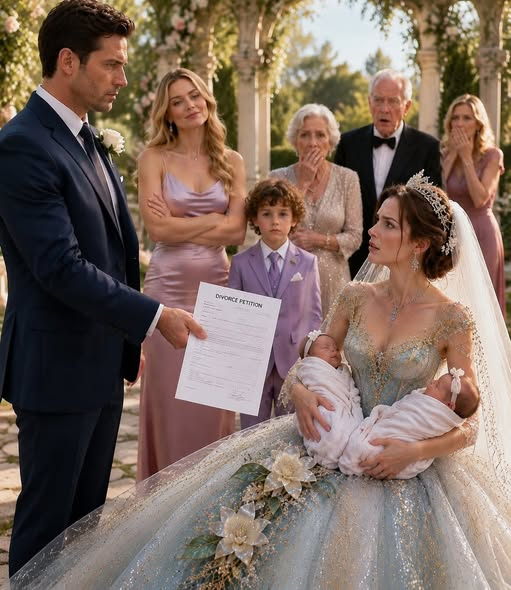
The divorce proceedings became public after Livingston Holdings disclosed the federal investigation.
Reporters waited outside courthouses.
Business channels discussed the collapse of the Livingston empire.
Chad blamed me in his first public statement.
He called me vindictive.
Emotionally unstable.
A mother using children as weapons.
That strategy lasted less than twenty-four hours.
Rebecca released one piece of evidence through the court record.
Not my medical information.
Not private messages.
The hospital video.
People saw me in a wheelchair holding two newborns while Chad and his family surrounded me.
Public opinion changed instantly.
The board removed him as chief executive.
Samantha disappeared from social events.
Mildred stopped answering reporters.
And the relatives who had stood behind Chad at the hospital began claiming they had never understood what was happening.
I remembered every face.
Every person who looked down instead of leaving.
Their silence had been a choice too.
Four months later, Samantha approached prosecutors.
She wanted immunity.
She brought messages.
Thousands of them.
Chad had promised to marry her after I surrendered custody.
But there was another reason he wanted the twins.
The Livingston family trust transferred a controlling voting interest to the first male heirs of Chad’s generation.
Wyatt and Cooper were worth billions on paper.
Not because they owned the money immediately.
Because controlling their guardianship gave Chad leverage over the trust.
The three-million-dollar offer had never been generous.
It had been an investment.
He wanted to buy me out cheaply so he could control assets tied to our sons.
When Mildred called them “the Livingston heirs,” she meant it literally.
I sat in Rebecca’s office reading the trust documents.
“He never wanted the children because he loved them.”
Rebecca answered carefully.
“I cannot tell you what he felt.”
I looked at the financial projections.
“But I can tell you he had a financial motive for seeking immediate sole custody.”
That was enough.
The criminal case began before our divorce finished.
Samantha testified against Chad and Mildred.
She admitted she knew about the shell companies and helped create fake invoices.
In exchange, prosecutors recommended a reduced sentence.
Mildred refused to cooperate.
She insisted everything belonged to the Livingston family anyway.
The prosecutor asked her one question.
“Did investor money belong to your family?”
She had no answer.
Chad’s defense tried to portray me as the mastermind.
They argued I had collected evidence because I planned to seize the company.
Then my attorney produced an email I had sent six months before the twins were born.
It was addressed to Chad.
I had written:
I’m seeing irregular transfers in the Horizon accounts. Please review them before the next audit. I’m worried someone could get hurt if this continues.
His reply contained four words:
Stay out of business.
That email destroyed his argument.
I had warned him.
He had ordered me to stop looking.
A jury convicted Chad of wire fraud, conspiracy, misappropriation of investor funds, falsification of corporate records, and related financial crimes.
The forged insurance signature resulted in additional charges.
He received fifteen years in federal prison.
Mildred received six.
Samantha received three after cooperation.
Several relatives were ordered to return money they had received through fraudulent contracts.
Livingston Holdings survived only because the board separated the legitimate divisions from Chad’s financial schemes.
I was offered a seat on the restructured board.
I refused.
I had spent enough of my life inside their empire.
The divorce became final eleven months after the hospital confrontation.
I received primary custody.
Chad was granted the possibility of supervised communication with the twins under strict conditions, subject to court approval during his incarceration.
I did not erase him from their lives.
I also did not lie to them.
One day, when they were old enough, they would learn the truth in an age-appropriate way.
Their father made choices.
Those choices had consequences.
But his crimes would never become their identity.
The trust became the final battle.
Chad’s relatives argued Wyatt and Cooper should remain under Livingston family financial guardianship.
I disagreed.
After months of litigation, the court appointed an independent fiduciary.
No Livingston relative could control the boys’ inheritance.
Neither could I use it freely.
The money belonged to them.
Protected until adulthood.
That was exactly what I wanted.
I did not need their billions to raise my sons.
I had my own career.
My grandmother’s townhouse.
Savings Chad had never successfully hidden or taken.
And something more valuable than money.
Freedom from the belief that wealth entitled anyone to ownership over another human being.
Three years later, Wyatt and Cooper started preschool.
On their first morning, they wore matching backpacks and completely different expressions.
Wyatt cried.
Cooper ran toward the classroom without saying goodbye.
I laughed through my tears.
Their teacher crouched beside them.
“Mom will be back this afternoon.”
Wyatt looked up at me.
“You promise?”
I knelt carefully.
“I promise.”
The word mattered.
Promises had once been cheap inside the Livingston family.
I wanted my sons to grow up knowing that when their mother promised to return, she returned.
When she said they were safe, she meant it.
When she said nobody could buy them, it was true.
Years later, reporters still occasionally contacted me whenever Chad became eligible for another legal review.
I declined every interview.
My life was not an appendix to his scandal.
I built a consulting firm specializing in corporate compliance and fraud prevention.
The skills Chad dismissed became the foundation of my independence.
Eventually, I began teaching seminars about coercive financial agreements.
I never used my own case as spectacle.
But I always told young attorneys one thing:
“A signature is not always proof of agreement.”
“Sometimes you have to ask who was in the room.”
That sentence came from the day everything changed.
More than twenty people had stood around my wheelchair.
Chad believed their presence would intimidate me.
Instead, they became witnesses.
The camera he ignored became evidence.
The confidentiality clause he inserted became proof of motive.
And the signature he celebrated became the beginning of the case that exposed him.
On Wyatt and Cooper’s tenth birthday, we returned to Pinecrest Medical Center.
Not because of Chad.
The hospital had invited me to speak at the opening of a new family advocacy office for patients facing legal or domestic pressure during hospitalization.
Denise Morgan, the social worker who had been in my room that day, was now its director.
She hugged me.
“I still remember your face when you signed those papers.”
“I was terrified.”
“You didn’t look terrified.”
“I was.”
That was something I had learned.
Courage did not always look like shouting.
Sometimes it looked like reading every page carefully while everyone around you believed you were defeated.
Wyatt and Cooper stood beside me during the ribbon cutting.
Afterward, Cooper asked why the office existed.
I thought for a moment.
“So people in hospitals always have someone on their side.”
He accepted the answer easily.
Then the boys ran toward the vending machines.
I watched them go.
Three days after giving birth, Chad offered me three million dollars to disappear.
At the time, he believed money was the strongest thing in that room.
It was not.
The strongest thing was the mother holding two newborns who finally understood that accepting a pen did not mean surrendering her future.
I signed his papers.
He smiled.
His family celebrated.
Samantha believed she had won.
But what none of them understood was simple:
They were buying my silence with money that was never truly theirs.
And the moment they put their scheme in writing, they gave me exactly what I needed to take everything into the light.
