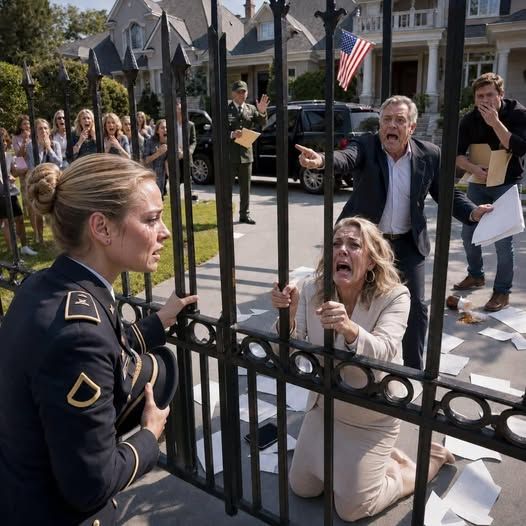
“This is my home.”
My mother stared at me through the intercom screen.
Then she pressed something off-camera.
The speaker went dead.
A red light appeared above the gate.
Locked.
For several seconds, I stood there in the rain with my duffel beside my boots and the birthday card still inside it.
Then my father appeared behind her on the monitor.
Harlan Vale had aged more than I expected. His hair was almost completely gray now, but his posture was still rigid, expensive sweater perfectly pressed despite the late hour.
He looked directly into the camera.
And unlike my mother, he recognized me immediately.
I saw it in his eyes.
“Arden,” he said.
My mother turned sharply.
The silence between them answered a question I had not even asked yet.
She had known who I was.
“Open the gate,” I said.
Dad’s expression hardened.
“This isn’t a good time.”
“My sister is getting married.”
“Yes.”
“And no one told me.”
“You’ve been away.”
“I’ve been serving.”
“You made your choices.”
Rain ran from the brim of my cap.
“And you returned every letter I sent?”
Neither of them answered.
I reached into my duffel and pulled out the bent envelope.
My mother’s face changed when she saw the red stamp.
Returned to sender.
“You could have emailed,” she said weakly.
“I did.”
Dad moved closer to the camera.
“Maribel has spent eighteen months planning this wedding. There are important people here. Donors. Business partners. Politicians. We are not reopening old family conflicts two days before the ceremony.”
I almost smiled.
So that was it.
Not confusion.
Not memory loss.
Management.
I was an inconvenient problem standing outside the gate in a uniform they could no longer pretend meant nothing.
“I drove here to give my sister a birthday card,” I said.
“It’s not her birthday.”
“It was seven months ago.”
Dad said nothing.
“She never received it.”
My mother looked away.
I put the envelope back inside my bag.
“Tell Maribel I came.”
Dad’s answer was immediate.
“Don’t involve her.”
That hurt more than I expected.
But I nodded.
“Understood.”
I picked up my duffel.
Behind the gate, my mother suddenly spoke.
“Arden.”
I stopped.
For one foolish second, some small piece of me thought she was going to open it.
Instead she said:
“Please don’t post anything about this.”
I laughed.
Just once.
Then I walked away.
I checked into a small hotel near the harbor.
At 1:14 in the morning, I removed my dress uniform, hung it carefully beside the window, and finally opened the wedding website.
Maribel Vale and Christopher Ashford.
Three hundred guests.
Black tie.
The ceremony would take place on the grounds of our parents’ estate.
Then I noticed the charity banner beneath the guest information.
IN LIEU OF GIFTS, PLEASE SUPPORT THE VALE HEROES MEDICAL FOUNDATION.
My stomach tightened.
I clicked.
A photograph loaded.
It was me.
Twenty-four years old, standing beside an evacuation aircraft during my first overseas assignment.
Underneath it were the words:
Inspired by Captain Arden Vale, U.S. Army Medical Logistics Officer.
I sat completely still.
I had never authorized that photograph.
I had never authorized the use of my rank.
And I had never heard of the Vale Heroes Medical Foundation.
I kept scrolling.
My father was listed as chairman.
My mother was treasurer.
Maribel was director of community relations.
And beside my own name:
Military Advisory Board — Captain Arden Vale.
I whispered one word.
“No.”
The foundation claimed to supply emergency medical equipment to wounded veterans, rural clinics, and military families.
Millions had apparently been raised over five years.
Five years during which my parents had returned my letters.
Five years during which they told everyone I was “figuring things out.”
And yet my uniform was respectable enough to appear on their fundraising page.
I took screenshots of everything.
Then I made one call.
Not to my parents.
Not to Maribel.
To the legal office attached to my command.
By 2:30 a.m., I had forwarded every page.
By sunrise, someone had already discovered the first problem.
Several fundraising documents contained an electronic signature supposedly belonging to me.
It was not mine.
The second problem was worse.
The foundation reported purchasing refrigerated medical-storage units and emergency blood-transport containers using charitable donations.
I knew the model numbers.
I knew the vendors.
I knew the prices.
And the numbers on the invoices were impossible.
Some equipment had been billed at nearly three times its normal value.
Other serial numbers belonged to units still listed in government-controlled inventory overseas.
Someone had copied military logistics information and used it to make fake purchases look legitimate.
And they had attached my name to it.
At 8:07 that morning, Maribel called.
I stared at her name until the call nearly ended.
Then I answered.
“Hello?”
There was silence.
Finally:
“Were you really at the gate last night?”
“Yes.”
“Mom said some woman from the government showed up.”
I closed my eyes.
“Did she?”
“Arden…”
Her voice broke.
“You’re a captain?”
“I have been for three years.”
Another silence.
“I thought you worked in a warehouse.”
That almost made me laugh.
“I coordinate medical logistics.”
“Dad said you dropped out of college.”
“I finished while serving.”
“He said you kept changing jobs.”
“I changed assignments.”
“He said you never came home because you were ashamed.”
I looked toward the returned birthday card on the desk.
“I came home last night.”
Maribel started crying.
“I didn’t know.”
For the first time, I believed someone.
“Why didn’t you invite me?”
“Dad said you refused.”
The room seemed to tilt.
“What?”
“He told me he contacted you four times. He said you wrote back that you didn’t approve of Christopher and didn’t want anything to do with the wedding.”
“I never received anything.”
She stopped crying.
“Arden…”
“Maribel, listen carefully. Do you know anything about the Vale Heroes Medical Foundation?”
Her breathing changed.
“It’s Dad’s charity.”
“My name is on it.”
“You’re the reason he started it.”
“I never agreed to be part of it.”
Silence.
Then she whispered:
“Oh my God.”
Before I could ask another question, someone entered the room on her end.
My father’s voice.
“Who are you talking to?”
The call ended.
Two days later, at 6:32 in the morning, my mother called.
Not through the gate.
Not through an assistant.
Directly.
I answered on the second ring.
She was crying so hard I barely recognized her voice.
“Arden, please.”
I sat upright.
“What happened?”
“Your father is gone.”
I glanced at the clock.
“What do you mean, gone?”
“He left sometime during the night. His closet is empty. His passport is missing.”
Then came the sentence I had somehow known was coming.
“There are investigators here.”
I said nothing.
“They’re saying millions are missing from the foundation. They’re saying I signed transfers.”
“Did you?”
“I signed what Harlan gave me.”
“Did you read them?”
“No.”
I closed my eyes.
“Mom.”
“I trusted my husband!”
“And you didn’t trust your daughter enough to open a gate.”
She began sobbing again.
“Please don’t do this now.”
I stood and reached for my uniform trousers.
“What exactly are you asking me to do?”
Her voice became very small.
“Save me.”
When I returned to the estate, the gate was open.
No one stopped me.
Three dark vehicles stood in the circular driveway.
Maribel sat on the front steps in yesterday’s rehearsal clothes, mascara streaked beneath her eyes. Christopher had one arm around her.
My mother waited in the foyer.
The moment she saw me, she ran toward me.
I stepped back.
Not cruelly.
But enough.
She stopped.
“I need you to tell them the foundation was legitimate,” she whispered.
“I can’t.”
“But you know military medicine. You can explain the invoices.”
“I can explain why many of them are false.”
Her face collapsed.
“Arden…”
“I will not lie for you.”
“I’m your mother.”
“And I’m an officer.”
She stared at me.
Then I added:
“But I can help establish what you actually knew.”
That was different.
For the next seven hours, I sat with investigators, attorneys, accountants, and foundation staff.
I identified equipment numbers.
Compared purchase records.
Explained which items could never have come from the sources listed.
And eventually, we found the pattern.
My father had created shell vendors.
Money donated for medical equipment moved through them, then into private investment accounts.
But he had made one mistake.
He assumed nobody in the family understood logistics well enough to recognize the serial-number structure.
I did.
By afternoon, investigators had separated my mother’s signatures into two categories.
Documents she had actually signed.
And documents containing copied versions of her signature.
She had been careless.
She had enjoyed the social status.
She had asked too few questions.
But the evidence suggested she had not engineered the theft.
Then one of the investigators brought me a folder.
Inside was something worse.
Copies of my emails.
My letters.
Photographs I had sent home.
Even the original wedding invitation Maribel had mailed to my deployment address.
All of them had been intercepted.
Several envelopes had handwritten instructions attached:
RETURN.
DO NOT FORWARD.
SHE CANNOT APPEAR UNTIL AFTER THE FOUNDATION GALA.
The handwriting belonged to my father.
My mother sank into a chair.
“You knew?” I asked.
“No.”
I watched her carefully.
“Last night, you recognized me.”
Tears filled her eyes.
“Yes.”
“Then why did you pretend not to?”
She covered her mouth.
For several seconds, she could not speak.
Finally:
“Your father said if you came inside, you would start asking questions. He said you had become difficult. Suspicious. That you hated the family.”
“So you locked me out.”
“I was afraid.”
“No.”
My voice remained quiet.
“You were comfortable.”
That landed harder.
She lowered her eyes.
“You were comfortable believing his version because it required nothing from you.”
Maribel began crying behind us.
Then she placed something on the table.
My birthday card.
The one from my duffel.
I had given it to her that morning.
She opened it.
Inside, I had written:
I don’t know if I’ll make it home this year, but I hope you never mistake distance for absence. I’m always your sister.
Maribel pressed the card against her chest.
Dad had told her I didn’t care.
Mom had let herself believe I was a stranger.
And I had spent years assuming silence meant they had simply moved on.
The truth was uglier.
Someone had built the silence deliberately.
My father was arrested three weeks later after investigators traced financial activity connected to one of the accounts.
The wedding was postponed.
Not because of scandal.
Because Maribel said she no longer wanted the biggest day of her life organized around people she barely understood.
She and Christopher married four months later at a small inn near the ocean.
Forty guests.
No politicians.
No donors.
No crystal chandelier.
I stood beside her in uniform.
This time, when people asked what I did, my mother did not answer for me.
Neither did anyone else.
Near sunset, she found me alone on the terrace.
“I have something for you.”
She handed me a small cardboard box.
Inside were seventeen envelopes.
Every letter I had sent home that my father had never mailed back.
Some were still sealed.
She had found them inside his office safe.
“I should have known,” she whispered.
I looked at her.
“Yes.”
She flinched, but I continued.
“You should have asked. You should have opened the gate. You should have recognized your own daughter even if I had been wearing a janitor’s uniform instead of Army dress blues.”
She nodded slowly.
“I don’t expect you to forgive me.”
“That’s good.”
She looked surprised.
“Because forgiveness isn’t something you request like a favor when consequences become uncomfortable.”
Her eyes filled.
I softened my voice.
“But if you want a relationship with me, you can start building one.”
“How?”
I looked through the glass doors toward Maribel laughing with her new husband.
“By learning who I am instead of believing whoever tells you.”
My mother nodded.
Then, very carefully, she asked:
“Will you come home for Christmas?”
I thought about the iron gate.
The rain.
The intercom.
The stranger in the SUV who had recognized me before my own mother did.
Then I answered.
“I’ll come for dinner.”
Her face brightened.
“But I’m staying at a hotel.”
She almost laughed.
Almost.
And that was enough.
Months later, the Vale Heroes Medical Foundation was dissolved. Remaining legitimate funds were transferred under independent oversight to organizations that actually served the people whose names had been used to raise them.
My photograph disappeared from the website.
My forged signature disappeared from the paperwork.
And my family finally stopped describing my life as something I had failed to explain.
I had spent years transporting supplies to people who could not afford mistakes.
Blood had to arrive cold.
Medicine had to arrive intact.
Equipment had to reach the right hands.
I had learned that anything valuable could be destroyed by sending it to the wrong place.
Trust was no different.
My father had spent years redirecting mine.
My mother had allowed him.
But when I came home, I finally stopped waiting for someone behind an iron gate to decide whether I belonged.
I already knew where I belonged.
And this time, I did not need anyone’s permission to enter.
