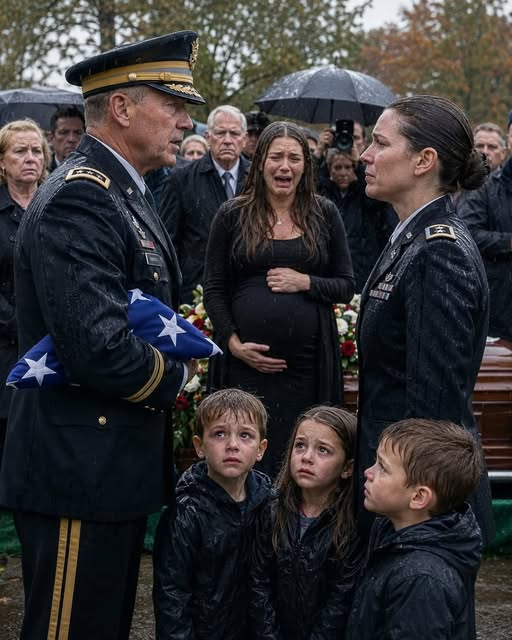
General Kingston did not hand me the envelope immediately.
He looked at my three children first.
Then at Monica.
Then at Diane.
Finally, he turned back to me.
“Captain Hunt, I need you and your children escorted inside.”
Diane stepped forward.
“General, my son is being buried. Whatever this is, I have a right to know.”
Kingston’s expression did not change.
“No, ma’am. You have a right to grieve your son.”
He glanced at the sealed envelope.
“You do not automatically have a right to classified information.”
The cemetery went silent again.
Monica’s hand tightened over her stomach.
“What about me?”
The general looked at her.
“You will be contacted separately.”
That answer frightened her.
I could see it.
Ten minutes later, I was inside a secure administration room with General Kingston while my children waited with a military family liaison just outside.
The envelope remained between us.
“Before I open this,” I said, “tell me one thing.”
“Yes?”
“Was Caleb actually killed on a combat mission?”
Kingston paused.
“Not exactly.”
My stomach tightened.
He opened the envelope.
Inside were several pages, a photograph, and a handwritten note.
The photograph showed Caleb standing beside three men outside a private defense company.
I recognized the company name immediately.
Northstar Strategic Logistics.
Two years earlier, my intelligence section had flagged one of its subsidiaries during a financial review.
Nothing criminal had been proven at the time.
The investigation disappeared above my level.
I had never known why.
Kingston tapped the photograph.
“After leaving the Army, Caleb began consulting for Northstar.”
I stared at him.
“He told everyone he was still doing classified contract work.”
“That part was true.”
“What wasn’t?”
“He was not the hero the press described this week.”
The words landed heavily.
Kingston continued.
“Eighteen months ago, federal investigators discovered that Northstar personnel were moving restricted government information through private commercial channels.”
I straightened.
“Caleb was involved?”
“At first, yes.”
My chest went cold.
For all his failures as a husband and father, part of me still wanted to believe he had died honorably.
“He gave them information?”
Kingston’s answer was careful.
“He helped people who should never have had access.”
I looked down.
“So why is he being buried here?”
“Because that was not the end of the story.”
He pushed another page toward me.
“Caleb eventually realized the network was larger than he had been told. He contacted investigators and agreed to cooperate.”
I looked at him.
“Why?”
Kingston’s eyes moved toward the door where my children were waiting.
“According to his statement, because he discovered someone had begun collecting information about you.”
My breath stopped.
“Me?”
“And your unit.”
Suddenly the room felt smaller.
Kingston continued.
“Caleb knew your name still carried value to people who remembered you were once married. He realized his former connection to you had become useful.”
My voice dropped.
“Did he give them anything about me?”
“No.”
“You’re certain?”
“Yes.”
Then Kingston said quietly:
“When they asked him to, he refused.”
For several seconds, I could hear only the rain against the window.
Caleb had abandoned us.
He had ignored birthdays.
He had let his parents treat my children like strangers.
Nothing could erase that.
But at the end, when someone attempted to use us again—
he had finally drawn a line.
“What happened to him?”
Kingston folded his hands.
“He was helping investigators document the network. His final meeting went wrong. He did not survive.”
No glorious battlefield.
No heroic charge.
No simple story for television.
Just a deeply flawed man who had made dangerous choices and, too late, tried to correct one of them.
Then Kingston pushed the handwritten note toward me.
It was Caleb’s handwriting.
I knew before reading the first line.
Katherine,
I don’t expect forgiveness.
I stopped.
Kingston looked away, giving me privacy.
I continued.
I spent years telling myself I left because your career made me feel invisible. The truth is uglier. You were stronger than I was, and instead of becoming better, I found people who made my weakness feel justified.
My vision blurred.
I failed you. I failed the kids.
If this goes badly, make sure they know none of it was because they weren’t enough. I was the one who wasn’t enough for what they needed.
Then came the line that explained why a four-star general had crossed a cemetery to reach me.
The people inside Northstar know Katherine’s name. Do not let this become another internal review that disappears. Give everything to Hunt. She’ll know where to look, and she won’t be afraid of the people involved.
Below it was Caleb’s signature.
And a date.
Four days before his death.
I folded the note slowly.
“So that’s the classified message?”
“Part of it.”
General Kingston opened the final page.
“Caleb left evidence identifying several compromised contractors. Some of the financial patterns match a report you wrote two years ago.”
I stared at him.
“The Northstar review.”
“Yes.”
“I was told there was insufficient evidence.”
“There wasn’t.”
His jaw tightened.
“There was interference.”
That was the real reason he had come personally.
Not to honor Caleb.
Not to embarrass Monica.
To tell me that a report I had written years earlier had been right.
And someone powerful had buried it.
The investigation expanded quietly.
I was not allowed to investigate Caleb’s death myself.
That boundary mattered.
Instead, I was assigned as a protected intelligence witness and asked to reconstruct the earlier financial analysis I had completed.
That was enough.
The old records still existed.
So did the unusual payment trails.
Once investigators knew where to look, Northstar’s carefully constructed story began collapsing.
Then Monica was interviewed.
She denied knowing anything.
At first.
But investigators recovered messages between her and Caleb.
She knew he was frightened.
She knew he had been cooperating.
And she knew enough to understand that the cheerful “war hero” story being fed to reporters was incomplete.
What she did not know was that Caleb had named me in his final statement.
Diane knew even less.
For years, Caleb had allowed his parents to believe I was the reason he had left.
It had been easier than admitting he had abandoned three premature babies because family life felt too heavy.
When the truth finally reached them, Diane called me.
I almost did not answer.
“Katherine.”
Her voice sounded smaller than I remembered.
“I found Caleb’s old emails.”
I said nothing.
“He wrote to his father after the divorce.”
She started crying.
“He admitted you never stopped him from seeing the children.”
My hand tightened around the phone.
For seven years, Diane had accused me of poisoning her grandchildren against them.
“I know.”
“We believed him.”
“You wanted to.”
Silence.
Then:
“I said terrible things to you.”
“Yes.”
“And at the funeral…”
“Yes.”
“I thought Monica was carrying the only grandchild we had left.”
I closed my eyes.
“No, Diane.”
My voice remained calm.
“You had three grandchildren standing twenty yards behind you in the rain.”
She began sobbing.
I did not comfort her.
Some realizations should be allowed to hurt.
The Northstar case took more than a year.
Several contractors lost security clearances.
Executives were charged with financial and disclosure-related offenses.
Internal reviews exposed the officials who had suppressed the earlier warnings.
My report was formally restored to the record.
I received no dramatic medal for being right.
I did not need one.
My children were safe.
That mattered more.
Caleb’s public story was corrected too.
The Army did not turn him into a saint.
Neither did I.
Officially, he had participated in misconduct, later cooperated with investigators, and died during that cooperation.
Complicated.
Uncomfortable.
True.
Monica gave birth to a healthy boy several months later.
I met her once after everything ended.
She approached me outside an attorney’s office.
“I used to think you were bitter because Caleb chose me.”
I looked at her.
“I was angry because he abandoned his children.”
She lowered her eyes.
“He told me you made seeing them impossible.”
“I never did.”
“I know that now.”
She looked exhausted.
“I’m sorry.”
I nodded.
Not forgiveness.
Acknowledgment.
Then she asked:
“Do you think I should tell my son what Caleb did?”
“Yes.”
Her face tightened.
“All of it?”
“When he is old enough.”
I looked at her.
“Children do not need perfect parents in their memories.”
I thought about my triplets.
“They need truthful ones.”
The next Memorial Day, I took my children back to Arlington.
No cameras.
No reporters.
No dramatic procession.
Just the four of us.
My oldest triplet, Noah, stood in front of Caleb’s headstone.
“Was Dad a hero?”
There it was.
The question I had known would come.
I crouched beside them.
“Your father made some very bad choices.”
Their faces became serious.
“And?”
“And at the end, he tried to fix part of what he had done.”
Emma, the quietest of the three, looked at the stone.
“So was he good or bad?”
I smiled sadly.
“People are usually more complicated than that.”
Then Lucas asked:
“Did he love us?”
That one hurt.
I looked at three children Caleb should have watched grow up.
“I believe he did.”
“Then why did he leave?”
Because love is not always enough to make someone brave.
Because some people run from responsibility.
Because Caleb had been selfish.
I chose the truth they could carry at seven.
“Because sometimes adults love someone and still make choices that hurt them.”
Noah looked at me.
“Did you forgive him?”
I glanced at the grave.
“I stopped waiting for him to become the father I wanted him to be.”
That was the closest answer I had.
We placed flowers down.
Then we walked away together.
Several months later, General Kingston attended a promotion ceremony at Fort Belvoir.
When my name was called, my children were in the front row.
So was my father.
And, unexpectedly, Diane.
She had slowly begun rebuilding contact with the triplets.
Not because I forgot what she had done.
Because she finally learned that access to children is earned through consistent behavior, not demanded through blood.
After the ceremony, Kingston approached me.
“Major Hunt.”
The new rank still sounded unfamiliar.
I smiled.
“Sir.”
He returned the smile.
“Caleb was right about one thing.”
“What?”
“You knew where to look.”
I thought about the rainy cemetery.
The envelope.
The hundreds of people who had turned toward me because a four-star general had walked past the woman everyone assumed mattered most.
For a moment, I had believed Caleb’s final secret would change how I remembered him.
It didn’t.
It changed something more important.
It allowed me to stop reducing seven years of pain to a simple question of whether he had been good or bad.
Caleb had abandoned us.
That remained true.
He had made choices that endangered others.
Also true.
And when the consequences finally became impossible to ignore, he had chosen to help expose the people involved.
All of those truths could exist at once.
The classified envelope did not give me my husband back.
It did not erase the years my children spent asking why their father never called.
It did not turn Monica into a villain or Caleb into a saint.
What it gave me was the one thing everyone at that funeral had been missing:
the truth.
And after spending seven years being told I was the woman Caleb had left behind, I finally understood something.
I had never been left behind.
I was the one who stayed, raised three children, rebuilt a career, and kept moving forward while everyone else was still trying to decide which version of Caleb O’Connor they wanted to believe.
The general’s salute did not make me important that morning.
It simply forced everyone else to notice that I already was.
