My attorney’s message contained only three lines.
Do not resign.
Do not sign anything Ryan or Linda gives you.
Your promotion activated George Morgan’s trust at 1600 yesterday. You now control 51% of Sentinel Systems. They knew.
I read it twice.
Then a third time.
George Morgan had been Ryan’s father.
He had died eighteen months earlier after a long illness.
Unlike Linda, George had never mocked my military career.
He had served himself when he was young, then spent thirty years building Sentinel Systems, a cybersecurity and communications company that eventually became worth tens of millions.
When he was sick, Ryan visited when convenient.
Linda complained constantly about hospitals.
I was the one who drove George to appointments whenever I was home.
I never expected anything for it.
Apparently George remembered.
I called my attorney.
“Explain.”
“George created a separate trust five years ago,” she said. “He placed his controlling shares in it.”
“For Ryan?”
“No.”
My stomach tightened.
“For you.”
I sat down.
“That makes no sense.”
“There was a condition.”
“What condition?”
She hesitated.
“You had to either retire honorably after twenty years of service or be promoted to colonel while still on active duty.”
I looked at the silver eagle insignia on my uniform.
Yesterday.
Four o’clock.
My promotion orders had become official.
My attorney continued.
“George’s letter says he believed anyone capable of earning that responsibility would understand stewardship better than someone who simply inherited his last name.”
For the first time that morning, I almost laughed.
That sounded exactly like George.
“Ryan knew?”
“Yes.”
“How long?”
“At least six months.”
“And Linda?”
“She signed one of the probate acknowledgments.”
I looked toward the bedroom door.
Suddenly last night made sense.
The pressure to resign.
Linda’s obsession with my promotion.
Ryan telling me to obey.
They were not merely offended that I had become a colonel.
They were terrified of what becoming one gave me.
“What happens if I resign today?”
“Nothing.”
I frowned.
“The condition was already satisfied yesterday when the promotion became effective.”
A pause.
“They were too late.”
At 6:30 a.m., I left the house in uniform.
Ryan came downstairs while I was fastening my coat.
His face changed when he saw the rank insignia.
“You’re going in?”
“Yes.”
“I thought we agreed.”
“We didn’t.”
Linda appeared behind him.
Her expression turned furious.
“After everything we said to you?”
I looked at her.
“Yes.”
She pointed at my shaved head.
“You’re really going to embarrass this family looking like that?”
I felt nothing.
“Linda, you altered my appearance while I was asleep.”
Her confidence flickered.
“It was hair.”
“It was not your decision.”
Ryan stepped closer.
“Don’t make this bigger than it is.”
I looked at my husband.
For years, those words had worked.
When Linda insulted my work.
When Ryan quit another job and expected me to cover the bills.
When my military commitments were treated as selfish while his hobbies were treated as necessities.
Not anymore.
“I’ve already documented what happened.”
His face changed.
“With who?”
“My attorney. My doctor. And the appropriate authorities.”
Linda went pale.
“You called the police on me?”
“I reported what you did.”
“Your own mother-in-law?”
“Relationship does not create permission.”
Ryan’s voice hardened.
“You’re destroying this family.”
“No.”
I opened the door.
“You did that when you decided obedience mattered more than respect.”
Then I left.
I reported to my new command at eight.
Nobody laughed at my head.
Nobody asked whether my husband approved.
My deputy colonel looked at me for one second longer than usual, then said:
“Ma’am, congratulations again.”
That was it.
Work continued.
Because the career Linda believed could be destroyed with a pair of clippers had been built over twenty-two years.
Hair had nothing to do with it.
At noon, my attorney called again.
“There’s more.”
“Of course there is.”
“Sentinel’s board meets tomorrow.”
“I’m supposed to attend?”
“You are now the controlling shareholder.”
I rubbed my forehead.
“I command an intelligence unit. I cannot run a private defense company.”
“I know. Your ethics counsel will need to review everything.”
That was the first call I made.
Not to Sentinel.
Not to Ryan.
To military legal and ethics personnel.
Within hours, the boundaries were clear.
I could not personally involve my military position in the company’s business.
I could not use government information, influence, or relationships.
I could place the shares under independent management and exercise only the rights permitted under applicable rules.
Fine.
I did not want a second career.
I wanted the truth.
And the truth arrived at the board meeting the next morning.
Ryan was already sitting beside Linda when I entered with my civilian attorney and an independent trustee.
His face was gray.
Linda looked furious.
“You had no right to freeze us out.”
I sat at the end of the conference table.
“I removed you from my personal accounts.”
“We’re married!”
“Not for much longer.”
Ryan closed his eyes.
Linda stared at me.
“You wouldn’t dare.”
I slid a divorce petition across the table.
“I already did.”
Nobody spoke.
Then the company attorney began reading the trust documents.
George Morgan’s controlling block represented 51% of Sentinel Systems’ voting shares.
Estimated value:
Thirty-two million dollars.
Linda’s mouth tightened.
Ryan looked at the table.
Then the attorney opened George’s final letter.
He had written it six months before his death.
Rachel earned every promotion she received. Ryan believes ownership is something a surname gives him. It is not. Ownership is responsibility.
The room went silent.
The letter continued.
George had known the company was becoming Ryan and Linda’s private bank.
He knew about the vehicles.
The vacation properties disguised as corporate retreats.
The consulting payments to Linda’s brother.
He had tried to stop it.
After he became ill, they began ignoring him.
So he moved his shares into the trust.
And he created one more condition.
Upon transfer to me, Sentinel was required to undergo a full independent audit.
That was the real reason Ryan and Linda wanted me to resign.
Not because they cared about having an obedient wife.
Not even because they hated my career.
They were trying to stop the audit.
I looked across the table.
“What did you do?”
Ryan immediately shook his head.
“Nothing illegal.”
That was not the question.
Linda snapped:
“Your military salary paid for this family for years. Do you know how humiliating that was for Ryan?”
I stared at her.
“So you compensated for his humiliation with company money?”
One director looked away.
The audit chairman cleared his throat.
“We should proceed formally.”
I nodded.
“Do it.”
Ryan leaned toward me.
“Rachel, if you authorize this, everything my father built could collapse.”
“No.”
My voice remained calm.
“If the company is healthy, the audit protects it.”
“And if it isn’t?”
I held his gaze.
“Then your father deserved to know why.”
The results took three months.
Sentinel survived.
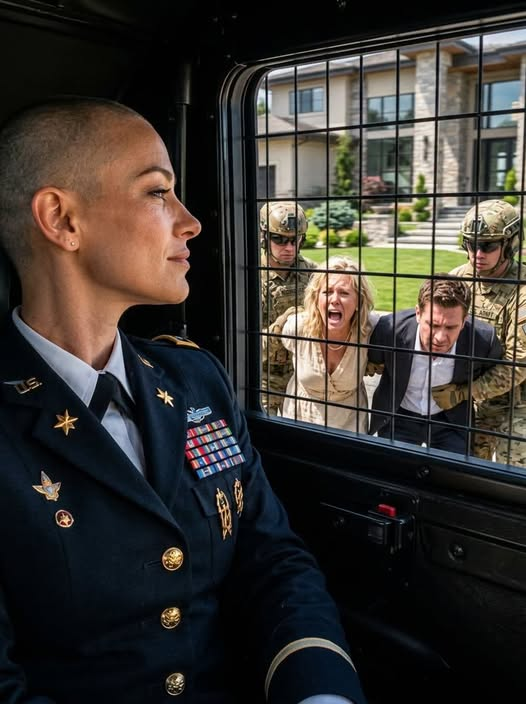
Ryan’s lifestyle did not.
Investigators found years of unauthorized personal expenses, self-dealing contracts, and payments routed through companies linked to Linda’s relatives.
Not every bad decision was criminal.
Some were simply arrogant.
Others became legal matters handled by people whose job it was to decide.
I stayed out of that process.
I did not call military contacts.
I did not use my rank.
I did not threaten anyone.
I signed what my civilian attorneys advised me to sign and let records speak for themselves.
Ryan was removed from executive management.
Linda lost every company benefit she had treated like an inheritance.
The vacation condo was sold.
The corporate vehicles were returned.
Her brother’s consulting agreement was terminated.
And the house where she had shaved my head?
The deed contained another surprise.
George had quietly paid off the remaining mortgage years earlier and transferred his contribution into a protected marital-property agreement specifying that my financial contributions were to be reimbursed if Ryan and I divorced.
Ryan had signed it.
He simply assumed I would never read it.
That assumption became expensive.
Linda tried to apologize only after the consequences arrived.
She came to my attorney’s office wearing pearls and carrying flowers.
“I was angry.”
I did not take the flowers.
“You assaulted me while I was asleep.”
Her eyes filled.
“I was trying to save my son’s marriage.”
“No.”
I looked at her.
“You were trying to control his wife.”
She lowered her voice.
“Ryan loves you.”
“Ryan loved what my presence made possible.”
“That isn’t true.”
“Then why did neither of you tell me about George’s trust?”
She stopped.
There was no answer that could help her.
Before leaving, she whispered:
“You took everything.”
I shook my head.
“I took back what legally belonged to me.”
Then I added:
“The difference feels like theft only when you’ve spent years treating someone else’s property as yours.”
She left without another word.
Ryan resisted the divorce for six months.
Then one evening he asked to meet.
He looked thinner.
Quieter.
For once, there was no anger.
“I didn’t know Mom was actually going to shave your head.”
I stared at him.
“You watched the aftermath and told me to obey.”
“I know.”
“That was worse.”
His eyes dropped.
“I was scared.”
“Of me?”
“Of losing everything.”
Finally.
The truth.
“My father always admired you more than me.”
“I never asked him to.”
“I know.”
“He trusted you with the company.”
“I didn’t know.”
“I know that too.”
Ryan rubbed both hands together.
“When you got promoted, Mom panicked. She said if we could get you to resign before the trust vested, the shares would stay with the family.”
I almost laughed.
“I was your family.”
He looked at me.
That realization arrived years too late.
“You were,” he whispered.
I nodded.
“Yes.”
Then I stood.
“Goodbye, Ryan.”
He did not ask me to stay.
Perhaps he finally understood that obedience was no longer available.
Our divorce became final ten months after the night of my promotion.
Sentinel received a professional outside CEO.
My shares remained independently managed under the ethical structure my attorneys helped establish.
The company recovered.
Employees kept their jobs.
George’s name remained on the building.
That mattered more to me than punishing anyone.
I remained in uniform.
And eventually, my hair grew back.
At first it was uneven.
Then short.
Then long enough to brush behind my ears.
I could have hidden what happened.
I didn’t.
The first official portrait taken after I assumed command showed me with barely an inch of hair.
For a while, I hated that photograph.
Then I stopped.
Because when I looked at it, I no longer saw the woman who woke up to find part of herself taken without permission.
I saw the colonel who reported for duty the next morning anyway.
A year later, my attorney sent me George’s original handwritten letter.
One sentence had been underlined twice.
Power is safest with the person who does not need to prove she has it.
I framed that line.
Not the share certificate.
Not the company valuation.
Not my divorce decree.
That sentence.
Linda believed power meant controlling someone.
Ryan believed power meant owning things.
For years, both of them thought my patience meant I had none.
They were wrong.
The night Linda shaved my head, she believed she had humiliated a woman into submission.
The next morning, I put on my uniform and reported to command.
The audit exposed what they had hidden.
The trust protected what George had built.
The divorce ended what Ryan had already broken.
And the “prize” they had fought so desperately to keep was never really the thirty-two-million-dollar company.
It was control.
They wanted control of my career, my money, my body, and my choices.
That was the one thing they never owned.
And after that night—
they never would again.
