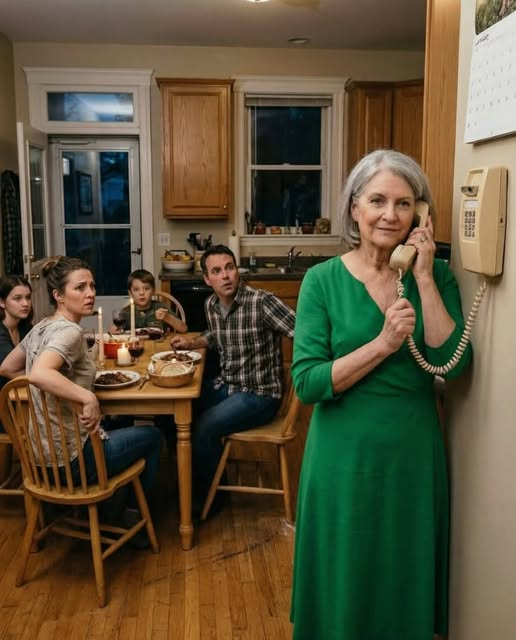
Gabriella’s voice came clearly through the kitchen receiver.
“Margaret, are you absolutely sure?”
Edward’s chair scraped backward.
“Mom.”
I kept my eyes on Linda.
“Yes,” I said.
Gabriella paused.
“Then I’ll revoke Edward’s authority tonight and prepare the new trust documents first thing tomorrow.”
Linda’s smile vanished.
Edward stood so quickly his napkin fell to the floor.
“Mom, hang up.”
I didn’t.
Gabriella Russo had been my attorney for twenty-three years.
She had handled Anthony’s estate when my husband died.
She prepared my will.
My medical directives.
My living trust.
And, six years earlier, when Edward’s business had nearly failed, she had prepared the paperwork that kept my son from losing everything.
Linda stared at him.
“What authority?”
Edward looked at me.
“Mom, please.”
I finally hung up.
The dining room had gone completely silent.
Even Dylan seemed to understand something had changed.
Linda folded her arms.
“What exactly did you just do?”
I returned to my seat.
“I protected my house.”
She laughed nervously.
“From us?”
“Yes.”
Edward lowered his voice.
“Mom, you don’t need to involve Gabriella.”
“That depends.”
I picked up my spoon.
“Are you planning to continue letting your wife tell me where I’m allowed to eat?”
His face reddened.
Linda stepped in immediately.
“I was establishing boundaries.”
“In my home.”
“You invited us to live here.”
“I invited you to stay temporarily.”
“That makes this our home too.”
“No.”
I said it gently.
“That makes you guests.”
Her expression hardened.
“You can’t throw a family with a child onto the street because your feelings got hurt.”
“I’m not throwing anyone into the street tonight.”
I took another bite of stew.
“Gabriella will handle everything properly.”
Edward stared at me.
“What did you mean by revoking my authority?”
I looked at my son.
“You know exactly what it means.”
Linda turned toward him.
“Edward?”
He sat down slowly.
Years earlier, after Anthony died, I had named Edward my successor trustee and granted him limited financial authority in case I became unable to manage my affairs.
Not ownership.
Not control while I was competent.
Just responsibility if I ever needed help.
At the time, it felt natural.
He was my only child.
I trusted him.
Then six months ago, Edward asked me to sign something.
He called it routine estate planning.
Gabriella reviewed it before I signed.
It would have expanded Edward’s authority over several assets, including the house.
I refused.
Edward claimed the document had been prepared incorrectly.
I chose to believe him.
Now I wondered whether that had been the first warning.
Linda looked between us.
“You were going to inherit this house anyway?”
Edward said nothing.
I answered for him.
“He was.”
Her eyes widened.
“Was?”
There it was.
The word she finally understood.
I smiled.
“Eat your dinner, Linda.”
She did not.
Instead, she stood.
“You’re changing your will because of one argument?”
“No.”
“I’m changing my plans because one argument showed me what everyone believed would happen after I was gone.”
Edward’s face tightened.
“That isn’t fair.”
“Then explain tonight.”
He rubbed his forehead.
“Linda got carried away.”
“She told your mother to eat outside.”
“I know.”
“And you said nothing.”
“I was caught in the middle.”
I laughed softly.
“No, sweetheart.”
For sixty-eight years, I had learned a few things.
One of them was that people loved describing themselves as trapped in the middle when choosing a side would cost them something.
“You were sitting at my table.”
I pointed toward the chair.
“That was your side.”
Linda scoffed.
“So what now? You’re going to give everything to charity just to punish us?”
I looked at her.
That question told me more than the insult had.
Not Are you really hurt?
Not Can we fix this?
Who gets the money?
I stood.
“Tomorrow morning, Gabriella is bringing paperwork.”
“For what?”
“First, a written temporary occupancy agreement.”
Linda stared.
“You want your own son to sign a lease?”
“No rent.”
I looked at Edward.
“Thirty days while you find another place.”
His face dropped.
“Mom.”
“You said you needed breathing room.”
“I did.”
“You’ve had it.”
Linda’s voice rose.
“You cannot do this!”
Sarah finally spoke.
She had been quiet all evening.
“Yes, she can.”
Linda turned.
“This has nothing to do with you.”
Sarah smiled faintly.
“You told Margaret to take her dinner outside and eat with me. I believe that invited me into the conversation.”
Dylan covered a laugh with his hand.
Linda glared at him.
I almost smiled.
Then I looked at my grandson.
“Dylan, none of this is your fault.”
His face became serious.
“I know, Grandma.”
“You will always have a place with me.”
Linda stiffened.
“What is that supposed to mean?”
“It means adults don’t use children as bargaining chips.”
I looked directly at her.
“And I won’t start tonight.”
Gabriella arrived at 8:30 the next morning.
She carried a leather briefcase and the expression of a woman who had already heard enough.
Linda came downstairs in exercise clothes and acted as though nothing had happened.
“Coffee?” she asked Gabriella.
“No, thank you.”
Gabriella placed three documents on the dining table.
The first revoked Edward’s successor authority.
The second amended my revocable trust.
The third formally documented the family’s temporary occupancy and the date it would end.
Edward read the trust amendment.
Then looked at me.
“You removed me as beneficiary.”
“Not entirely.”
His eyes moved across the page.
The house would no longer pass directly to him.
Instead, after my death, it would be sold.
Half of the net proceeds would go into an education trust for Dylan.
The other half would fund scholarships for students entering public education careers—the same work Anthony and I had spent our lives doing.
Linda nearly laughed from disbelief.
“You’re giving away Edward’s inheritance?”
Gabriella looked at her.
“It is not Edward’s inheritance until Margaret dies and the trust becomes irrevocable.”
Linda opened her mouth.
Gabriella continued.
“Until then, it is Margaret’s property.”
That ended the conversation.
Edward looked devastated.
“Dad wanted me to have the house.”
My chest tightened.
Anthony had loved our son deeply.
But he had also made one thing clear before he died.
Do not spend your final years afraid to use what we worked for.
I looked at Edward.
“Your father wanted you to become the kind of man we could trust with it.”
He flinched.
“That’s cruel.”
“No.”
My voice softened.
“Cruel would be pretending last night meant nothing.”
Then Gabriella opened the final folder.
“There is another matter.”
Edward’s face changed.
I noticed.
“So does he.”
Gabriella looked at him.
“Would you like to explain?”
Linda stared at her husband.
“Explain what?”
Edward said nothing.
Gabriella slid a bank statement toward me.
Three months earlier, someone had attempted to obtain a home-equity line using my address and property information.
The application had never completed because the bank required my direct verification.
I had dismissed the letter as junk.
Gabriella hadn’t.
The contact number on the preliminary application belonged to Edward.
Linda whispered:
“Edward?”
He closed his eyes.
“It never went through.”
I felt colder than angry.
“You tried to borrow against my house?”
“No.”
The answer came too quickly.
Gabriella tapped the page.
“The application lists your phone number.”
“I was exploring options.”
“With my property?”
“I lost my job, Mom.”
“You lost your job three weeks ago.”
He said nothing.
The application was three months old.
Linda turned toward him.
“You told me your mother had agreed to help with the condo investment.”
I looked at her.
“What condo?”
That was when the rest came out.
Edward and Linda had planned to purchase an investment property.
They needed capital.
Edward believed that because he would inherit my house someday, using part of its equity now was simply “accelerating” what would eventually be his.
I stared at my son.
“You thought my house already belonged to you.”
He looked ashamed.
“Not exactly.”
“Then explain the difference.”
He couldn’t.
Suddenly Linda’s behavior made perfect sense.
The bedroom.
The bathroom.
The closets.
The declaration that she was in charge.
She had not walked into my house believing she was a guest.
She believed she had arrived early at her inheritance.
I sat down.
For the first time since Anthony died, I missed him so badly I could barely breathe.
Not because I needed him to rescue me.
Because I wanted him beside me when our son finally understood what entitlement had turned him into.
Edward whispered:
“I’m sorry.”
I looked at him.
“Are you?”
“Yes.”
“For trying to borrow against the house?”
“Yes.”
“For lying?”
“Yes.”
“For staying quiet last night?”
His eyes filled.
“Yes.”
That answer finally sounded different.
They moved out twenty-six days later.
Not homeless.
Not ruined.
Edward found a smaller apartment near Dylan’s school.
Linda hated it.
She blamed me for everything.
Then she blamed Edward.
Eventually, she stopped speaking to me altogether.
I did not chase her.
Edward did.
For months, our conversations were limited to Dylan.
Pickup times.
School events.
Birthdays.
Nothing more.
Then one Sunday, almost a year later, Edward came alone.
I opened the door.
He remained on the porch.
“Can I come in?”
That question nearly broke me.
Not because it was profound.
Because my son had finally learned to ask.
“Yes.”
He entered.
He looked around the dining room.
Same table.
Same china cabinet.
Same back door Linda had once pointed toward.
“I think about that night all the time.”
“So do I.”
He sat down.
“Linda and I are separating.”
I said nothing.
“This isn’t because of you.”
“I know.”
“She never forgave me for losing the house.”
I raised an eyebrow.
“You never had the house.”
A sad smile appeared.
“I know that now.”
He looked toward Anthony’s photograph.
“Dad would be ashamed of me.”
“Probably disappointed.”
Edward looked at me.
“There’s a difference?”
“Your father always believed disappointment meant there was still room to improve.”
That made him cry.
My sixty-two-year-old son sat at my dining table and cried like the ten-year-old boy who once broke Anthony’s favorite radio and tried to hide it under his bed.
I reached across the table.
Not to erase what happened.
Just to remind him that consequences and love could exist at the same time.
“I’m sorry, Mom.”
This time, I believed him.
The trust stayed exactly as Gabriella rewrote it.
Edward never asked me to change it back.
Dylan eventually learned about the education fund.
He hugged me and said:
“Grandma, I don’t need your money.”
I laughed.
“That is precisely why you’re getting some of it.”
Years later, he chose to study engineering instead of education.
Anthony would have pretended to complain.
I paid his tuition anyway.
As for the house, I remained there.
I planted tomatoes badly.
Sarah came over for dinner twice a week.
Sometimes Edward joined us.
Always after calling first.
One evening, he carried his plate toward the patio.
I looked at him.
“Where are you going?”
He smiled.
“Outside to eat with your friend.”
Sarah laughed so hard she nearly spilled her wine.
I pointed at the chair beside me.
“Sit down.”
He did.
And for the first time, the memory did not hurt.
Linda had believed power meant walking into someone else’s home and declaring ownership loudly enough that everyone would accept it.
For years, I had believed love meant staying quiet enough to prevent conflict.
We were both wrong.
A house is not yours because you sleep in it.
An inheritance is not yours because you expect it.
And family does not mean one person must surrender dignity so everyone else can remain comfortable.
That night, Linda pointed at my back door and ordered me to leave my own table.
I made one phone call.
She thought Gabriella was going to help me throw her out.
But Gabriella did something more important.
She reminded everyone at that table of a truth I should never have forgotten:
Generosity is not surrender.
Hospitality is not ownership.
And the woman who opens her door for you still has every right to decide when it closes.
