Instead of pulling away, Arthur closed his eyes and took one slow breath.
Then another.
His hands were still trembling.
But he didn’t try to force them still.
He simply adjusted.
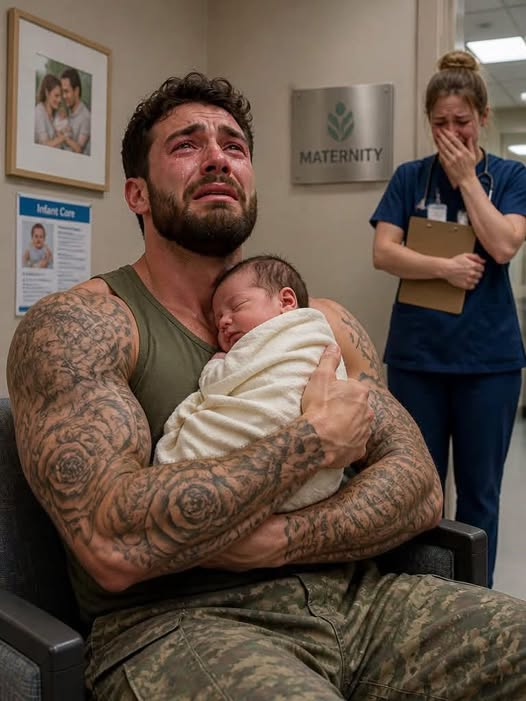
One palm supported the baby’s head. The other rested gently across her blanket.
“I’m here,” he whispered.
The monitors continued chirping.
Then something changed.
Baby Girl Sterling’s cry weakened.
Her tiny body stopped twisting.
Within seconds, she became quiet.
Every nurse in the room stared.
Arthur opened his eyes.
“That’s it, little one,” he murmured. “You don’t have to fight everybody at once.”
Then his hospital gown shifted.
A silver dog tag slipped from beneath his shirt.
I saw the engraving.
CPT ARTHUR VANCE — U.S. ARMY
And beneath it:
SARAH STERLING
I froze.
Sterling.
The baby’s temporary surname.
“Mr. Vance…”
Arthur noticed where I was looking.
His expression changed.
I pointed toward the tag.
“Who is Sarah Sterling?”
For several seconds, he said nothing.
Then he looked at the infant in his arms.
“She was a medic.”
His voice became softer.
“Best one I ever knew.”
Arthur explained that seventeen years earlier, his convoy had been caught in an attack overseas.
He survived.
Barely.
Sarah Sterling had been part of the evacuation team.
“She stayed with me when everyone was telling her to move.”
His eyes glistened.
“She kept saying, ‘Nobody gets left alone.’”
Arthur touched the scars along his forearm.
“She saved my life.”
I looked at the baby.
Then back at him.
“Is this child related to her?”
“I didn’t know until yesterday.”
Arthur reached carefully into his pocket and handed me an old photograph.
A young woman in uniform stood beside a little girl.
On the back:
Sarah and Madison Sterling.
My stomach tightened.
Madison Sterling.
The name listed as Baby Girl Sterling’s mother.
Arthur nodded.
“Sarah’s daughter.”
Suddenly the entire situation became clear.
The abandoned premature baby Arthur was holding was the granddaughter of the woman who had once refused to abandon him.
Arthur looked down at her.
His voice cracked.
“Sarah stayed when I needed someone.”
He swallowed.
“So I figured I could stay for hers.”
I had worked in neonatal care for eleven years.
I had learned how to remain professional through moments that could break your heart.
That morning, I failed.
I turned away and wiped my eyes.
Arthur returned the next day.
Then the day after that.
Soon, everyone simply expected him.
Every morning at eight, the enormous veteran with trembling hands appeared beside bed seven.
He read stories.
He hummed terribly.
He sometimes sat silently for hours with one finger resting inside the incubator so the baby could hold it.
Eventually we gave her a first name.
Grace.
Arthur suggested it.
“Sarah always said people survive on more grace than they realize.”
So Baby Girl Sterling became Grace Sterling.
Weeks passed.
Grace gained weight.
Her breathing strengthened.
The crying episodes became less frequent.
And Arthur changed too.
At first, monitor alarms sometimes caused him to freeze.
One morning a metal tray crashed in the hallway.
Arthur’s whole body went rigid.
His breathing changed.
I moved toward him.
Before I could speak, Grace wrapped her tiny hand around his finger.
Arthur stared at her.
Then slowly breathed out.
“I’m okay,” he whispered.
I wasn’t sure whether he was speaking to us or himself.
Maybe both.
That was when I began wondering who was actually healing whom.
Three months later, Grace was almost ready to leave the NICU.
That should have been good news.
Instead, Arthur became unusually quiet.
Social services still hadn’t found Madison.
There were no grandparents willing to take custody.
No father had been identified.
Grace would likely enter foster care.
Arthur stood beside her crib after the meeting.
“Where will she go?”
“We don’t know yet.”
“With strangers?”
“With an approved family.”
He stared at Grace.
“They’ll know about her medical needs?”
“Yes.”
“They’ll know what calms her down?”
“We’ll explain everything.”
Arthur nodded.
But he didn’t leave.
Finally, he asked:
“What would I have to do?”
I understood immediately.
“Arthur…”
“What would I have to do to become approved?”
I stared at him.
He was fifty-two.
Single.
Living alone.
A veteran with scars, a permanent tremor, and a history of trauma he had never tried to hide.
But he had also spent three months doing something no one else had done.
Showing up.
Every day.
The social worker met with him the next morning.
Arthur filled out every form.
He attended every class.
His home was inspected.
His doctors were consulted.
His therapist wrote a letter.
His former commanding officer provided a reference that ended with:
If Arthur Vance tells a child he will stay, that child will never have to wonder whether he means it.
Still, there were doubts.
One evaluator looked at Arthur’s shaking hands.
“Do you believe you can safely care for an infant?”
Arthur looked down at them.
“No.”
The evaluator seemed surprised.
Arthur continued.
“I believe I can safely care for Grace.”
He explained the adaptive techniques therapists had taught him.
How he sat before lifting her.
How he supported his arms.
How he never carried her when his tremors became worse.
“I know my limitations.”
Then he looked directly at the evaluator.
“Being strong enough to care for someone doesn’t mean pretending you have none.”
Two weeks later, temporary approval came through.
I found Arthur sitting alone in the hospital chapel when I went looking for him.
“You can take her home.”
He didn’t move.
“What?”
I smiled.
“They approved you.”
The enormous man covered his face with both hands.
His shoulders shook.
For several minutes, Captain Arthur Vance cried like someone who had finally survived a war he never expected to win.
Grace left the NICU on a Tuesday morning.
Arthur had bought almost everything wrong.
Too many blankets.
Three different bottle warmers.
Enough diapers for a small army.
And a car seat he had practiced installing seventeen times.
As I helped secure Grace inside it, Arthur looked terrified.
“You’ve been in combat,” I said.
He nodded.
“You’ve coordinated evacuations.”
“Yes.”
“And a seven-pound baby scares you?”
“Absolutely.”
I laughed.
“Good. That means you understand parenting.”
Before he left, he removed the old dog tag from his neck.
The one carrying Sarah Sterling’s name.
“I’ve worn this for seventeen years.”
He turned it over in his palm.
“I think I finally understand why.”
Then he showed me a second tag.
New.
Simple.
It read:
GRACE VANCE-STERLING
Underneath:
NOBODY GETS LEFT ALONE.
The adoption became official eighteen months later.
I attended the hearing.
Grace was wearing a yellow dress and repeatedly trying to steal the judge’s pen.
Arthur stood beside her in a dark suit.
His hands still trembled.
They always would.
When the judge signed the final order, Arthur lifted Grace into his arms.
She immediately rested her head against his scarred chest.
“Congratulations, Mr. Vance,” the judge said.
Arthur looked at her.
“Thank you.”
Outside the courthouse, I finally asked him something.
“Do you ever wonder why Sarah’s granddaughter somehow ended up in your NICU volunteer program?”
Arthur smiled.
“Every day.”
“You think it was fate?”
“I don’t know.”
He looked toward Grace, who was laughing at pigeons on the courthouse steps.
“I spent seventeen years asking why Sarah saved me.”
He paused.
“Maybe I was asking the wrong question.”
“What should you have asked?”
Arthur’s trembling hand reached down.
Grace immediately grabbed it.
He smiled.
“What am I supposed to do with the life she gave me?”
Then they walked toward the parking lot together.
A battle-scarred veteran.
And the child nobody had come back for.
People had looked at Arthur’s hands and seen damage.
Grace never did.
She only knew those hands as the ones that lifted her when she cried.
The ones that held her through difficult nights.
The ones that never disappeared.
Years ago, Sarah Sterling had stayed beside a wounded soldier when leaving would have been easier.
Years later, that soldier finally returned the promise.
Nobody gets left alone.
And this time—
neither did Grace.
