For five seconds after I said the words criminal investigation, nobody moved.
Then Admiral Vale turned toward the security chief.
“Seal the yard.”
Commander Holt’s face changed instantly.
“Admiral, that’s unnecessary.”
Vale looked at him.
“I wasn’t asking.”
The gates were closed.
Phones were collected.
The surveillance room was placed under guard.
And for the first time since I arrived at Coronado, the people who had spent years intimidating junior sailors realized the rules could apply to them too.
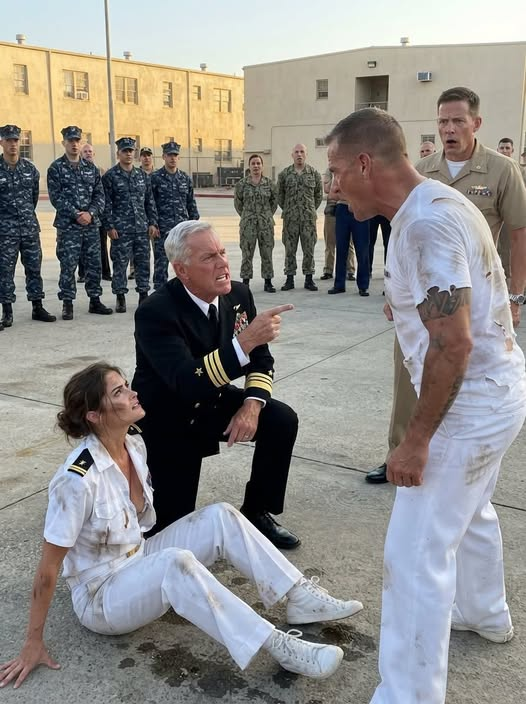
Mercer stood several feet away from me, staring at the torn shoulder of my uniform.
His confidence was gone.
“I didn’t know who she was,” he muttered.
I heard him.
So did everyone else.
I turned.
“That’s the problem, Petty Officer.”
His eyes lifted.
“You think what you did becomes unacceptable only because of who I am.”
Silence.
I pointed toward the younger sailors gathered along the edge of the yard.
“You should never have done it to any of them either.”
One sailor looked down.
Another clenched his jaw.
That reaction told me more than Mercer understood.
This had happened before.
Admiral Vale noticed too.
“Lieutenant Commander Ward,” he said quietly, “what exactly were you sent here to investigate?”
I looked at Holt.
“Officially?”
I reached inside what remained of my jacket and removed a sealed authorization card.
“Training irregularities.”
Holt swallowed.
“Unofficially, the Inspector General received seventeen anonymous complaints in fourteen months.”
The yard went dead silent.
Mercer looked toward Holt.
That glance mattered.
I continued.
“Abusive initiation exercises. Retaliation against whistleblowers. Falsified readiness reports.”
One of Holt’s officers stepped backward.
“And three unexplained medical discharges involving sailors from the same training division.”
Holt finally found his voice.
“This is absurd.”
“Is it?”
I nodded toward the cameras.
“You just ordered a subordinate to assault an officer because she challenged you.”
His expression hardened.
“I ordered a training demonstration.”
“No.”
A voice came from the back.
Everyone turned.
A young seaman stepped forward.
He couldn’t have been older than twenty.
His nametag read PARKER.
His hands were shaking.
“That wasn’t training.”
Holt stared at him.
“Seaman, return to formation.”
Parker didn’t move.
I looked at him.
“What’s your first name?”
“Evan, ma’am.”
“Tell us what you mean.”
Holt stepped forward.
“Ward, you cannot conduct interviews in the middle of—”
Admiral Vale blocked him.
“Commander Holt.”
His voice was dangerously calm.
“You will remain exactly where you are.”
Parker inhaled.
Then said the sentence that changed everything.
“They did the same thing to Mason Reed.”
Several sailors reacted immediately.
I knew that name.
Mason Reed.
One of the medical discharges.
Official report: training accident.
Broken shoulder.
Severe concussion.
Permanent loss of flight eligibility.
I had read every page.
“What happened to Reed?” I asked.
Parker’s voice dropped.
“He filed a complaint.”
Mercer looked away.
“Holt found out.”
Commander Holt exploded.
“That is a lie!”
Parker flinched.
For one second, I saw the fear he had been living with.
Then another sailor stepped beside him.
“Parker’s telling the truth.”
Then another.
And another.
Within a minute, seven sailors had stepped out of formation.
Holt stared at them as though betrayal had surrounded him.
I saw something else.
Relief.
These sailors had been waiting for the first person brave enough to speak.
Parker continued.
“They took Reed into Hangar Four after evening drills.”
My stomach tightened.
Hangar Four wasn’t part of the original inspection.
“Who is ‘they’?”
Parker looked toward Mercer.
Then Holt.
“Both of them.”
Mercer went pale.
“That’s not what happened.”
Holt snapped at him.
“Shut up.”
Too late.
I looked at Vale.
“We need Hangar Four secured.”
He nodded immediately.
The hangar looked ordinary.
That was what bothered me.
Rows of equipment.
Tool cabinets.
Training gear.
Nothing obviously wrong.
Then one investigator noticed fresh paint along the rear wall.
A section approximately six feet wide.
Different shade.
Different texture.
We brought in base facilities personnel.
Behind the paneling was a narrow storage space that did not appear on the current floor plans.
Holt began sweating.
Inside were boxes.
Phones.
Personal notebooks.
Several damaged nameplates.
And a locked filing cabinet.
Mercer whispered:
“Oh God.”
I heard him.
“What?”
He shook his head.
“I didn’t know that was still here.”
Again.
Wrong answer.
The cabinet was opened under warrant.
Inside were dozens of handwritten reports.
Not official reports.
Private ones.
Names.
Dates.
Punishments.
Descriptions of unauthorized exercises.
Beside some names was a single word:
BROKEN.
Beside others:
USEFUL.
My stomach turned.
This was not hazing.
It was a system.
Holt had created an unofficial hierarchy based on fear.
Sailors who obeyed were protected.
Those who complained were isolated.
Those who resisted were punished until they requested transfer, failed evaluations, or left the service entirely.
And someone had been helping him erase the evidence.
Vale picked up one folder.
His face hardened.
“This signature.”
I stepped beside him.
At the bottom of several altered readiness reports was the same approving officer.
Captain Daniel Ross.
Vale’s chief of staff.
The man responsible for arranging my supposedly secret arrival.
I looked at the admiral.
Neither of us spoke.
We understood simultaneously.
Holt had known an inspector was coming.
Maybe not my identity.
But enough to prepare.
Which meant the rot reached higher.
Ross was detained before sunset.
By midnight, the Inspector General had expanded the investigation across three commands.
Mercer requested an attorney.
Holt refused to speak.
Parker and the other sailors gave protected statements.
And Mason Reed was located in Colorado.
When investigators called him, he stayed silent for nearly a minute.
Then he asked:
“Did Parker finally talk?”
That was how we knew.
Reed still remembered exactly who had witnessed what happened.
Three days later, he flew to Coronado.
He walked with a slight limp.
When he entered the conference room, Parker immediately stood.
Neither man spoke.
Then Reed crossed the room and hugged him.
Parker broke down.
“I’m sorry.”
Reed shook his head.
“You were nineteen.”
“I should’ve helped.”
“You survived.”
Then Reed looked at me.
“Are they actually listening this time?”
“Yes.”
His face crumpled.
Not dramatically.
Just years of disbelief finally giving way.
“Good.”
The investigation lasted six months.
Commander Holt was removed from command and later convicted on multiple offenses related to abuse of authority, obstruction, and falsification of official records.
Mercer accepted responsibility for his role and testified about what Holt had ordered over the years.
Captain Ross’s involvement ended his career.
More importantly, seventeen sailors had their disciplinary records reviewed.
Nine had evaluations corrected.
Three were offered opportunities to return to specialized training.
Mason Reed received formal acknowledgment that his injuries had not resulted from a legitimate training accident.
No ceremony could return what he lost.
But the official record finally stopped calling him responsible for it.
As for me, I remained at Coronado until the final interviews were completed.
On my last morning, I returned to the training yard.
Parker was there.
So was Admiral Vale.
The same patch of concrete where Mercer had thrown me down had been repaired.
Vale glanced at the scar hidden beneath my uniform.
“I still think about the Red Sea.”
“So do I.”
“You saved my life.”
I shook my head.
“We saved each other.”
He smiled faintly.
Then Parker approached.
“Ma’am?”
“Yes?”
He looked nervous.
“I wanted to ask something.”
“Go ahead.”
“That first day… you could have stopped Mercer, couldn’t you?”
Vale looked at me.
I didn’t answer immediately.
Then I nodded.
“Yes.”
Parker frowned.
“Why didn’t you?”
I looked across the yard.
At the cameras.
At the sailors training without anyone screaming humiliation disguised as leadership.
“Because everyone already knew what Holt was.”
Parker listened.
“What we didn’t have was proof strong enough to protect the people willing to say it.”
I touched the repaired seam of my jacket.
“Sometimes an investigation changes when the wrong person finally believes they’re untouchable.”
Parker nodded slowly.
Then he saluted.
I returned it.
As I walked toward the gate, Admiral Vale called after me.
“Elena.”
I turned.
He looked toward the scar hidden beneath my uniform.
For years, that scar had represented the worst day of my career.
The Red Sea.
Fire.
Loss.
Survival.
But after Coronado, it meant something else too.
Evidence did not always look like a document.
Sometimes it looked like a sailor finally stepping forward.
Sometimes it looked like a hidden room behind fresh paint.
And sometimes it looked like a scar exposed by the very person who believed violence would make someone smaller.
Mercer’s shove was supposed to humiliate me.
Instead, it opened an investigation that freed seventeen people from lies buried in their records.
Commander Holt had spent years teaching sailors that silence was strength.
He was wrong.
Silence only protects the powerful when everyone agrees to keep it.
That morning, one person stopped.
Then another.
Then seven.
And once the truth finally had enough voices behind it—
no rank in the Navy was high enough to bury it again.
