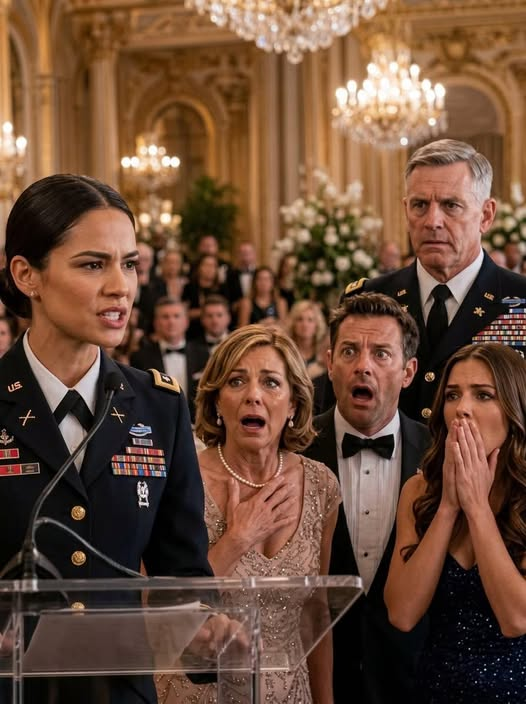
For several seconds after General Hayes saluted me, I forgot my family was even in the room.
Then the applause began.
Not polite applause.
A standing ovation.
Veterans rose first.
Then donors.
Then politicians.
Finally, almost everyone in the ballroom was on their feet.
Everyone except my parents and Mia.
General Hayes lowered his hand.
“Colonel Parker.”
“Sir.”
His expression softened.
“Twelve years is a long time to keep doing difficult work without asking for recognition.”
My throat tightened.
He had no idea how deeply those words landed.
Or maybe he did.
The master of ceremonies returned to the microphone.
“Colonel Parker’s service record cannot be discussed in full tonight, but we are authorized to recognize her leadership during multiple overseas assignments and her work training specialized medical evacuation teams.”
My mother stared at me.
“Medical?”
My father whispered:
“You never told us.”
I turned toward them.
“I did.”
He frowned.
“When?”
“Several times.”
Silence.
“You just never listened long enough to remember.”
Mia looked at the medal case an aide carried toward the stage.
Her smile had vanished.
General Hayes gestured toward the front.
“Colonel, this evening was always supposed to include you.”
My father blinked.
“What do you mean?”
The General looked at him.
“The Army contacted the foundation three months ago.”
The color disappeared from my father’s face.
I slowly turned.
“Three months?”
The event coordinator standing near the stage looked suddenly terrified.
My father said nothing.
General Hayes continued.
“We were told Colonel Parker preferred not to be publicly recognized.”
I stared at my parents.
“I never said that.”
My mother grabbed my father’s arm.
“Robert…”
And that was when I understood.
They hadn’t simply overlooked me.
They had deliberately removed me from the program.
Because tonight was supposed to belong to Mia.
My father finally spoke.
“We thought Lauren would be uncomfortable.”
“No,” I said.
“You thought Mia would be overshadowed.”
Mia’s eyes filled with anger.
“This is ridiculous. Nobody knew you were some important colonel.”
“That was never the point.”
I looked at her.
“You didn’t need to know I was important.”
The room around us had grown painfully quiet.
“You only needed to know I was your sister.”
Then someone touched my elbow.
An elderly man I recognized as my grandmother’s attorney.
“Colonel Parker?”
“Yes?”
“Your grandmother asked me to give you something if this family ever held another Veterans Gala without properly acknowledging you.”
My mother went completely still.
The attorney handed me a small brass key.
“Her safety-deposit box.”
My father stepped forward.
“What does that have to do with tonight?”
The attorney looked at him.
“Quite a lot.”
The box was opened the next morning.
Inside were photographs.
Letters.
Foundation records.
And one envelope addressed:
TO LAUREN — WHEN THEY FINALLY FORCE YOU TO SEE THE TRUTH.
My hands shook as I opened it.
My grandmother’s handwriting filled four pages.
Lauren,
If you are reading this, your parents are still repeating the same mistake I watched them make when you were a child.
They believe Mia needs applause more than you need fairness.
I tried to stop it.
I failed.
But there is something they never told you.
I kept reading.
The Parker Veterans Foundation had not been created by my father.
It had been created by my grandfather.
A Korean War veteran.
When he died, my grandmother inherited control.
My father managed its public operations, which was why everyone assumed it belonged to him.
But legally, voting authority would transfer after my grandmother’s death.
Not to Dad.
Not to Mia.
To me.
I stopped reading.
The attorney slid a document across the table.
“Your grandmother named you controlling trustee.”
I stared at him.
“When?”
“Seven years ago.”
“Why didn’t anyone tell me?”
“She instructed us not to interfere with your military obligations unless foundation assets were endangered.”
He opened another folder.
“They are now.”
My stomach tightened.
The documents showed hundreds of thousands of dollars spent on “public outreach.”
Luxury hotels.
Private dinners.
Consulting fees.
Wardrobe expenses.
Travel.
Most were connected directly to Mia’s public appearances.
One payment caught my attention.
$84,000 — Strategic Veterans Ambassador Development.
Recipient:
Mia Parker.
I looked at the attorney.
“She was paying herself?”
“Through a consulting company.”
My father had approved it.
Then I found something worse.
Scholarship funds meant for children of disabled veterans had been redirected to cover gala expenses.
Including last night’s event.
The same gala where my father had told me VIP seats were reserved for people who represented the family.
I closed the folder.
“How much is missing?”
“Potentially over nine hundred thousand dollars.”
My father called before I could answer.
I put him on speaker.
“Lauren, we need to talk before you do anything impulsive.”
I almost laughed.
“What would count as impulsive?”
“You don’t understand how foundations operate.”
“I understand scholarships shouldn’t pay for Mia’s dresses.”
Silence.
Then:
“Those expenses build visibility.”
“For veterans?”
“For the organization.”
“Then why is Mia’s company receiving consulting fees?”
His tone hardened.
“Your sister worked for years building that foundation.”
I looked at my grandmother’s letter.
“No.”
I said it quietly.
“She built herself using the foundation.”
My father exhaled sharply.
“You have no right to judge this family after being gone twelve years.”
There it was.
The accusation I had carried forever.
I left.
Therefore, I forfeited my place.
“I wasn’t gone, Dad.”
I looked at the uniform hanging beside me.
“I was serving.”
He hung up.
Three days later, I called an emergency board meeting.
My parents arrived with Mia and two attorneys.
Dad still believed he controlled the room.
He didn’t.
The attorney announced the trust succession.
Then he identified me as controlling trustee.
My mother whispered:
“This cannot be happening.”
Mia stood.
“You don’t even care about this foundation!”
I looked at her.
“You’re right.”
She seemed surprised.
“I care about the veterans it was created to serve.”
That was different.
I ordered an independent audit.
Suspended all family consulting contracts.
Froze discretionary spending.
And temporarily removed my father from financial authority pending review.
He slammed both hands onto the table.
“You’re destroying everything I built!”
“No.”
I slid my grandfather’s original charter toward him.
“I’m trying to save what Grandpa built.”
The audit took four months.
The results were embarrassing.
Some spending was legal but excessive.
Other transactions required repayment.
My father avoided criminal charges after the board accepted restitution and governance reforms.
Mia was required to return substantial consulting payments.
She blamed me publicly at first.
Then the records became available to donors.
She stopped talking.
The foundation survived.
Better than survived.
Within a year, administrative spending dropped dramatically.
Scholarships increased.
We expanded mental-health assistance for veterans’ families and created emergency housing grants.
I refused to put my photograph on promotional material.
General Hayes laughed when he heard.
“Still hiding?”
“No, sir.”
I smiled.
“I’m just finally putting the right people in front.”
My relationship with my family took longer.
Mom apologized first.
Not well.
“I’m sorry you felt excluded.”
I stopped her.
“No.”
She frowned.
“You excluded me.”
Her eyes filled.
For once, I didn’t soften the truth to protect her.
Eventually she tried again.
“I’m sorry we excluded you.”
That apology I accepted.
Mia took almost two years.
We met after a foundation ceremony honoring military families.
She looked different without photographers around her.
“I hated you that night,” she admitted.
“I know.”
“When that General saluted you, I thought you had stolen everything from me.”
I waited.
She looked down.
“Then I realized you hadn’t taken anything.”
Her voice cracked.
“Mom and Dad just taught me that if you were praised, there was less praise left for me.”
That hurt because I understood it.
“They did the same thing to me.”
She looked up.
“How?”
“They taught me your happiness was more important than mine.”
For the first time in decades, neither of us was competing.
We were simply two sisters recognizing the same damage from opposite sides.
Mia eventually returned to the foundation.
Not as its star.
As a volunteer fundraiser.
No salary.
No cameras.
She turned out to be very good at it.
Three years after that gala, our family held another Veterans Appreciation event.
I arrived in uniform.
Mom saw me first.
For one second, an old memory returned.
Don’t stand next to your sister.
Then she walked toward me.
“Lauren.”
“Yes?”
“The photographer is waiting.”
I almost smiled.
“Where do you want me?”
Mom took my hand.
“Wherever you want to stand.”
Mia appeared beside her.
Then she stepped away from the center.
“Actually…”
She pointed toward the middle.
“You should be there.”
I shook my head.
“No.”
I took her arm and pulled her beside me.
“Both of us.”
Dad stood behind the photographer.
He looked older.
Quieter.
When everyone was ready, he said:
“Wait.”
He walked toward me.
For twelve years, I had wanted him to say he was proud.
When he finally did, it came without an audience.
“I spent your whole life looking at the daughter who demanded attention.”
His voice shook.
“And I missed the one who never asked for it.”
I swallowed.
“I’m sorry, Lauren.”
I nodded.
Then the photographer raised the camera.
This time nobody moved me aside.
Nobody hid me at the back.
And strangely, I no longer needed the photograph to prove that I belonged.
Because I had finally learned something my family should have taught me years ago.
Being overlooked does not make you insignificant.
Sometimes the person standing quietly outside the frame is carrying the greatest story in the room.
And when the truth finally steps into the light—
no one gets to crop her out again.
