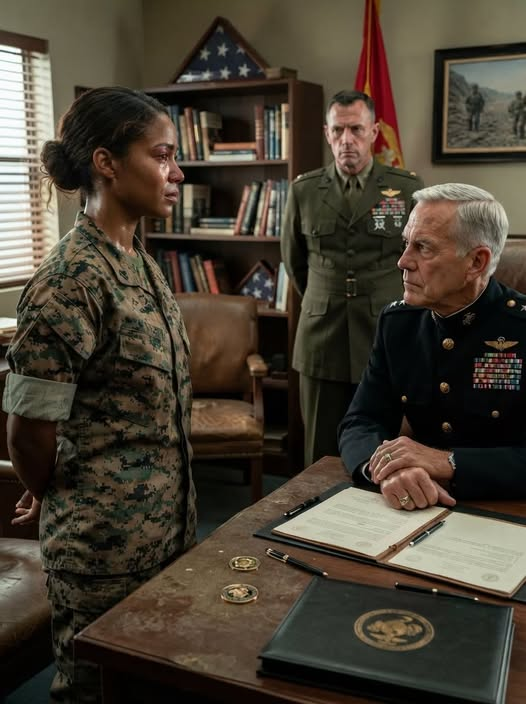
The four-star general placed the document on the desk but did not hand it to me.
Not yet.
“Stand at ease, Corporal.”
I obeyed.
My commanding officer, Lieutenant Colonel Hayes, remained silent beside him.
That made me more nervous than anything.
The general studied me for a long moment.
“Do you remember me?”
“Yes, sir.”
“From?”
“The diner, sir.”
He nodded.
“And what did you think when my card was declined?”
I hesitated.
“I didn’t think much about it, sir.”
His eyebrow lifted.
“That’s not an answer.”
I swallowed.
“I thought you were a veteran having a bad night.”
“And?”
“That if I could help, I should.”
The general looked at Hayes.
Then back at me.
“You didn’t ask my rank.”
“No, sir.”
“You didn’t ask what I had done.”
“No, sir.”
“You didn’t ask whether paying my bill might benefit you.”
“No, sir.”
A faint smile appeared.
“Good.”
Then he tapped the folder.
“This meeting is not about the bill.”
My stomach tightened again.
General Samuel Barrett walked toward the window.
“There is a leadership selection board convening next month for a specialized security and logistics program.”
I blinked.
I had heard rumors about it.
A joint unit.
Small.
Competitive.
Usually reserved for Marines with records far more impressive than mine.
“Sir?”
“You were recommended.”
I looked at Lieutenant Colonel Hayes.
He shook his head slightly.
Not him.
General Barrett continued.
“Three weeks ago, I visited this installation unofficially.”
My mind went back to the diner.
The veteran cap.
The faded jacket.
The declined card.
Suddenly, none of it felt accidental.
“You were testing people?” I asked before I could stop myself.
Hayes’s expression warned me.
But Barrett laughed.
“No, Corporal.”
Then his face became serious.
“I was observing.”
He returned to the desk.
“Leadership looks very different when nobody believes leadership is watching.”
That sentence stayed in the room.
He opened the folder.
Inside were evaluation summaries.
My name appeared on the first page.
Corporal Jake Reynolds.
Physical performance.
Unit readiness.
Peer reports.
Disciplinary history.
Volunteer work.
Every detail of my military life reduced to lines of black ink.
“I asked for your record after that evening,” Barrett said.
My throat tightened.
“Why, sir?”
“Because paying for a stranger’s dinner is easy.”
I frowned.
He continued.
“What interested me was what you did afterward.”
I had no idea what he meant.
Barrett read from another page.
“March seventeenth. You stayed two hours after shift to help Lance Corporal Everett correct a logistics inventory error even though it wasn’t your responsibility.”
I stared at him.
“March twenty-fourth. You declined credit when your team received recognition for a successful field exercise.”
Another page.
“April second. You reported a maintenance issue before deployment even though doing so delayed your own section and made you unpopular for forty-eight hours.”
Hayes looked at me.
I suddenly understood.
They had not investigated whether I was nice.
They had investigated whether the diner matched the rest of my behavior.
Barrett closed the folder.
“Anybody can perform one good deed when someone is watching.”
His eyes locked onto mine.
“Character is repetition.”
I said nothing.
Then Hayes finally spoke.
“General Barrett requested you personally for the selection board.”
That nearly stopped my breathing.
“Sir, with respect, I’m a corporal.”
Barrett smiled.
“I noticed.”
“The candidates are officers and senior NCOs.”
“Mostly.”
“Then why me?”
His smile disappeared.
“Because we have enough people who know how to give orders.”
He stepped closer.
“I’m looking for people who know what responsibility feels like before anyone gives them authority.”
I felt something tighten in my chest.
For years, I had assumed advancement came from being louder.
More visible.
Better connected.
I had watched others take credit.
I had kept doing my job.
Apparently somebody had noticed.
But then Barrett’s expression changed.
“However, there is another reason you’re here.”
Of course there was.
He pulled a second document from the folder.
This one had red markings across the top.
INCIDENT REVIEW — RESTRICTED
Hayes shut the office door.
Barrett slid the paper toward me.
I recognized the location immediately.
Warehouse Three.
Our logistics section.
A place where equipment sometimes disappeared into paperwork before magically reappearing days later.
“What am I looking at, sir?”
“You tell me.”
I read.
Serial numbers.
Transfer records.
Missing protective equipment.
Signatures.
One of them belonged to Staff Sergeant Cole.
My direct supervisor.
Another belonged to a civilian contractor.
I felt my stomach drop.
“There have been discrepancies for six months,” Barrett said.
“I didn’t know.”
“I believe you.”
That surprised me.
“Why?”
“Because two weeks ago, someone altered an inventory report using your login credentials.”
My pulse jumped.
“What?”
Hayes handed me another sheet.
My username.
A 1:43 a.m. access time.
I had been asleep in my barracks.
“That wasn’t me.”
“We know.”
Barrett watched my reaction.
“The system logged a second authentication point.”
He gave me the device location.
Staff Sergeant Cole’s office.
I stared at the paper.
Someone had used my credentials.
And positioned me to take the blame.
Barrett continued.
“We believe somebody realized an inspection was coming.”
The diner suddenly felt very far away.
“Why are you telling me this?”
“Because I need to know whether I chose the right Marine.”
I looked at him.
“For what?”
Barrett leaned forward.
“To help us identify how far this goes.”
My chest tightened.
“Sir, are you asking me to investigate my own unit?”
“No.”
He shook his head.
“I’m asking you to continue doing exactly what you’ve been doing.”
“Which is?”
“Your job.”
He paused.
“While paying attention.”
That was more frightening than an order.
Because it meant the people involved could not know anything had changed.
Hayes spoke quietly.
“Your selection-board recommendation remains legitimate. This investigation is separate.”
I looked between them.
“And Staff Sergeant Cole?”
Barrett’s expression hardened.
“He has no idea we know.”
Over the next nine days, I said nothing.
I inventoried equipment.
Filed reports.
Drank terrible coffee.
Listened.
Then I began noticing things.
Cole always volunteered to handle late-night deliveries.
Certain crates bypassed normal inspection.
A civilian contractor named Bradley Knox visited far more often than his schedule required.
And three junior Marines acted nervous whenever Warehouse Three was mentioned.
On the tenth night, Lance Corporal Everett found me outside the barracks.
“Reynolds.”
He looked terrified.
“What?”
“Can we talk?”
We walked away from the building.
Everett lowered his voice.
“You remember that inventory mistake you helped me fix?”
“Yes.”
“It wasn’t a mistake.”
My body went still.
“What was it?”
He looked over his shoulder.
“Someone changed the numbers after I submitted them.”
“Who?”
Everett swallowed.
“I saw Cole in the system.”
There it was.
“Why didn’t you report it?”
His eyes filled with shame.
“I tried.”
“To whom?”
He said a name.
Major Daniel Reese.
Our logistics officer.
My blood went cold.
“What did Reese say?”
Everett laughed bitterly.
“He told me mistakes happen.”
Then he looked at me.
“The next day I got threatened with disciplinary action for poor performance.”
Cole wasn’t the top.
Maybe not even close.
I reported the conversation through the secure channel Barrett had given me.
The response came minutes later.
Do not confront anyone. Continue normal duties.
The next morning, Cole smiled at me across the warehouse.
“Reynolds, you look tired.”
“Long night.”
He laughed.
“You need to stop caring so much.”
I smiled back.
“Working on it.”
He had no idea.
Three nights later, investigators moved.
Military police entered Warehouse Three during an unauthorized transfer.
Cole was inside.
So was Knox.
But Major Reese wasn’t.
He had disappeared two hours earlier.
By dawn, the investigation had expanded across two installations.
The missing equipment was only part of it.
There were falsified maintenance records.
Fraudulent contracts.
Kickbacks.
And a chain of approvals reaching far beyond one warehouse.
Everett’s testimony became critical.
So did the altered login tied to my account.
Months later, several people were prosecuted or removed from service.
Everett’s disciplinary threats were erased from his record.
And me?
I appeared before the selection board.
When they asked why I wanted leadership responsibility, I didn’t mention General Barrett.
I didn’t mention the diner.
I said:
“Because authority doesn’t make someone responsible. It only reveals whether they already were.”
General Barrett sat at the end of the table.
He smiled.
I was promoted the following year.
Not because I paid for a stranger’s meal.
That was the lesson I almost misunderstood.
The diner didn’t change my career.
It revealed something that had already been there.
A few months after my promotion, I returned to that same diner.
Linda poured my coffee.
Then nodded toward the register.
An older man stood there searching through his wallet.
I smiled.
“No.”
Linda frowned.
“No what?”
“You’re not putting him on my tab.”
She laughed.
“Learned your lesson?”
I stood.
“I’m paying in person this time.”
The stranger tried to refuse.
I gave him the same answer I had given General Barrett.
“Veterans look out for each other.”
As I returned to my booth, Linda shook her head.
“You never know who people are, do you?”
I looked at the rain sliding down the window.
Then thought of a four-star general in a faded veteran cap.
“No.”
I smiled.
“That’s why you should treat them well before you find out.”
