The judge held Meadow’s photograph between two fingers.
Then she looked directly at Dustin.
“Mr. Carter,” she said, “if this was appropriate discipline, why did your daughter need medical treatment afterward?”
The courtroom went completely silent.
Dustin opened his mouth.
Nothing came out.
Judith leaned toward his attorney and whispered something.
The judge noticed.
“Mrs. Carter, you will have an opportunity to speak if I ask you.”
Judith straightened.
Dustin finally found his voice.
“My mother didn’t mean to hurt her.”
“That wasn’t my question.”
The judge placed the photograph on the desk.
“Did you know your mother intended to shave Meadow’s head?”
Dustin glanced toward Judith.
“Yes.”
My stomach dropped even though I already knew.
The judge continued.
“Did you give permission?”
He hesitated.
“Yes.”
Beside me, Meadow’s fingers tightened around her stuffed elephant.
I reached under the table and took her hand.
The judge looked at Dustin for several seconds.
“Why?”
He shifted in his chair.
“She was becoming difficult.”
“Your eight-year-old daughter?”
“She wasn’t listening.”
“And shaving her head addressed that behavior how?”
Dustin’s attorney quietly touched his arm.
A warning.
But Dustin had spent days convincing himself he had done nothing wrong.
He kept talking.
“My mother believed Meadow was becoming obsessed with her appearance.”
Judith nodded vigorously.
The judge’s eyes moved toward her.
“Was there any school report documenting behavioral concerns?”
“No.”
“Any therapist recommending this?”
“No.”
“Any physician?”
Dustin shook his head.
The judge looked back at the photographs.
“So this was not treatment. It was punishment.”
Nobody answered.
Then Meadow spoke.
Very quietly.
“I asked Grandma to stop.”
Every adult in the courtroom turned.
Meadow lowered her face.
I squeezed her hand.
“You don’t have to say anything,” I whispered.
But she looked toward the judge.
Her voice trembled.
“I told her I would be good.”
Judith started crying.
Suddenly.
Perfectly.
“Oh, sweetheart, Grandma loves you.”
Meadow recoiled so violently that her chair scraped backward.
That reaction changed everything.
The judge immediately raised a hand.
“Mrs. Carter, do not address the child.”
Judith looked offended.
“I’m her grandmother.”
“Today you are also the subject of an allegation involving that child.”
The tears disappeared almost instantly.
I saw the judge notice that too.
Then Francine’s attorney presented Dustin’s messages.
The first:
Mom was trying to help.
The second:
You’re turning Meadow against us.
Then the one that mattered most:
If you take this to court, I’ll tell everyone you’re unstable and trying to destroy my mother.
The judge read it twice.
“Mr. Carter, did you write this?”
Dustin looked down.
“Yes.”
“Did you ask your wife whether Meadow was medically okay?”
Silence.
“Did you ask whether your daughter was frightened?”
Nothing.
“Did you ask why she had stopped speaking?”
Dustin finally whispered:
“No.”
I closed my eyes.
That hurt more than I expected.
Because some part of me had still been waiting for him to become Meadow’s father again.
He never had.
Not when it mattered.
The judge granted temporary primary custody to me pending investigation.
Dustin received supervised contact.
Judith received none.
When the ruling was read, Judith stood.
“This is ridiculous! I raised children!”
The judge looked at her calmly.
“That does not grant you ownership over this one.”
Judith’s face went red.
“She is my blood.”
The judge’s answer was immediate.
“Then you should have treated her like someone you loved, not something you controlled.”
Meadow looked up.
I will never forget her face.
For days, adults had told her she was too sensitive.
Too dramatic.
That hair grew back.
That Grandma meant well.
Now someone in authority had finally said what she needed to hear.
What happened mattered.
We left through a side exit.
Outside, Meadow stood beneath the sunlight wearing her pink hat.
“Mom?”
“Yes?”
“Do I have to see Grandma?”
“No.”
“Ever?”
I crouched beside her.
“You don’t have to decide forever today.”
She thought about that.
Then nodded.
For the first time in days, her shoulders relaxed.
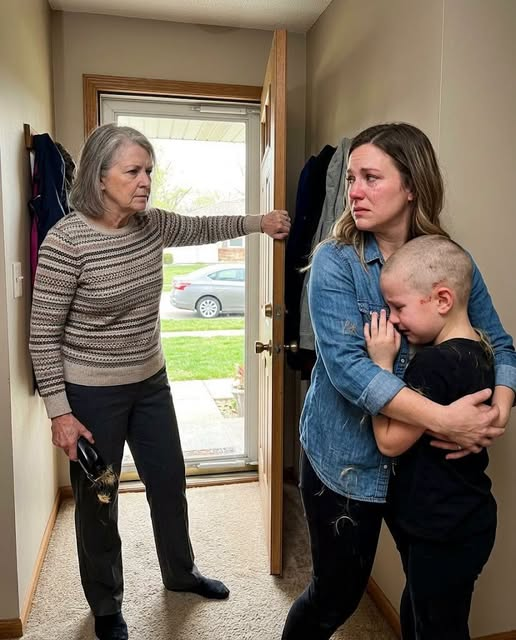
The investigation uncovered things I hadn’t known.
Judith had been punishing Meadow behind my back for months.
Nothing as extreme as the haircut.
But controlling things.
Taking away meals she considered “treats.”
Making her stand facing a wall when she disagreed.
Telling her that crying was manipulation.
And every time Meadow complained to Dustin, he told her:
“Grandma loves you.”
Eventually, Meadow stopped telling us.
That realization nearly destroyed me.
My daughter had tried to speak.
We had simply taught her that adults would explain away what she said.
I started therapy with her.
The first few sessions were almost silent.
She drew.
Her therapist never forced conversation.
One afternoon, Meadow drew two houses.
One had no windows.
The other had enormous windows covering every wall.
“Which one is ours?” the therapist asked.
Meadow pointed to the second.
“Why?”
She looked at me.
“Because Mom can see me now.”
I cried in the parking lot afterward.
Not because it was beautiful.
Because I realized she had once believed I couldn’t.
Dustin’s supervised visits began three weeks later.
The first one lasted seventeen minutes.
Meadow refused to remove her hat.
Dustin stared at it.
Then said:
“Your hair is already coming back.”
Meadow immediately looked at the supervisor.
“I want Mom.”
The visit ended.
Dustin called me afterward.
“She won’t even try.”
“She’s eight.”
“I’m still her father.”
“Then act like one.”
“I apologized.”
“No. You said her hair was growing back.”
“That means I know it was wrong.”
“No.”
I took a breath.
“It means you still think the problem was temporary because the hair was temporary.”
He went quiet.
“The problem is that she begged you for protection and you chose your mother.”
He hung up.
For weeks afterward, he blamed me.
Then something changed.
The court ordered parenting counseling.
For the first time, Dustin sat in a room where nobody allowed him to hide behind Judith.
His counselor asked him why he always defended his mother.
The answer took months.
Judith had controlled his childhood too.
She chose his clothes.
His friends.
His college.
Even the woman he married.
Whenever he resisted, she withdrew affection until he apologized.
Dustin had never learned the difference between respect and obedience.
That explained him.
It did not excuse him.
But eventually, it helped him understand.
Six months later, during a supervised visit, he sat across from Meadow.
No speeches.
No excuses.
He simply said:
“I was supposed to protect you.”
Meadow looked down.
“I didn’t.”
Her fingers tightened around the elephant.
Dustin continued.
“Grandma was wrong.”
Meadow looked up immediately.
It was the first time he had said those words.
“And I was wrong because I let her do it.”
His voice cracked.
“I’m sorry.”
Meadow studied him.
Then asked:
“If Grandma says something mean about me again, what will you do?”
Dustin swallowed.
“I’ll stop her.”
“What if she cries?”
“I’ll still stop her.”
“What if she gets mad?”
“I’ll still stop her.”
Meadow nodded.
That was all.
No hug.
No instant forgiveness.
But she stayed for the full visit.
It was a beginning.
Judith refused counseling.
She blamed me.
Then the judge.
Then Meadow’s doctor.
Then the therapist.
According to Judith, everyone had misunderstood her except herself.
Eventually, she violated the no-contact order by appearing outside Meadow’s school.
That decision ended any chance of informal resolution.
The court extended restrictions on contact.
Dustin finally stopped defending her.
She called him ungrateful.
He cried afterward.
But he didn’t change his answer.
“No, Mom.”
It may have been the first real boundary he had ever given her.
A year later, Meadow’s hair reached her shoulders again.
One Saturday morning, I found her standing in front of the bathroom mirror.
For months, mirrors had made her uncomfortable.
Now she was carefully brushing her hair.
“Mom?”
“Yes?”
“Can I cut it?”
My heart stopped for half a second.
Then I smiled.
“Of course.”
“How short?”
“However you want.”
She chose a chin-length bob.
At the salon, the stylist asked:
“Are you sure?”
Meadow nodded seriously.
“Yes.”
The first lock fell.
I watched her face in the mirror.
No fear.
No shaking.
She smiled.
That was when I understood something.
Her hair had never been the point.
Choice was.
Judith had taken something from Meadow’s body to prove she had control.
Now Meadow was cutting her own hair because the decision belonged to her.
When we got home, she ran toward the mirror.
Then spun around.
“Do you like it?”
“I love it.”
She grinned.
“But more importantly?”
She already knew the answer.
“I like it.”
Dustin and I eventually divorced.
Our marriage never recovered.
But his relationship with Meadow slowly did.
He remained in counseling.
He respected the custody plan.
And when Judith demanded that he choose between “his real family” and me, Dustin finally answered:
“Meadow is my real family.”
That mattered.
Not enough to restore our marriage.
Enough to make him a better father.
Years later, Meadow asked me why I had left him.
I told her the truth in words she could understand.
“Because love is not enough when someone doesn’t make you feel safe.”
She thought about it.
Then touched her hair, now long again because she had decided to grow it.
“And that’s why Grandma can’t see me?”
“Yes.”
“Because she wasn’t safe?”
“Yes.”
Meadow nodded.
No guilt.
No shame.
Then she ran outside to play.
I stood watching her through the window.
Judith had been right about one thing.
Hair does grow back.
But trust doesn’t simply grow back because time passes.
Neither does safety.
Those things must be rebuilt through actions.
The afternoon I carried Meadow out of Judith’s house, I thought I was rescuing my daughter from one terrible incident.
I eventually understood I was doing something larger.
I was teaching her that nobody—
not a grandmother,
not a father,
not even someone who claims to love you—
has the right to frighten you and then demand that you call it love.
Her hair grew back.
But the girl who learned she was allowed to say “no” became stronger than anything Judith had tried to cut away.
