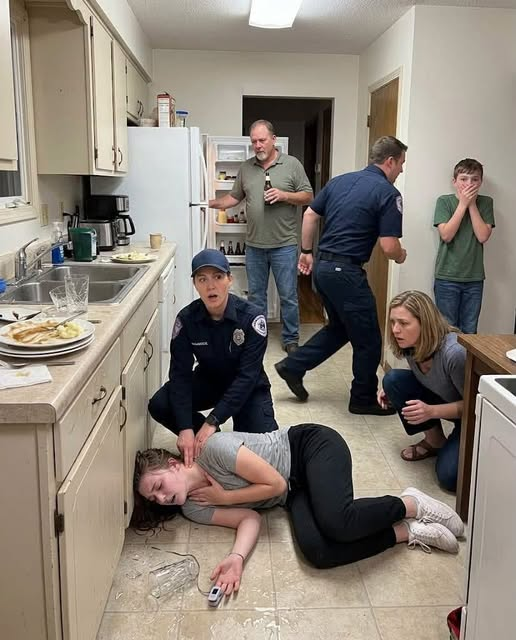
The paramedic’s words changed the entire kitchen.
“Her oxygen is dropping.”
Mom’s face went white.
Uncle Ray lowered his beer.
For the first time that night, nobody accused me of pretending.
The second paramedic returned with the stretcher, and they moved quickly.
An oxygen mask covered my face.
Cold air rushed against my skin, but my chest still felt impossibly tight.
“Emma,” the woman beside me said, “stay with me. Look at me.”
I tried.
The ceiling lights blurred together as they wheeled me through the front door.
Caleb ran after us barefoot.
“Can I come?”
Mom grabbed his shoulder.
“No. I’m going.”
But Daniel stepped between them.
“I’ll drive Caleb. You ride with Emma.”
Mom looked at me.
Then at the ambulance.
Something in her expression told me she was finally frightened by what she had spent years refusing to see.
At the hospital, everything moved fast.
Monitors.
Blood tests.
Questions.
A doctor listened to my lungs, then ordered imaging and additional tests.
I remember Mom sitting in the corner with her hands clasped tightly together.
She kept saying the same sentence.
“She’s never had anything serious before.”
The doctor finally turned toward her.
“That doesn’t mean tonight isn’t serious.”
Mom stopped speaking.
Several hours later, after my breathing stabilized, Dr. Patel came into the room carrying a chart.
“Emma, have you been having episodes like this before?”
I nodded.
Mom answered for me.
“She gets anxious sometimes.”
I looked at her.
“No.”
She frowned.
“Emma—”
“I’ve been telling you for months.”
The room went quiet.
I told the doctor.
The dizziness after climbing stairs.
The racing heartbeat.
The shortness of breath at school.
The exhaustion.
The times I had needed to sit down after carrying laundry upstairs.
Mom’s expression slowly changed.
Because she remembered every single one.
She had called them excuses.
Dr. Patel asked another question.
“Any recent illness?”
“About three weeks ago.”
“What kind?”
“Fever. Cough. I felt awful for several days.”
He nodded slowly.
Then he pulled a chair closer.
“What happened tonight appears to have been caused by a serious medical complication affecting your breathing and circulation. We caught it in time, but you need monitoring and treatment.”
Mom stared at him.
“Could she have…”
She couldn’t finish.
Dr. Patel didn’t soften the answer.
“If emergency services had been delayed much longer, this could have become life-threatening.”
My mother covered her mouth.
I looked toward the window.
I didn’t feel victorious.
I had imagined this moment before.
A doctor proving I wasn’t dramatic.
Someone finally telling Mom that I had been telling the truth.
I thought it would feel satisfying.
Instead, I was exhausted.
Because being believed only after collapsing didn’t erase all the times I had begged to be believed before.
Caleb came in twenty minutes later.
He ran straight to my bed.
“You look less blue.”
I laughed weakly.
“That’s encouraging.”
His eyes filled.
“I knew something was wrong.”
I squeezed his hand.
“You called.”
He nodded.
Daniel stood behind him.
Then he looked at Mom.
“He called while the adults argued.”
She lowered her eyes.
Uncle Ray arrived later.
He didn’t enter immediately.
He stood outside the room holding a paper bag from the hospital café.
Finally, he stepped inside.
“Hey, kid.”
I looked at him.
He placed the bag on the table.
“I brought you something.”
“I’m not hungry.”
“Right.”
Silence.
Then he shoved his hands into his pockets.
“I shouldn’t have said what I said.”
No excuse.
No joke.
That surprised me.
“I thought you were trying to get out of dishes.”
“I know.”
He stared at the floor.
“I was wrong.”
“Yes.”
He nodded.
Then he left.
Mom stayed.
At midnight, she finally moved her chair beside my bed.
“Emma.”
I kept watching the television with the sound off.
“I’m sorry.”
My throat tightened.
“For tonight?”
She hesitated.
That told me she still didn’t understand.
I turned toward her.
“Remember when I called you from school last month?”
She looked confused.
“When?”
“I couldn’t breathe after gym.”
Her face changed.
“You said you were embarrassed because you hadn’t exercised enough.”
“And the grocery store?”
She remembered that too.
I had needed to sit down in the aisle.
Mom had told me to stop making people stare.
“And when I asked to see a doctor?”
Her eyes filled with tears.
“You said we’d wait.”
“I said you were worrying too much.”
“Yes.”
Silence.
“You didn’t ignore one emergency, Mom.”
My voice cracked.
“You taught me not to trust myself every time my body told me something was wrong.”
She started crying.
I didn’t comfort her.
Not because I wanted to punish her.
Because I was tired of becoming responsible for everyone else’s feelings whenever they hurt mine.
“I thought I was making you stronger,” she whispered.
“No.”
I looked at her.
“You were making me quieter.”
I stayed in the hospital for several days.
Doctors created a treatment plan and explained exactly what warning signs I should never ignore again.
Daniel listened to everything.
So did Mom.
This time, she wrote it down.
Before discharge, a social worker also came to speak with me privately.
She asked whether I felt safe at home.
That question shocked me.
Nobody had ever asked me like my answer mattered.
“Yes,” I said eventually. “But I don’t always feel heard.”
She nodded.
“That matters too.”
We made a plan.
Follow-up appointments.
School accommodations while I recovered.
Emergency contacts.
And one rule I insisted on myself:
If I said something felt medically wrong, nobody in the family was allowed to call it dramatic before it was checked.
Daniel agreed immediately.
Caleb raised his hand like we were in class.
“I agree too.”
Even Uncle Ray apologized again.
Mom was the last.
But finally she said:
“I agree.”
Three months later, I was much stronger.
Not completely recovered.
But stronger.
The strangest change wasn’t physical.
It was the kitchen.
One evening after dinner, Mom started assigning chores.
“Caleb, table. Daniel, leftovers. Emma—”
She stopped herself.
Old habits.
I waited.
Then she asked:
“How are you feeling?”
“Fine.”
“Actually fine?”
I smiled a little.
“Actually fine.”
“Okay. Dishwasher?”
“Deal.”
It was such a small moment.
But that was how trust came back.
Not through one dramatic apology.
Through hundreds of ordinary choices.
She asked.
I answered.
She believed me.
Caleb never stopped reminding everyone that he was the one who called 911.
At Thanksgiving, Uncle Ray jokingly announced:
“From now on, if Emma says she can’t breathe, nobody argues with her.”
Mom didn’t laugh.
She looked at me.
“From now on, if any of you say something is wrong, we listen first.”
That mattered more.
Because I didn’t want what happened to me to turn me into the only person worth believing.
I wanted it to change the rule for everyone.
Later that night, Caleb found me washing glasses at the same kitchen sink where I had collapsed.
He leaned against the counter.
“You scared me that night.”
“I scared myself.”
He looked at me seriously.
“What if I hadn’t called?”
I dried my hands.
Then hugged him.
“But you did.”
He smiled into my shoulder.
And that was the truth I chose to keep.
Not Uncle Ray’s accusation.
Not Mom telling me to stop pretending.
Not even the monitor alarms.
I remembered my little brother looking at my face and trusting what he saw.
Sometimes the person who saves you isn’t the oldest.
Or the loudest.
Or the one who thinks they know best.
Sometimes it’s the person willing to say:
“Something is wrong.”
And refuse to be quiet until somebody listens.
