The officer stared at the kitchen table.
“Call an ambulance,” he told his partner. “And call child services.”
Beside the mother’s hand was not a weapon.
Not a confession.
Not anything criminal.
It was a hospital discharge folder.
Across the front, someone had written:
URGENT FOLLOW-UP REQUIRED.
Underneath it sat several unopened medical bills, an empty infant-formula container, and a handwritten list.
Milk.
Diapers.
Medicine.
Call hospital.
Ask neighbor for ride.
And at the very bottom:
If I get sick again, Emma knows where to go.
The seven-year-old girl had a name.
Emma.
And suddenly the officers understood.
Her mother had known something was wrong.
She had tried to prepare her child for an emergency she prayed would never happen.
It had happened anyway.
Paramedics arrived quickly.
Emma’s mother, Rachel, was still alive.
Barely.
She had suffered a severe medical complication after giving birth and had become too weak to seek help.
There was no working phone in the house.
No reliable car.
No adult who had checked on them.
The nearest neighbor lived far enough away that Emma had never been allowed to walk there alone.
So when her mother stopped responding and the twins stopped crying as strongly, Emma remembered the instruction she had been given months earlier.
Find the hospital.
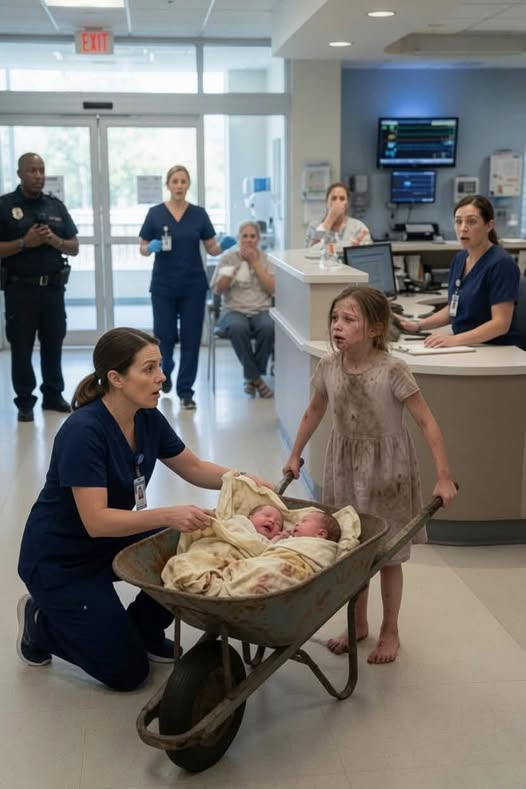
She found the wheelbarrow behind the shed.
Placed blankets inside.
Lifted one baby.
Then the other.
And started walking.
Back at the hospital, Emma still refused to sleep.
She sat beneath a blanket in a pediatric room, eating crackers one tiny bite at a time.
Every few minutes she asked:
“Are the babies awake?”
The nurse, Maria, always answered honestly.
“They’re being taken care of.”
“And Mommy?”
“We found her.”
Emma froze.
“Is she mad because I left?”
Maria’s face changed.
“No, sweetheart.”
She knelt beside her.
“Your mommy told you what to do if something happened.”
Emma nodded.
“You listened.”
“Are you sure?”
“Yes.”
Maria took her hand.
“You saved your family.”
That was when Emma finally cried.
Not loudly.
She simply folded against Maria and let herself become seven years old again.
The twins were stabilized over the next several hours.
One was named Oliver.
The other Grace.
Both required intensive care, but doctors believed they had arrived in time.
Rachel was brought into the same hospital that evening.
She remained unconscious at first.
Emma was not allowed into her room yet.
So she drew her mother a picture.
It showed five people holding hands.
Mommy.
Emma.
Oliver.
Grace.
And a fifth person.
Maria pointed at it.
“Who’s that?”
Emma looked at her as though the answer were obvious.
“The doctor who fixes Mommy.”
Maria had to turn away for a moment.
The police investigation found something else.
Rachel had not always been alone.
The twins’ father, Michael, existed.
He had left during the pregnancy.
According to text messages recovered from Rachel’s old phone, she had repeatedly asked him for help.
Not money for herself.
Formula.
Transportation to appointments.
Someone to stay with Emma if she had to return to the hospital.
His replies were short.
Not my problem.
Figure it out.
Stop calling me.
When investigators finally contacted him, Michael suddenly became interested.
Not because Rachel was hospitalized.
Because local news had started reporting the story of the seven-year-old girl who pushed newborn twins for miles to save them.
Reporters gathered outside the hospital.
Donations began arriving.
Michael called within hours.
“I’m their father,” he told hospital administration. “I have rights.”
That sentence reached Detective Nolan, the officer who had entered Rachel’s house.
He replied simply:
“You also had responsibilities.”
Three days later, Rachel opened her eyes.
Emma was asleep in a chair beside the bed when it happened.
Maria saw Rachel move first.
She called the doctor.
Within minutes, Emma woke.
She stared at her mother.
“Mommy?”
Rachel turned her head.
Weakly.
Slowly.
But she saw her.
Emma ran toward the bed.
Maria caught her gently before she could climb on top.
“Careful.”
Rachel lifted one trembling hand.
Emma grabbed it.
“I’m sorry,” Emma said immediately.
Rachel’s eyes filled.
“For what?”
“I left you.”
Rachel shook her head.
“No.”
Her voice was barely audible.
“You did what I told you.”
“I took the babies.”
“I know.”
“I used the wheelbarrow.”
A tiny smile appeared on Rachel’s face.
“You hate that wheelbarrow.”
Emma started laughing and crying at the same time.
“I still do.”
Rachel closed her eyes for a second.
Then whispered:
“My brave girl.”
Emma shook her head fiercely.
“No. I was scared.”
Rachel squeezed her fingers.
“Being brave doesn’t mean you weren’t scared.”
The story spread far beyond the hospital.
But the hospital staff refused to let Emma become a spectacle.
People wanted interviews.
Photographs.
Television appearances.
Maria declined all of them until Rachel could decide for herself.
What the family actually needed was simpler.
A safe place to recover.
Food.
Transportation.
Childcare.
Medical support.
A social worker named Denise coordinated everything.
Within weeks, the community had provided enough assistance for Rachel and the children to move into a small apartment closer to the hospital.
The old rural house was left behind.
So was the wheelbarrow.
Almost.
Emma refused to abandon it completely.
“Can we keep it?”
Rachel stared at the rusted thing.
“Why?”
Emma shrugged.
“It carried Oliver and Grace.”
So Detective Nolan arranged for it to be cleaned.
Months later, it sat in Rachel’s little garden filled with flowers.
Michael attempted to reenter their lives.
Rachel did not simply hand him access because he suddenly appeared.
The courts handled that question.
His earlier messages mattered.
His long absence mattered.
Most importantly, the safety of the children mattered.
For once, Rachel did not have to negotiate everything alone.
“I kept thinking I had to make everyone happy,” she later told Denise.
“And now?”
Rachel looked across the apartment.
Emma was helping feed Grace while Oliver slept nearby.
“Now I need to keep them safe.”
A year passed.
The twins learned to walk.
Emma turned eight.
On her birthday, the hospital staff invited the family back.
Maria had arranged something in the lobby.
When Emma entered, she stopped.
There was a small plaque beside a photograph of a wheelbarrow filled with flowers.
It read:
THE EMMA FUND
Transportation and emergency assistance for families with children who cannot safely reach medical care.
Emma stared at it.
“What’s that?”
Maria smiled.
“Some people heard what happened to you.”
Emma immediately looked uncomfortable.
“I didn’t do anything.”
The adults around her went quiet.
Maria crouched beside her.
“You walked farther than any child should have needed to walk.”
She pointed toward the plaque.
“So now we’re going to make sure other children don’t have to.”
Emma read the words again.
Then asked:
“Does it help mommies too?”
“Yes.”
“And babies?”
“Yes.”
She smiled.
“Okay.”
That was the only approval anyone needed.
Later, Rachel and Emma walked outside together.
Oliver and Grace sat in a double stroller.
Rachel still became tired easily.
Emma still watched her mother more closely than any eight-year-old should.
Healing does not erase memory.
But it changes what memory controls.
As they reached the parking lot, Emma asked:
“Mom?”
“Yes?”
“If something bad happens again, do I have to walk to the hospital?”
Rachel stopped.
She knelt.
“No.”
She pointed toward the phone clipped safely inside Emma’s backpack.
“You call.”
“And if it doesn’t work?”
“You call Mrs. Bennett downstairs.”
“And if she isn’t home?”
“You call Maria.”
Emma frowned.
“And if everybody is gone?”
Rachel smiled through tears.
“Then you keep asking for help until someone listens.”
Emma nodded seriously.
Then she looked at the twins.
“I can do that.”
Rachel pulled her close.
“I know.”
That was the part of the story people remembered.
Not the dirty wheelbarrow.
Not the miles.
Not even the hospital doors opening.
A seven-year-old child had been forced to carry a responsibility far too large for her.
But afterward, the adults around her finally understood something:
Emma should never have needed to become the hero.
So they made sure she could go back to being a child.
And every spring, flowers bloomed from the old wheelbarrow that once carried two silent newborns toward the only place Emma believed could save them.
Three lives survived that journey.
But the fourth life changed too.
Because the little girl who had walked those miles finally learned the lesson she should have been taught from the beginning:
She did not have to carry everyone alone.
