“He put me in the shed.”
For several seconds, nobody spoke.
Sarah sat beside the bed.
“Leo, how long were you there?”
He shrugged.
“I don’t know.”
“Tonight?”
He shook his head.
“Since yesterday morning.”
My stomach dropped.
“And your face?”
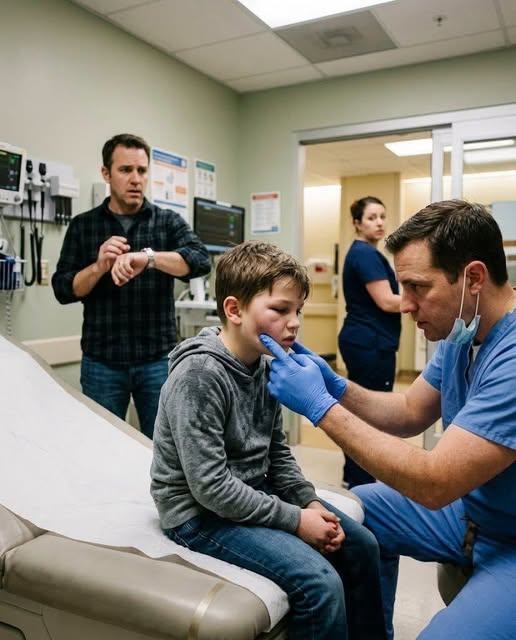
Leo touched the swollen side carefully.
“There are bugs in the shed.”
Greg’s sudden panic finally made sense.
Not because he was worried about Leo.
Because he knew what proper medical care would reveal.
I ordered imaging immediately.
The scan showed a severe untreated wound with infection and evidence of a larval infestation beneath the damaged tissue.
It was treatable.
But it required surgery.
Not a Z-Pak.
Not a quick prescription.
And certainly not another night in a shed.
I told Leo:
“We can fix this.”
His first question wasn’t whether it would hurt.
It was:
“Can I go home after?”
Before I could answer, he reached inside his hoodie.
His hand emerged closed into a fist.
When he opened it, a small brass key lay in his palm.
Sarah and I looked at each other.
“What does that open?” I asked.
Leo whispered:
“The shed.”
Then his eyes filled.
“I took it when he opened the door.”
“Why?”
His answer made Sarah stand immediately.
“Because Ellie is still inside.”
Ellie was Leo’s six-year-old sister.
Greg had never mentioned her.
According to Leo, their mother worked overnight shifts at a nursing facility.
Greg watched the children while she was gone.
Except “watching” often meant locking them in the backyard shed when they annoyed him.
No television.
No dinner unless they had “earned it.”
Leo had been put there after taking bread from the kitchen.
Ellie had cried and followed him outside.
Greg locked both of them in.
Sometime later, Leo managed to get the key when Greg opened the door.
He escaped through the yard.
He tried walking toward the police station.
But his face hurt too much.
The hospital lights were closer.
So he came to us.
“Why didn’t Ellie come with you?” Sarah asked.
Leo looked down.
“She was scared.”
His voice became smaller.
“And Greg came outside.”
Leo ran.
He thought Greg had discovered the missing key.
Instead, Greg found him near a convenience store and brought him to the ER only because the swelling on Leo’s face had become impossible to ignore.
He planned to get antibiotics.
Then take him straight back.
Police were at Greg’s house within minutes.
I stayed with Leo.
We did not tell him every detail.
Only:
“They’re looking for Ellie.”
Meanwhile, Greg had stopped pretending to be impatient.
Now he was furious.
From the hallway I heard him telling security:
“That kid lies constantly.”
“He steals.”
“He destroys things.”
“He needs discipline.”
The officer taking his statement asked one question:
“Where is Ellie?”
Greg stopped talking.
That silence told them more than anything else.
At 4:02 a.m., Sarah’s phone buzzed.
She read the message.
Then looked at me.
“They found her.”
Leo sat upright.
“Is she okay?”
Sarah smiled.
“She’s safe.”
He closed his eyes.
For the first time that night, his entire body relaxed.
Then he began to cry.
Not loudly.
Just years of fear finally leaving through a nine-year-old boy who had believed protecting his little sister was his job.
Police found Ellie in the shed wrapped in an old blanket.
She was frightened and hungry, but she was alive.
They also found things that explained why Greg had been desperate to leave the hospital.
A lock on the outside of the shed.
Children’s belongings inside.
A notebook containing dates and punishments.
And a small camera pointed toward the door.
Greg had documented his own cruelty because he considered it discipline.
There was no clever explanation that could erase that.
Leo’s mother, Rachel, arrived at the hospital just before dawn.
She came running through the doors wearing nursing scrubs.
“Leo!”
He flinched.
Not because he was afraid of her.
Because he had expected anger.
She reached the bed and stopped when she saw his face.
“What happened?”
Leo stared at her.
“You didn’t know?”
Rachel looked confused.
Then horrified.
“Know what?”
That question mattered.
Investigators later determined that Greg had hidden much of what he was doing while Rachel worked.
But not everything.
There had been warning signs.
Leo asking not to be left alone with him.
Ellie suddenly wetting the bed.
Bruises explained away as playground accidents.
Food disappearing because the children hid snacks in their rooms.
Rachel had accepted Greg’s explanations because admitting the alternative would have destroyed the life she thought she had built.
She sat beside Leo.
“I should have listened.”
He looked at her.
“You always said Greg was strict because he cared.”
Rachel started crying.
“I was wrong.”
No excuses.
No demand that Leo forgive her.
Just the truth.
Leo went into surgery that morning.
The doctors cleaned and treated the wound and infection.
By afternoon, his condition was stable.
When he woke, Ellie was waiting in the next room with a social worker.
The first thing he asked was:
“Can I see her?”
When they brought her in, Ellie climbed onto the chair beside his bed.
She held out something.
The brass shed key.
An officer had placed it in an evidence bag.
Leo stared at it.
“I don’t want it.”
Ellie nodded.
“Me neither.”
The social worker took it away.
Neither child ever touched it again.
Greg was arrested.
The investigation uncovered repeated neglect and abusive punishment.
He later faced criminal charges, and a court barred him from contacting the children.
Rachel was not allowed simply to take Leo and Ellie home and pretend nothing had happened.
Child protective services became involved.
There were interviews.
Parenting evaluations.
Counseling.
Supervised visits.
Rachel hated parts of the process.
But she cooperated.
Because this time, protecting her children mattered more than protecting her pride.
Months later, the children were allowed to return to her under continuing oversight.
Greg was gone.
The shed was demolished.
Rachel did that herself.
I saw Leo again nearly a year later.
He walked into the ER holding Ellie’s hand.
My heart jumped until I saw the balloons.
They weren’t patients.
Rachel was behind them carrying a box of cupcakes.
Leo’s face had healed.
He had grown taller.
His hoodie actually fit.
“Dr. Thomas.”
“Leo?”
He smiled.
Ellie pushed a card toward me.
On the front was a drawing of a hospital with terrible perspective and enormous automatic doors.
Inside, Leo had written:
THANK YOU FOR BELIEVING ME BEFORE I KNEW HOW TO SAY EVERYTHING.
I swallowed hard.
“You did the difficult part.”
He frowned.
“What?”
“You came through those doors.”
Leo thought about that.
Then he said:
“I almost didn’t.”
“I know.”
“Ellie was why I did.”
His sister rolled her eyes.
“You always say that.”
“Because it’s true.”
She took his hand anyway.
Rachel approached me before they left.
“There’s something I wanted you to know.”
I waited.
“Leo sleeps with his bedroom door open now.”
I wasn’t sure what she meant.
Then she explained.
“For months he needed it open because he was afraid someone would lock him in.”
Her eyes filled.
“Last week I asked whether he wanted me to close it.”
“And?”
“He said, ‘It doesn’t matter anymore. I know I can leave if I want to.’”
That sentence stayed with me.
For years afterward, whenever someone asked about the strangest case I had seen in emergency medicine, I thought of Leo.
Not because of what was beneath the swollen skin.
Medicine had explanations for that.
The part I could never forget was the brass key.
A nine-year-old child had carried it through the rain while injured and frightened.
He could have used it only to save himself.
Instead, he walked into a hospital because his little sister was still behind the door he had escaped from.
Greg thought Leo was weak.
Worthless.
Not worth missing a shift over.
He was wrong.
That night, the smallest person in the room was the only one brave enough to expose what was happening.
The doctors healed Leo’s wound.
The police opened the shed.
But the person who unlocked the truth—
was the nine-year-old boy everyone had underestimated.
