I stared at the timestamp beneath my mother’s post.
9:07 a.m.
The nursery camera alert had reached me at 9:15.
She had created the story first.
Then arranged the evidence to fit it.
My mother was still talking.
“She’s been unstable for weeks. I’ve been trying to help you see it.”
I looked at Clara.
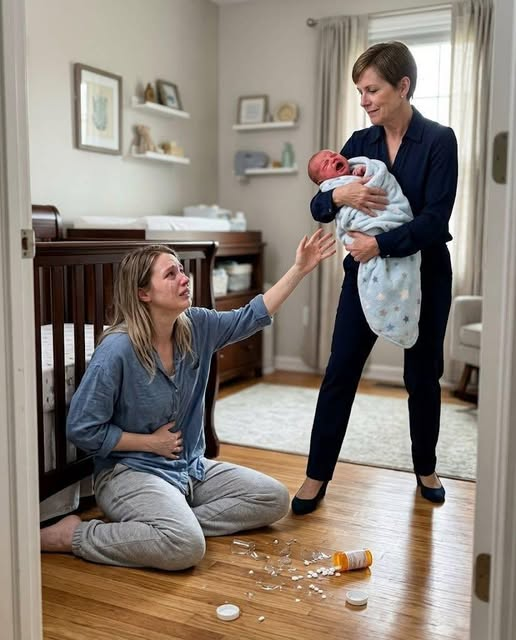
She sat against the crib, pale and shaking.
Then I looked at the crushed medication on the floor.
Finally, at my mother.
“You posted that before Clara was on the floor.”
Her mouth closed.
“What?”
“The timestamp.”
Her eyes flicked toward her phone.
Eight minutes.
That was all it took for her confidence to disappear.
“You’re misunderstanding.”
“No.”
Sirens sounded outside.
My mother went rigid.
“You called someone?”
“I called for help.”
“For her?”
“For my wife and my son.”
Her face twisted.
“And what about me?”
For years, that question had controlled me.
What about Mom?
Mom is lonely.
Mom means well.
Mom is just excited about the baby.
Mom deserves to be included.
Every boundary Clara asked for somehow became an attack on my mother.
That ended in that nursery.
“You need to leave.”
She stared at me.
“You’re throwing your own mother out?”
“Yes.”
The paramedics arrived first.
They moved carefully around the broken glass and checked Clara.
I stayed with the baby while they helped her.
One of them asked what had happened.
Before I could answer, my mother stepped forward.
“My daughter-in-law became agitated.”
I turned toward her.
“No.”
The paramedic looked at me.
“I have video.”
My mother’s expression changed.
I continued.
“The entire thing.”
She went silent.
That was the first time all morning she did.
Clara was taken back to the hospital for evaluation.
I went with her and our son.
My mother was not allowed to come.
At the hospital, Clara kept apologizing.
“I should have told you sooner.”
“No.”
“I knew she was doing things when you weren’t home.”
I held her hand.
“You did tell me.”
She looked at me.
And I forced myself to say the part that mattered.
“I didn’t believe you.”
Her eyes filled.
“I kept explaining it away.”
The camera.
The missing medication.
My mother entering without knocking.
The comments about how the baby “preferred” her.
The social media posts presenting herself as the exhausted grandmother saving us from parenthood.
Clara had noticed everything.
I had turned each warning into a misunderstanding.
“I’m sorry.”
She looked away.
“I needed you to protect us.”
“I know.”
There was nothing useful I could add.
No excuse could make that sentence smaller.
The police asked for the recording.
I gave them everything.
Not just the hidden camera footage.
The screenshots.
The nursery camera disconnections.
My mother’s social media posts.
Messages she had sent me for weeks.
One of them suddenly looked different now.
Clara sleeps too much. That baby needs someone reliable.
Another:
You know postpartum women can become irrational. You should let me stay over permanently.
And one from three days earlier:
If anything ever happens, remember I warned you.
At the time, I thought she was being dramatic.
Now it read like preparation.
My mother called twenty-six times that day.
I answered once.
“You’ve humiliated me.”
Not:
Is Clara okay?
Not:
Is the baby okay?
Just her reputation.
“You staged a photograph of my wife during a medical recovery.”
“She was being difficult.”
“You destroyed her medication.”
“She was becoming dependent on it.”
“It was prescribed.”
Silence.
Then:
“You don’t understand what women like her can do to men.”
There it was.
The real problem had never been postpartum recovery.
It had never been the baby.
It had never even been Clara.
My mother believed marriage had taken something from her.
Me.
And instead of accepting that her adult son had built his own family, she had decided to prove my wife was incapable of keeping it.
I said:
“You are not coming back to this house.”
She laughed.
“You’ll change your mind.”
“No.”
“When you realize what Clara is really like—”
“I watched what you are really like.”
She stopped.
I ended the call.
Then blocked her.
The investigation uncovered more than we expected.
The main nursery camera had not been malfunctioning.
Someone had repeatedly disconnected it manually.
My mother had access because months earlier I had given her the home-system password.
Another mistake I had called convenience.
She had also been entering our bedroom while Clara slept.
Clara’s medication had not vanished by accident.
My mother had taken it.
Not all at once.
Just enough each time to make Clara wonder whether exhaustion was affecting her memory.
That realization broke something in my wife.
“She wanted me to think I was losing my mind.”
I sat beside her hospital bed.
“Yes.”
Clara looked at me.
“And you almost believed her.”
I couldn’t deny it.
“Yes.”
The hospital social worker spoke with us before discharge.
Not because Clara had done anything wrong.
Because the circumstances involved a vulnerable recovering parent, a newborn, and a relative deliberately escalating conflict inside the home.
We changed everything.
Locks.
Passwords.
Emergency contacts.
Security codes.
My mother’s access disappeared from every system.
I also took down every photograph of our son she had posted online without permission.
Then I wrote one message to the extended family.
No drama.
No insults.
Just facts.
Clara and the baby are safe. My mother is no longer permitted in our home. Please do not share our address, schedule, photographs, or information with her. This decision follows an incident that has been documented and reported. We will not debate it.
Within fifteen minutes, my aunt called.
“Your mother says Clara attacked her.”
I sent one still image from the hidden camera.
Not Clara on the floor.
My mother standing with the baby while shattered medication lay between her and my wife.
My aunt stopped talking.
Then came the online post.
My mother had already gathered hundreds of sympathetic comments.
People called Clara unstable.
Dangerous.
Ungrateful.
One person wrote that the baby should be removed from her care.
My first instinct was rage.
Clara stopped me.
“Don’t fight strangers online.”
She was right.
So we did something quieter.
Our attorney sent a preservation notice.
The platform was asked to retain the posts.
The photographs became evidence.
My mother had built the case against herself.
A week later, every post disappeared.
Not because she suddenly regretted them.
Because she finally understood that lying publicly had consequences outside her comment section.
Three weeks passed.
Clara recovered slowly.
The baby gained weight.
We slept in fragments.
The house became quiet again.
One evening, Clara found me sitting alone in the nursery.
“You okay?”
“No.”
She sat beside me carefully.
“I keep thinking about how many times you told me something was wrong.”
She said nothing.
“I thought being fair meant giving both sides the benefit of the doubt.”
Clara looked toward the crib.
“And?”
“I was giving my mother the benefit of the doubt by making you carry all of it.”
She turned toward me.
That was the closest I could come to explaining my failure.
I had wanted peace so badly that I had made the person causing the harm comfortable and the person warning me prove it over and over.
“I don’t expect you to trust me immediately,” I said.
Clara’s voice was quiet.
“I don’t.”
It hurt.
But she had earned the right to say it.
I nodded.
“Okay.”
Then I started proving myself instead of asking her to make me feel forgiven.
My mother faced legal consequences related to the medication, the staged incident, and her actions inside our home.
I won’t pretend the process was dramatic.
It was mostly interviews.
Documents.
Hearings.
Restrictions.
Eventually, a court order prohibited her from contacting Clara directly or coming to our property.
She told everyone I had destroyed her life.
That wasn’t true.
I had simply stopped allowing her to control ours.
There is a difference.
Six months later, she sent me a letter through her attorney.
It was twelve pages.
Eleven pages explained why she had behaved the way she did.
How lonely she had been.
How becoming a grandmother had given her purpose.
How Clara had “pushed her away.”
How she thought the baby needed her.
On the final page, there were three sentences.
I scared Clara.
I used your son to control her.
I was wrong.
Those were the only lines I showed my wife.
Clara read them.
Then handed the page back.
“Do you forgive her?” I asked.
“No.”
Neither did I.
Maybe someday.
Maybe never.
Forgiveness was no longer the deadline.
Safety was.
A year later, Clara returned to the hospital.
This time, not as a patient.
She had volunteered to speak with a support group for new parents recovering from traumatic births.
I sat in the back holding our son.
He was walking by then.
Badly.
Determinedly.
He escaped my arms halfway through the session and waddled straight toward Clara.
She laughed and picked him up.
The room laughed too.
For a second, I remembered my mother’s words:
He settles better for me anyway. People can see that.
She had believed love was a competition.
That being needed gave her ownership.
That if Clara looked weak enough, she could become the center of our family again.
She was wrong.
After the session, Clara came toward me with our son asleep against her shoulder.
“You know what I was thinking?”
“What?”
“That morning, I thought you were three blocks away.”
“I was.”
“No.”
She shook her head.
“You had been farther away than that for months.”
That hurt because it was true.
Then she took my hand.
“But you came back.”
I looked at her.
“I should have been there before.”
“Yes.”
She squeezed my fingers.
“But you’re here now.”
That was not absolution.
It was better.
It was a beginning.
My mother had staged a photograph because she wanted the world to believe Clara was dangerous.
She disconnected cameras because she believed darkness protected her.
She underestimated one thing.
The truth didn’t need a perfect angle.
It only needed one camera she didn’t know existed.
But even that wasn’t the real lesson.
The camera showed me what my mother had done.
My wife had been telling me long before the camera ever did.
And the part I will regret for the rest of my life is that it took a recording for me to believe what the woman I loved had already been brave enough to say.
