Richard’s face changed.
Not fear.
Recognition.
He knew exactly what was inside the envelope.
Evelyn looked between us.
“What did Mark do?”
Richard snapped:
“Be quiet.”
That was the first time I had ever heard him speak to her that way.
I stepped out of the car.
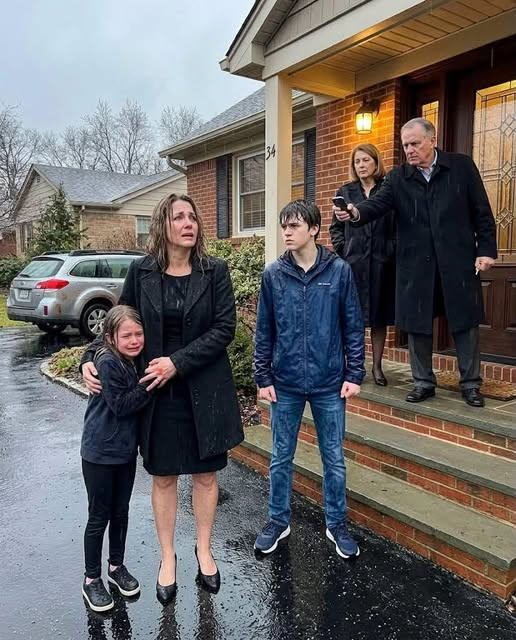
The rain had already soaked through my funeral dress.
Noah opened his door.
I raised one hand.
“Stay with Sophie.”
Then I walked toward the porch.
Richard held out his palm.
“Give me the letter.”
“No.”
“Laura.”
“No.”
His jaw tightened.
“You don’t understand what Mark was doing near the end. He was sick. He wasn’t thinking clearly.”
I lifted the first page.
“Then why did you sign the release?”
Evelyn turned sharply.
“Richard?”
He said nothing.
I continued.
“Mark says you personally signed the document removing this house from Bennett Holdings.”
Evelyn’s face went pale.
“You told me the company owned it.”
Richard finally lost his calm.
“He manipulated me.”
“While dying?”
I almost laughed.
“You want that to be your defense?”
There were twelve pages in the envelope.
The first was Mark’s letter.
The second was a copy of the deed.
The third was the trust agreement.
Then came signatures.
Witnesses.
Notarization.
And one name I recognized immediately.
Rebecca Sloan.
Mark’s attorney.
At the bottom of the final page, he had written her number.
I called.
She answered on the second ring.
“Laura?”
“How did you know it was me?”
“Because Mark told me this call might come.”
My knees nearly gave out.
Rebecca’s voice became firm.
“Are Richard and Evelyn at the property?”
“Yes.”
“Did they change the locks?”
“Yes.”
“Do not surrender the documents.”
“I won’t.”
“I’m coming.”
Then she added:
“And Laura?”
“Yes?”
“Mark left much more than a house.”
Richard heard enough.
His expression hardened.
“You’re making a mistake.”
“No.”
I looked at the new key in his fist.
“You did.”
He stepped toward me.
Noah immediately got out of the car.
“Dad said the house is ours.”
Richard looked at his grandson.
For a second, something almost human crossed his face.
Then it disappeared.
“Your father didn’t know what was best near the end.”
Noah’s voice shook.
“He knew enough to warn Mom about you.”
That silenced everyone.
Rebecca arrived twenty-five minutes later with another attorney.
So did the police.
Not because I wanted anyone arrested.
Because Rebecca had advised me to create a record that we had been unlawfully denied access to a property held for our benefit.
Richard’s confidence evaporated when Rebecca showed the officers the certified trust documents.
The house had been transferred six months earlier.
Richard had signed as corporate chairman acknowledging that Bennett Holdings released every claim.
He had known.
The officers did not debate family history.
They looked at paperwork.
Then at Richard.
“You need to return the keys.”
He resisted.
Then Rebecca said:
“If you damage or remove anything from the property after receiving notice of the trust, we’ll document that too.”
The brass key fell into my palm.
Evelyn whispered:
“This is humiliating.”
I stared at the red mark where my wedding ring had been.
“No.”
“This morning was humiliating.”
“This is paperwork.”
We entered the house at 6:12 that evening.
Sophie immediately ran upstairs.
Noah stayed beside me.
The living room looked almost normal.
Except drawers had been opened.
Mark’s desk had been searched.
The lockbox in our bedroom had been forced.
Rebecca noticed it too.
“Did you give them permission to enter?”
“No.”
She photographed everything.
That was when Evelyn appeared behind us.
“I was looking for family property.”
My eyes dropped to her hand.
She was wearing my wedding ring on a chain around her neck.
I pointed.
“Start with that.”
Her hand flew to it.
“This belonged to Mark.”
“Yes.”
“And Mark gave it to me when we married.”
“It’s a Bennett heirloom.”
“Then you can prove ownership through your attorney.”
She stared at me.
I held out my hand.
“Until then, return what you took from my finger at my husband’s funeral.”
For once, Richard did not defend her.
Evelyn unclasped the chain.
She placed the ring in my palm.
I put it back on.
Not because I was still married in the legal sense.
Because nobody else got to decide when I stopped being Mark’s wife.
Rebecca asked the children to go upstairs.
Then she opened the second sealed packet.
“Mark completed his estate plan eight months ago.”
Richard scoffed.
“I know his will.”
Rebecca looked at him.
“You knew the old one.”
That sentence changed the room.
Mark had rewritten everything.
Not secretly.
Carefully.
Bennett Holdings remained largely within the Bennett family.
Mark had no interest in destroying the business his grandfather created.
But his personal assets were another matter.
Investment accounts.
Life insurance.
A commercial property he had bought independently.
And the family trust.
All of it was structured for me, Noah, and Sophie.
Richard’s face darkened.
“How much?”
Rebecca closed the file.
“That information is not yours.”
His outrage was immediate.
“I’m his father.”
“And Laura is his surviving spouse.”
“She married into this family.”
Rebecca didn’t blink.
“Mark disagreed with your interpretation of that relationship.”
Then came the part even I didn’t know.
Three months before he died, Mark had written a statement explaining why he changed the estate plan.
Rebecca read only the section he had authorized her to share if Richard challenged me.
My parents have repeatedly treated Laura as temporary and my children as leverage. If I die before them, I believe they may attempt to pressure Laura while she is grieving. Any effort to remove her from the home, threaten custody, or seize personal property should be treated as deliberate, not misunderstood grief.
I covered my mouth.
Mark had known.
Not everything.
But enough.
Richard sat down.
Evelyn stared at the floor.
For ten years, I thought Mark avoided conflict with his parents because he was afraid of them.
Now I understood.
He had been quietly building a wall they couldn’t cross after he was gone.
The custody threat disappeared quickly too.
Richard had used Child Protective Services like a weapon.
Rebecca advised me to document it.
Noah also gave a statement about exactly what his grandfather had said.
No one took my children.
No one even came close.
Because grief did not make me unfit.
Standing in the rain after being locked out did not make me unfit.
And being threatened by wealthy grandparents did not make them more suitable parents.
The threat had worked for five minutes because I was terrified.
On paper, it was nothing.
Three days later, Richard called.
I almost ignored him.
Then I answered.
“Laura.”
“What?”
“We need to resolve this privately.”
“It is private.”
“You have lawyers involved.”
“Because you changed the locks after your son’s funeral.”
He exhaled sharply.
“You’re going to split this family apart.”
I looked toward the kitchen.
Sophie was eating cereal.
Noah was trying to repair one of Mark’s old cameras.
“My family is sitting ten feet away from me.”
Richard went silent.
Then:
“What about us?”
I answered honestly.
“I don’t know.”
That frightened him more than anger would have.
Evelyn apologized first.
Sort of.
She came to the house a month later.
I made her stand on the porch.
She looked at my wedding ring.
“I shouldn’t have taken it.”
“No.”
“I was grieving too.”
“I know.”
She waited for that to erase something.
It didn’t.
Then she whispered:
“I thought if I took control quickly, everything Mark built would stay with the family.”
I looked through the doorway at Noah and Sophie.
“It did.”
Her face crumpled.
Because she finally understood.
She had been so determined to preserve the Bennett family that she had almost thrown Mark’s actual family into the rain.
Richard took longer.
Six months passed before he wrote to Noah.
Not me.
Noah showed me the letter.
I was wrong to threaten your mother. I was angry and frightened, and I treated grief like a fight I needed to win. Your father would have been ashamed of me.
Noah read it twice.
“Do I have to answer?”
“No.”
“Can I?”
“Yes.”
He nodded.
“I’ll think about it.”
That was his right.
I refused to teach my children that forgiveness was a debt owed to adults who hurt them.
A year after Mark’s funeral, we remained in the house.
Not because it was expensive.
Because Sophie still had pencil marks on the kitchen doorway showing how tall she had grown.
Because Noah’s bedroom ceiling still had the model airplanes he and Mark hung together.
Because Mark’s coffee mug remained in the cabinet.
The trust allowed us to stay.
So we stayed.
I also used part of the insurance money to return to school.
I had spent years caring for Mark through treatment.
For a long time, I had forgotten that my future continued beyond his illness.
Mark had not.
Inside the envelope was one more note I found months later.
Just six words:
Laura, live after me. Not for me.
That one finally made me cry.
Richard and Evelyn eventually earned limited contact with the children again.
Slowly.
Supervised at first.
No keys to my home.
No financial authority.
No threats disguised as concern.
No pretending the funeral never happened.
Trust returned in teaspoons.
Not buckets.
And some of it never returned at all.
That was okay.
People later told me Mark had been brilliant for hiding the deed.
They imagined some elaborate revenge from beyond the grave.
It wasn’t.
Mark hadn’t prepared that envelope to destroy his parents.
He prepared it because he knew grief would leave me exhausted, frightened, and vulnerable to people who believed money gave them authority.
The sealed envelope contained property documents.
Trust papers.
Legal instructions.
But the most important thing inside was not a deed.
It was proof.
Proof that Mark had seen what I had refused to see.
Proof that he trusted me with our children.
Proof that even while dying, he had been thinking about how to make sure Noah, Sophie, and I still had a front door that belonged to us.
My in-laws thought they had locked us out of everything.
The house.
The money.
The Bennett name.
Our future.
Instead, three flashes of my headlights told Richard the truth:
Mark had already chosen his family.
And it was not the two people standing on the porch guarding a house they didn’t own.
It was the widow and two children waiting in the rain to come home.
