Graham stared at the doctor.
“Why do I have to leave?”
Dr. Mercer didn’t raise his voice.
“Because I need to speak with my patient privately.”
“I’m her husband.”
“And she is my patient.”
For several seconds, Graham didn’t move.
Then a nurse opened the door.
He finally walked out.
The moment it closed, Dr. Mercer turned back to me.
“Nora, I need to ask you something.”
My stomach tightened.
“What?”
He pulled up the scans.
“There are signs of older injuries.”
I stared at him.
“Older?”
“Not from today.”
He spoke carefully.
Some had already begun healing.
Nothing immediately life-threatening.
But enough to show that my body had been hurt before.
I knew exactly when.
Christmas.
Four months earlier.
Judith had “accidentally” knocked into me beside the garage steps after I refused to cancel our holiday with my parents.
I fell.
Graham told me I was lucky it wasn’t worse.
Then there was February.
Judith grabbed my arm during an argument over our savings.
I pulled away, stumbled against the kitchen counter and spent days in pain.
Again, Graham called it an accident.
Again, I believed keeping peace was more important than naming what had happened.
Dr. Mercer asked:
“Did anyone cause those injuries?”
I started crying.
Not loudly.
I simply couldn’t keep protecting the story anymore.
“Yes.”
A hospital advocate came in.
Then an officer.
I told them everything.
Christmas.
February.
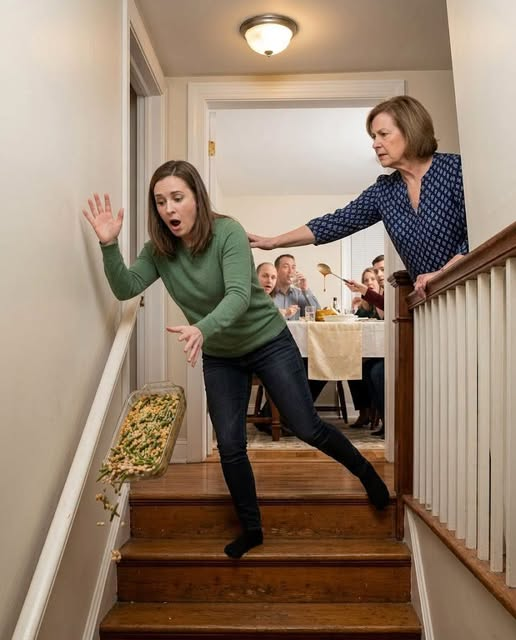
The basement stairs.
And Graham’s constant insistence that his mother “never really meant it.”
When Graham was allowed back inside later, he looked at my face and knew.
“You told them?”
“Yes.”
His shoulders dropped.
“Nora, why?”
I couldn’t believe he asked.
“Because your mother pushed me down the stairs.”
“She lost her temper.”
“That is not a defense.”
“She’s sixty-eight.”
“So?”
“She could get into serious trouble.”
I stared at him.
“I’m lying in a hospital bed, and you’re worried about what happens to her.”
His mouth closed.
Then I asked:
“Did you know about the other times?”
His expression told me before he answered.
“I knew Christmas wasn’t exactly an accident.”
Everything inside me went cold.
“You knew?”
He looked away.
“Mom told me afterward.”
“And you said nothing?”
“She promised it wouldn’t happen again.”
I almost laughed.
“You let me spend months believing I was clumsy.”
“Nora—”
“You knew.”
That hurt more than the stairs.
Judith had hurt me.
Graham had edited reality afterward so the family wouldn’t have to deal with it.
The officer asked whether anyone at Sunday dinner had witnessed the incident.
Graham immediately said:
“No one saw clearly.”
Another lie.
But this time, someone else was tired of carrying it.
His uncle Robert came to the hospital that night.
He stood awkwardly beside my bed.
“I should have said something downstairs.”
Graham went rigid.
“Uncle Rob.”
Robert ignored him.
He looked at me.
“I saw Judith follow you.”
My heart started pounding.
“I didn’t see the exact moment her hand touched you.”
He swallowed.
“But I saw her standing directly behind you.”
“And after you fell, I heard her say, ‘Maybe now she’ll learn.’”
Graham’s face drained of color.
Robert continued:
“Your father told everyone to keep quiet until Graham decided what to do.”
I closed my eyes.
It hadn’t been one frightened husband trying to protect his mother.
It had become a family decision.
Judith arrived the next morning.
She wasn’t allowed into my room.
I heard her in the hallway anyway.
“She’s destroying my son’s marriage!”
For once, Graham didn’t immediately defend her.
Then Judith said something that changed his expression.
“If you had controlled your wife properly, none of this would have happened.”
Silence.
I could almost see the moment Graham finally heard his mother the way everyone else did.
Not protective.
Not misunderstood.
Controlling.
He stepped into my room ten minutes later.
His face looked hollow.
“I told her to leave.”
I said nothing.
“I told her she can’t come to our house.”
“Our house?”
He stopped.
I looked at him.
“Graham, I’m not going back.”
He stared at me.
“Nora.”
“No.”
“I chose you just now.”
I almost felt sorry for him.
“After how many years?”
He lowered his eyes.
“You didn’t choose me when she humiliated me.”
“You didn’t choose me after Christmas.”
“You didn’t choose me in February.”
“You didn’t choose me when I was at the bottom of those stairs.”
“And you didn’t choose me in triage.”
His eyes filled.
“I was scared.”
“So was I.”
That was the difference.
His fear made him protect himself.
Mine had taught me to disappear.
I was done disappearing.
I went home once.
With my sister.
And a police escort while I collected essentials.
Judith was gone.
Graham sat alone at the dining table.
Sunday’s serving dishes were still stacked beside the sink.
He looked exhausted.
“Nora, please stay.”
“No.”
“I’ll change.”
“I hope you do.”
He looked up.
“For us?”
“For yourself.”
Then I removed my wedding ring.
I placed it beside his hand.
“I’m filing for divorce.”
He started crying.
I didn’t.
I had already spent too much of my life crying quietly so his family could continue pretending everything was fine.
The legal process took time.
Judith faced consequences related to the assault, and the earlier incidents became part of the documented pattern considered by investigators.
Robert cooperated.
So did another relative who finally admitted Judith had bragged for years that I needed to be “put in my place.”
Graham was never charged with pushing me.
He hadn’t.
But he had to live with a different truth:
Every time he minimized what happened, he made it easier for the next incident to happen.
During mediation, he told me:
“I didn’t think silence was the same as choosing her.”
I answered:
“When one person is hurting another, silence is still a choice.”
He nodded.
No argument.
It was probably the first time he truly understood.
Too late for our marriage.
But maybe not too late for him.
My recovery took months.
At first, I hated needing help.
My sister stayed with me.
Friends brought food.
A neighbor drove me to appointments.
Every time someone helped without making me feel indebted, I realized how strange my marriage had made ordinary kindness seem.
One afternoon, Dr. Mercer saw me at a follow-up.
“You look different.”
“I feel different.”
He smiled.
“Good different?”
I thought about it.
“Yes.”
Then I added:
“You were the first person who refused to call it an accident.”
His expression became serious.
“You told the truth.”
“I just listened.”
That mattered more than he probably knew.
A year later, Graham contacted me.
Not to reconcile.
He asked whether I would read a letter.
I agreed.
Most of it was an apology.
But one paragraph stayed with me:
I thought being a good husband meant preventing conflict between my wife and my mother. I understand now that I was not preventing conflict. I was forcing you to absorb it so I wouldn’t have to.
That was accurate.
I wrote back only:
I hope you remember that.
Nothing more.
Forgiveness did not require reopening the door.
Judith never apologized properly.
Her final message to me said:
Families should not involve outsiders in private matters.
I deleted it.
That was precisely how families like hers survived.
Everything became private.
A shove became misunderstanding.
Fear became sensitivity.
Silence became loyalty.
And eventually someone ended up in a hospital while everyone else debated whether telling the truth was too embarrassing.
I no longer believed in that kind of privacy.
People later asked whether the scans were what ended my marriage.
Not exactly.
The scans only showed injuries.
What ended my marriage was watching Graham see evidence that I had been hurt before—
and realizing he already knew.
The doctor found marks of the past on my body.
But the real pattern was somewhere no machine could photograph.
Judith hurt me.
Graham minimized it.
I forgave.
Then it happened again.
The X-rays didn’t create the truth.
They simply made it impossible for everyone else to keep calling the truth an accident.
And once I finally stopped protecting the family that refused to protect me—
I discovered that walking away, even slowly and painfully, was still walking toward something better.
