The door opened.
Caleb froze.
A nurse stood there.
Behind her was Dr. Marcus Reed.
And behind him—
hospital security.
For half a second, nobody moved.
Then the nurse looked at me.
Not at Caleb.
At me.
“Rebecca, are you safe?”
My husband immediately stepped backward.
“This is a misunderstanding.”
The words came so quickly that I almost laughed.
Dr. Reed looked at the monitor, then at my face.
“Sir, step away from the bed.”
Caleb straightened.
“I’m her husband.”
“That does not give you authority over her medical care.”
“I’m taking my wife home.”
“No,” I whispered.
Everyone heard me.
Caleb turned toward me.
That familiar warning appeared in his eyes.
Usually, it was enough.
Not anymore.
I looked at the security officers.
“I don’t want him near me.”
That was all it took.
Caleb tried to argue while they escorted him into the hallway.
He said I was medicated.
Confused.
Emotional.
He told them I had exaggerated problems throughout our marriage.
Then one of the nurses said something I would remember for the rest of my life.
“She doesn’t need your permission to say no.”
The door closed.
The room became quiet again.
For the first time in eleven years, Caleb’s anger existed somewhere I did not have to manage it.
I started crying.
Not because I wanted him back.
Because I finally understood how exhausted I had become.
The hospital documented what had happened.
The visitor logs.
The staff who heard the shouting.
The sudden change in my monitor.
The condition I had already been in before Caleb arrived.
A hospital advocate sat beside me and asked questions calmly.
Did I feel safe returning home?
No.
Was my daughter currently with Caleb?
My heart stopped.
“Yes.”
Emma.
Everything else disappeared.
“I need my daughter.”
My sister Rachel collected Emma that evening.
Not Caleb.
Not his mother.
Rachel.
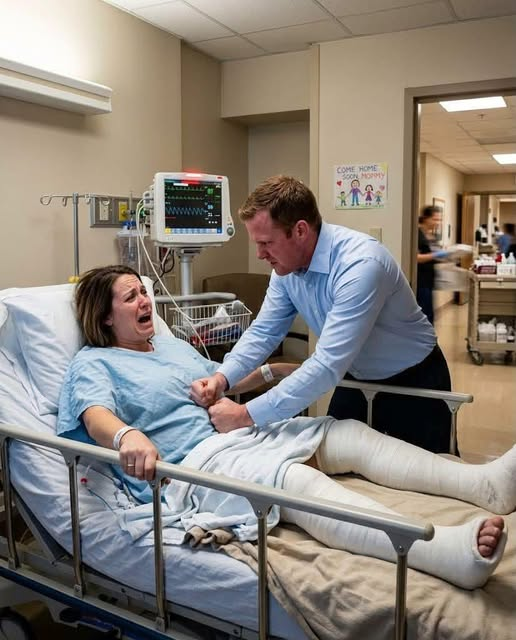
When Emma entered my hospital room, she was carrying the drawing that had been taped beside my bed.
She climbed carefully into the chair next to me.
“Mommy, why isn’t Dad here?”
I looked at her little face.
I did not tell her adult details.
She was nine.
She needed safety, not a burden she could not carry.
“Dad made some choices that mean he can’t be here right now.”
Her eyes filled.
“Was he mad at you?”
I reached for her hand.
“Yes.”
“Because of the accident?”
“No, sweetheart.”
“This isn’t your fault.”
She nodded slowly.
Then rested her cheek against my arm.
That night she slept in the family chair beside my bed.
And I made myself another promise.
The crash had nearly taken me from Emma.
I would not return home and let fear finish what the accident had started.
Caleb called repeatedly.
I did not answer.
Then came the messages.
You embarrassed me.
You’re destroying our family.
Emma needs her father.
Finally:
You won’t survive without me.
I stared at that last sentence.
Eleven years earlier, I might have believed him.
Now I was lying in a hospital bed with two broken legs and still somehow felt freer than I had inside our marriage.
I handed the phone to the advocate.
“Please save everything.”
She did.
My attorney filed for divorce before I left rehabilitation.
Caleb responded exactly as I expected.
He claimed I had never contributed financially.
That the house was his because his salary paid the mortgage.
That I had “chosen” not to work.
So my lawyer asked for the financial records.
Then something almost funny happened.
For eleven years, Caleb had called me useless.
But the household accounts told a different story.
Every budget.
Every tax document.
Every insurance renewal.
Every mortgage refinance.
Every investment statement.
I had managed them.
I had also used part of an inheritance from my grandmother toward the house.
And my accounting background meant I had kept records.
All of them.
Caleb had forgotten that the woman he called a burden was the person who knew exactly where every dollar had gone.
Then the accident itself came under review.
Not because Caleb had caused it.
He hadn’t.
But investigators discovered that while I was hospitalized, he had already contacted the insurance company about the settlement.
Before asking whether I could walk.
Before discussing rehabilitation.
Before spending more than fifteen minutes beside my bed.
He had asked when the payment would be released.
That detail broke something in me.
Not because it surprised me.
Because it didn’t.
Caleb’s mother called.
“Rebecca, marriages have difficult moments.”
“This wasn’t a difficult moment.”
“He was under stress.”
“So was I.”
“You’re really going to destroy eleven years over one mistake?”
I looked at my casts.
Then at Emma coloring beside the window.
“No.”
“I’m ending eleven years of making excuses for the same problem.”
She stopped calling after that.
My recovery was slow.
I learned how to move through the world again in stages.
Bed.
Wheelchair.
Physical therapy.
Then short distances with support.
Emma celebrated every small improvement as though I had won an Olympic medal.
One afternoon, she held my hand and said:
“You’re getting strong again.”
I smiled.
“I was always strong.”
I had simply spent too many years using that strength to endure instead of leave.
Caleb saw me once during mediation.
He looked smaller than I remembered.
Or maybe I had finally stopped shrinking around him.
“I’m sorry,” he said.
I waited.
“I lost control.”
“That isn’t an apology.”
His eyes tightened.
“I said I’m sorry.”
“You’re describing what happened.”
“You’re not taking responsibility for it.”
He looked away.
Then said:
“I was scared about the bills.”
I nodded.
“So you decided my pain was costing too much.”
“That’s not what I meant.”
“It’s what you said.”
Silence.
For years, Caleb had always found a better explanation after doing something cruel.
Stress.
Money.
Work.
My tone.
My mistakes.
That day, I no longer needed to argue with any of them.
I simply said:
“The marriage is over.”
The divorce became final the following year.
I returned to accounting.
Not immediately.
First part-time.
Then full-time.
I discovered that the career I thought I had abandoned forever had not disappeared.
I was rusty.
Not incapable.
There was a difference.
Emma and I moved into a smaller house.
The kitchen was outdated.
The carpet needed replacing.
The backyard fence leaned slightly to one side.
It was perfect.
Because when I closed the front door at night, nobody inside frightened me.
Years later, Emma asked me about the hospital.
She was old enough then to understand more.
“Was that the day you decided to leave Dad?”
I thought about it.
“No.”
“I think part of me had known for years.”
“So what changed?”
I remembered the door handle turning.
The nurse looking directly at me.
The question:
Are you safe?
“No one had ever asked me that so plainly before.”
Emma took my hand.
“And what did you say?”
“No.”
She nodded.
Then smiled sadly.
“I’m glad somebody listened.”
“So am I.”
People assumed the accident changed my life.
It did.
But not in the way they thought.
The crash injured my body.
The hospital revealed my marriage.
Caleb entered that room believing my recovery was an expense he controlled.
He thought being my husband gave him the right to decide when I was sick enough.
When I could leave.
When I could say no.
He was wrong.
The most important moment was not when the door opened.
It was the second before it did—
when I held onto the bedrail, looked at the man I had feared for eleven years, and said one word:
No.
The staff heard me.
The hospital documented it.
My attorney built from it.
And eventually, Emma learned from it.
Because sometimes surviving is not the moment you escape an accident.
Sometimes it is the moment you finally understand that the life you return to must be safer than the one you almost lost.
