Adrian stared at the letter for so long that I finally stopped pretending to clean.
“Who is it?”
He swallowed.
Then he handed me the paper.
The first line made my knees weak.
Dear Adrian,
My name is Thomas Hale. I am your father’s younger brother.
I sat down.
I knew the name.
Not well.
But I knew it.
Thomas had been twenty-two when Adrian was born.
Quiet.
Awkward.
Nothing like his older brother, Michael.
I had met him only twice.
Then Michael disappeared from our lives, and eventually his entire family did too.
I never heard from Thomas again.
Until apparently—
he had been writing to my son every year.
Adrian continued reading aloud.
Thomas explained that he had learned Adrian’s birthday because he had been at the hospital the day he was born.
Michael had called him.
Not because he wanted to become a father.
Because he was terrified.
He told Thomas he wasn’t ready for a baby, wasn’t ready for responsibility, and planned to leave.
Thomas tried to stop him.
He failed.
A week later, Michael disappeared.
But before leaving, he made his brother promise something strange.
“Don’t contact her. Don’t make things worse.”
I closed my eyes.
That sounded exactly like Michael.
Running away, then pretending absence was kindness.
Thomas obeyed at first.
For almost a year.
Then Adrian’s first birthday arrived.
And Thomas couldn’t stop thinking about the nephew he had held once in the hospital.
So he mailed a card.
No signature.
Five dollars inside.
He expected it to be the only one.
It wasn’t.
Every year, Thomas sent another.
When Adrian was four, he mailed ten dollars because he had gotten his first steady job.
When Adrian turned seven, Thomas had been unemployed, so the envelope contained only a card.
I remembered that year.
Adrian had still been thrilled.
When he was ten, the envelope arrived three days late.
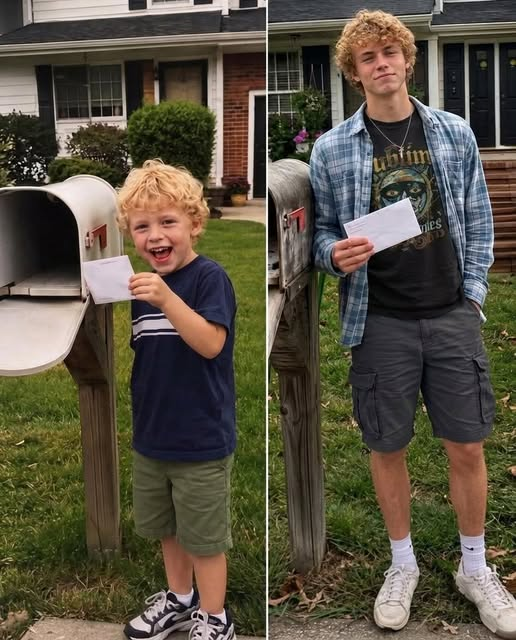
Adrian checked the mailbox every afternoon until it came.
Thomas wrote:
I never knew those cards mattered to you. I assumed most of them were probably thrown away. I kept sending them because it was the only way I knew how to say: somebody on your father’s side remembers that you exist.
Adrian stopped reading.
His eyes had filled.
“So my dad didn’t send them.”
“No.”
I reached for his hand.
He let me take it.
For a while, neither of us spoke.
Then Adrian noticed there was another page.
This one was harder.
Michael had contacted Thomas several times over the years.
He knew Adrian existed.
He knew his birthday.
And eventually, Thomas had even given him our general location after finding me through an old acquaintance.
Michael could have reached out.
He chose not to.
Thomas had begged him once.
His brother answered:
He’s better off thinking I’m gone than finding out what kind of father I’d be.
Adrian’s jaw tightened.
“What does that even mean?”
I didn’t answer.
Thomas did.
Michael had struggled for years with gambling, unstable work, and repeated financial problems.
Whenever Thomas encouraged him to contact us, Michael found another excuse.
He didn’t have enough money.
He was embarrassed.
Too much time had passed.
Adrian might hate him.
I might refuse.
There was always a reason to wait until next year.
Then next year became eighteen.
Adrian laughed bitterly.
“That’s funny.”
“What?”
“He kept waiting until he was ready.”
He looked at the pile of old cards I had saved in a kitchen drawer.
“And Uncle Thomas just mailed something anyway.”
The final paragraph contained a phone number.
You’re eighteen now. I don’t think I have the right to stay anonymous anymore. If you want to speak to me, call. If you don’t, I will understand. I’m not asking you to forgive your father, meet him, or call me family. I only wanted you to know the cards were real. You were remembered. Happy birthday, Adrian. —Thomas
For the first time in eighteen years, there was a name at the bottom.
Adrian stared at the number.
“Should I call?”
“That’s your decision.”
“What would you do?”
I smiled sadly.
“I’ve spent eighteen years making decisions for you.”
“You get this one.”
He looked at the phone for another minute.
Then pressed call.
Thomas answered on the second ring.
“Hello?”
Adrian froze.
I could see the little boy in him suddenly.
The one who checked the mailbox before birthday cake.
The one who once wondered whether his father secretly remembered him.
Finally, he said:
“Is this Thomas?”
Silence.
Then a shaky breath.
“Yes.”
“My name is Adrian.”
The man on the other end began crying.
Not loudly.
Just enough that we both heard it.
“I know.”
Adrian’s eyes filled too.
“Why didn’t you sign the cards?”
Thomas took a moment before answering.
“Cowardice, partly.”
“And partly because I didn’t know whether your mother wanted your father’s family in your life.”
I leaned toward the phone.
“Thomas?”
He went quiet.
Then:
“Sarah?”
“It’s me.”
“I’m sorry.”
“For what?”
“For not asking you.”
That answer surprised me.
Not defending himself.
Not blaming Michael.
Just admitting what he should have done differently.
I said:
“You can ask now.”
We met Thomas three weeks later.
At a diner halfway between our cities.
He was nothing like Adrian had imagined.
No expensive car.
No dramatic secret fortune.
He worked as an electrician.
Had a wife named Rebecca.
Two daughters.
And gray beginning at his temples.
He brought a shoebox.
Inside were copies of every birthday card he had ever sent.
He had bought two identical cards each year.
One for Adrian.
One to keep.
Adrian laughed when he saw the ridiculous dinosaur card from his eighth birthday.
“I remember this one.”
Thomas smiled.
“So do I.”
“You sent me twenty dollars.”
“I had overtime that week.”
For the first time, the mystery became ordinary.
And somehow that made it more meaningful.
There had been no grand plan.
No hidden inheritance.
Just a man who remembered.
Every year.
Then Adrian asked the question we both knew was coming.
“Where is my father?”
Thomas’s expression changed.
“Arizona.”
“Does he know I’m talking to you?”
“No.”
“Would he want to meet me?”
Thomas did not protect his brother.
“I don’t know.”
That honesty mattered.
Adrian nodded slowly.
“Then I don’t want to meet him yet.”
Thomas said:
“That’s fair.”
No pressure.
No speech about blood.
No guilt.
Just fair.
Michael eventually learned.
Three months later, Adrian received a message.
His first message from his father in eighteen years.
Thomas told me you know everything. I’m sorry. If you ever want to talk, I’ll answer.
Adrian showed it to me.
“What should I say?”
“Whatever is true.”
He typed for a long time.
Then sent:
I spent years wondering whether you remembered my birthday. You did. You just chose not to show up. I’m not ready to talk. If that changes, I’ll tell you.
Michael replied:
I understand.
That was all.
Adrian did not forgive him overnight.
There was no dramatic reunion.
Some absences are too large to be repaired with one message.
But for the first time, Adrian had an answer.
And answers are sometimes enough to stop old questions from controlling you.
Thomas became part of our lives slowly.
Christmas cards.
Occasional phone calls.
Then visits.
Adrian met his cousins.
Rebecca showed me the drawer where Thomas kept eighteen duplicate birthday cards.
I cried when I saw it.
Thomas looked embarrassed.
“I probably should’ve done more.”
“Yes,” I said.
He nodded.
Then I smiled.
“But you also could have done nothing.”
He looked toward Adrian laughing with his cousins.
“I couldn’t.”
The following year, Adrian turned nineteen.
There was no mysterious envelope.
He checked the mailbox anyway.
Old habits.
Instead, the doorbell rang.
Thomas stood outside holding a cheap birthday card.
Adrian opened it.
Ten dollars fell out.
He burst out laughing.
“You’re still giving me ten bucks?”
Thomas shrugged.
“Tradition.”
Adrian hugged him.
And I had to turn away for a second.
For eighteen years, we thought the envelopes were about secrecy.
They weren’t.
They were about someone who did not know how to enter our lives but refused to pretend Adrian did not exist.
His father had spent eighteen years waiting until he felt ready.
Thomas spent eighteen years sending a card even when he wasn’t sure he was welcome.
That difference mattered.
Adrian never got the childhood with his father that he once imagined.
But when he finally learned who had been remembering him every year, he gained something he had never expected.
Not a replacement father.
Not a fortune.
Not a perfect explanation.
An uncle.
A family connection.
And proof that even during all those birthdays when he wondered whether anyone on his father’s side thought about him—
someone always had.
The mysterious envelopes stopped after his eighteenth birthday.
But Adrian never missed them.
Because after eighteen years of receiving unsigned cards from a stranger—
he finally had someone he could thank by name.
