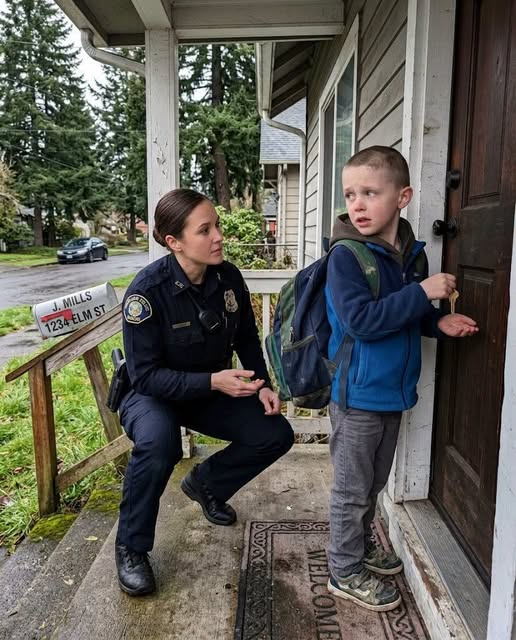
I looked at the boy’s shaking hand.
Then at the locked door.
“I can promise you this,” I said. “If you show me something that means you’re not safe, I will not pretend everything is okay.”
He searched my face.
“That’s different from promising I’ll never have to come back here,” I added. “I can’t lie to you about decisions other people may have to make.”
He nodded slowly.
“That’s okay.”
Then he unlocked the door.
His name was Ethan.
I learned that ten minutes later.
What I noticed first was the smell.
Not something dramatic.
Just stale air, old food, and a house that had been shut too tightly for too long.
The living room looked normal enough.
Television.
Couch.
Family photographs.
Then Ethan pointed toward a hallway.
“Not there.”
I looked at him.
“Where?”
“The basement.”
We went down together.
I kept Ethan behind me.
At the bottom of the stairs was a small room with a mattress on the floor.
No window.
A plastic storage bin.
A blanket.
Several schoolbooks.
And a child-sized backpack.
Ethan whispered:
“That’s where I sleep when I’m bad.”
I did not ask him to explain what “bad” meant.
Not there.
Not yet.
I already knew enough to stop treating the situation like an ordinary welfare check.
I radioed for another officer.
Then I called our child-safety liaison.
Ethan immediately grabbed my sleeve.
“Are you taking me away?”
“I’m making sure you’re not alone.”
His eyes filled.
“Dad is going to be angry.”
“That is not your job to fix.”
He stared at me.
I repeated it.
“You are seven years old.”
“Adults are responsible for what adults do.”
Something in his face changed.
Like no one had ever said that sentence to him before.
His father arrived eight minutes later.
Mark Dalton stepped through the front door wearing work boots and an expression of irritation.
Then he saw my uniform.
Then Ethan.
“What happened?”
Ethan shrank behind me.
Mark noticed.
His voice hardened.
“What did you tell him?”
I stepped between them.
“Sir, stay where you are.”
He laughed once.
“You’re standing in my house.”
“Yes.”
“And right now I need you to remain in the living room.”
He looked toward the basement door.
That was when I knew he understood exactly why I was there.
Mark immediately began explaining.
Ethan was difficult.
Ethan lied.
Ethan had behavior problems.
The basement room was “just discipline.”
Everyone in Mark’s family had been raised that way.
His own father had been stricter.
That was when Ethan’s earlier sentence returned to me.
They all believe it’s normal.
Mark believed that made it better.
It didn’t.
Our job was not to debate his childhood.
Our job was to determine whether Ethan was safe.
The second officer arrived.
Then a child-protection worker named Ms. Alvarez.
She spoke to Ethan in the kitchen where he could see me through the doorway.
She did not ask leading questions.
She did not make him repeat himself over and over.
She let him describe routines.
Where he slept.
What happened when he made mistakes.
Who else knew.
Which adults he trusted.
The answers came slowly.
His grandmother knew.
An uncle knew.
A neighbor had heard him crying once and told him to “listen better.”
His father’s girlfriend sometimes gave him food afterward but told him not to complain because Mark “had enough stress.”
Everyone had found a different way to make Ethan responsible for keeping the adults comfortable.
Nobody had stopped to ask whether he was afraid.
Until he asked me to walk him home.
That afternoon, Ethan did not stay in the house.
Ms. Alvarez arranged emergency placement with his maternal aunt, whom Ethan identified as someone he felt safe with.
Before leaving, he looked at me.
“You said you wouldn’t make me act like everything was okay.”
“I remember.”
“Is this because I told?”
“No.”
I crouched beside him.
“This is because adults finally listened.”
That mattered.
I never wanted him believing the consequences belonged to him.
He had not broken the family.
He had described what was happening inside it.
Those were not the same thing.
The case did not end with flashing lights and handcuffs.
Real cases rarely end that neatly.
There were interviews.
Home assessments.
School records.
Medical evaluations.
Court hearings.
Family members who insisted Mark loved his son.
People who said he only needed parenting classes.
Others who wanted permanent separation immediately.
My role was smaller than Ethan imagined.
I reported what I saw.
I documented the room.
I testified about his condition when he approached me.
Then professionals with far more expertise than I had made the long-term decisions.
That was how it should be.
Mark was ordered to complete a series of evaluations and services before any possibility of unsupervised contact could be considered.
The basement room was documented.
So were Ethan’s statements.
The family members who had dismissed what was happening were interviewed too.
Some became defensive.
One aunt cried.
His grandmother repeatedly said:
“That’s how we were all raised.”
Ms. Alvarez answered:
“Then somebody should have stopped it earlier.”
I never forgot that.
Harm does not become harmless because it is traditional.
Sometimes all tradition means is that nobody challenged it soon enough.
Three months later, I saw Ethan outside Evergreen Elementary.
His shoes fit.
That was the first thing I noticed.
His backpack was still too big.
But he was laughing with another boy.
Actually laughing.
When he saw me, he ran over.
“Officer Dunham!”
“Hey, buddy.”
He pointed proudly at his sneakers.
“My aunt got these.”
“Nice.”
“They don’t hurt.”
I smiled.
“Even better.”
Then his expression became serious.
“Dad is doing classes.”
“I heard.”
“Am I supposed to forgive him?”
I paused.
“No one gets to order you to feel something before you feel it.”
He nodded.
“Ms. Alvarez said something like that.”
“She’s smarter than me.”
He grinned.
“I know.”
I pretended to be offended.
For the first time since I met him, Ethan looked like a seven-year-old.
Nearly a year passed before I learned the final arrangement.
Ethan remained with his aunt.
His father was allowed only structured contact while continuing to work through the court’s requirements.
Whether their relationship would ever become something safe and healthy was not something anyone could promise.
But Ethan no longer had to carry that decision alone.
He had adults watching now.
Teachers.
His aunt.
A caseworker.
A counselor.
People who understood that “family” was not a magic word that made fear acceptable.
One spring afternoon, Ethan handed me an envelope after school.
Inside was a drawing.
Two stick figures walking down a street.
One small.
One tall.
At the end was a house.
But the house had no door.
Instead, he had drawn another building beside it.
His aunt’s apartment.
Bright yellow windows.
Three people standing outside.
On the back, in uneven handwriting, he had written:
Thank you for coming home with me.
I kept that drawing.
Not because I had saved Ethan.
That would have been the wrong way to remember it.
Ethan saved himself first.
He was seven years old.
Terrified.
Surrounded by adults who had taught him that silence was normal.
And still, he walked up to an officer after school and asked for help in the smartest way he knew how.
Come see it yourself.
He understood something many adults never learn:
Sometimes telling the truth feels impossible when everyone around you has agreed not to call something wrong.
So he found one person outside that agreement.
And asked him to walk home.
At the door, Ethan believed the promise he needed was:
Don’t make me go back.
But the promise every child actually deserves is simpler.
If something is wrong, you do not have to carry it alone.
That was the promise I could keep.
And this time—
the adults did too.
