I stared at the photograph.
My parents looked barely thirty.
Samuel stood beside my father, thin and serious.
And next to them was a man I had never seen before.
He had my eyes.
The same slightly crooked left eyebrow.
Even the shape of his mouth was mine.
I looked at Samuel.
“Who is he?”
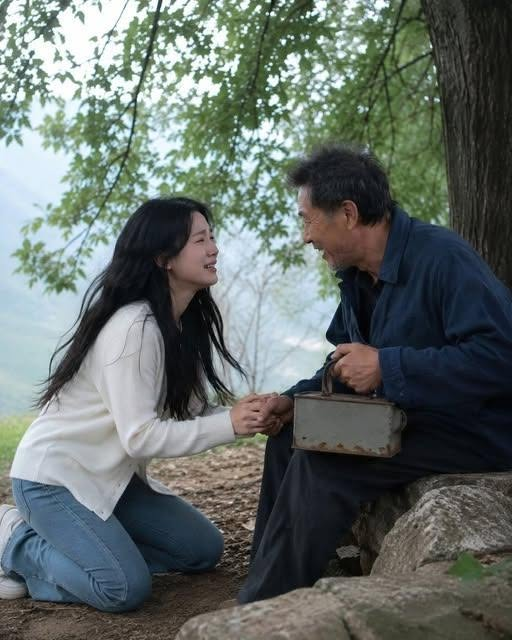
My uncle closed the rusty box.
Then, in the same clear voice that still sounded impossible coming from him, he said:
“Your biological father.”
The hill seemed to move beneath my feet.
“No.”
“His name was Thomas Bennett.”
I shook my head.
“My father was David Bennett.”
“David was your father.”
Samuel’s voice softened.
“He raised you. Loved you. Protected you.”
He pointed toward the photograph.
“But Thomas gave you life.”
I couldn’t breathe.
Samuel continued.
Thomas had been the oldest Bennett brother.
David was second.
Samuel was third.
My grandparents had owned hundreds of acres around the village—land nobody valued much thirty years ago.
Thomas managed the family accounts.
David worked the fields.
Samuel had been studying accounting in the provincial capital.
I stared at him.
“You went to university?”
“For two years.”
Every childhood memory rearranged itself.
The uncle who counted steps.
The uncle who struggled with simple arithmetic when shopkeepers were watching.
The man who could apparently read old contracts hidden inside a rusty box.
“What happened?”
Samuel looked toward the village.
“Greed.”
There had been another Bennett.
Their cousin.
Vincent Bennett.
The fourth man everyone treated like a brother.
Vincent discovered that a highway and industrial project was being planned near the family land.
If approved, property that had once been worth almost nothing would become extraordinarily valuable.
Thomas refused to sell cheaply.
Vincent wanted control.
Then Thomas discovered something worse.
Several deeds had been altered.
Signatures copied.
Land parcels transferred through companies connected to Vincent.
Thomas began collecting evidence.
And then—
“He died,” I whispered.
Samuel nodded.
Officially, Thomas died in a highway accident before I was born.
My mother had been pregnant with me.
She and Thomas had planned to marry after the harvest.
After his death, Vincent began asking questions.
About the baby.
About Thomas’s estate.
About whether Thomas had left documents behind.
David married my mother shortly before I was born.
He put his name on my birth certificate.
He raised me as his daughter.
And everyone agreed never to tell me.
“Why?”
“Because Thomas left his shares to his child.”
I looked at the baby bracelet.
“To me.”
“Yes.”
Samuel opened the box again.
At the bottom was a sealed envelope.
He handed it to me.
The handwriting belonged to my father.
David.
For Clara, when hiding the truth becomes more dangerous than telling it.
My hands shook as I opened it.
Inside were six pages.
I read them under the acacia tree while Samuel waited.
My father had written everything.
Thomas.
My mother.
The land.
Vincent.
And Samuel.
One paragraph made me stop.
Samuel is smarter than all of us. That is why we asked him to become invisible.
I looked up.
“You agreed to pretend?”
Samuel gave a tired smile.
“Not at first.”
After Thomas died, Samuel confronted Vincent publicly.
Vincent realized Samuel knew about the missing deeds.
Within weeks, people began saying Samuel was unstable.
Then Samuel actually became seriously ill with fever.
He spent nearly a month recovering.
David saw an opportunity.
“When I came home,” Samuel explained, “your father told everyone the fever had damaged me.”
“And you went along with it?”
“I hated him for asking.”
Samuel stared at his hands.
“Then I heard Vincent speaking in our yard.”
“What did he say?”
“He said it was fortunate the only brother who knew numbers had become an idiot.”
I felt cold.
“So you kept pretending.”
Samuel nodded.
Because once everyone believed Samuel understood nothing, people stopped hiding things around him.
Vincent discussed business while Samuel carried tea.
Relatives complained about money while Samuel repaired fences.
Old men talked about property transfers in front of him as if he were furniture.
Samuel listened.
Remembered.
Collected copies.
For twenty years.
My “fool” uncle had been building a case one overheard conversation at a time.
“And me?”
Samuel’s eyes filled.
“You were Thomas’s daughter.”
He touched the rusty box.
“And the only person who could undo what Vincent had taken.”
I sat beneath that tree until darkness began covering the hill.
Then I asked:
“Why didn’t Dad tell me before he died?”
“He wanted to.”
“Then why didn’t he?”
Samuel looked ashamed.
“Because I stopped him.”
I stared at him.
“You?”
“Vincent still came to the village.”
Samuel’s voice became quiet.
“He watched your father after the cancer diagnosis. Asked about wills. Asked whether you planned to return permanently.”
I remembered Vincent.
Barely.
A distant “Uncle Vince” who came to funerals, weddings, Lunar New Year gatherings.
Always smiling.
Always bringing expensive cigarettes.
I had never thought about him twice.
Samuel continued.
“As long as you remained Clara Bennett, David Bennett’s daughter working in the city, you were uninteresting to him.”
“But if Dad told me I was Thomas’s daughter…”
“He would know you could challenge the old transfers.”
I looked at the box.
“So when my parents died, you disappeared with the evidence.”
“Yes.”
“Why?”
“To see whether anyone followed me.”
I stared at him.
“Did they?”
Samuel nodded.
My stomach turned.
“Who?”
“A man from Vincent’s company.”
That night I did not return to the city.
I slept in my childhood room.
Samuel slept in the small room behind the house.
For the first time in my life, I knew the man in that room was not “Dumb Sam.”
At six the next morning, someone knocked on the front gate.
Vincent Bennett.
Of course.
He entered carrying fruit and wearing the same gentle smile I remembered from childhood.
“Clara.”
He sighed dramatically.
“Such tragedy. First your father, then your mother.”
I watched him differently now.
He glanced toward Samuel’s room.
“Where’s your second uncle?”
Samuel had already returned to his old performance.
He sat beneath the eaves peeling an apple slowly.
Vincent looked at him and laughed.
“Still useless as ever.”
Samuel smiled vacantly.
My hands clenched.
Vincent turned back to me.
“You’ll sell this place now, I assume.”
“Why?”
“You live in the city.”
He gestured toward the old house and surrounding fields.
“What will you do with all this?”
“I haven’t decided.”
“I can help.”
Of course he could.
He produced a folder.
Prepared already.
An offer to buy our house, fields and hillside parcels.
I looked at the price.
$140,000.
It sounded enormous for our village.
Two days earlier, I might have accepted.
Now I knew a development consortium had recently offered nearby landowners more than four times that amount.
I smiled.
“You came prepared.”
Vincent laughed.
“Family should help family.”
Behind him, Samuel continued peeling the apple.
Slowly.
Carelessly.
Invisible.
I closed the folder.
“I’ll think about it.”
Vincent’s smile tightened.
“Don’t wait too long.”
“Why?”
“The market changes.”
“So do families.”
For the first time, his eyes sharpened.
Only for a second.
Then the smile returned.
He left.
Samuel waited until his car disappeared.
Then he looked at me.
“You did well.”
I almost laughed.
“I learned from the village fool.”
His face broke into the old smile I remembered.
This time, knowing the man behind it made my chest hurt.
We took the rusty box to an attorney in the provincial capital.
Not Michael’s family attorney.
Not anyone connected to the village.
A property-litigation specialist named Rebecca Chen.
She spent three days reviewing the documents.
Then she called me.
“Clara, your uncle kept almost everything.”
Samuel sat beside me.
Rebecca spread records across the table.
Original parcel maps.
Old transfer contracts.
Copies of bank records.
Letters from Thomas.
And most importantly, documents showing that several supposed sales had been completed after Thomas’s death using authorizations that should no longer have been valid.
Some land could not simply be reclaimed after decades.
Other claims had expired.
But not all of them.
And Thomas’s ownership interest in one holding company had never legally disappeared.
Rebecca looked at me.
“That interest passed to his estate.”
“And then?”
“To his child.”
My mouth went dry.
“Me.”
“Yes.”
The current value was not $140,000.
Not even close.
The holding company controlled land along the proposed development corridor.
My share was worth several million dollars.
Samuel looked at me.
I expected triumph.
He only said:
“Now you know why they wanted you ignorant.”
Michael arrived the next evening.
He was furious.
“You’ve been gone four days.”
“My parents died.”
“I know, Clara, but we have a child. You can’t disappear.”
He stopped when he saw Samuel sitting at the kitchen table reading a newspaper.
Actually reading it.
Michael stared.
Samuel folded the paper.
“Hello, Michael.”
My husband nearly dropped his bag.
“What the hell?”
I told him everything.
Not every legal detail.
Enough.
By the end, Michael was no longer looking at Samuel.
He was looking at me.
“How much is the land worth?”
That was his first question.
Not:
Are you okay?
Not:
Your father wasn’t your biological father?
Not even:
Samuel sacrificed twenty years for you?
How much?
I felt something sink inside me.
“We don’t know yet.”
“But millions?”
“Possibly.”
His expression changed.
Then he smiled.
A warm smile I had not seen at my mother’s funeral.
“Clara, this changes everything.”
Samuel looked down.
I didn’t.
“What does it change?”
“Our mortgage.”
“Our daughter’s school.”
“My parents’ retirement.”
I froze.
“Your parents?”
Michael didn’t notice.
“We could buy a larger apartment.”
“We?”
He finally stopped.
“Clara, we’re married.”
There it was.
Family.
Again.
That word people used when they were about to decide what belonged to me.
I looked toward Samuel.
He did not interfere.
He had spent twenty years protecting me.
Apparently now he was going to let me protect myself.
I said:
“This isn’t money yet.”
“But when it is—”
“It came from Thomas.”
“So?”
“So maybe I want to understand who he was before I start spending what he left.”
Michael sighed.
“Don’t become sentimental about a man you never knew.”
Samuel’s hand stopped on the newspaper.
Mine did too.
I looked at my husband.
“That man died before I was born.”
“I didn’t mean—”
“He was my father.”
“David was your father.”
“Yes.”
My voice hardened.
“And Thomas was too.”
Michael muttered something about me being emotional.
That ended the conversation.
Not the marriage.
Not yet.
But something cracked.
Vincent made his move two weeks later.
He filed a challenge claiming the documents in Samuel’s possession were unreliable because Samuel had “suffered severe cognitive impairment for decades.”
I laughed when Rebecca told me.
“He’s using Uncle Sam’s act against us.”
“He’s trying.”
Then she smiled.
“But Samuel planned for that too.”
For twenty years, Samuel had maintained something nobody knew about.
A bank account.
Tax filings.
Correspondence with an accountant in another province.
Even continuing-education certificates completed by mail under his full legal name.
Samuel Bennett had quietly maintained proof that he was financially competent for decades.
Rebecca stared at him.
“Why?”
Samuel shrugged.
“One day I knew someone would call me stupid in court.”
I burst out laughing.
I couldn’t help it.
Rebecca laughed too.
Samuel looked offended.
“What?”
“You planned twenty years ahead.”
“Yes.”
“And everyone called you a fool.”
He smiled.
“That helped.”
The case never became the dramatic courtroom war Vincent expected.
Once forensic accountants began examining the old transactions, his lawyers pushed for settlement.
Too many records existed.
Too many signatures raised questions.
Too many companies led back to him.
The final agreement restored part of Thomas’s interest to his estate and compensated the remainder financially.
Vincent also lost control of several disputed parcels.
The development company negotiated directly with us afterward.
For the first time, I saw the actual numbers.
I sat in Rebecca’s office staring at the offer.
Samuel asked:
“Are you afraid?”
“Yes.”
“Good.”
I looked at him.
“Good?”
“People who aren’t afraid of big money usually lose it.”
I smiled.
“Definitely not stupid.”
“No.”
He leaned back proudly.
“I told you.”
Michael changed as soon as the settlement became certain.
He started sending me apartment listings.
Luxury condos.
Cars.
Private schools.
He even suggested putting some of the assets into a company managed by his father.
I said no.
Then one night he finally exploded.
“You don’t trust me.”
“I trusted you enough to marry you.”
“That’s not an answer.”
“It is.”
He pointed toward Samuel.
“You trust him more than your husband.”
I stared at him.
“He slept in a backyard room for twenty years so no one would know he was protecting me.”
Michael laughed bitterly.
“That story is insane.”
“No.”
I shook my head.
“What’s insane is that you heard it and your first thought was how much money we could spend.”
His face hardened.
“We have a family.”
“Yes.”
“Our daughter deserves this.”
That sentence sounded painfully familiar.
People always became generous with money that wasn’t theirs.
I answered:
“Our daughter deserves stability.”
“She deserves opportunities.”
“I agree.”
“But she doesn’t deserve to grow up believing another person’s inheritance becomes hers because she wants it.”
Michael went silent.
Three months later, we separated.
Not because of the money.
Money merely turned on the lights.
Underneath, I discovered a marriage in which my husband considered my family an inconvenience when they needed care—and an asset when they had wealth.
I couldn’t unsee it.
Samuel came to live with me in the city.
This time, I didn’t ask Michael.
I had my own apartment.
My own decisions.
My daughter was nine.
The first night Samuel stayed with us, she sat across from him at dinner and asked:
“Great-Uncle Sam, Mom says you’re actually really smart.”
Samuel considered the question.
Then said:
“Your mother exaggerates.”
I nearly choked on my soup.
My daughter giggled.
“Can you help me with math?”
“No.”
She looked disappointed.
Samuel added:
“I hate math.”
I stared at him.
“You studied accounting.”
“That is why I hate math.”
For the first time since my parents died, the house felt alive again.
We did not sell the old village home.
I renovated it.
Samuel’s little backyard room remained.
But I added a bathroom, heating and a proper desk.
When he saw it, he frowned.
“What?”
“You changed my room.”
“You spent twenty years sleeping on a wooden bed.”
“It was a good bed.”
“It leaned to the left.”
“So do I.”
I laughed until I cried.
Then he opened the desk drawer.
Inside I had placed a bag of cheap hard candies.
The same kind he used to keep in his pocket for me.
Samuel stared at them for a long time.
Then his eyes filled.
He took one.
Carefully unwrapped it.
And placed it in my hand.
Just as he had given me the fried egg when I was five.
“Clara eats.”
I started crying.
He immediately looked uncomfortable.
“Clara doesn’t cry.”
That made it worse.
I hugged him.
This time, he didn’t pretend not to understand why.
Years later, my daughter asked me why Samuel had sacrificed so much.
We were sitting beneath the old acacia tree.
Samuel was nearby, arguing with a radio that refused to work.
I thought about my answer.
“He loved your grandfather.”
“David?”
“Yes.”
“And Thomas?”
“Yes.”
“And Grandma?”
“Yes.”
“And you?”
I smiled.
“Apparently enough to pretend to be a fool for half his life.”
My daughter frowned.
“That sounds lonely.”
It was.
That was the part nobody romanticized.
Samuel had survived humiliation.
Children mocking him.
Adults cheating him at markets.
Relatives discussing him like a burden while he understood every word.
He had given up education.
Career.
Marriage.
An ordinary adult life.
All because three brothers once agreed that one of them needed to disappear in plain sight until a little girl was safe.
I looked toward him.
He deserved more than gratitude.
He deserved the rest of his life back.
So that became what I gave him.
Not repayment.
You cannot repay twenty years.
Just freedom.
He traveled.
Took photography classes.
Bought ridiculous hats.
Learned to use a smartphone and immediately became addicted to sending me blurry pictures of flowers.
And every year, on my parents’ memorial day, we returned to the village together.
Three graves stood near one another.
Thomas.
David.
My mother.
Samuel always placed flowers on all three.
No distinction.
No explanation.
Family had never been as simple as blood.
The rusty box remains in my study today.
Cleaned, but not restored.
I refused to remove all the rust.
My daughter once asked why.
“Because it survived like that.”
Inside are the photographs.
Thomas’s letters.
David’s confession.
My baby bracelet.
And the note with the sentence that once terrified me:
If Clara asks one day, tell her that her real danger is not outside the family.
For years, I thought those words referred only to Vincent.
Eventually, I understood they meant something broader.
The people closest to us can protect us.
But they can also feel entitled to our silence, our money, our choices, or our future.
A family name does not automatically make someone safe.
And someone the whole world dismisses as useless may be the one person quietly standing between you and disaster.
The village called Samuel Bennett a fool for more than twenty years.
They laughed when he counted his steps.
They cheated him by pennies.
They talked over him.
They treated him like furniture.
Samuel let them.
Because every person who underestimated him revealed something.
And every secret they dropped in front of “Dumb Sam” eventually ended up inside a rusty box.
When my parents died, I thought I had lost the last people in the world who would protect me.
I was wrong.
My second uncle was still there.
Waiting under an acacia tree.
Holding twenty years of truth against his chest.
And the first clear sentence he gave me was the one I would remember forever:
“Clara, your second uncle is not stupid.”
No.
He never was.
He was simply the smartest man in the family—and the only one willing to look like a fool long enough to save me.
