Mr. Hall froze the security footage.
Megan was walking through the automatic doors.
She looked back.
Not casually.
Directly at Lily.
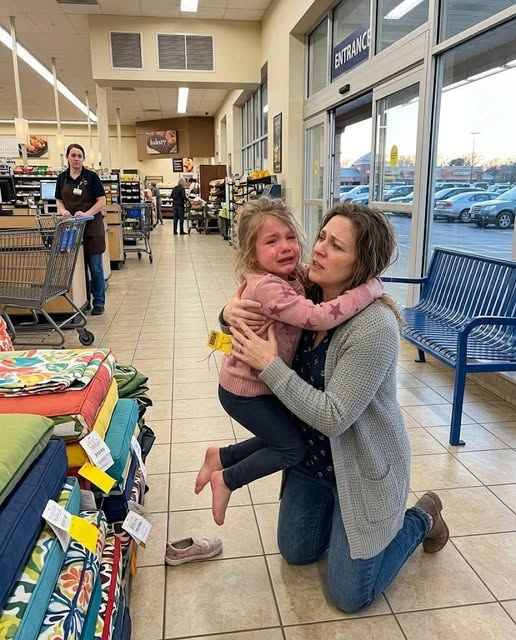
My daughter stood beside the blue bench exactly where Megan had told her to wait.
Megan saw her.
Then she turned around and left.
Officer Ruiz leaned closer to the monitor.
“Play it again.”
Mr. Hall did.
Same result.
Megan left at 4:51.
No panic.
No searching.
No running through aisles calling Lily’s name.
She simply pushed the grocery cart into the parking lot.
The next camera showed her loading bags into Mom’s car.
Then she sat behind the wheel.
For thirteen minutes.
Using her phone.
At 5:07, she drove away.
Lily had been intentionally left behind.
My daughter buried her face against me.
I covered her ears before asking:
“Can you preserve all of this?”
Mr. Hall’s face had gone pale.
“Yes.”
Officer Ruiz nodded.
“We’ll need copies.”
Then Lily moved her hand.
The yellow price tag was still clenched inside her fist.
Officer Ruiz noticed.
“What’s that, sweetheart?”
Lily looked at me before answering.
“Aunt Megan gave it to me.”
My stomach tightened.
“Why?”
“She said if I stayed on the bench until she came back, I could have the yellow bear.”
Mr. Hall frowned.
“What yellow bear?”
Lily pointed toward the seasonal section.
We found it ten minutes later.
A stuffed bear with a clearance sticker.
The tag in Lily’s hand had been torn from its ear.
And another camera showed exactly how it happened.
Megan picked up the bear.
Tore off the tag.
Handed it to Lily.
Then pointed toward the bench.
It was not a child wandering away.
It was not confusion.
Megan had given my five-year-old daughter a reason to remain exactly where she left her.
Officer Ruiz stopped the recording.
“That changes the statement she gave us.”
I looked at him.
“Yes.”
“It does.”
When we returned to Mom’s house, Megan was no longer laughing.
She was pacing.
Mom rushed toward us.
“Thank God. Can we please put this behind us now?”
“No.”
She stopped.
Megan looked at Officer Ruiz.
“What happened?”
He answered calmly.
“We reviewed the security footage.”
Every bit of color left her face.
Mom immediately stepped between us.
“Megan already explained—”
“No, Mom.”
I took Lily’s coat from the chair.
“She lied.”
Megan snapped:
“I didn’t lie!”
I pulled out my phone.
“You said Lily ran away.”
“She did!”
“The cameras show you telling her to stay.”
Silence.
“You gave her the tag from the bear.”
Megan’s eyes moved to Lily’s hand.
For the first time, I saw fear.
“She was throwing a tantrum!”
“She was five.”
“She needed to learn that she can’t always get what she wants.”
“So you abandoned her in a store?”
“I was going back!”
“When?”
No answer.
“After dinner?”
“Tomorrow?”
“When someone else found her?”
Mom grabbed my arm.
“That’s enough.”
I pulled away.
“No.”
Her face hardened.
“Megan made a terrible mistake. But you are making this into something that could destroy her life.”
I stared at my mother.
“My daughter thought I had left her.”
“She’s safe now.”
And there it was.
The sentence that ended something inside me.
Safe now.
As though fear stopped mattering once the child was physically returned.
As though the only consequence that counted was the one adults had to suffer.
I picked up my phone.
Megan scoffed.
“Who are you calling now?”
I looked directly at her.
“My attorney.”
Mom frowned.
“For what?”
“To change every document that gives either of you authority over Lily.”
The room became silent.
Megan actually laughed.
“You’re serious?”
“Yes.”
Mom’s face changed.
“Claire…”
I had named Megan as Lily’s emergency guardian three years earlier.
If something happened to me, my sister would have been the person legally designated to step in temporarily until the court reviewed permanent arrangements.
Mom was listed second.
They both knew.
They had both treated it like proof that no matter how much we fought, family would always come first.
Not anymore.
I called my attorney in front of them.
“Daniel, it’s Claire.”
I looked down at Lily.
“I need my guardianship documents changed immediately.”
Mom whispered:
“Don’t do this out of anger.”
I looked at her.
“I’m not angry.”
That scared her more.
“I’m making sure the person responsible for my daughter’s safety is someone who believes leaving a five-year-old alone for two hours is an emergency.”
No one spoke.
“That rules out both of you.”
Megan’s story changed three more times that night.
First she said she intended to return after teaching Lily a lesson.
Then she said she expected Mom to pick Lily up.
Mom denied that.
Then Megan admitted the truth.
She had been angry with me.
Earlier that day, Mom had told her I would not lend her $18,000.
Megan was behind on several payments.
She wanted money to start an online boutique.
I had refused because she still owed me from the last “business opportunity.”
Lily had apparently repeated something she had heard me say on the phone:
“Mom says Aunt Megan needs to learn to handle her own money.”
Megan became furious.
So she punished my daughter.
Not because Lily had done anything wrong.
Because she wanted me to feel afraid.
When Officer Ruiz asked why she didn’t simply call me, Megan cried.
“I wanted Claire to understand what it feels like when someone doesn’t help you.”
I stared at her.
“You used my child to teach me a financial lesson?”
She covered her face.
“I wasn’t thinking.”
“No.”
I shook my head.
“You were thinking very clearly.”
She had chosen the store.
Chosen the bench.
Chosen the bear.
Chosen to drive away.
Then she returned home and laughed.
That wasn’t forgetting.
That was a decision.
The legal consequences were handled by professionals.
I gave my statement.
The store provided its recordings.
Officer Ruiz documented Megan’s changing explanations.
I did not exaggerate anything.
I didn’t need to.
The truth was bad enough.
Then I did something Mom considered even crueler.
I stopped leaving Lily alone with her.
Not for five minutes.
Not because Mom was evil.
Because when danger appeared, her first instinct had been to protect Megan from consequences instead of protecting Lily from another incident.
She called me two days later.
“You can’t keep my granddaughter away from me.”
“I’m not.”
“Then bring her over.”
“I’ll come with her.”
“That isn’t the same.”
“No.”
“It isn’t.”
She began crying.
“I made one mistake.”
I answered quietly:
“You told me not to overreact before you even knew whether Lily was safe.”
Silence.
“You were worried about the neighbors seeing a police car.”
More silence.
“You told Officer Ruiz that Megan had been terrified when you knew she came home laughing.”
Mom’s voice cracked.
“I was trying to keep the family together.”
“And I’m trying to keep my daughter safe.”
For once, those two goals were not the same.
Lily struggled for weeks afterward.
Whenever we entered a large store, she held my hand so tightly my fingers hurt.
If I stepped two aisles away, she panicked.
One afternoon she asked:
“Mom, if I’m bad, will you leave me somewhere?”
I almost stopped breathing.
I knelt beside her.
“No.”
“What if I’m really bad?”
“No.”
“What if I break something?”
“No.”
Her eyes filled with tears.
“Then why did Aunt Megan?”
I could have lied.
I could have told her Megan made a mistake.
Instead I said:
“Aunt Megan was angry and made a choice adults should never make.”
“Was it my fault?”
“No.”
That answer came instantly.
“Never.”
She wrapped both arms around my neck.
That night I cried after she fell asleep.
Not because Megan had damaged my relationship with Lily.
Because she had placed a question inside my child that should never have been there:
Can love disappear when I misbehave?
I spent months answering it.
No.
Again.
No.
Until she finally stopped asking.
Six months later, Mom came to my apartment.
Alone.
She placed the ceramic key bowl from her hallway on my table.
I stared at it.
“Why did you bring that?”
“Because I keep thinking about that night.”
She sat down.
“Megan dropped your keys in this bowl and laughed.”
I said nothing.
“And I smiled at her.”
Mom’s eyes filled.
“I knew something was wrong.”
That surprised me.
“What?”
“She came home without Lily.”
“Then why didn’t you ask?”
Her face crumpled.
“Because with Megan, I’ve spent her whole life fixing things before anyone could blame her.”
There it was.
A pattern much older than that evening.
When Megan failed school, Mom blamed the teacher.
When she lost jobs, the bosses were unfair.
When she borrowed money and never repaid it, she was “going through a difficult period.”
When she left my child in a store—
Mom’s first instinct was the same.
Make it smaller.
Protect Megan.
Avoid embarrassment.
“I thought protecting her made me a good mother,” Mom whispered.
I looked at her.
“It made her believe consequences were optional.”
She nodded.
“Yes.”
That was the beginning of our repair.
Not forgiveness overnight.
Accountability.
Mom began seeing Lily only when I was present.
Over time, trust returned.
Slowly.
Because unlike Megan, Mom eventually understood that access to a child is not something adults are owed.
It is something children deserve to feel safe inside.
Megan took much longer.
Nearly a year passed before she wrote to me.
Not called.
Not showed up.
A letter.
Most of it contained no excuses.
Near the end, she wrote:
I kept telling myself I forgot Lily because admitting I deliberately walked away meant admitting what kind of person I had been that day.
I read that sentence twice.
Then:
I was angry at you and punished someone small enough that I knew she couldn’t stop me. There is no explanation that makes that acceptable.
For the first time, Megan had said exactly what happened.
She did not ask to see Lily.
That mattered.
She wrote:
If someday Lily wants to know me again, I will let her decide.
I put the letter away.
I did not answer immediately.
Forgiveness is not an emergency.
Two years later, Lily was seven.
We returned to Oakridge Market for the first time without her becoming afraid.
Near the seasonal doors, she stopped.
The blue bench was gone.
The store had remodeled.
She looked around.
“Was it here?”
“Yes.”
She thought for a moment.
Then reached for my hand.
“I don’t remember much.”
I smiled.
“That’s okay.”
We continued walking.
At the toy aisle, she picked up a yellow stuffed bear.
Not the same one.
Just similar.
She looked at the price tag.
Then looked at me.
“Can I get it?”
I laughed.
“You know asking doesn’t automatically mean yes.”
“I know.”
She hugged the bear dramatically.
“But look at his face.”
I bought it.
Not because of guilt.
Because sometimes reclaiming something painful can be ridiculously ordinary.
A toy.
A shopping cart.
A child laughing where she once cried.
Megan eventually saw Lily again.
Not alone.
Not secretly.
And only after Lily asked.
Their first meeting lasted twenty minutes.
Megan did not hug her until Lily stepped forward first.
Then she cried.
Lily asked:
“Do you remember leaving me?”
Megan closed her eyes.
“Yes.”
“Why?”
“Because I was angry at your mom and did something cruel.”
Lily thought about that.
Then said:
“That was stupid.”
Megan laughed through tears.
“Yes.”
“It was.”
There was no magical reconciliation.
But there was truth.
And truth was more useful.
People in my family once said I overreacted.
I called the police.
Saved the footage.
Changed my legal documents.
Restricted access.
Apparently those things sounded cruel when the person facing consequences was someone they loved.
But I learned something that night.
Protecting a child will sometimes look cruel to adults who benefited from your lack of boundaries.
My phone call did not destroy my family.
It changed the rules.
My daughter would never again be used as punishment.
My mother would never again confuse covering for someone with loving them.
And Megan would never again assume that saying “I forgot” could erase a deliberate choice.
For years afterward, I kept that yellow price tag.
It stayed inside the folder with the police report and my amended guardianship documents.
A tiny piece of cardboard.
Worth almost nothing.
But it reminded me of the exact evening I stopped worrying about whether my family thought I was overreacting.
Lily had waited on a blue bench because an adult told her to stay.
From that night forward, I made sure every adult in her life understood one thing: her trust was not theirs to test.
