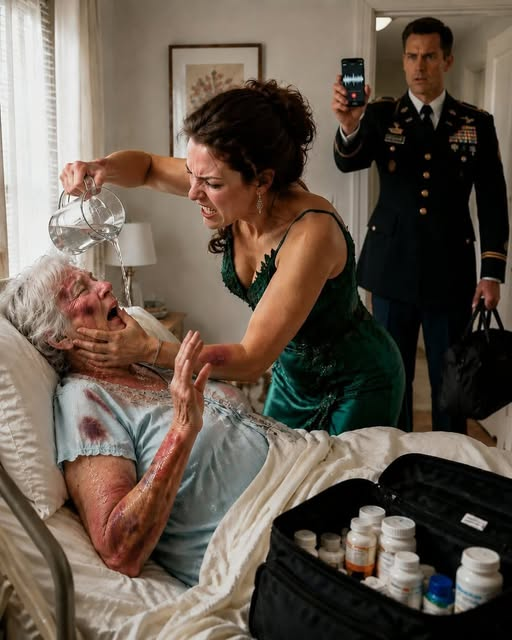
I pulled the black bag from beneath my mother’s bed.
Gwendolyn’s smile disappeared.
—What’s that doing there?
I held up one of the prescription bottles.
Sealed.
Then another.
And another.
Six months of medication.
Untouched.
—You tell me.
Gwendolyn recovered quickly.
—Your mother refuses to take them. I’ve told you before how difficult she is.
From the bed came Florence’s trembling voice.
—That’s not true.
Silence filled the room.
My mother rarely contradicted anyone.
Gwendolyn slowly turned toward her.
Florence shrank beneath the blanket.
That tiny movement told me more than any confession could.
I stepped between them.
—Mom, look at me.
She did.
—Has Gwendolyn been withholding your medication?
Florence began crying.
—She said…
Her voice broke.
—She said if I told you, she’d put me in a nursing home where you’d never find me.
Gwendolyn exploded.
—She’s confused! She’s had a stroke!
I touched the recorder inside my jacket.
Still running.
—Keep talking.
She stared at me.
—What?
—Explain everything.
For nearly twenty minutes, Gwendolyn did exactly that.
She complained about the cost of Florence’s care.
About how my mother had “ruined our marriage.”
About how she deserved compensation for sacrificing her life while I was deployed.
Then she said something strange.
—Besides, none of this would matter if your mother would just sign the papers.
I froze.
—What papers?
Gwendolyn realized her mistake.
Too late.
My mother whispered:
—The house.
I looked at her.
—What house?
Florence closed her eyes.
—Your grandfather’s property.
I had heard of it.
An old piece of land outside the city that everyone assumed had been sold decades earlier.
Apparently, it hadn’t.
Two years earlier, a development company had purchased most of the surrounding area for a massive commercial project.
My mother’s land sat directly in the center.
Developers had offered $4.8 million for it.
And Florence was the sole legal owner.
Gwendolyn had discovered the offer while sorting through my mother’s mail.
Then she found something even more useful.
Under the terms of my grandfather’s trust, if Florence died without completing a new transfer, the property would eventually pass to me.
As my wife, Gwendolyn believed she could gain control of the money through our marriage.
But Florence had changed her estate plan shortly before my deployment.
She intended to place the property in a trust benefiting me—and several charities that had supported military families after my father’s death.
Gwendolyn would receive nothing directly.
That was when my mother’s “care” suddenly changed.
The missing medication.
The dehydration.
The constant cold.
The isolation.
She wasn’t trying to help Florence recover.
She was waiting for her to become weak enough to sign.
Or weak enough that signing would no longer matter.
I looked at my wife.
—Were you trying to kill my mother?
Her face went white.
—Don’t be ridiculous.
—Then why hide her medicine?
—I didn’t hide anything.
I lifted the black bag.
—You just told me she refused it.
Gwendolyn said nothing.
That night I moved my mother to a military medical facility.
I didn’t tell Gwendolyn where.
The doctors examined Florence.
Their conclusion devastated me.
Her condition had deteriorated significantly, but not naturally.
She had been repeatedly denied essential medication and proper hydration.
One physician told me quietly:
—If this continued much longer, she might not have survived another month.
I walked into the hallway and pressed my forehead against the wall.
I had spent six months protecting national security.
And I had failed to protect the woman waiting for me at home.
But guilt could wait.
Evidence couldn’t.
The next morning I contacted military investigators and civilian police.
I handed them the recording.
The medication.
Bank statements.
Security footage from our home.
Then we found something Gwendolyn hadn’t anticipated.
My mother had secretly recorded her too.
Florence’s old tablet had automatically backed up several audio files to the cloud.
In one recording, Gwendolyn said:
—Once you’re gone, Lucas won’t fight me. He’ll be grieving. I’ll handle the property.
Another voice answered.
A man’s voice.
My stomach turned.
I recognized it immediately.
My cousin, Nathan.
A real-estate attorney.
The same man who had recommended the developer trying to purchase Florence’s property.
The conspiracy wasn’t only inside my marriage.
Nathan had prepared forged documents designed to make it appear that Florence had willingly authorized Gwendolyn to negotiate the sale.
If the deal closed, millions would move through companies Nathan controlled.
Gwendolyn would receive her share.
Florence only needed to disappear from the equation.
Three days later, police arrested Nathan at his office.
Gwendolyn tried to leave the country.
She made it as far as the airport.
I was there when investigators stopped her.
She saw me standing behind them.
—Lucas!
For the first time, there was no arrogance in her voice.
Only fear.
—Tell them this is a misunderstanding.
I looked at the woman I had once trusted with my home.
—Was my mother begging for water a misunderstanding?
—You don’t understand what I sacrificed!
—And that gave you the right to hurt her?
She began crying.
—We can fix this.
I almost laughed.
—No.
I removed my wedding ring.
—We can’t.
The prosecution took almost a year.
Nathan eventually cooperated in exchange for a reduced sentence.
His testimony exposed everything.
Gwendolyn had planned to manipulate Florence into signing the transfer.
When Florence refused, Gwendolyn began withholding medication and making her physically weaker.
The property sale collapsed.
The forged documents were voided.
Gwendolyn was convicted.
Nathan lost his law license and went to prison.
I filed for divorce before the criminal trial even ended.
But the most important battle wasn’t about money.
It was my mother’s recovery.
Slowly, Florence improved.
Not completely.
Some damage could never be reversed.
But one spring morning, I took her outside in her wheelchair.
She lifted her face toward the sunlight.
—Lucas?
—Yeah, Mom?
—Did we lose the land?
I smiled.
—No.
—Good.
She squeezed my hand.
—Then sell it.
I stared at her.
—Are you sure?
She nodded.
—Land is just land.
Then she looked at me.
—People are what matter. I nearly learned that too late.
We sold the property months later.
But not for the original $4.8 million.
After another developer entered negotiations, the final price reached $6.2 million.
My mother kept enough to guarantee lifelong medical care.
The rest went into a trust.
Part supported military families.
Part funded stroke rehabilitation programs.
And part remained for the family she still had.
One evening, while helping her into bed, I found the old black medication bag in a box of evidence the police had returned.
I stared at it for a long time.
Six months earlier, I thought coming home early would give my wife a pleasant surprise.
Instead, it exposed a truth that had been hiding beneath my own roof.
My mother noticed the bag.
—Throw it away, son.
I did.
Then Florence smiled.
—And stop blaming yourself.
I sat beside her.
—I should have known.
—No.
Her voice was weak, but certain.
—You trusted your wife. She betrayed that trust. Those aren’t the same thing.
I never forgot those words.
Neither did I forget the recorder.
I still keep it in my desk.
Not because I enjoy remembering that day.
But because sometimes the difference between suspicion and justice is one decision made in silence.
I had wanted to burst through that bedroom door and confront Gwendolyn immediately.
Instead, I pressed record.
And in doing so, I gave her something she never expected.
Enough time to reveal exactly who she really was.
THE END.
