Madison’s voice filled the hospital room.
Small.
Shaking.
But unmistakable.
“Daddy, stop. Mommy can’t get up.”
Daniel went completely still.
Patricia grabbed the edge of the chair.
—Where did you get that?
The officer looked at her.
—From Mr. Daniel’s phone.
Daniel’s head snapped toward him.
—That’s private property.
The officer continued playing the recording.
Madison was crying.
Then Daniel’s voice came through.
“Go upstairs. This is what happens when your mother refuses to listen.”
My eyes closed.
I had never known Madison recorded that morning.
Later, police would discover that she had used Daniel’s own phone.
He had left it on the kitchen counter before dragging me outside.
My six-year-old daughter had pressed the red button because months earlier I had taught her one rule:
If something scary happens, get somewhere safe and call for help.
She hadn’t known how to call.
So she recorded.
The officer stopped the audio.
Daniel immediately began talking.
—She’s six. Children misunderstand things.
Dr. Morris stared at him.
—The scan doesn’t.
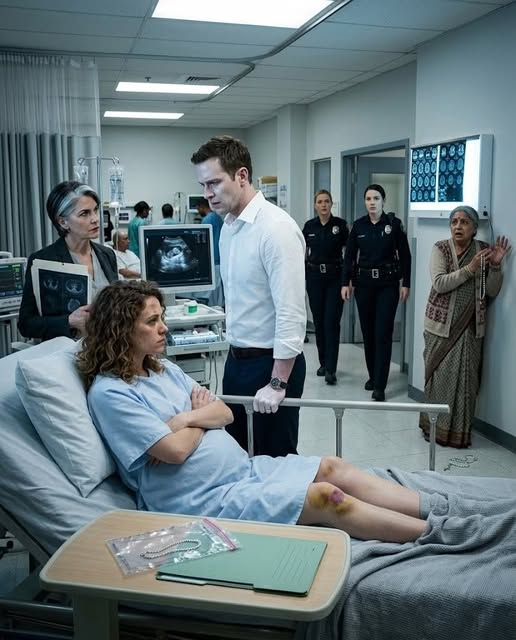
She placed the medical report on the table.
There were injuries in different stages of healing.
Not one accident.
Not one bad morning.
A pattern.
Then she pointed toward the ultrasound screen.
My hand instinctively covered my abdomen.
Nineteen weeks.
I hadn’t known.
For months, exhaustion and irregular cycles had been easy to explain away because stress had consumed almost every part of my life.
Daniel looked at the monitor.
—Is it a boy?
The room became so quiet that even the security officer looked at him differently.
I stared at my husband.
Not:
Is the baby safe?
Not:
Is my wife safe?
Is it a boy?
Dr. Morris’s expression hardened.
—That is not the question you should be asking.
One officer stepped forward.
—Daniel Walker, we need you to come with us.
Patricia immediately stood.
—You cannot arrest my son over a domestic misunderstanding!
I finally looked at her.
—A misunderstanding?
She avoided my eyes.
I remembered her behind the blinds.
Watching.
Doing nothing.
—You saw everything.
Patricia’s face tightened.
—I was afraid.
—So was Madison.
That silenced her.
Daniel resisted verbally until the officer mentioned the recording, the medical evidence, and the photographs.
Then something changed.
His confidence disappeared.
He looked at me.
—Claire, tell them this got out of control.
For years, that sentence would have worked.
I would have softened the truth.
Protected the girls from scandal.
Protected his job.
Protected Patricia’s reputation.
Protected everyone except myself.
This time I looked directly at the officer.
—I want to make a statement.
Daniel’s face went white.
The hospital did not discharge me into his care.
Madison and Chloe were brought to me that afternoon by a family-services worker.
Madison ran toward the bed, then stopped suddenly because she was afraid of hurting me.
That broke my heart more than anything else.
—Mommy?
I opened my arms.
She climbed carefully beside me.
Chloe followed.
Then Madison whispered:
—I’m sorry.
I stared at her.
—For what?
—I couldn’t make Daddy stop.
I held her face between my hands.
—Listen to me.
Her eyes filled with tears.
—It was never your job to stop him.
She began crying.
So did I.
For the first time, we cried without worrying whether Daniel could hear us.
The next surprise came two days later.
My attorney arrived carrying financial records.
—I need to ask you something. Did you know Patricia owns the house?
I frowned.
—Daniel said it belonged to him.
—It doesn’t.
The property had originally belonged to Daniel’s late father.
But shortly before his death, he had placed it in a family trust.
And the trust contained an unusual condition.
If Patricia knowingly allowed violence or criminal conduct inside the property and failed to report it, trustees could remove her control.
There was more.
Daniel had recently tried to borrow against the property.
He needed Patricia’s cooperation.
That was why she had protected him so fiercely.
Not only because he was her son.
Because millions of dollars were tied to keeping the family scandal hidden.
The house alone was worth nearly four million.
Daniel had also used it as collateral while negotiating a business investment.
If the trust removed Patricia, his financing collapsed.
Suddenly her silence behind the kitchen blinds made even more sense.
She hadn’t just been protecting Daniel.
She had been protecting money.
My attorney leaned closer.
—There’s one more thing.
She showed me bank transfers.
For almost two years, Daniel had been moving marital funds into an account controlled by Patricia.
He had been preparing for the possibility that I might leave.
While telling me I had nowhere to go.
The criminal case moved forward.
So did my divorce.
Daniel tried apologizing.
Then threatening.
Then apologizing again.
I never met him alone.
Patricia visited the hospital once.
She stood at the door holding the same rosary.
—I failed you.
I looked at her quietly.
She began crying.
—I kept telling myself he would calm down.
—He didn’t.
—I thought protecting my son meant protecting the family.
I shook my head.
—You protected the person hurting the family.
She lowered her eyes.
I did not forgive her that day.
Maybe forgiveness would come later.
Maybe not.
But I no longer believed forgiveness was something people were entitled to just because they finally admitted what they had done.
Months passed.
Daniel lost access to the house.
The trust began separate proceedings after reviewing the police evidence.
His business financing collapsed.
The hidden marital funds were discovered during the divorce and returned to the marital estate for proper division.
None of that felt like revenge.
It felt like doors finally locking in the correct direction.
Daniel had spent years making me believe he controlled every exit.
The money.
The house.
The children.
My reputation.
He had been wrong.
Our third child was born months later.
A boy.
When the nurse placed him beside me, I stared at his tiny face and thought about the question Daniel had asked in the hospital.
Is it a boy?
For years, he had treated our daughters as though they were evidence that I had failed him.
Now Madison stood beside my bed holding her brother’s hand while Chloe whispered:
—He’s really small.
I smiled.
—You were too.
Madison looked at me.
—Does Daddy know?
I took a breath.
—Yes.
—Is he happy because it’s a boy?
I pulled her closer.
—Your brother is not more important than you because he’s a boy. Never believe that.
She nodded slowly.
Then smiled.
That mattered more to me than anything Daniel might ever think.
A year later, I returned to the old neighborhood once.
The house looked exactly the same from outside.
Same patio.
Same fence.
Same upstairs window.
But I was different.
Madison held one hand.
Chloe held the other.
Their little brother slept safely in the stroller.
Madison looked at the patio.
—Mom?
—Yes?
—Why did Grandma watch?
I thought carefully.
Then answered:
—Sometimes adults know something is wrong and still choose not to act because telling the truth would cost them something.
She frowned.
—That’s bad.
I smiled sadly.
—Yes.
Then she asked:
—What did it cost Grandma?
I looked at the house.
The property.
Her son.
Her relationship with her grandchildren.
Perhaps most importantly, the belief that silence could keep a family together.
—More than telling the truth would have.
We walked away.
Daniel had believed concrete could hide what happened.
Patricia believed blinds could make her only a witness instead of a participant in the silence.
Both believed my fear would protect them.
They forgot one thing.
Evidence doesn’t care about family reputation.
A scan remembers old injuries.
A phone remembers voices.
A child remembers what she saw.
And eventually, I remembered something too.
I was allowed to leave.
I was allowed to speak.
And my daughters deserved to grow up knowing that love never requires anyone to endure fear in silence.
THE END.
