Chu Pho Xuyen stood in the store long after I left.
Something about my calmness disturbed him.
Perhaps because I had always argued before.
I cried.
I demanded explanations.
I asked whether An An and I still mattered.
But that day I simply said:
“Yes, I know.”
As if nothing connected us anymore.
The saleswoman looked at the toy car disappearing through the door with me.
Then she hesitated.
“Captain Chu…”
“What?”
“Wasn’t that car for your son?”
He frowned.
“An An?”
“Yes. Your wife said he had wanted it for a long time.”
Pho Xuyen looked at Canh Canh, who was hugging the imported doll he had just bought her.
For the first time, the difference seemed to bother him.
He handed the shopping bag to Co Tran.
“Take her home.”
She stiffened.
“Aren’t we eating together?”
“Another day.”
Then he ran after me.
He found me at the cemetery.
I was kneeling beside a small grave.
The toy car was gone.
Only a little metal wheel remained beside the memorial offerings.
Pho Xuyen stopped several meters away.
He looked at the name engraved on the stone.
Then looked again.
CHU AN AN.
His son.
He did not move.
I heard his footsteps behind me but didn’t turn around.
Finally, his voice came out strangely.
“Phuong Nhuoc…”
I continued arranging the flowers.
“What is this?”
I said nothing.
He stumbled closer.
“Why is An An’s name here?”
Still nothing.
His voice suddenly rose.
“I asked you a question!”
I looked at him.
For seven years, I had feared that expression.
That afternoon I felt nothing.
“An An died six days ago.”
His entire face emptied.
“No.”
“He had a high fever. His condition became critical.”
“No.”
“I called you.”
He shook his head violently.
“You said it was a cold.”
“At first, it was.”
I looked directly at him.
“Then it wasn’t.”
He took out his phone with shaking hands.
Old missed calls were still there.
Mine.
Again.
Again.
Again.
There was also a message he had never opened.
Pho Xuyen, please come back. The doctor says An An may not have much time. He keeps asking for you.
His knees buckled.
“No…”
I remembered An An’s last words.
Mom, don’t blame Dad.
Even at the end, that child had protected the father who had not returned for him.
Pho Xuyen looked at me desperately.
“Why didn’t you send someone?”
“I did.”
He froze.
“The infirmary called your unit.”
His lips parted.
“One of your men said you had taken personal leave.”
Not military duty.
Not an emergency assignment.
Personal leave.
He had been celebrating Canh Canh’s birthday.
I whispered:
“An An kept telling me you were protecting the country.”
Pho Xuyen covered his face.
“I didn’t know.”
“That is true.”
I stood.
“You didn’t know because you never stopped long enough to find out.”
He grabbed my sleeve.
“I’ll go home with you.”
“There is no home.”
His eyes lifted.
“What?”
“The divorce was approved yesterday.”
He stared at me.
Then suddenly remembered the papers he had signed.
His face turned white.
“That document…”
“Yes.”
“You tricked me.”
“No.”
I pulled my sleeve free.
“You signed without reading because anything I handed you was less important than delivering tomato eggs to someone else’s daughter.”
He opened his mouth.
Nothing came out.
That sentence hurt because it was true.
Pho Xuyen ran directly to the political commissar.
He demanded the divorce be stopped.
The commissar opened the file.
“Captain Chu, this carries your signature.”
“I didn’t know what I was signing.”
“That does not change what happened.”
Pho Xuyen’s eyes were red.
“My son died.”
The older man slowly stood.
“What?”
Only then did he understand that I had been telling the truth when I said I had lost my child.
He had assumed Pho Xuyen missed the funeral because of duty.
When the duty records were checked, the truth became embarrassing even to people who had once praised our marriage.
Pho Xuyen had been on approved personal leave.
He had chosen where to spend it.
The commissar looked at him for a long time.
“Your wife begged you to return?”
Pho Xuyen lowered his head.
“Yes.”
“And you did not?”
No answer.
The old man sighed.
“Then this is not something an organization can repair for you.”
That evening Pho Xuyen went looking for Co Tran.
She was waiting with Canh Canh.
When she saw him, she immediately stood.
“What happened?”
He placed his phone on the table.
“Did you see Phuong Nhuoc calling me that night?”
Co Tran’s face changed.
That was enough.
Pho Xuyen stared at her.
“You saw it?”
She panicked.
“You were finally spending one peaceful evening with Canh Canh.”
“My son was dying.”
“I didn’t know it was that serious!”
“She called twelve times.”
Co Tran began crying.
“I thought she was jealous again.”
He looked at her as if he had never seen her before.
Then she whispered:
“I only silenced the phone once. After that, you ignored it yourself.”
That stopped him.
Because she was right.
He could blame Co Tran for one call.
Not the other eleven.
Not the messages.
Not the previous years.
Not every time An An asked for something and heard no.
Pho Xuyen slowly picked up his phone.
Co Tran reached for him.
“Pho Xuyen…”
He stepped away.
“Don’t.”
From that day forward, whatever dream he had carried about his first love ended too.
But losing Co Tran did not bring his son back.
And it did not bring me back either.
Saturday morning arrived.
I carried one suitcase.
Inside were clothes, some savings, An An’s photographs, and the little red scarf he used to wear in winter.
Nothing else mattered.
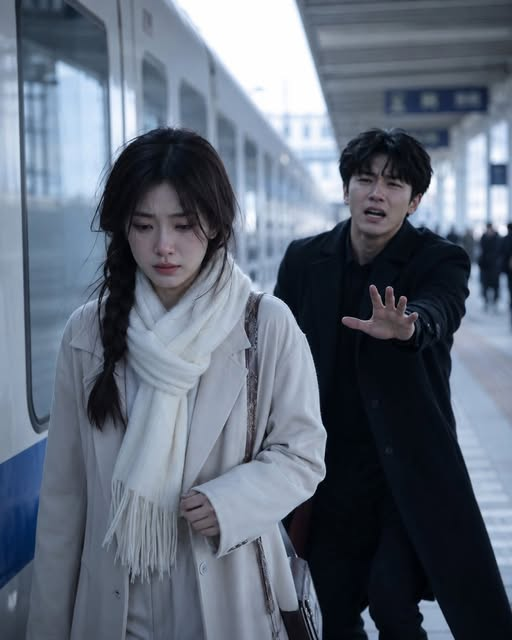
At the station, the announcement for my train began.
I stepped onto the platform.
Then I heard someone shouting my name.
“Phuong Nhuoc!”
Pho Xuyen was running through the crowd.
His uniform jacket was unbuttoned.
His face looked as though he had not slept in days.
He stopped in front of me, breathing hard.
“Don’t go.”
I looked at him quietly.
“I have to.”
“I’ll change.”
“I hope you do.”
His eyes filled.
“I’ll resign from the regiment if you want.”
“That isn’t what I want.”
“I’ll leave this military region.”
“No.”
“I’ll never see Co Tran again.”
I shook my head.
“You still don’t understand.”
His face crumpled.
“This isn’t about what you give up now.”
I tightened my grip on the suitcase.
“It’s about what An An needed when he was alive.”
Pho Xuyen began crying.
I had never seen him cry before.
“Give me one chance.”
“I gave you seven years.”
“Phuong Nhuoc…”
“And An An gave you every chance a child knows how to give.”
The train doors opened.
He looked at the small urn case inside my bag.
His shoulders shook.
“Let me take him home with you.”
I paused.
Then shook my head.
“No.”
He closed his eyes.
“Why?”
“Because this is the last thing I need to do for my son without waiting for his father.”
The whistle sounded.
I stepped onto the train.
Pho Xuyen remained on the platform.
For years, I had been the person watching him walk away.
That morning, he finally learned what it felt like to be left behind.
I returned to my hometown.
My parents had kept my old room.
Behind the house stood the peach tree An An used to climb whenever we visited.
I placed his photograph beneath it.
Then I started again.
Not quickly.
Grief does not disappear because a marriage ends.
Some mornings I still woke believing I needed to prepare An An for school.
Some evenings I saw shrimp dumplings at the market and had to turn away.
But slowly, I built a life that did not require me to wait for someone who had already chosen elsewhere.
I found work at a local clinic.
I rented a small apartment near my parents.
And eventually I could speak An An’s name without feeling as though the entire world had stopped.
Pho Xuyen wrote letters.
Dozens.
At first they were apologies.
Then memories.
Then simply updates.
He had requested reassignment.
He began volunteering with families in the military community whose spouses were deployed.
Perhaps he was trying to become the man An An had believed he was.
I never mocked him for changing.
But I never returned.
Some lessons deserve to change your future.
They do not automatically restore your past.
A year later, on An An’s birthday, I found Pho Xuyen standing beneath the peach tree.
He had asked permission to come.
In his hands was a small toy car.
Exactly like the one An An once wanted.
He placed it beside the photograph.
Then sat silently for a long time.
Finally, he said:
“Do you hate me?”
I thought carefully.
“No.”
He looked surprised.
“I did once.”
“And now?”
“Now I’m tired of carrying you inside my grief.”
He lowered his head.
“I’m sorry.”
“I know.”
“Will you ever forgive me?”
I looked at An An’s photograph.
The child smiling there had forgiven his father before I ever could.
“I already have.”
Hope flashed across his face.
I stopped it gently.
“But forgiveness isn’t remarriage.”
His eyes closed.
After a long moment, he nodded.
This time he understood.
Before leaving, Pho Xuyen touched the little car once.
Then whispered:
“Dad came late, An An.”
I turned away so he could have that moment alone.
For years, everyone in the military region believed Chu Pho Xuyen and I had the perfect marriage.
They were wrong.
A marriage is not proven by a wedding photograph.
A father is not proven by a uniform.
And love is not proven by how much someone regrets losing you.
It is proven by where they are when you need them.
An An waited until his final day believing his father was somewhere doing something important.
The truth was much smaller and much crueler.
Pho Xuyen was simply somewhere else.
When he finally learned his son was gone, he searched everywhere for me.
The military compound.
My old workplace.
The station.
My hometown.
But by then I no longer wanted to be found.
I had spent too many years waiting for him to come home.
So on that Saturday morning, I took my son with me and boarded the train.
For the first time in seven years, I did not wait for Chu Pho Xuyen.
And that was the moment our marriage truly ended.
