I stood slowly.
Marlene finally spoke.
“Why does the chef know your name?”
I smoothed my dress.
“I suppose we’re about to find out.”
Michael frowned.
“Mom, don’t make a scene.”
I looked at him.
“I haven’t.”
That was the truth.
They had made the scene.
I had merely sat through it.
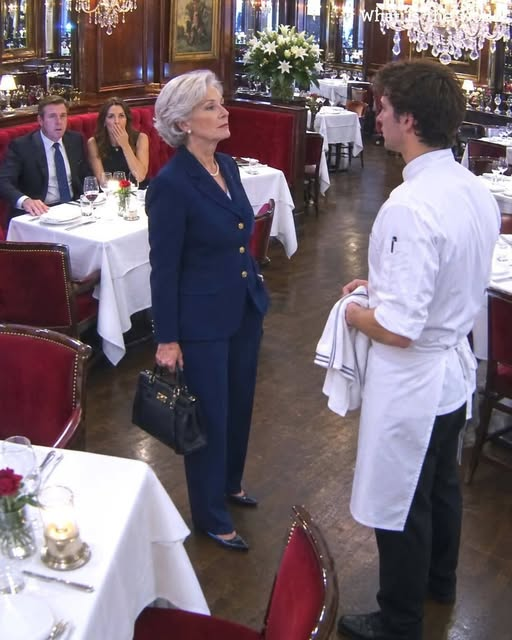
The head chef, Gabriel Moreau, escorted me through the kitchen.
Every cook we passed greeted me.
“Good evening, Mrs. Helen.”
“Welcome back.”
One young pastry chef even smiled nervously.
“It’s an honor to finally meet you.”
Behind me, I heard footsteps.
Of course they had followed.
Marlene entered first.
Then Michael.
Then her parents.
Gabriel opened the office door.
Inside were the restaurant’s general manager, the chief financial officer of Sterling Dining Group, and an attorney I had known for almost twenty years.
On the desk sat a leather folder.
The attorney stood.
“Helen. We weren’t expecting you until tomorrow.”
Marlene’s father stopped walking.
His face changed.
“Richard?”
The attorney looked at him.
“Mr. Davenport.”
Now everyone was confused except me.
I sat.
“Gabriel said you needed me.”
The general manager glanced toward my family.
“I’m sorry to interrupt your dinner, but Mr. Davenport’s acquisition proposal arrived this evening. Since you were already here, we hoped you could review it.”
Marlene’s father stared at me.
“What acquisition proposal?”
The CFO turned the folder around.
DAVENPORT HOSPITALITY — PROPOSED PURCHASE OF 12% INTEREST IN STERLING DINING GROUP
Silence.
Marlene looked between us.
“Dad?”
Her father’s lips barely moved.
“You’re Helen Sterling?”
I smiled.
“Helen Carter legally.”
Then I added:
“Sterling professionally.”
Michael’s face emptied.
Sterling Dining Group owned eleven restaurants.
Including the one we were standing inside.
For almost twenty years, my son had known I once worked in kitchens.
What he did not know was what happened afterward.
I had started by investing my savings in a tiny restaurant whose owner could not afford to replace a broken oven.
I became a partner.
Then another restaurant followed.
Then another.
I spent years working behind the scenes because I had no interest in being photographed beside champagne towers.
I liked numbers.
I liked kitchens.
I liked giving talented people enough room to succeed.
By sixty-four, the woman Marlene’s parents had just mocked for poor financial planning controlled 52% of Sterling Dining Group.
Marlene whispered:
“You own this restaurant?”
“Most of the company that owns it.”
Michael stared at me.
“Why didn’t you tell me?”
I looked at him.
“You never asked.”
His face reddened.
“That’s not fair.”
I almost laughed.
“No?”
For years, whenever I mentioned work, Michael interrupted.
“You’ve worked enough, Mom.”
When I tried to explain that I still attended meetings, he assumed they were volunteer committees.
When I told him I was traveling for business, he joked that retirees always invented reasons to stay busy.
Eventually, I stopped correcting him.
It is difficult to explain your life to someone who has already decided what it is.
Marlene’s father stepped forward.
“Helen, obviously there’s been a misunderstanding tonight.”
I glanced toward him.
“Which part?”
His face tightened.
“My daughter was joking.”
“No, she wasn’t.”
Marlene said quickly:
“I thought Michael said you preferred simple food.”
Michael looked at her.
“I never said not to let her eat.”
She turned on him.
“You said she needed to stop expecting us to pay for everything!”
And there it was.
I understood.
This dinner had not only been humiliation.
It had been preparation.
I looked at Michael.
“What were you planning to ask me?”
He went pale.
“Nothing.”
The CFO beside me quietly opened another document.
“There is one other matter, Helen.”
He handed it over.
A loan-guarantee request.
Applicant:
Michael Carter Consulting LLC.
Requested guarantor:
Helen Carter.
Amount:
$1.4 million.
I stared at my son.
He could not meet my eyes.
Marlene’s father closed his eyes.
Apparently he knew.
I asked:
“You invited me here to sign this?”
Michael finally spoke.
“My company is going through a temporary problem.”
“And you thought telling me to know my place would encourage me?”
“That wasn’t—”
“Your wife gave me water while everyone else ate lobster.”
Marlene snapped:
“Because we are already paying for enough!”
I looked at her.
“You have never paid one bill for me.”
She stopped.
I paid my own mortgage.
My own insurance.
My own travel.
Even tonight’s reservation had unknowingly been made under a dining group account connected to me.
The irony was almost elegant.
I turned back to Michael.
“Did you think I was financially dependent on you?”
He hesitated.
That hesitation answered me.
“Yes.”
His voice became defensive.
“You never acted like someone with money!”
I smiled.
“How does someone with money act?”
He had nothing.
Marlene’s mother suddenly found the carpet fascinating.
I closed the loan folder.
“I will not guarantee this.”
Michael stared at me.
“Mom.”
“No.”
“You don’t even understand the business.”
That made the CFO cough into his hand to hide a laugh.
I looked at my son.
“Your company has lost money for seven consecutive quarters.”
His mouth opened.
“You refinanced twice.”
Silence.
“You have three large clients responsible for almost seventy percent of your revenue.”
His face became pale.
“And one of them has already informed you that they will not renew.”
Marlene looked at Michael.
“What?”
He turned toward me.
“How do you know?”
“Because your loan officer approached my family office last week.”
Complete silence.
I had known he needed money.
I did not know tonight’s dinner had been designed to make me feel small before asking for it.
That changed everything.
Michael whispered:
“I was going to explain.”
“No.”
I stood.
“You were going to make me believe I should be grateful for being included at your table, then ask me to risk my assets to protect yours.”
His eyes reddened.
“Mom, please.”
I looked at him for a long time.
This was the child I had carried through rain.
The boy I had fed first.
The teenager whose tuition I had quietly covered while pretending the scholarship had been larger than it really was so he would not feel guilty.
I loved him.
That was precisely why I would not save him from every consequence.
“I’ll pay for an independent restructuring adviser.”
Hope appeared in his face.
“But I will not guarantee your debt.”
It disappeared.
“You’ll help me fix the business.”
“If you want help.”
“And if I don’t?”
“Then you handle it yourself.”
Marlene muttered:
“This is unbelievable.”
I turned toward her.
“No.”
I pointed gently toward the dining room.
“What happened ten minutes ago was unbelievable.”
Marlene’s father cleared his throat.
“Helen, regarding our investment proposal—”
I looked at the folder.
Davenport Hospitality wanted to purchase part of Sterling Dining Group.
For six months, my management team had been negotiating with them.
I had never met the owners personally.
Until tonight.
Richard asked:
“Should we continue the review?”
I thought about canceling it.
For three seconds.
Then I shook my head.
“Personal behavior should not automatically determine whether a commercial proposal is sound.”
Marlene’s father visibly relaxed.
“But it does tell me something about the people I may be doing business with.”
His relief vanished.
I slid the folder toward my CFO.
“Restart due diligence from the beginning.”
“Helen—”
“Especially governance and culture.”
Marlene’s father said nothing.
That was not revenge.
That was business.
People who humiliate waiters, relatives, or anyone they believe has less power often reveal how they behave when nobody important is watching.
Unfortunately for them, I was important.
I returned to the dining room.
The lobster was cold.
My untouched glass of water still sat at the end of the table.
Gabriel came beside me.
“Mrs. Helen, would you like dinner prepared?”
“Yes.”
Marlene stiffened.
I looked at the waiter who had been forced to follow her instructions earlier.
“I’ll order for myself.”
I opened the menu.
Not lobster.
I chose roast chicken, potatoes, and the soup I had helped develop fourteen years earlier.
Simple food.
Good food.
Mine to choose.
Michael remained standing.
“Mom, can we talk?”
“Not tonight.”
“Please.”
I looked at him.
“I meant what I said earlier.”
His eyebrows pulled together.
“What?”
“Noted.”
Then I ate dinner alone.
It was the most peaceful meal I had had in months.
Michael called every day for the next week.
I answered on the seventh.
His voice sounded different.
“Mom.”
“Yes?”
“I’m sorry.”
I waited.
“For what?”
Silence.
Then he understood.
“For telling you to know your place.”
I said nothing.
“For letting Marlene treat you like you didn’t belong.”
Still nothing.
“For assuming you were poor because you never showed me your money.”
Closer.
“And for inviting you because I needed your signature.”
There it was.
I exhaled.
“Thank you.”
He sounded surprised.
“That’s all?”
“What were you expecting?”
“I don’t know.”
“Forgiveness and a check?”
He gave a miserable little laugh.
“Probably.”
“No check.”
“I know.”
His company eventually downsized.
He sold the oversized office.
Let go of a luxury car he did not need.
Worked with the restructuring adviser I paid directly rather than giving him cash.
The company survived.
Smaller.
Healthier.
His marriage did not.
I did not celebrate that either.
Marlene increasingly blamed him for losing access to what she now called “your mother’s fortune.”
Michael finally understood something that should have bothered him much earlier:
She became far more interested in respecting me once she knew what I owned.
Within a year, they separated.
That was their story.
Not mine.
Davenport Hospitality’s investment never happened.
Our renewed review found enough concerns that the board chose another partner.
Marlene’s father called me once.
“Was this because of dinner?”
“No.”
I meant it.
“The dinner only convinced me to look more carefully.”
What we found made the decision.
He had no response.
Two years later, Michael invited me to dinner.
A small neighborhood restaurant.
No chandeliers.
No private room.
No lobster.
He arrived before me.
When the waiter handed us menus, Michael looked at me.
“What are you having?”
I smiled.
“I haven’t decided.”
“Take your time.”
That was all.
But sometimes the smallest correction tells you whether somebody learned anything.
Halfway through dinner he said:
“I spent years thinking I knew everything about you.”
“You knew plenty.”
“Not the important things.”
I looked at him.
“You knew I was your mother.”
He lowered his eyes.
“And I should have treated that as enough.”
For the first time since that terrible dinner, I reached across the table and touched his hand.
We did not become perfect.
Real families rarely do.
But we became honest.
People later loved telling the story about the night my daughter-in-law denied me lobster in a restaurant I secretly owned.
They always focused on the irony.
The water.
The chef.
The office.
The investment proposal.
But that was not the part I remembered.
I remembered my son saying:
“Know your place, Mom.”
For sixty-four years, I had known exactly where my place was.
I had stood in kitchens.
Office buildings.
School payment lines.
Hospital corridors.
Boardrooms.
I had spent half my life in places where nobody bothered asking who I was because they thought they could tell by looking.
So when Michael told me to know my place, I did not argue.
I said:
“Noted.”
Because ten minutes later, he learned something I had spent a lifetime understanding:
Your place is not decided by the chair someone gives you at their table.
And sometimes the woman they leave with nothing but a glass of water—
owns the table, the kitchen, and the building around it.
