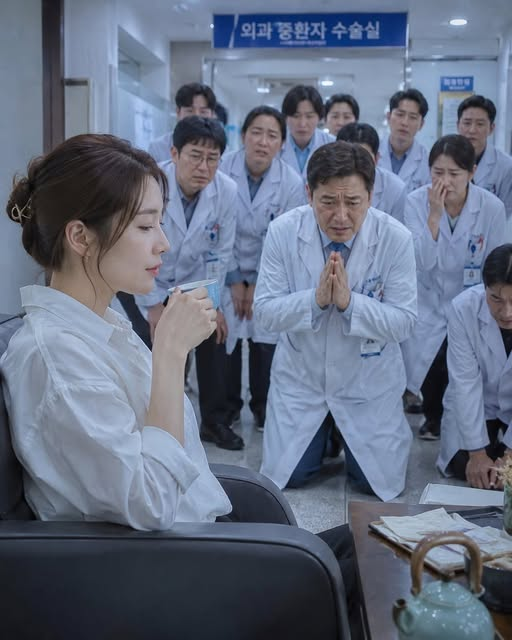
Director Bennett’s smile collapsed.
Behind him stood four board members, the chief nursing officer, and Ryan’s father.
For the first time in eight years, none of them looked important.
They looked frightened.
Bennett cleared his throat.
“Clara, yesterday’s decision was… poorly communicated.”
I took another sip of tea.
“No.”
He stopped.
“The decision was perfectly clear.”
Ryan Whitmore would lead the Whipple surgery.
I would step aside.
Again.
Bennett lowered his voice.
“We need you to return temporarily.”
“How temporarily?”
“Until the department stabilizes.”
I smiled.
“So until I repair everything.”
Nobody answered.
That was the pattern.
Ryan received the title.
I received the consequences.
Ryan’s father finally stepped forward.
“Dr. Miller, perhaps emotions are running high.”
I looked at him.
“They aren’t.”
“You deleted important hospital materials.”
“No.”
His expression tightened.
I set my cup down.
“I deleted my personal working copies from my personal encrypted system.”
The official patient records remained in the hospital’s approved systems.
The signed protocols already adopted by St. Gabriel remained available.
I had not taken patient files.
I had not sabotaged equipment.
I had simply stopped donating years of unpaid intellectual labor after they made it clear they did not value the person who created it.
“What they don’t have,” I continued, “is me.”
Silence.
“That is not theft.”
I looked directly at Bennett.
“That is resignation.”
The extended Whipple surgery scheduled that morning had been postponed before the patient entered the operating room.
Not because Ryan suddenly became cautious.
Because Ethan Parker had refused to proceed without senior backup.
When Ryan demanded that they continue, Ethan had asked three questions about the reconstruction plan.
Ryan could not answer two of them.
The anesthesiology lead intervened.
Then the chief nurse.
Then the patient’s family.
Once they learned the surgeon originally assigned to the case had resigned the previous afternoon, they withdrew consent until an experienced specialist could review everything.
That one postponement triggered the rest.
Other families started asking questions.
Who was leading their cases?
Why had the department head changed repeatedly?
Why were outside consultants suddenly unavailable?
Then Boston called.
Then Rochester.
Then Houston.
Three specialists who had maintained informal consultation arrangements with me made the same decision:
They were happy to cooperate with St. Gabriel through formal institutional agreements.
But the free professional favors they had extended because of our personal relationships ended when I left.
By noon, the hospital discovered how much of its “national network” had really been a collection of people answering my calls.
Director Bennett handed me a folder.
“We’ve prepared a new offer.”
I did not touch it.
“Department chair.”
I stayed silent.
“Full authority over surgical assignments.”
Nothing.
“Salary increase.”
I almost laughed.
Yesterday I needed to polish my character.
Today apparently I was qualified to control the department.
Bennett continued.
“Ryan will return to supervised training.”
Ryan’s father stiffened behind him.
Interesting.
I looked at the folder.
“What happens the next time someone donates equipment?”
Nobody spoke.
I leaned back.
“What happens when another board member’s nephew wants an operating room?”
The chief nursing officer looked away.
“What happens when I say no to someone richer than me?”
Bennett’s face reddened.
“We’ve learned from this.”
“No.”
I shook my head.
“You learned that I could leave.”
There was a difference.
Then Ethan called me.
I almost didn’t answer.
But I did.
“Dr. Miller.”
His voice sounded strained.
“What happened?”
“The patient scheduled for tomorrow wants to transfer.”
I sat straighter.
“Is she stable?”
“Yes.”
“Then let the transfer team manage it.”
“They’re asking where.”
I paused.
Then gave him the names of two established centers with appropriate hepatobiliary programs.
Not secret contacts.
Not shortcuts.
Just legitimate places capable of evaluating the case.
Ethan went quiet.
“You’re really not coming back.”
“No.”
He sounded devastated.
“What about us?”
That hurt.
Not Bennett.
Not Ryan.
The residents.
The nurses.
The people who had worked honestly.
I softened.
“I didn’t resign from medicine.”
He stopped.
“I resigned from St. Gabriel.”
Two weeks earlier, Dr. Alexander Hayes had called me.
My old mentor.
The photograph I had packed in the cardboard box was from the day he taught me my first major liver resection.
He had moved to Northbridge University Hospital three years earlier.
Their new surgical institute had been recruiting me quietly for months.
Every time he called, I gave the same answer.
“I built St. Gabriel.”
Alexander always replied:
“No, Clara. You built a department inside St. Gabriel. There’s a difference.”
I had finally understood.
That afternoon, after Bennett left my garden, I called him.
“Is the offer still open?”
Alexander laughed.
“Are you finally done being loyal to people who confuse loyalty with ownership?”
“Yes.”
“Then come build something better.”
I accepted.
The news spread through St. Gabriel within twenty-four hours.
Not that I was unemployed.
Not that I had stormed out because my ego was hurt.
That I had accepted the directorship of hepatobiliary surgery at Northbridge.
With authority to design the program.
Recruit faculty.
Choose fellows.
Build formal research partnerships.
And establish a proper complex-case referral board instead of depending on private favors.
Ryan came to my house that evening.
Alone.
He looked very different without his father behind him.
“Dr. Miller.”
I waited.
“Did you recommend that they demote me?”
“No.”
He blinked.
“I didn’t recommend anything.”
“They suspended me from complex cases.”
“That sounds responsible.”
His face reddened.
“You ruined my career.”
I looked at him.
“No.”
“You wanted my surgeries.”
I shook my head.
“I wanted my surgeries.”
That stopped him.
“You were given mine.”
He looked away.
For the first time, the arrogance weakened.
“I thought if I got enough difficult cases, I’d improve quickly.”
“You improve through supervised training.”
I kept my voice calm.
“You do not improve by using sick people as résumé material.”
His jaw tightened.
“My father said I needed visibility.”
“Your father is not a surgeon.”
Silence.
Then I said:
“Ryan, you are not incapable.”
He looked surprised.
“You are undertrained and overprotected.”
That was worse.
Because it was true.
“Those are fixable,” I continued.
“But only if you stop letting your surname convince you that feedback is humiliation.”
He said nothing.
Then left.
Northbridge gave me something St. Gabriel never had.
A contract defining authority.
Written staffing minimums.
Mandatory supervision standards.
Protected research time.
Formal consultation agreements.
No more invisible labor.
No more “Clara will handle it.”
No more pretending systems existed when they were actually one exhausted woman answering calls at midnight.
I brought no patient database with me.
No confidential files.
Nothing belonging to St. Gabriel.
I built from scratch.
Properly.
And something unexpected happened.
People followed.
Not everyone.
I never asked anyone to resign.
But over the next year, two experienced nurses applied to Northbridge.
Then Ethan.
Then another fellow.
Each went through normal hiring.
When Ethan arrived for his first day, I looked at him.
“Why did you leave?”
He smiled.
“You told me to strengthen my foundations.”
“And?”
“I wanted to do it somewhere they mattered.”
That answer made me proud.
St. Gabriel did not literally collapse.
Hospitals are bigger than one surgeon.
But the hepatobiliary program did.
At least the version I had built.
Complex-case volume dropped sharply.
Referral physicians moved patients elsewhere.
Recruitment became difficult after the internal dispute became known in professional circles.
The board eventually forced Bennett to resign.
Ryan’s father stepped down from several governance roles after the conflict-of-interest review.
The Da Vinci robot arrived.
It was beautiful.
State-of-the-art.
And for months, it sat underused.
Because the hospital had focused on buying a machine instead of retaining people who knew how to build a surgical program around it.
That irony became famous among the staff.
Six months later, Ryan contacted me again.
This time by email.
No arrogance.
No accusations.
He had entered a structured fellowship at another institution.
At the bottom, he wrote:
You were right. I was trying to look like a surgeon before learning how to become one.
I read it twice.
Then replied:
Then learn. You still have time.
That was all.
I did not need him destroyed.
Patients needed him competent.
That mattered more.
A year after I resigned, Northbridge opened its new complex hepatobiliary center.
Alexander stood beside me during the ceremony.
On the wall behind us were eighteen protocols.
Updated.
Revalidated.
Written by multidisciplinary teams.
Not mine alone.
That was intentional.
I had spent eight years being indispensable.
I no longer wanted to be.
Indispensability sounds flattering until you realize it often means the system is badly designed.
So I built something that could survive my vacation.
My illness.
My eventual retirement.
A real department.
Not a monument to one exhausted surgeon.
Director Bennett attended the opening.
I almost did not recognize him in the crowd.
Afterward, he approached.
“Dr. Miller.”
“Mr. Bennett.”
He smiled awkwardly.
“I owe you an apology.”
I waited.
“For removing you from those surgeries.”
“That’s part of it.”
He nodded.
“For expecting you to keep fixing the consequences.”
Closer.
“For believing donations and relationships mattered more than competence.”
There it was.
I accepted the apology.
Then he asked:
“Do you ever regret leaving?”
I looked through the glass wall.
Ethan was reviewing a case with two residents.
A nurse challenged one of his assumptions.
He stopped.
Listened.
Changed the plan.
No ego.
No humiliation.
Just medicine.
“No.”
I smiled.
“I regret staying long enough to need three warnings.”
Bennett looked confused.
“Three warnings?”
“The three surgeries.”
Then he understood.
People later told the story dramatically.
They said:
Dr. Clara Miller resigned, and the hospital collapsed the next day.
That was not quite true.
St. Gabriel did not collapse because I left.
It collapsed because, for years, administrators had mistaken invisible labor for permanent infrastructure.
They thought the protocols belonged to them because I wrote them inside their building.
They thought specialists were loyal to the logo because they answered my calls.
They thought residents would remain because I kept training them.
They thought complex surgery could be assigned like a ceremonial title.
And most dangerously—
they believed a talented surgeon would tolerate endless disrespect because patients mattered too much for her to walk away.
They were almost right.
That was why I stayed through the first stolen surgery.
And the second.
By the third, I finally understood something.
Caring about patients did not require sacrificing myself to an institution that refused to protect standards.
The day I resigned, Director Bennett told me:
“Train yourself a little more. Polish your character.”
A year later, I became director of a program built around the very standards he had asked me to compromise.
And St. Gabriel?
It eventually recovered.
With new leadership.
New specialists.
New rules.
That was good.
Hospitals should recover.
Patients should never become collateral damage in someone else’s ego battle.
But they never rebuilt the exact department I had created.
Because the most valuable thing I took with me was not a database.
Not a protocol.
Not a contact list.
It was the one thing they had treated as infinitely replaceable:
my judgment.
They gave Ryan my operating room because they thought a surgeon was just another name on a schedule.
The next morning, they finally learned the difference between occupying a position—
and being the person who made the position work.
