Sarah did not send me the footage.
She sent it directly to the detective assigned to my case.
That mattered.
Julian had spent weeks telling everyone I was confused, emotional, and angry because of the divorce.
A video sitting on my phone could be called revenge.
A preserved cloud backup with timestamps, metadata, and a documented chain of custody was something else entirely.
The detective watched all seventeen minutes.
Then he called me.
“Mrs. Sterling, I need to ask you one question.”
“Yes?”
“Did your husband know the kitchen camera was recording?”
“He knew about the visible one.”
“And the backup?”
“No.”
There was a pause.
“Good.”
Not because secrecy made the evidence magical.
Because Julian had acted naturally.
He had not been performing for anyone.
The recording began almost twenty minutes before the incident.
Julian and Evelyn were already in the kitchen.
I had not entered yet.
Evelyn was holding documents.
A real-estate valuation.
A loan statement.
And a proposed sale agreement for my father’s house.
Julian said:
“She won’t sign voluntarily.”
Evelyn answered:
“Then stop asking like she has a choice.”
My blood ran cold.
Then came the sentence Sarah had already warned me about.
“If she won’t sign, Mom, we’ll make it look like an accident.”
They had discussed frightening me.
Making me “more cooperative.”
And immediately afterward, Evelyn asked:
“What happens if she still refuses?”
Julian laughed.
“Then I divorce her and argue the house needs to be sold for marital debts.”
That was the part he had never expected anyone to hear.
The divorce papers had not been an angry reaction to my injuries.
They were part of the plan.
The detective kept watching.
The footage showed me entering.
It showed me refusing to sign.
It showed Evelyn taking my phone after the confrontation began.
It showed Julian’s aggression.
And it showed enough of what happened next that there was no believable way to call it a simple slip.
I did not watch that section again.
I did not need to.
I had lived it once.
That was enough.
What mattered was what happened afterward.
Evelyn wiped the counter.
Julian moved the documents.
Then he looked toward the camera above the pantry.
His face changed.
“Turn that thing off.”
Evelyn asked:
“Did it record?”
Julian climbed onto a chair and removed it.
The visible camera disappeared.
But the hidden recorder in the garage continued receiving the feed until he cut the connection.
Then, two days later, the separate garage camera captured him entering with bolt cutters.
He believed destroying the recorder would destroy the truth.
He did not know my father had paid for off-site backup years earlier.
Dad had installed it after saying one sentence I had once thought was overly dramatic:
“Never trust the only copy of something important to remain in the same house as the person who wants it gone.”
Six months later, that sentence walked into court with me.
Julian was arrested before the divorce hearing.
Evelyn too.
Not because I asked the police to “destroy” them.
Because investigators now had evidence supporting a planned assault, evidence tampering, false statements, and a financial motive tied to my property.
The house became central.
Sarah discovered why Julian had become so desperate to sell it.
He had hidden more debt than I knew.
A failed private investment.
Personal loans.
Money borrowed against accounts he had never told me about.
And Evelyn had guaranteed part of it.
They needed liquidity quickly.
My father’s house was the easiest asset they could see.
Except it was not theirs.
It had been left to me separately.
Julian had repeatedly pressured me to refinance it.
I refused.
Then he tried to turn my refusal into a moral failure.
“You care more about a dead man’s house than your living family.”
That sentence had haunted me.
Now I understood.
It had never been about family.
It was about debt.
When the divorce proceedings resumed, Julian’s attorney tried to argue that the house should still be considered in the overall financial settlement.
Sarah placed the inheritance documents on the table.
Then the proposed sale agreement.
Then the kitchen recording transcript.
Julian stared at me across the courtroom.
His expression had changed.
No arrogance.
No sneer.
Just fear.
His attorney asked for time.
The judge granted only what was legally necessary.
The property remained protected.
Julian could not force a sale.
He could not mortgage it.
He could not claim that my injuries suddenly entitled him to a piece of my father’s legacy.
The debts he had hidden remained his problem to explain.
For years, he had treated my house like an emergency fund with my name inconveniently attached.
It never was.
Then came the criminal case.
I was terrified to testify.
Not because I doubted what happened.
Because Julian had trained me for years to doubt whether anyone would believe me.
Every argument ended the same way.
“You’re too sensitive.”
“You misunderstood.”
“You made me angry.”
“You always exaggerate.”
So when I sat in court and saw him watching me, some old part of me still wanted to become smaller.
Then the detective entered carrying the recovered camera equipment and the authenticated backup records.
And suddenly I remembered:
I did not need to be more convincing than Julian.
The evidence had already spoken.
The jury heard the conversation before I entered the kitchen.
They heard the planning.
They heard the motive.
They saw the attempts to remove evidence afterward.
Evelyn’s defense was that she had only been present.
The recording contradicted that.
She had encouraged him.
Helped clean up.
Taken my phone.
Repeated the false accident story.
Julian’s defense shifted repeatedly.
First it was an accident.
Then panic.
Then marital conflict.
Then he claimed the recording was taken out of context.
But seventeen minutes is a long context.
Long enough for excuses to collapse.
The verdict did not make me happy.
I thought it would.
Instead, I felt tired.
Julian was convicted on serious charges related to what he had done and the cover-up.
Evelyn also faced consequences for her role.
Their sentences were for the court to decide.
I did not ask for the maximum.
I did not ask for mercy either.
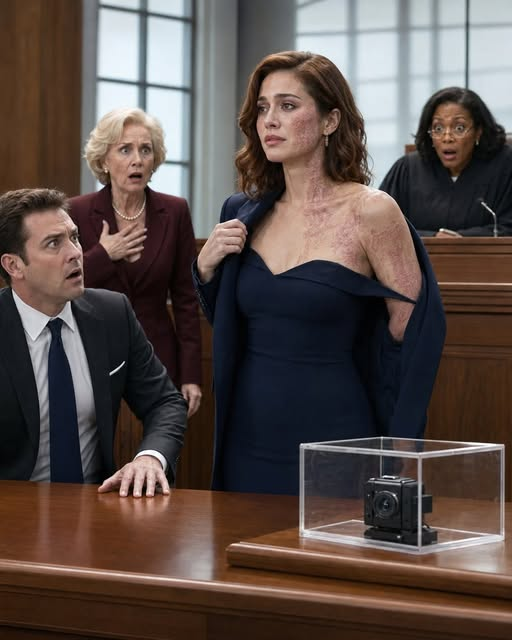
I gave a victim-impact statement.
Only a short one.
I told the court:
“I spent months believing the worst thing Julian did was injure me.”
I looked directly at him.
“It wasn’t.”
His eyes lifted.
“The worst thing was teaching me, slowly, that my safety depended on keeping him happy.”
The courtroom was silent.
“I am here because that lesson was false.”
Then I sat down.
That was all.
The divorce became final shortly afterward.
Julian received none of my father’s house.
I kept what was legally mine.
The marital property was divided according to the law and the documented finances.
His hidden debts were reviewed separately.
I did not walk away with everything.
Neither did he.
That was fine.
I had stopped measuring justice by whether Julian lost more than I did.
I wanted the truth recorded.
The house protected.
And my life back.
Recovery was slower.
People think leaving is the ending.
Sometimes leaving is only the first page where you finally have room to become yourself again.
For months, I hated mirrors.
Then I hated myself for hating them.
A therapist told me something simple:
“You do not have to admire every change in your body to respect the person living in it.”
That helped.
So did physical rehabilitation.
So did returning to the house my father left me.
At first, I could not enter the kitchen.
I stood in the doorway and shook.
Sarah offered to help me sell the property.
I almost agreed.
Then I looked at the wall where Dad’s old clock still hung.
No.
Julian had already tried to take the house once.
I was not giving it up because of what he did inside it.
So I rebuilt the kitchen.
Not to erase what happened.
To reclaim the room.
New cabinets.
New stove.
Different layout.
The damaged camera was replaced too.
But I kept the old one.
Not on the wall.
In a box with the court documents.
Evidence no longer needed to live above my head.
One afternoon, nearly a year later, Sarah came over for coffee.
She stood in the new kitchen and smiled.
“Looks completely different.”
“I needed that.”
She nodded toward the back door.
“What happened to the garage recorder?”
“I kept part of it.”
“Why?”
I thought about my father.
Then answered:
“Because Dad installed it before I was willing to admit why we needed it.”
Sarah looked at me.
“He knew?”
“Not everything.”
But he had seen Julian’s temper.
The broken objects.
The way arguments became intimidation.
Dad never ordered me to leave.
He only made sure that if I ever needed proof, I might have it.
That realization hurt and comforted me at the same time.
He had protected me after death without controlling me while alive.
There was love in that difference.
Two years after the trial, I received a letter from Julian.
I almost threw it away.
Instead, I gave it to my therapist first.
Then I read it.
There were apologies.
Explanations.
References to counseling.
He wrote that he finally understood he had treated the house as something he deserved because he had married me.
At the end he wrote:
I saw your injuries and demanded a divorce because looking at them forced me to see what I had done. I blamed you for carrying the evidence on your body.
That was the first sentence from him that sounded completely true.
I did not respond.
Understanding does not create entitlement to forgiveness.
And forgiveness, if it ever comes, does not mean access.
People later told the story as if my greatest moment happened in court.
The doors opening.
Me walking in.
The detective behind me carrying the camera Julian thought he had destroyed.
It certainly made a dramatic picture.
But that was not the moment I became free.
It happened earlier.
In the rehabilitation room.
Julian looked at my bandaged arms and said:
“I didn’t marry a damaged woman.”
At the time, he thought he was rejecting me.
He did not realize he was giving me the final reason to stop protecting him.
Six months later, he saw the camera.
The court saw the recording.
Everyone heard the plan he and his mother thought had disappeared with a cut wire and a missing recorder.
And I finally understood something my father had been trying to teach me all along:
Truth does not always survive because someone is strong enough to fight immediately.
Sometimes it survives because someone preserved it long enough for the frightened person to become ready.
Julian tried to take my house.
Then my safety.
Then my credibility.
Finally, he tried to erase the evidence.
He failed at all four.
The house stayed mine.
The truth stayed recorded.
And the woman he called “damaged” walked out of court with something he could never take from her again:
the right to decide what happened next.
