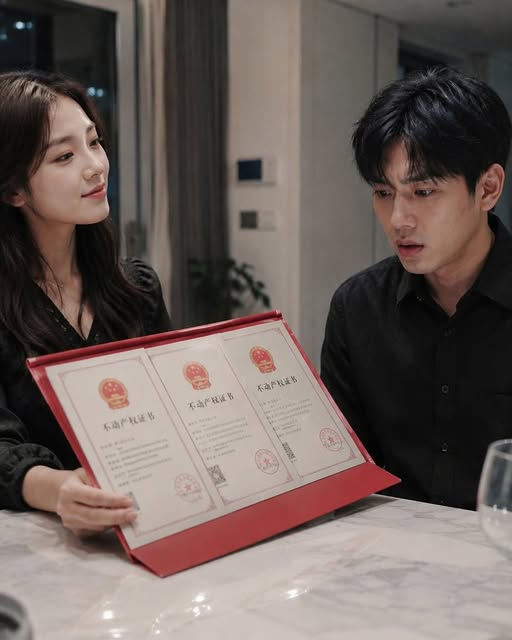
Tran Hao stared at the three ownership certificates for almost a full minute.
His wine glass remained suspended in his hand.
“This… where did you get these?”
I almost laughed.
“Where do people normally get property certificates?”
He picked up the first one.
Building 7, Unit 1602.
The apartment we were sitting in.
Owner:
Thanh Van.
Second certificate.
Unit 1201.
Also mine.
Third.
Unit 901.
Mine again.
Tran Hao’s lips slowly lost their color.
“That’s impossible.”
I sat back down.
“Why?”
“My parents bought this apartment five years ago.”
“No.”
I pointed at the registration date.
“I bought it four years and eight months ago.”
His hand tightened.
For the first time since I had known him, the patient, considerate, endlessly gentle Tran Hao had no prepared answer.
Then he said something even more interesting.
“Did you investigate my family before marrying me?”
I smiled.
“You just told me I have to pay twelve thousand yuan every month to live in my own apartment.”
“And your first concern is whether I investigated you?”
He went silent.
The truth was that I had not discovered the apartment after we married.
I had known for almost a year.
The three apartments were investment properties I purchased through a redevelopment project managed by my company.
I never lived in them.
A professional agency handled the leases.
I remembered addresses and floor plans, not tenants’ faces.
Until eight months before the wedding, Tran Hao casually told me:
“My parents have prepared a wedding apartment for us.”
He sent me the address.
Building 7.
Unit 1602.
I stared at the message for a long time.
Then opened my property-management application.
Tenant:
Tran Guoqiang.
Tran Hao’s father.
Lease start date:
Eighteen months earlier.
Monthly rent:
8,500 yuan.
That was when the grain of sand in my shoe finally became a stone.
His parents did not own the apartment.
They rented it from me.
And Tran Hao either didn’t know—
or he knew and was lying.
I decided not to confront him immediately.
I wanted to know which.
I asked him casually:
“Is the wedding apartment really your parents’ property?”
He answered without hesitation.
“Yes.”
“Fully paid?”
“Yes.”
“Whose name is on the title?”
“My father’s.”
Three lies.
In less than ten seconds.
From that day onward, I stopped listening to what Tran Hao said.
I started watching what he did.
After we registered our marriage, his mother became unusually enthusiastic.
She called me three times in one week.
“Van, once you marry into our family, you don’t need to worry about housing.”
“Our family may not be incredibly wealthy, but we have property.”
“Tran Hao is our only son. Everything will eventually belong to him.”
I smiled each time.
“Thank you, Auntie.”
She corrected me:
“Mom.”
I never did.
Something in me refused.
Now I understood why.
I looked at Tran Hao across the dining table.
“You said your parents own this apartment.”
He swallowed.
“They… they paid for it.”
“No.”
“They paid rent.”
His eyes flickered.
That tiny movement answered my next question.
“You knew.”
“Thanh Van…”
“You knew this apartment was rented.”
He immediately stood.
“Listen to me.”
“So you knew.”
He rubbed his face.
“My father told me the landlord rarely appeared. He said the owner was an investment company.”
“It is managed by one.”
“I didn’t know the individual owner was you.”
That part might actually have been true.
But it changed almost nothing.
I tapped the table.
“You told me it belonged to your parents.”
He lowered his voice.
“I didn’t want you to look down on my family.”
“And tonight?”
His eyes moved away.
“What?”
“You asked me for twelve thousand yuan rent.”
Silence.
“The actual lease is eighty-five hundred.”
His face froze.
I smiled.
“So where was the extra thirty-five hundred going?”
He didn’t answer.
I already knew.
The next morning, his mother arrived before eight.
She came with his father.
Neither bothered pretending this was a misunderstanding.
His mother slapped her handbag onto my coffee table.
“Thanh Van, married couples shouldn’t calculate everything so clearly.”
I almost admired the confidence.
I poured myself tea.
“You were going to collect twelve thousand yuan from me for an apartment I own.”
His father frowned.
“We’ve lived here for more than a year. We’ve paid rent. Doesn’t that count for something?”
“Yes.”
“It counts as tenancy.”
His face darkened.
His mother snapped:
“You have three apartments. What’s wrong with letting your husband’s parents have one?”
“Nothing.”
She relaxed slightly.
Then I continued:
“If I choose to.”
Her mouth closed.
“That is the part everyone seems to forget.”
Tran Hao sat silently beside them.
That disappointed me more than the lie itself.
For two years, he had always been the reasonable one.
Whenever someone became emotional, he mediated.
Whenever I was upset, he apologized.
Now his parents were sitting in my apartment explaining why they deserved my property—
and he could not even look at me.
I asked:
“Who came up with the twelve-thousand figure?”
His mother answered too quickly.
“It is market rent.”
“No, it isn’t.”
She stiffened.
“I work in commercial real estate.”
I smiled.
“Remember?”
The room became very quiet.
My husband had apparently forgotten that attempting to deceive a regional real-estate manager about rental values was not an ideal strategy.
Then his father made the mistake that exposed everything.
He said:
“We only wanted to recover what we spent preparing this marriage.”
I looked at him.
“What exactly did you spend?”
No answer.
“The wedding banquet was split between both families.”
Silence.
“I bought my own car.”
Nothing.
“We didn’t request a bride price.”
His mother interrupted:
“Exactly! We didn’t ask you for anything.”
I almost laughed.
“Usually the groom’s family doesn’t ask the bride for a bride price.”
Tran Hao closed his eyes.
His mother realized too late what she had said.
I continued.
“My parents are gone.”
“I paid for my wedding dress.”
“My company paid my annual health insurance.”
“I never asked your family for a house.”
“So tell me.”
“What exactly are you recovering?”
No one answered.
I pulled out another document.
This one was not a property certificate.
It was a statement from the management company.
Tran Hao’s father immediately recognized it.
Three months of unpaid rent.
25,500 yuan.
His face changed.
His mother stared at him.
“You said you paid it.”
Interesting.
Apparently even she did not know everything.
I turned another page.
There were also repeated complaints from management.
Unauthorized renovation.
Changing the electronic lock without permission.
Subletting the parking space.
And one particularly strange note:
Tenant repeatedly represented himself to neighbors as property owner.
I looked at my father-in-law.
“For how long have you been telling people this apartment belongs to you?”
He became furious.
“We’ve paid more than one hundred thousand yuan in rent!”
“Yes.”
“That means nothing?”
“It means you rented an apartment.”
I spoke slowly.
“Paying rent does not gradually transform someone else’s deed into yours.”
Tran Hao finally spoke.
“That’s enough.”
I looked at him.
He was pale, but his voice had changed.
Not gentle anymore.
“Even if the apartment is yours, we’re married now.”
“And?”
“Shouldn’t we think as one family?”
“I did.”
I nodded.
“That’s why I waited until tonight.”
He frowned.
I opened the red folder again.
Underneath the deeds was a prenuptial property declaration.
Signed by both of us two months earlier.
Tran Hao stared at his own signature.
The three apartments were clearly listed as my premarital property.
He had barely looked at the attachment before signing.
At the time, he joked:
“I trust my future wife.”
Now that sentence looked ridiculous.
I asked:
“Did you not read what you signed?”
He said nothing.
His mother suddenly turned toward him.
“You told us she only owned one small apartment.”
There it was.
I looked at Tran Hao.
He looked furious with her.
Not because she was wrong.
Because she had spoken too soon.
“What else did you tell them about my finances?” I asked.
“Nothing.”
His mother laughed bitterly.
“You said her salary was high but most of her money was tied up.”
“Mom!”
“You said after marriage she’d manage money badly because she was too busy working, so you would take care of the household assets.”
My husband stood abruptly.
“Stop talking.”
I became completely calm.
Because now the entire two-year romance made sense.
The patience.
The perfect manners.
The refusal to show me his home.
The vague finances.
Even his insistence that we register the marriage before holding the wedding banquet.
He had not necessarily approached me knowing I owned these specific apartments.
But somewhere along the way, he had learned enough about my income to decide marriage would upgrade his entire family.
And he had mistaken my discretion for ignorance.
I looked at him.
“What did you plan to do with the twelve thousand?”
He said nothing.
His mother did.
“Six thousand for us.”
Tran Hao turned toward her.
“Mom!”
“And six thousand toward his studio loan.”
Silence.
I leaned back.
His father muttered:
“You earn more than a million a year. Twelve thousand isn’t much to you.”
There it was.
The sentence greedy people always believe is convincing.
You can afford it.
As though affordability created obligation.
I nodded.
“You’re right.”
All three looked surprised.
“Twelve thousand isn’t much to me.”
Then I smiled.
“But I’d rather lose twelve thousand every month than pay one yuan to reward a lie.”
Tran Hao followed me into the bedroom.
“Thanh Van, don’t turn this into something bigger than it is.”
I began packing a suitcase.
He stared.
“What are you doing?”
“Leaving.”
“This is your house.”
“Yes.”
“So why are you leaving?”
“Because I have another one.”
His expression was almost comical.
I continued folding clothes.
“Tomorrow my lawyer will contact you about the marriage.”
His face changed.
“We registered yesterday.”
“Yes.”
“You want a divorce after one day?”
“No.”
I closed the suitcase.
“I wanted a divorce after I realized you had been lying for months.”
“Then why did you marry me?”
That was a fair question.
I stopped.
Because part of me had still hoped.
I wanted to believe there was some explanation.
That perhaps his parents had lied to him.
That perhaps the apartment story was embarrassment, not calculation.
That when marriage became real, he would finally tell me the truth.
Instead, on the first night—
he tried to charge me rent for my own home.
“I married you because I wanted to give the man I loved one final chance to tell me the truth.”
I looked at him.
“You used it to send me an invoice.”
The legal process was far less dramatic than his family expected.
No one lost everything.
No one became homeless overnight.
His parents’ lease was handled according to its terms.
Because of the arrears and violations, the management company ended the tenancy through the proper process.
They moved.
His father complained everywhere that his daughter-in-law had “thrown elderly parents into the street.”
They were fifty-eight and sixty.
Both employed.
They rented another apartment within three weeks.
Apparently the street had excellent property-management services.
Tran Hao’s studio also had problems.
Not because I sabotaged it.
Because the “successful founder” image had been heavily financed.
He had debts.
His parents had been subsidizing him.
Several luxury items I thought reflected business success had been purchased on installment plans.
There was nothing wrong with having debt while building a business.
The problem was pretending wealth existed and then planning to quietly use a spouse’s income to maintain the illusion.
He later admitted:
“I was afraid you wouldn’t marry me if you knew.”
I answered:
“I might have married a man with debt.”
He looked at me.
“I would not knowingly marry a man who lied about it.”
That difference seemed to take him a long time to understand.
The marriage ended.
Short.
Embarrassing.
But clean.
I kept my three apartments.
Tran Hao kept his studio.
Our finances had barely had time to intertwine.
His parents stopped contacting me after their lawyer explained that the deeds were not negotiable simply because their son had married the owner.
Six months later, I ran into Tran Hao at an industry exhibition.
The same kind of event where we first met.
He looked thinner.
More ordinary.
No Omega.
No Gucci shoes.
Just a white shirt and a name badge.
“Thanh Van.”
I stopped.
“How are you?”
“Good.”
He smiled awkwardly.
“My studio survived.”
“I’m glad.”
He seemed surprised.
“You don’t hate me?”
“No.”
He looked down.
“I really did love you.”
“I believe you.”
His head lifted.
That was probably not the answer he expected.
I continued:
“But you also thought loving me gave you permission to calculate around me.”
His face tightened.
“I was ashamed of being poorer than you.”
“You shouldn’t have been.”
“I know now.”
He gave a small laugh.
“I spent two years pretending I had more than I did.”
“And lost someone who didn’t require it.”
He nodded.
“Yes.”
That was the first honest conversation we ever had.
It happened after the marriage was over.
A year later, I moved into Unit 1602 myself.
Not because it was the largest.
Not because it had the best view.
Because I wanted to erase the absurd memory of sitting at my own dining table while someone explained what rent I owed.
I replaced the furniture.
Changed the locks.
Repainted the living room.
Then I placed the three ownership certificates in a bank safe.
My friend Tieu Hoa came over with wine.
She looked around and laughed.
“So how much rent are you charging yourself?”
I pretended to calculate.
“Twelve thousand.”
“Expensive.”
“Terrible landlord.”
We laughed until my stomach hurt.
People later asked why I had carried three property certificates into the dining room instead of simply showing Tran Hao the online registration.
Because I wanted to see his face.
I admit it.
I’m human.
But the satisfying part was not humiliating him.
It was realizing how little proof the truth actually needed.
For two years, Tran Hao had built an image carefully.
Successful studio.
Wealthy parents.
Family property.
Financial stability.
And on the first night of marriage, he tried to turn that image into a monthly payment from me.
He thought twelve thousand yuan was small enough that I would stay quiet.
He was wrong.
Money was never the issue.
If he had told me before marriage:
“My parents rent this apartment.”
“My studio has debt.”
“I’m embarrassed.”
“I need help.”
Perhaps our story would have been completely different.
Instead, he said:
“This house belongs to my parents.”
So I opened a red folder.
Three deeds.
Three addresses.
One owner.
Me.
The strangest part was not discovering that my husband wanted me to pay rent.
It was discovering that, after two years together, he still believed the easiest person to deceive—
was the woman who already owned the house.
