My father looked at my mother before answering.
“A letter written in your name.”
For the first time since I arrived, my mother looked afraid.
Not angry.
Afraid.
“What letter?” I asked.
Dad swallowed.
“One saying you wanted nothing more to do with Daniel.”
The street went silent.
I stared at him.
“That makes no sense.”
“I know.”
He reached into his jacket and took out a folded photocopy.
The original, he said, was with Daniel’s attorney.
I opened it.
My name was at the bottom.
My handwriting had been imitated badly.
The letter said I blamed Daniel for “destroying the family,” that I never wanted him contacting me again, and that I authorized my parents to handle anything involving my inheritance while I was “incarcerated.”
I stopped breathing.
“Inheritance?”
Dad closed his eyes.
That was the real secret.
Three months before I joined the Army, my grandmother died.
She had owned forty acres outside town.
Most people thought the land was worthless.
Old pasture.
A collapsing barn.
No highway access.
But two years after I left, a logistics company began buying property in that area for a distribution center.
My grandmother’s land suddenly became valuable.
Very valuable.
And according to her will, half of it belonged to Daniel.
Half belonged to me.
My parents received nothing.
My mother had always known.
I hadn’t.
Daniel hadn’t either until he found the paperwork.
Dad spoke so quietly I almost couldn’t hear him.
“Your mother forged your signature on a power of attorney.”
My mother snapped:
“You signed papers too!”
Dad flinched.
“Yes.”
At least he admitted it.
They used the forged authorization to sell most of my share.
The money paid off the mortgage.
Then debts.
Then a new roof.
Then my mother’s SUV.
Then other things Dad couldn’t even remember.
The prison story had served two purposes.
It brought in sympathy donations.
And it gave them an explanation for why I never appeared personally to sign anything.
If anyone asked why I wasn’t at the closing—
I was incarcerated.
If anyone asked why I never visited—
I was incarcerated.
If anyone asked why I wasn’t responding—
Prison.
Suddenly four years of lies made perfect sense.
They hadn’t merely erased me because they were ashamed.
They had needed me unavailable.
I looked at my mother.
“You sold my inheritance?”
She crossed her arms.
“We used family assets to save the family home.”
“It wasn’t yours.”
“You were gone.”
“I was serving.”
“You chose the Army.”
The words came out with the same contempt she had used when I was seventeen and said I wanted a life beyond this town.
I laughed once.
“So because I left, you decided I no longer existed?”
She shouted:
“You think you’re better than us because of that uniform?”
“No.”
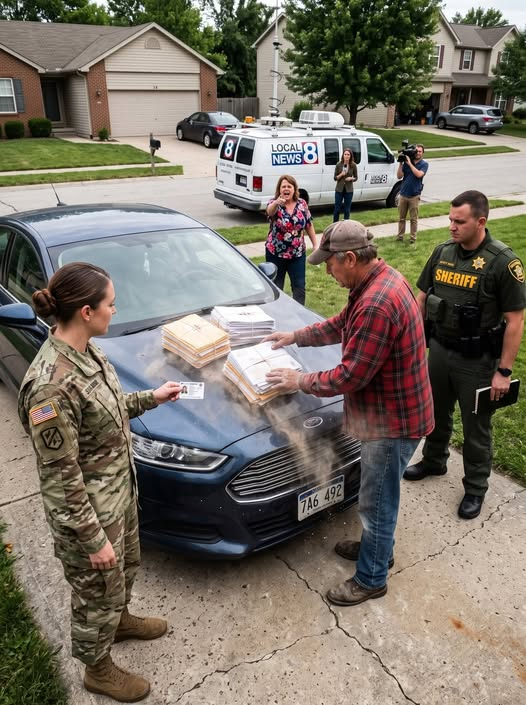
I looked at the unopened letters spread across the truck hood.
“But I think I deserved to exist while wearing it.”
She had no answer.
Then I remembered Daniel.
“What happened when he found out?”
Dad’s face collapsed.
My brother had discovered everything eleven months earlier.
The forged power of attorney.
The land sale.
The donation ledger.
The fake letter.
He confronted my parents.
Then he tried to find me.
He searched military directories.
Contacted an old high-school counselor.
He even called the recruiting station where I had enlisted.
My mother panicked.
She told him I had asked never to hear from the family again.
When he didn’t believe her, she showed him the forged letter.
He knew immediately it was fake.
Daniel and I had fought plenty growing up.
But he knew how I wrote.
He knew I would never call him by his full name the way the letter did.
He also knew I would never blame him for “destroying the family.”
That had always been our mother’s language.
So Daniel hired an attorney.
He was preparing to challenge the property transfers.
And then, two weeks later, he died in a highway accident.
No conspiracy.
No hidden murder.
No dramatic confession.
Just an accident.
That almost made it worse.
Because Daniel had died believing he had failed to reach me.
And I had spent the same year believing he had simply stopped replying.
My letters had been sitting ten feet from my mother’s kitchen.
Unopened.
I asked Dad:
“Why didn’t you tell me Daniel died?”
His knees seemed to weaken.
“Your mother said if we contacted you, everything would come out.”
I stared at him.
“And you agreed?”
He started crying.
“I was a coward.”
My mother turned away.
Dad continued:
“I kept thinking I would fix it later.”
Later.
The favorite word of people who want forgiveness without courage.
I looked at the house.
The siding was newer.
The roof was newer.
The truck in the driveway was newer.
All purchased while an entire town believed my parents were desperately funding appeals for their imprisoned daughter.
Mr. Holloway, still beside me, whispered:
“My God.”
He had donated too.
Five hundred dollars.
He had thought it was helping me get a lawyer.
It had paid my parents’ utilities.
The deputy who had verified my military ID stepped forward.
“Ma’am, because allegations now involve financial fraud and forged documents, we need everyone to stop handling those papers.”
My mother immediately protested.
“This is a family matter.”
The deputy looked at the crowd.
Then at the donation ledger.
Then at my forged signature.
“It may have started as one.”
That was enough to finally silence her.
I did not move back into the house.
I didn’t even step inside.
Instead, I went with Mr. Holloway to the motel on the edge of town.
He had been Daniel’s high-school history teacher.
And apparently, during the final months of my brother’s life, one of the few adults Daniel trusted.
That evening, Mr. Holloway gave me a small cardboard box.
“Daniel left this with me.”
Inside were copies of the land records.
Emails.
Attorney correspondence.
And a flash drive.
There was also an envelope.
This one was actually addressed to me.
Daniel’s handwriting.
My hands shook opening it.
The letter was short.
He told me he had discovered “something ugly.”
He apologized for believing Mom when she said I wanted nothing to do with him.
Then came the line that hurt most:
If you ever get this, I need you to know I never thought you were a criminal. I thought you were angry at us. I should have tried harder to find you.
I pressed the paper against my chest.
For four years, my mother had controlled the story between two siblings simply by keeping us from speaking directly.
That was all.
No magic.
Just silence.
Daniel’s flash drive contained a video.
I almost didn’t watch it.
But I did.
He was sitting in his car.
Tired.
Angry.
Alive.
He looked directly into the camera.
“If you’re watching this, it means I didn’t get to explain it myself.”
I stopped the video.
For several minutes, I couldn’t continue.
Then I pressed play again.
Daniel explained the land.
The forged power of attorney.
The donations.
The fake letter.
He said he had already given copies to an attorney because he was afraid our parents would destroy the originals.
Then he said:
“They keep telling everyone my sister ruined this family.”
He shook his head.
“She didn’t.”
A pause.
“They’re afraid she’ll come home and prove the family they described never existed.”
That was the secret.
Not that I was dangerous.
That the truth was.
The investigation took months.
I returned to my unit before it finished.
I had responsibilities.
A career.
A life my parents had told everyone did not exist.
For the first time, leaving town didn’t feel like running away.
It felt like going home.
The county prosecutor reviewed the forged documents and donation records.
Civil attorneys handled the land-sale proceeds.
Some money was gone.
Some assets could be recovered.
The house itself became part of the financial dispute because funds from my inheritance had been used to save it.
I didn’t demand that my parents be left homeless.
I also did not sign away what remained just to prove I was a good daughter.
The process followed the evidence.
That was enough.
My father cooperated.
Completely.
It did not erase what he had done.
He had signed papers.
Accepted money.
Helped maintain the lie.
But eventually, he stopped protecting himself.
He gave investigators passwords.
Bank statements.
Messages.
Everything.
My mother called him a traitor.
Dad answered:
“I already betrayed one daughter. I’m not doing it again.”
I wasn’t ready to forgive him.
But I remembered the sentence.
My mother never gave me a clean apology.
Not at first.
She blamed debt.
Fear.
Daniel.
Me.
The town.
She said people would never understand what pressure she had been under.
Then, during a mediated meeting almost a year later, I asked one question.
“Why didn’t you open my letters?”
She looked at the table.
“There was nothing in them I wanted to read.”
That answer hurt more than the property.
More than the money.
I had written about promotions.
Cold nights.
People I served with.
The first time I earned a commendation.
The birthdays I missed.
Daniel.
Home.
Every month I gave her another chance to know me.
She chose not to.
Finally, she whispered:
“If I opened one, I would have had to admit you weren’t who I told everyone you were.”
There it was.
The truth.
The prison story became easier to protect than her daughter.
The town changed too.
Some people apologized.
Some avoided me out of embarrassment.
A few insisted they had “always suspected something.”
I didn’t bother correcting them.
Mr. Holloway organized a meeting for people who had donated money.
My father stood in front of them and admitted the truth.
No excuses.
Some shouted.
Some cried.
One elderly neighbor asked:
“Was any of it ever for her?”
Dad answered:
“No.”
That word probably cost him more than every check he later had to repay.
Two years later, I came home again.
This time there were no police.
No news van.
No screaming mother on the porch.
I came for Daniel.
The town had created a small memorial scholarship in his name, funded partly from money recovered from the donation fraud and partly by people who had known him.
The scholarship went to students planning careers in public service.
I was asked to present the first one.
Standing at the podium, I looked at the empty chair where Daniel should have been.
Then I looked at the recipient.
I said:
“My brother learned something important before I did.”
“Truth doesn’t become less true because the people around you agree on a lie.”
That was all.
I didn’t tell the whole story.
It no longer belonged to the town as entertainment.
Afterward, my father found me outside.
He looked older.
He held a bundle of envelopes.
The originals.
Every letter I had mailed.
Still sealed.
“I thought you should have them.”
I took them.
Then asked:
“Where’s Mom?”
“At home.”
“Does she know I’m here?”
“Yes.”
“Is she coming?”
“No.”
I nodded.
For once, that did not hurt.
Some doors close because someone else refuses to open them.
Eventually, you stop standing outside.
I kept Daniel’s letter.
His video.
And one of my own unopened envelopes.
The first one I sent from basic training.
On the front I had written:
Mom and Dad — I made it. I’m okay.
For four years, nobody opened it.
But the strange thing is, I really had made it.
Without them reading a single word.
Without the town knowing.
Without anyone back home believing me.
I had built an entire life while my parents told everyone I was behind bars.
In the end, my mother called 911 because she thought the uniform was the lie.
It wasn’t.
The lie was the house.
The donations.
The forged letter.
The inheritance.
The story that I had abandoned everyone.
My brother discovered that before he died.
And my parents spent four years trying to make sure nobody ever heard me contradict them.
They thought erasing me would protect their secret.
Instead, every unopened letter became evidence of something much simpler:
I had never disappeared.
They had just decided not to see me.
