I pressed the phone harder against my ear.
“Not just mine?”
The bank manager took a breath.
“Your mother attempted to access the custodial account in Caleb’s name.”
Everything inside me went still.
“What custodial account?”
There was silence.
Then:
“The one created by your late father.”
I sat down.
Slowly.
Carefully.
Because my knees had stopped working.
“My father never told me about an account.”
“That’s what concerns us.”
The manager continued in that same careful voice.
“Your mother presented documents claiming she was still the authorized custodian.”
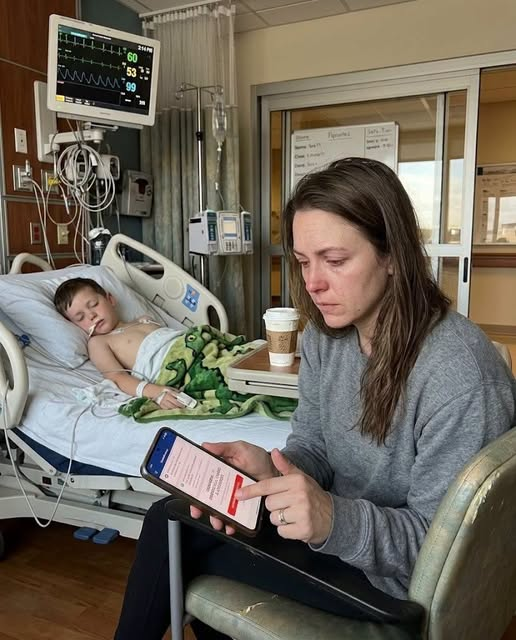
I looked through the ICU glass.
Caleb was asleep with one small hand resting on his dinosaur blanket.
“How much is in it?”
Another pause.
“Approximately one hundred eighty-seven thousand dollars.”
I stopped breathing.
My father had died five years earlier.
Caleb was two.
Dad had adored him.
Every Saturday morning, he would arrive carrying blueberry pancakes and some ridiculous dinosaur book.
When he died suddenly, my mother told me his estate was simple.
House.
Insurance.
A few investments.
She said there had been no separate provision for Caleb because Dad had expected to live much longer.
I believed her.
Apparently, I had believed too many things.
The manager said:
“Your father created the account six months before his death.”
“And Mom knew?”
“She was originally listed as successor custodian if something happened to him.”
My hand tightened around the phone.
“Then why didn’t she tell me?”
“I can’t answer that.”
Of course he couldn’t.
But I could guess.
Because an account nobody knew about was easier to treat like personal money.
I asked:
“Has she withdrawn from it before?”
The manager became very quiet.
“That is why the fraud department wants to speak with you.”
I left the ICU only after Nurse Ramirez promised to call me if Caleb woke.
The branch was twelve minutes away.
It felt like crossing another country.
When I arrived, the manager was waiting with a compliance officer.
On the table were statements going back four years.
I recognized my mother’s handwriting on several old withdrawal forms.
Not large amounts at first.
Two thousand.
Three thousand.
Then more.
A “family emergency.”
A “temporary loan.”
A “medical expense.”
Later, larger transfers.
Eight thousand.
Twelve thousand.
Fifteen thousand.
The descriptions became increasingly vague.
I stared at one transaction.
$9,800.
Date:
The week Vanessa booked her wedding venue.
Another:
$6,200.
Three days before Patricia posted photographs from a luxury resort.
My stomach turned.
“How much did she take?”
The compliance officer answered:
“We are still reviewing whether each transaction was authorized under the account terms, but the total outflow associated with your mother is substantial.”
“How substantial?”
“Just over ninety thousand dollars.”
I closed my eyes.
Ninety thousand.
From Caleb.
Not me.
My son.
Then came the worst part.
The account was supposed to be used for Caleb’s benefit.
Education.
Medical needs.
Future support.
My father had included a letter with the paperwork.
The bank still had a scanned copy.
The manager turned the screen toward me.
My father’s words appeared.
For Caleb, so my grandson never has to be afraid that being sick, studying, or starting his life will become a burden on his mother.
I had to stop reading.
For three nights, I had slept upright beside my son worrying about deductibles, follow-up care, missed work and whether I had enough savings if his recovery became complicated.
And all that time, my father had prepared for exactly this possibility.
My mother knew.
And she had been taking the money.
I whispered:
“Why didn’t the bank contact me?”
The compliance officer did not become defensive.
That mattered.
“Because the account was established with your father as custodian and your mother as successor. Your name was not originally listed.”
He tapped another page.
“But there are questions about whether she continued to meet her duties as custodian after certain withdrawals.”
“So what happens now?”
“We freeze further movement while legal ownership and custodial authority are reviewed.”
“Can she touch anything?”
“No.”
For the first time that week, I exhaled.
Then my phone rang.
Mom.
I let it ring.
Again.
Again.
Then Vanessa.
Then a message.
Mom: What did you tell the bank? They’re accusing me of stealing from my own grandson. Fix this NOW.
I stared at it.
Then typed:
Did you take money from Caleb’s account?
Three dots appeared.
Disappeared.
Returned.
Finally:
We are family. That money was sitting there doing nothing.
I took a screenshot.
Then another message arrived.
Vanessa needed things. Your father would have understood.
That one I saved too.
When I returned to the hospital, Caleb was awake.
He looked at me.
“Mom?”
I sat beside him immediately.
“You left.”
“Just for a little while.”
He frowned.
“Was Grandma there?”
I swallowed.
“No.”
He looked disappointed.
Then asked:
“Is Aunt Vanessa getting married today?”
Not yet.
The wedding was two weeks away.
I forced a smile.
“Yes, soon.”
He nodded sleepily.
“Tell her I hope her dress is pretty.”
That almost broke me.
The child whose money they had been taking was still worried about whether Vanessa looked beautiful.
I kissed his forehead.
“I’ll tell her.”
I didn’t.
Patricia and Vanessa came to the hospital that evening.
Not to see Caleb.
To see me.
Mom stormed into the family waiting area carrying a folder.
“What have you done?”
I remained seated.
“Lower your voice.”
“You froze the family accounts.”
“No.”
“I froze my accounts.”
“And Caleb’s is under fraud review.”
Vanessa crossed her arms.
“You sent Mom fifty cents like some kind of joke.”
“Yes.”
“That was humiliating.”
I looked at her.
“You asked me for five thousand dollars for a dress while my son was in intensive care.”
“That was Mom.”
“You were standing beside her at the bank this morning.”
Vanessa stopped.
Apparently she hadn’t expected me to know that.
Mom immediately said:
“She came for emotional support.”
I almost laughed.
“While you attempted to empty my son’s account?”
Patricia’s face changed.
“Your son wouldn’t even have that money if it weren’t for my husband.”
“My father.”
Silence.
“He was also my father.”
Her jaw tightened.
“And Caleb’s grandfather.”
Mom slapped the folder down.
Inside were receipts.
Vanessa’s tuition.
Car repairs.
Rent.
Wedding deposits.
Apparently this was supposed to justify everything.
Patricia pointed.
“I used that money for this family.”
I picked up the first receipt.
“Vanessa’s bridal shower.”
Another.
“Your cruise.”
Another.
“Her apartment deposit.”
I looked at her.
“Which one helped Caleb?”
Mom’s voice rose.
“You always think everything has to be about you.”
I stared at her.
Then laughed.
Not loudly.
Not angrily.
Just because the sentence was so absurd.
“My seven-year-old is in intensive care.”
I pointed toward the hallway.
“And somehow you’re still angry that this moment isn’t about Vanessa.”
Vanessa’s face reddened.
“Don’t drag me into this.”
“You are already in it.”
I looked at her.
“Did you know Grandpa left Caleb money?”
She hesitated.
That was enough.
“How long?”
“Mom said it was a family account.”
My chest went cold.
“You knew.”
“I didn’t know it was specifically Caleb’s.”
“You never asked.”
She looked away.
Same pattern.
Nobody asked questions when the answer might make free money uncomfortable.
Patricia suddenly leaned toward me.
“Withdraw the complaint.”
“I haven’t filed one.”
“Then tell the bank it was authorized.”
“It wasn’t.”
“Your father trusted me.”
“So did I.”
That stopped her.
For perhaps the first time, she looked uncertain.
I continued:
“I gave you access to my account because you said grief made you afraid of emergencies.”
“I let you use my card because Vanessa said she needed temporary help.”
“I ignored charges because every time I objected, you told me family doesn’t keep score.”
I stood.
“But Dad created money for Caleb.”
“And you kept score carefully enough to spend it on everyone except him.”
Hospital security appeared a few minutes later because Patricia would not lower her voice.
Before leaving, Mom said:
“If you do this, don’t come to Vanessa’s wedding.”
I looked at her.
“I wasn’t planning to.”
Vanessa’s face changed.
“What?”
“I’m staying with my son.”
“My wedding is two weeks away.”
“And Caleb’s recovery is happening now.”
She stared at me like I had chosen wrong.
Again.
That was when I understood something painful.
My family had not failed to recognize priorities.
They had simply always assumed I would sacrifice mine for theirs.
Caleb left intensive care the next day.
No parade.
No miraculous recovery.
Just a quiet transfer to a regular room.
He was weak, sore and tired.
But when the nurse wheeled him down the hall, he raised one fist and whispered:
“Regular room.”
I laughed.
“Yes.”
He smiled.
“Does that mean I won?”
I squeezed his hand.
“You’re doing really well.”
That was enough.
The bank investigation continued while we were still in the hospital.
My attorney reviewed the custodial account.
Some withdrawals had been improperly documented.
Others appeared inconsistent with the account’s intended purpose.
The matter was referred for formal review.
I did not demand anyone be dragged away in handcuffs.
I wanted records.
Repayment.
Protection.
And control of Caleb’s money placed somewhere no relative could quietly reinterpret “family” as permission.
A court eventually appointed an independent custodian until the matter was resolved.
Later, I was added with professional oversight.
No one person could move large amounts without documentation.
Especially not me.
I liked that.
After what had happened, Caleb deserved systems stronger than anyone’s promises.
Vanessa’s wedding still happened.
She wore the $9,000 dress she eventually financed herself.
Apparently the $5,000 she demanded from me had only been the remaining balance.
Patricia borrowed money to cover other expenses.
I saw photographs online.
Huge flowers.
Gold chairs.
Champagne tower.
My seat at the family table remained empty.
So did Caleb’s.
For years that would have devastated me.
That night, I was at home helping him build a dinosaur puzzle.
He held up a piece.
“Mom, this one looks like a foot.”
“It is a foot.”
“Whose?”
I looked at the box.
“Triceratops.”
He nodded seriously.
“Good.”
Then we continued.
I never once wished I were at the wedding.
Three months later, Vanessa came to my house.
No mother.
No demands.
She stood on the porch holding an envelope.
“What’s this?”
She handed it to me.
“A check.”
“For?”
“Some of the money Mom used for me.”
I looked at the amount.
Ten thousand dollars.
“You don’t have to repay what she took.”
“I know.”
Her eyes filled.
“But I benefited from it.”
That was more self-awareness than I expected.
“I kept telling myself I didn’t know.”
She looked down.
“But sometimes I did know enough to ask.”
I said nothing.
She continued:
“I didn’t.”
For once, she wasn’t asking me to make her feel better.
I took the envelope.
“Thank you.”
She nodded.
Then looked past me.
“Can I see Caleb?”
I hesitated.
Not because I wanted revenge.
Because he had noticed.
He had asked why nobody came.
Children remember who shows up.
Finally, I said:
“Ask him.”
She did.
Caleb said yes.
Patricia was different.
She fought everything.
First she insisted Dad had intended the account for the whole family.
Then she claimed every withdrawal was temporary.
Then she said she deserved compensation for caring for him before he died.
But bank records did not change based on whichever explanation made her look best that week.
Eventually, she had to account for the money.
Some amounts were repaid from her savings and property.
Others became part of a structured settlement.
She lost access completely.
And for months she told relatives I had “chosen money over my mother.”
I stopped defending myself.
Anyone who wanted the truth could ask.
Anyone who preferred her version was free to keep it.
I had spent enough of my life trying to win trials held in other people’s living rooms.
My father’s letter stayed with me.
I kept a copy in Caleb’s medical folder.
Not because he needed to know the financial details at seven.
Because one day, when he was old enough, I wanted him to know that his grandfather had thought about him.
Planned for him.
Loved him.
The money mattered.
But the sentence mattered more:
So my grandson never has to be afraid that being sick, studying, or starting his life will become a burden on his mother.
Dad had understood something my mother never did.
Helping family should reduce fear.
Not create obligation.
A year later, Caleb was back in school.
His teacher called me one afternoon.
My heart nearly stopped before she said:
“Nothing is wrong.”
Apparently he had written an essay titled:
The Bravest Person I Know.
I assumed he had written about his surgeon.
Maybe a nurse.
Instead, the first line said:
My mom stayed when everyone else had somewhere more important to be.
I had to sit down.
That night, I asked:
“Buddy, you know Grandma and Aunt Vanessa love you, right?”
He shrugged.
“Aunt Vanessa does.”
I didn’t correct him about Patricia.
Children should not be forced into feelings because adults share DNA.
I just said:
“Okay.”
Vanessa slowly rebuilt her relationship with Caleb.
Birthday calls.
School events.
Visits without asking me for money.
She apologized to him once for missing his surgery.
He said:
“It’s okay.”
Then five minutes later asked her to play video games.
Children can be merciful when adults finally stop demanding it.
Patricia did not repair things as easily.
She kept treating access to Caleb like something she was entitled to.
It wasn’t.
So contact remained limited.
I no longer confused boundaries with cruelty.
Two years after the surgery, I returned to the same bank branch.
The manager recognized me.
“Mrs. Whitaker.”
“Still here?”
He smiled.
“Unfortunately.”
I laughed.
I was there to review Caleb’s account.
The balance had recovered substantially through repayments and investment growth.
Every transaction was documented.
Every beneficiary designation verified.
No mysterious debit cards.
No “temporary family emergencies.”
Before I left, the manager said:
“You know, I still remember the fifty-cent transfer.”
I covered my face.
“Oh no.”
“‘Buy a veil.’”
“I was exhausted.”
“It was memorable.”
I started laughing.
Then I became serious.
“I thought freezing my account was the big moment.”
He nodded.
“And it wasn’t.”
“No.”
The real moment came when he said:
Not just yours.
Because that was when I finally saw the pattern.
My mother had never treated my money as mine.
Eventually, she stopped treating my son’s money as his either.
There was always another excuse.
Another family need.
Another emergency more important than ours.
Until Caleb became the line I refused to let anyone cross.
The morning of his surgery, he asked whether Grandma was lost.
For a long time, I hated that memory.
Now I understand it differently.
Patricia wasn’t lost.
She knew exactly where the hospital was.
She simply chose not to come.
Three days later, she knew exactly which bank branch to visit.
That told me everything I needed to know.
I sent her fifty cents because I was angry.
I froze the accounts because I was finally thinking clearly.
And when the bank manager told me she had tried to take everything—
not only from me, but from Caleb—
I stopped treating financial abuse like an unfortunate family habit.
My son recovered.
The money was protected.
Vanessa learned that adulthood sometimes means paying for your own dress.
And Patricia discovered that “family” is not a password that unlocks someone else’s account.
Years later, I still have the dinosaur blanket Caleb carried into surgery.
Folded inside the closet.
Next to it is a copy of my father’s letter.
One reminds me of the day my son needed me.
The other reminds me that someone had planned to protect him long before I knew protection would be necessary.
And the fifty cents?
Patricia never returned it.
That’s fine.
She can keep the veil.
Caleb kept his future.
