For several seconds, nobody moved.
My mother-in-law, Margaret, stood between the pews breathing hard.
Then she made a mistake.
She looked at Emma and shouted:
“You little liar!”
My daughter recoiled.
The pastor immediately stepped between them.
“Do not speak to that child.”
Trevor stared at his mother as if he had never seen her before.
“Mom…”
Margaret’s face changed.
“It isn’t what she thinks.”
I felt my knees weaken.
“What did she see?”
“Nothing.”
“You just called her a liar before anyone said she was wrong.”
Margaret stopped.
Everyone heard it.
So did Trevor.
The police arrived before the funeral could continue.
The pastor moved Emma into a quiet room with me and a female officer.
Nobody interrogated her in front of the family.
Nobody told her what she “must have seen.”
The officer simply let her explain in her own words.
Emma said she had slept at Grandma’s house the night before the twins died.
She woke up thirsty.
She walked into the kitchen.
Margaret was preparing several bottles.
There had been something unusual beside them.
Emma saw her grandmother add something that did not belong there.
Then she heard Margaret speaking on the phone.
“Trevor will finally have his life back.”
And later:
“Those babies are ruining everything.”
Emma had not understood.
She was four.
She thought Grandma was making medicine.
Margaret gave her cookies and told her it was a grown-up secret.
My daughter had carried that secret for days because she thought keeping it made her good.
I held her until she stopped shaking.
“You did nothing wrong.”
She looked up at me.
“Are the babies gone because I didn’t tell?”
My heart broke all over again.
“No.”
I kissed her hair.
“Absolutely not.”
“You were a little girl who didn’t know.”
That mattered more than anything else I said that day.
Emma would not carry Margaret’s crime inside her childhood.
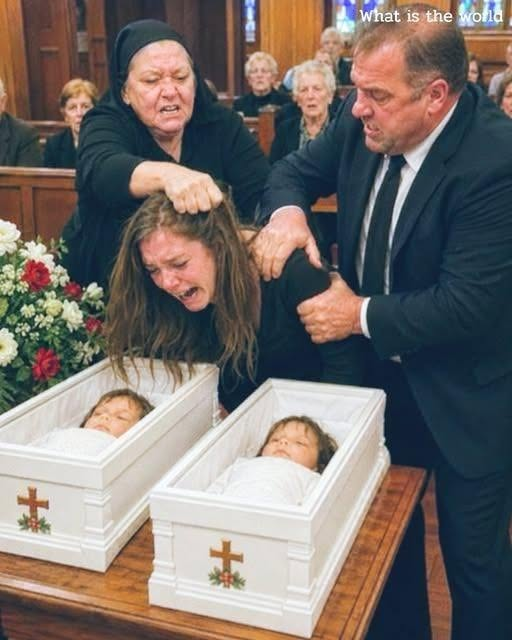
The police stopped the burial.
That was the hardest decision of my life.
I wanted my babies laid to rest.
I wanted the nightmare finished.
Instead, investigators needed additional testing.
The bottles from our house were collected.
So were medications and containers from Margaret’s home.
Her phone was seized.
Security footage from a pharmacy, a grocery store and our street was requested.
And the confession half the family had heard inside the church was documented.
Margaret was taken away for questioning.
As she passed me, she looked furious.
Not ashamed.
Not devastated.
Furious.
“You’ll destroy this family,” she hissed.
I stared at her.
“No.”
“You did.”
Trevor tried to follow the officers.
Then stopped.
He looked at me.
There was bloodless horror on his face.
“Claire…”
I stepped backward.
He whispered:
“I didn’t know.”
“I believe you.”
His eyes filled.
That seemed to give him hope.
Then I continued:
“But you knew she hated me.”
He froze.
“You knew she called the twins a mistake.”
“Claire—”
“You knew she said having more children would trap you.”
“That isn’t the same as knowing—”
“No.”
I nodded.
“It isn’t.”
I would not accuse him of a crime he had not committed.
“But five minutes ago, after your mother attacked me at our children’s funeral, you told me to leave.”
His face collapsed.
“I panicked.”
“You always panic in her direction.”
Silence.
That was our marriage in one sentence.
Whenever Margaret hurt me, Trevor explained her.
Whenever I objected, Trevor managed me.
When the twins were born and Margaret refused to hold them, he said:
“She needs time.”
When she called them “too much responsibility,” he said:
“She comes from another generation.”
When she told Emma that Mommy had ruined Daddy’s life with children, he said:
“Don’t start a family war.”
And at the funeral—
he had still chosen keeping his mother calm over protecting me.
I was finished helping him pretend that was neutrality.
The investigation took weeks.
There was no dramatic answer overnight.
But the evidence became harder and harder for Margaret to explain.
Testing found that the twins had been exposed to a substance that should never have been in their feeding bottles.
Investigators found traces connected to items recovered from Margaret’s kitchen.
Her phone contained deleted searches and messages.
The searches were not released publicly.
I was grateful for that.
No grieving family needed the details turned into entertainment.
What mattered was the conclusion:
The deaths had not been natural.
And the evidence pointed directly toward Margaret.
Then police recovered the phone call Emma had overheard.
Margaret had called her sister.
The recording did not exist.
But phone records proved the call happened.
And her sister eventually admitted what Margaret had told her.
Not how.
Why.
Margaret believed Trevor’s life had been “stolen” by fatherhood.
She hated that we had twins.
She hated that he left work earlier.
That he canceled golf.
That he spent weekends changing diapers instead of visiting her.
Most of all, she hated me because I was the person he had built that life with.
Her sister said:
“I thought she was venting.”
I asked:
“What exactly did she say?”
The woman started crying.
Then she answered:
“She said sometimes God needs help correcting people’s mistakes.”
I felt nothing.
That frightened me.
Not anger.
Not grief.
Just emptiness.
Because suddenly her words at the funeral made perfect sense.
God took them because He knew what kind of mother they had.
She had not been expressing a cruel belief.
She had been hiding a confession inside an insult.
Trevor broke when he learned.
He came to the temporary apartment where Emma and I were staying.
I did not let him inside.
We spoke in the lobby.
“My mother did it.”
His voice sounded hollow.
“Yes.”
He covered his face.
“I defended her.”
“Yes.”
“I threw you out of the funeral.”
“Yes.”
“Stop saying yes.”
I looked at him.
“What would you prefer?”
He had no answer.
Then he whispered:
“I should have protected you.”
That was the first true thing he had said.
I nodded.
“Yes.”
He cried.
I didn’t comfort him.
There are moments when compassion does not require closeness.
Trevor asked me to come home.
I refused.
He said Emma needed both parents.
I agreed.
So we arranged parenting through lawyers and therapists.
Emma still loved her father.
He had not harmed the twins.
I would not punish my daughter by forcing her to lose another parent because I could no longer be his wife.
But Trevor and I were finished.
He struggled to understand that.
“You believe I didn’t know.”
“Yes.”
“Then why divorce me?”
“Because murder isn’t the only thing that can end a marriage.”
He stared at me.
I continued:
“Your mother assaulted me at our babies’ funeral.”
“You watched.”
“And your first instinct was to remove me.”
His eyes dropped.
“You spent years training me to accept her cruelty so you wouldn’t have to confront her.”
“I was trying to keep peace.”
“No.”
I shook my head.
“You were outsourcing the cost of peace to me.”
That sentence stayed between us.
He never argued with it again.
Margaret was charged after the investigation concluded.
The case took more than a year.
I did not attend every hearing.
I refused to make my life revolve around her.
Emma was protected as much as possible from repeated questioning.
Specialists handled her statement.
Her initial account had been given before anyone told her what investigators suspected, which made it especially important.
Margaret’s attorneys challenged everything.
Her statements.
The testing.
The witnesses.
Emma’s memory.
That was their job.
But the prosecution had more than a four-year-old’s words.
Digital records.
Physical evidence.
Witness testimony.
Margaret’s own behavior.
Eventually, she was convicted.
The judge imposed a severe sentence.
I did not feel victorious.
My sons were still dead.
Justice is not resurrection.
Sometimes it is simply the world finally saying:
What happened to you was real.
That was enough.
Trevor testified too.
Against his mother.
It destroyed him.
He told the court about years of comments he had dismissed.
How Margaret resented the twins.
How she complained that I had “trapped” him with more children.
How he kept telling himself she was just difficult.
Afterward, he found me outside.
“I heard all those things.”
I looked at him.
“I know.”
“I should have listened.”
“Yes.”
He nodded.
He no longer asked me to soften the answer.
That was progress.
Too late for us.
But progress.
Emma started therapy.
For months, she asked the same question in different forms.
Was Grandma angry because of her?
Could she have stopped it?
Would the twins still be alive if she had woken me?
Each time, we answered the same way:
No.
Adults are responsible for adult choices.
Children are responsible for being children.
Eventually, the nightmares became less frequent.
She drew pictures of her brothers.
Then stopped drawing coffins.
Started drawing dinosaurs.
Dogs.
Our new apartment.
A purple bicycle she wanted for her fifth birthday.
Life came back quietly.
That was how healing happened for both of us.
Not by forgetting.
By making room for other things.
Trevor and I divorced eighteen months after the funeral.
At the final meeting, he looked at me and said:
“I don’t expect forgiveness.”
I thought about it.
“I forgive some things.”
His eyes lifted.
“But not so we can reconcile.”
He nodded.
“I know.”
I continued:
“I forgive the man who was weak enough to keep making excuses.”
“But I will never build another home with him.”
His eyes filled.
“That’s fair.”
It was the first time he had called one of my boundaries fair without trying to change it.
I wished he had learned that years earlier.
We buried the twins after the investigation no longer required us to wait.
The second funeral was private.
No large family.
No speeches from people who had ignored Margaret’s cruelty for years.
Just me.
Trevor.
Emma.
The pastor.
A few people we trusted.
Emma placed two little wooden stars beside her brothers.
Then she whispered:
“I told the truth.”
I knelt beside her.
“Yes, sweetheart.”
“You did.”
She looked at me.
“Are they proud?”
I swallowed.
“I think they would be.”
Then she took my hand.
For once, the funeral ended in silence that did not frighten me.
Two years later, Emma barely remembered the exact words she shouted in church.
I did.
I probably always will.
“Pastor, do I have to tell everyone what Grandma put in the babies’ bottles?”
One sentence.
From a frightened four-year-old.
It shattered every lie in the room.
Margaret had spent years making me look unstable.
Too sensitive.
Too protective.
Too controlling.
At the funeral, she even tried to make my grief evidence that I was a bad mother.
But the truth did not come from me.
It came from the smallest person there.
The child Margaret assumed would remain quiet because she had been given cookies and told to keep a secret.
She underestimated Emma.
Just as she underestimated me.
People sometimes ask me what I remember most from that day.
Not the slap.
Not Margaret’s confession.
Not even Trevor choosing his mother before he understood what she had done.
I remember Emma running toward the pastor.
Four years old.
Terrified.
But telling the truth anyway.
Margaret once whispered that if I didn’t stay quiet, I would end up beside my children.
Instead, her threat became one more piece of evidence showing exactly who she was.
I did not end up in that coffin.
I walked out of that church holding my daughter’s hand.
And when Emma finally asked me years later why Grandma had done something so terrible, I told her the only answer that mattered:
“Because Grandma made a terrible choice. Not because of you. Not because of your brothers. And not because of me.”
My daughter had spent too long carrying an adult’s secret.
So I gave her something better to carry.
The truth.
And from that day forward, in our house, we had one rule:
No secret that makes a child afraid is ever a secret they have to keep.
