Ethan stood in the basement corridor with his hand still suspended between us.
I looked at it.
Then at him.
Seven days earlier, that hand had belonged to my husband.
Now it belonged to the surgeon who had walked away from my father’s operating room.
“Move,” I said.
“Natalie, please.”
“I need to take my father home.”
“I’ll come with you.”
“No.”
“He was my family too.”
Something inside me almost laughed.
Instead, I looked at him.
“You had one chance to prove that.”
His face collapsed.
I walked past him carrying the paper bag that contained everything left of my father.
Ethan did not follow.
For once, he understood that following me was not the same as being there when I needed him.
The hospital investigation began that afternoon.
Not because I demanded revenge.
Because too many things had gone wrong.
My father’s surgery had been scheduled with Ethan as the lead surgeon.
He had scrubbed in.
Then left.
The replacement surgeon, Dr. Nelson, was qualified, but he had not planned the case and had to take over after complications had already begun.
The internal review would later conclude that nobody could say with certainty that my father would have survived if Ethan had remained.
That mattered.
I refused to turn grief into a lie.
But the review also found something Ethan could not escape:
Leaving a critical cardiac operation to personally attend a stable staff member with a minor injury had been clinically unjustified.
Especially after other physicians repeatedly told him he was needed back in the operating room.
And there was more.
Owen Clark, Ethan’s assistant, had rejected my calls.
Not once.
Eleven times.
Ethan confronted him the next morning.
I wasn’t there.
But Owen’s written statement eventually became part of the hospital review.
Ethan asked:
“Why did you reject Natalie’s calls?”
Owen answered:
“You told me to.”
Ethan apparently went silent.
Then:
“When?”
“Last week.”
Owen produced the message.
It was short.
Sent after our argument in the kitchen.
Natalie is upset. Unless it’s a real emergency, don’t interrupt me with her calls. She needs time to calm down.
A real emergency.
My father dying apparently had not met the threshold.
Owen continued:
“She kept calling.”
“Why didn’t you check?”
“I did.”
“What did she say?”
“That her father was deteriorating.”
Ethan’s voice reportedly dropped.
“And you still rejected her?”
Owen looked at him.
“You said she exaggerated.”
That was the sentence Ethan could not blame on anyone else.
Because he had said it.
More than once.
About me.
About my father.
About every situation that required him to choose between inconvenience and compassion.
Laura Lane was interviewed too.
At first, she cried.
Said she had been frightened.
Said dizziness could be serious.
Said she had never asked Ethan to abandon another patient.
Technically, that last part was true.
She had never said:
Leave your father-in-law’s surgery for me.
She had only said:
“I’m scared.”
“Don’t leave me.”
“You’re the only doctor I trust.”
And Ethan had supplied the rest.
But then investigators reviewed her messages.
One was sent to a friend thirty minutes before she arrived in the emergency department.
He’s operating on Natalie’s father tonight. Guess I won’t see him.
Another came later.
Never mind. He came.
The friend replied:
For your knee?
Laura answered:
Some people just know who matters.
When Ethan read that, whatever illusion he still had about her innocence disappeared.
But I refused to let him use Laura as a hiding place for his guilt.
She could manipulate.
Owen could obey.
The hospital could have imperfect systems.
But Ethan was the attending surgeon.
Ethan knew my father’s condition.
Ethan heard the calls for him to return.
Ethan chose not to.
Three days after the funeral, he came home.
I was packing.
Not angrily.
That part was over.
My father’s mug went into one box.
His old photographs into another.
The sweater he had forgotten at our house was folded carefully on top.
Ethan stood in the doorway.
“You’re leaving?”
“Yes.”
“For how long?”
I stopped folding.
He heard the stupidity of the question himself.
“Natalie…”
I picked up another shirt.
He stepped inside.
“The hospital suspended me from surgery while they investigate.”
I said nothing.
“Laura has been removed from the department.”
Still nothing.
“Owen resigned.”
I looked at him.
“Do you think those things bring my father back?”
“No.”
“Then why are you listing them?”
His face tightened.
“Because I’m trying to show you I understand how serious this is.”
I shook my head.
“You still don’t.”
He stared at me.
“Then tell me.”
I put the shirt down.
“My father’s death is not the only reason I’m leaving.”
His face went still.
“It’s the reason I finally stopped making excuses.”
“Excuses for what?”
“For you.”
I looked directly at him.
“You didn’t become this man in one operating room.”
“You became him slowly.”
“Every time I called and you said I was dramatic.”
“Every time I asked you to come home and you said medicine came first.”
“Every time another nurse, resident or patient got the version of you that was patient and gentle while your wife got whatever was left.”
He opened his mouth.
I continued.
“And somehow I accepted all of it because you were saving lives.”
My throat tightened.
“Then my father needed you to save his.”
“And suddenly you had time for a scraped knee.”
Ethan closed his eyes.
That was the contradiction he could not survive.
He whispered:
“I was angry with you.”
“I know.”
“The week before the surgery, I felt like you were trying to control me.”
“I know.”
“I thought if I immediately came every time you called, we’d never stop doing this.”
I stared at him.
“Doing what?”
“Fighting.”
I almost laughed.
“So you were teaching me a lesson.”
“No.”
“Yes.”
“You wanted me to learn that I couldn’t demand your attention.”
His eyes filled.
“And my father became part of the lesson.”
“No.”
His voice broke.
“Natalie, please don’t say that.”
“Why?”
“Because it makes me sound—”
He stopped.
I waited.
He could not finish.
Because there was no version of that sentence that made him sound like the man he wanted to believe he was.
I took an envelope from the drawer.
Divorce papers.
His face changed immediately.
“You already filed?”
“Yes.”
“When?”
“This morning.”
He looked genuinely shocked.
“My father died four days ago.”
“Natalie, you’re grieving.”
“Yes.”
“You shouldn’t make permanent decisions right now.”
I stared at him.
“Interesting.”
His brows drew together.
“When I begged you to come to the hospital, I was too emotional.”
“Now that I’m leaving you, I’m too emotional.”
“When exactly am I allowed to make a decision you don’t like?”
He had no answer.
I placed the envelope on the table.
“This marriage is over.”
Ethan did not sign immediately.
For two months, he kept asking for time.
Not to avoid financial obligations.
There was no dramatic fortune between us.
He simply could not accept that the woman who had waited through night shifts, canceled anniversaries and seven days of silence had finally stopped waiting.
He sent flowers.
I donated them to the hospital lobby.
He wrote letters.
I read one.
Only one.
It said:
I kept thinking you were asking me to choose you over medicine. I understand now that you were asking me to behave like your husband when medicine did not require me to abandon you.
That was the first thing he wrote that made me cry.
Because it was true.
And because truth does not always arrive in time to save anything.
The hospital’s final review came months later.
Ethan was not accused of intentionally causing my father’s death.
There was no simple line connecting one decision to the outcome.
Medicine rarely works that neatly.
But the committee found serious failures in professional judgment, conflict management and abandonment of his assigned role during a critical case.
He lost his surgical leadership position.
His clinical privileges were restricted for a period.
He was required to complete remediation, ethics review and supervised return-to-practice requirements before the hospital would consider restoring full responsibilities.
The medical board conducted its own review.
Laura received disciplinary consequences for unprofessional conduct and misuse of her relationship with a senior physician.
Owen’s role was also documented.
Nobody walked into prison.
Nobody’s life ended overnight.
But reputations built over years changed because records do not care how important someone believes themselves to be.
Ethan eventually stopped blaming Laura.
That mattered.
At first, he said:
“She knew exactly how to manipulate me.”
Maybe she did.
Then his therapist apparently asked him a question he later repeated to me:
“If Laura had asked you to jump off a bridge, would you have done that too?”
He hated the question.
Which was probably why it worked.
Months later, during one of our divorce meetings, he said:
“I used Laura as an excuse because admitting I chose wrong felt worse.”
I nodded.
“Yes.”
“She didn’t drag me out of the operating room.”
“No.”
“I walked out.”
“Yes.”
He lowered his head.
It was the first time I saw him accept the full sentence without trying to put someone else inside it.
My father’s apartment took me six months to clear.
That was harder than divorcing Ethan.
His reading glasses were still beside the bed.
There was soup in the freezer he had labeled in his terrible handwriting.
A hospital appointment card was stuck to the refrigerator.
And in the bottom drawer of his desk, I found a small box.
Inside was a watch.
For Ethan.
The receipt was dated two weeks before surgery.
There was a note.
For my son-in-law. Doctors always know the value of time.
I sat on the floor and cried until my chest hurt.
For a week, I considered throwing the watch away.
Then I changed my mind.
I gave it to Ethan.
Not as forgiveness.
Not as reconciliation.
As consequence.
He opened the box.
Read the note.
And started crying.
“I can’t take this.”
“Yes, you can.”
“Natalie—”
“My father bought it for you.”
His hands shook.
“I don’t deserve it.”
“That isn’t my decision to make anymore.”
I walked away.
Later, I heard he never wore it.
He kept it in his desk.
Maybe some objects are too accurate to use.
The divorce became final fourteen months after my father died.
Ethan signed without asking me to reconsider.
At the courthouse, he said:
“I’m sorry I made you become someone who could leave me.”
I looked at him.
“No.”
He frowned.
“You didn’t make me become her.”
“My father did.”
His eyes filled.
I continued:
“He raised me to know when love stops requiring patience and starts requiring self-erasure.”
For once, Ethan did not argue.
He simply nodded.
I moved into my father’s apartment.
At first, it felt unbearable.
Then gradually it felt like home.
I kept his old chair.
Changed the curtains.
Donated most of his medical equipment.
Turned his spare bedroom into a study.
I also started volunteering with a hospital family-support program.
Not because I wanted to live inside grief forever.
Because I remembered what it felt like to stand outside an operating room believing the person I trusted was coming.
Families deserve someone who tells them the truth.
Even when the truth is difficult.
Especially then.
Two years later, I saw Ethan again.
Not at court.
Not at a hospital review.
At a cardiology charity event created in my father’s name.
He had donated quietly.
I only discovered it when I saw his name on an internal list.
He stood near the back.
Older.
Quieter.
No white coat.
When the event ended, he approached.
“Your father would have liked this.”
“Yes.”
He looked around.
Then said:
“I’m operating again.”
“I heard.”
“Under a different department chief.”
“That’s probably good for you.”
He smiled faintly.
“It is.”
A pause.
Then:
“I never leave an operating room now without formally transferring responsibility.”
I looked at him.
“That should have always been true.”
“I know.”
No defensiveness.
No explanation.
Just:
“I know.”
Before leaving, he touched his coat pocket.
I saw the outline of a watch box.
“You still have it?”
He nodded.
“I still can’t wear it.”
I understood.
The note had been cruel without intending to be.
Doctors always know the value of time.
My father had written it as praise.
Ethan carried it as a warning.
I said:
“Maybe one day.”
He looked at me.
“Would your father forgive me?”
I thought for a long moment.
“My father forgave easily.”
Hope appeared in his face.
Then I added:
“But forgiveness wouldn’t change what happened.”
He nodded.
“I know.”
And this time, I believed he really did.
People asked me later what ended my marriage.
Most expected the answer to be my father’s death.
It wasn’t quite that.
My marriage ended during the seven days before it.
When Ethan thought silence was a punishment I would eventually submit to.
When my calls became inconveniences.
When my fear became exaggeration.
When he became so certain I would always be waiting at home that he stopped asking what waiting was costing me.
My father’s death did not create the truth.
It exposed it.
Ethan arrived at the hospital seven days late thinking he was coming to bring his wife home.
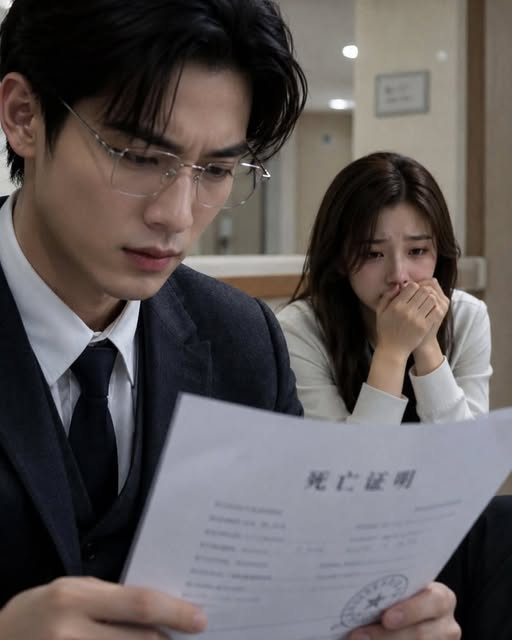
Instead, he found a death certificate.
A sealed investigation.
And a woman who had finally understood that being endlessly understanding was not the same as being loved well.
My father died waiting for Ethan.
I would carry that grief for the rest of my life.
But I refused to make the same mistake.
So when Ethan finally came looking for me—
I was no longer waiting.
