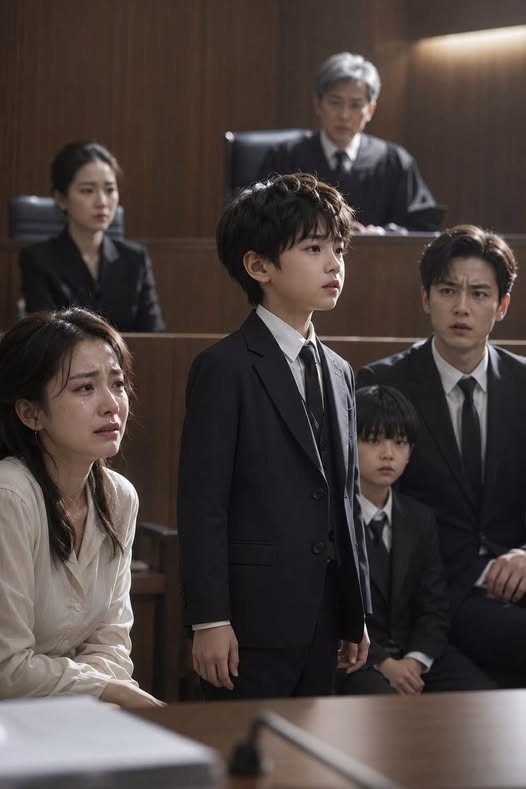
Daniel’s face changed the moment Liam held up the phone.
Not anger.
Fear.
The judge noticed.
“Mr. Whitman, sit down.”
Daniel’s lawyer grabbed his arm before he could take another step.
“Daniel.”
He stopped.
Liam kept the phone pressed against his chest.
The judge looked at him gently.
“Liam, nobody is going to take that from you right now. Can you tell me what is on it?”
My son swallowed.
“Dad talking.”
“What does he say?”
Liam looked at Daniel.
Then at me.
“He says Mom is poor because she’s stupid.”
My chest tightened.
“He says if Noah and I tell anyone we want to live with her, he’ll make sure she never sees us again.”
Daniel stood.
“That is completely out of context.”
The judge’s expression hardened.
“I told you to sit.”
Daniel obeyed.
Barely.
Liam continued.
“He also told us what to say about dinner.”
I stopped breathing.
The judge leaned forward.
“What do you mean?”
Liam looked down.
“Dad told us to say Mom didn’t feed us.”
Noah started crying.
And suddenly I understood why my younger son had barely looked at me all morning.
He had been carrying something far too heavy for nine years old.
Daniel’s attorney whispered urgently to him.
He ignored her.
“Liam, you misunderstood me.”
My son looked at him.
“No.”
One word.
Quiet.
Certain.
Daniel froze.
Liam unlocked the old phone.
“I recorded it because Noah kept crying after Dad talked to us.”
The judge immediately stopped him from playing anything aloud.
Instead, she ordered the device preserved and asked the court-appointed child specialist to take custody of it.
That mattered.
This was no longer a dramatic courtroom reveal.
It was potential evidence involving two children in a custody dispute.
The judge was not going to let anyone turn my sons into performers.
Neither was I.
The hearing was paused.
Daniel tried to speak to Liam as we left.
My son stepped behind me.
That was the first time in months he had chosen my side of a hallway without hesitation.
Daniel stopped.
His face went pale.
“Liam.”
My son whispered:
“You said Mom would disappear.”
Daniel looked at me.
“Elena, tell him I didn’t mean—”
“No.”
My voice surprised even me.
For once, it didn’t shake.
“You explain yourself to the professionals investigating this.”
He stared at me.
“You’re enjoying this.”
I almost laughed.
Enjoying?
My children were terrified.
My marriage had become a legal war.
My nine-year-old son had secretly recorded his own father because he believed no adult would protect his mother otherwise.
There was nothing enjoyable about it.
I looked at Daniel.
“I wanted a divorce.”
“You wanted a victory.”
“There’s a difference.”
The phone was reviewed over the following days.
There were several recordings.
Not edited.
Not dramatic.
Just conversations Liam had captured because he had become afraid.
Daniel telling the boys:
“If you choose your mother, things will get very difficult.”
Daniel saying:
“She doesn’t have enough money to take care of you.”
And then the worst:
“If she keeps fighting me, she may lose the right to see you altogether.”
There were also messages between Daniel and his attorney that were perfectly ordinary.
Nothing illegal.
Nothing sinister.
But Daniel had clearly been discussing the case around the children despite explicit instructions not to involve them.
More importantly, the child specialist found both boys had been coached about what to say.
Not every negative thing they had said about me was invented.
That was painful to hear.
I had struggled after the separation.
I had cried.
There were nights when dinner was cereal because I was exhausted.
There were mornings I forgot permission slips.
But the story Daniel had built from those imperfections was something else entirely.
He had transformed “Mom is overwhelmed” into “Mom is unfit.”
And then taught our sons to repeat it.
The judge ordered a full custody evaluation.
Daniel hated that.
He had expected money to make the answer obvious.
Big house.
Private school.
Driver.
Vacations.
He kept saying:
“I can give them stability.”
The evaluator asked:
“What do you believe emotional stability looks like?”
Daniel had no quick answer.
Meanwhile, I was asked harder questions than I expected.
Why had I stopped working?
Why had I surrendered nearly every marital asset?
Why had I reacted emotionally in court?
Why had I not documented Daniel’s behavior earlier?
I answered honestly.
“I thought leaving with nothing would make him leave the children alone.”
The evaluator looked at me.
“Did it?”
“No.”
That was the moment I stopped confusing surrender with peace.
My lawyer helped me reopen the financial side of the divorce where legally possible.
Not because I suddenly wanted Daniel’s mansion.
Because I had been pressured into accepting an agreement that left me unnecessarily dependent.
For ten years, I had stayed home because Daniel wanted one parent available full-time.
That unpaid work had value.
My financial position did not become irrelevant simply because he earned the salary.
We documented everything.
Career interruption.
Household labor.
Childcare.
Shared investments.
Accounts I had barely understood because Daniel handled them.
For the first time, I stopped saying:
“I don’t care about the money.”
I did care.
Not because I wanted revenge.
Because refusing everything had helped Daniel stand in court and call me financially unstable.
I would not help him build that argument twice.
Vanessa Crowe, his attorney, eventually asked to speak with mine privately.
I thought she was preparing another attack.
Instead, after reviewing the recordings, she withdrew several claims that could no longer be supported.
Daniel was furious.
“You work for me.”
Vanessa reportedly answered:
“I represent you. I do not manufacture evidence.”
That sentence traveled through the courthouse faster than gossip should.
Daniel replaced her soon afterward.
It did not improve his case.
The hardest part was Liam.
Everyone praised him for being brave.
I hated that.
He should never have needed bravery for this.
One evening, after Noah fell asleep, Liam sat beside me on the rented apartment floor.
We still hadn’t bought a sofa.
He asked:
“Are you mad I didn’t tell you?”
I pulled him closer.
“No.”
“I thought Dad would take us away faster if he knew you knew.”
My chest hurt.
“You are nine.”
He looked down.
“I know.”
“No, sweetheart.”
I touched his shoulder.
“You don’t understand what I mean.”
He looked at me.
“You are not supposed to protect me from your father.”
His face crumpled.
“But somebody had to.”
I closed my eyes.
That sentence almost broke me.
I said:
“That somebody should have been an adult.”
“Not you.”
He started crying.
So did I.
For the first time since the divorce began, neither of us pretended to be strong.
Noah struggled differently.
He loved Daniel.
That confused him.
He asked me:
“If Dad did bad things, is he a bad person?”
I answered carefully.
“People can make harmful choices without you having to stop loving them.”
“Do I have to choose you?”
“No.”
“You never have to prove you love me by hating your dad.”
He stared at me.
“Even after court?”
“Even after court.”
That mattered.
Whatever Daniel had done to me, I refused to make our children solve it by splitting themselves in half.
Three months later, we returned to court.
This time, there was no dramatic question asking the boys to choose.
The judge had enough professional evaluations.
The child specialist recommended that I become the primary residential parent for the time being.
Not because Daniel had money.
Not because I didn’t.
Because the children needed distance from the pressure surrounding the case.
Daniel received substantial parenting time, but with clear conditions.
No discussing litigation with the boys.
No asking them to report on my home.
No threats about custody.
No turning affection into evidence.
Family counseling was ordered.
Daniel’s face tightened as each condition was read.
Then the judge said something I will never forget:
“Children are not witnesses you recruit for your side.”
Daniel looked down.
Liam heard it too.
His shoulders relaxed.
Just slightly.
The court did not “destroy” Daniel.
That was never the goal.
He kept his job.
His house.
His reputation, mostly.
But he lost something he had always assumed belonged to him automatically:
Control of the narrative.
For years, Daniel had been the calm one.
The reasonable one.
The successful one.
I had been emotional.
Dependent.
Difficult.
Then people started looking at records instead of expressions.
And calm lies were still lies.
Six months later, Daniel asked me to meet alone.
I refused.
So we met with a mediator.
He looked exhausted.
“I never wanted to hurt the boys.”
I said nothing.
“I was scared you’d turn them against me.”
I looked at him.
“So you tried to turn them against me first.”
His eyes closed.
“Yes.”
That answer surprised me.
No justification.
Just yes.
He continued:
“I thought if they chose you, everyone would think I lost.”
I almost laughed.
“Daniel, they are our children.”
“I know.”
“No.”
I shook my head.
“You know now.”
He lowered his head.
That was the beginning of the first honest conversation we had had in years.
Too late for the marriage.
Not too late for our sons.
Daniel began therapy.
At first, I assumed it was for court.
Maybe it was.
Then months passed and he kept going after the court no longer required frequent reports.
He stopped sending messages through Liam.
Stopped criticizing my apartment.
Stopped buying enormous gifts immediately after the boys returned from my house.
He even apologized to them.
Not dramatically.
No excuses.
He said:
“I asked you to carry adult problems.”
“I should never have done that.”
Noah asked:
“Are you still mad at Mom?”
Daniel looked at me.
Then said:
“That isn’t something you need to worry about.”
It was the right answer.
It arrived years late.
But at least it arrived.
My own life changed too.
I found work.
Not glamorous work at first.
Administrative consulting.
Part-time.
Then full-time.
I refreshed certifications I had abandoned during the marriage.
Eventually, I joined a nonprofit that helped parents reenter the workforce after long caregiving gaps.
The first paycheck I received was not large.
I stared at it for five minutes anyway.
Not because money proved I was worthy.
Because Daniel had spent years making financial dependence feel like a personality defect after asking me to become dependent in the first place.
That paycheck reminded me I was still capable of building something.
A year after the hearing, I moved out of the tiny apartment.
Not into a mansion.
A townhouse.
Three bedrooms.
Small backyard.
Liam chose blue walls.
Noah chose green and changed his mind twice.
We bought a secondhand dining table.
The first night, we ate pizza on paper plates because none of the dishes had been unpacked.
Liam looked around.
“This feels like home.”
I had given up a luxury house in the divorce.
That sentence made me realize I hadn’t actually lost my home.
I had simply moved it.
Daniel and I eventually reached a stable co-parenting arrangement.
Not friendship.
Not reconciliation.
Stability.
There were school concerts where we sat three seats apart.
Birthdays where both of us attended without turning the cake into a legal negotiation.
Parent-teacher meetings where Daniel stopped beginning every sentence with:
“At my house…”
Progress became boring.
That was wonderful.
Children deserve boring peace.
Two years later, Liam found the old phone in a drawer.
He brought it to me.
“Do we still need this?”
I looked at it.
The device that had changed the custody case.
The thing my son had once carried like a weapon because he believed nobody would believe him without proof.
“No.”
“Can I throw it away?”
I thought for a moment.
Then shook my head.
“Not yet.”
“Why?”
“Because I want you to know something.”
He waited.
“That phone helped adults understand what was happening.”
“But saving me was never your job.”
His eyes filled slightly.
I continued:
“You never have to collect evidence against someone you love just to earn the right to feel safe.”
He nodded.
Then handed me the phone.
I put it away.
Not as a trophy.
As a reminder of how close we had come to asking a child to carry an adult war.
Years later, people still remembered the courtroom moment.
The nine-year-old boy.
The old phone.
The father turning pale.
They called it the day Liam destroyed Daniel.
They were wrong.
My son did not destroy his father.
He told the truth.
What happened after that belonged to the adults.
Daniel had to face what he had done.
I had to rebuild the life I had surrendered piece by piece.
And our boys had to learn that loving both parents did not make them disloyal to either.
The judge once asked Liam who he wanted to live with.
But that was never the most important question.
The most important question was the one my son had already answered before anyone asked:
Who makes me feel safe enough to tell the truth?
For too long, Daniel thought money, houses and perfect appearances would answer that for him.
They didn’t.
A nine-year-old with an old phone did.
And in the end, Liam did not win custody for me.
He gave the adults something we had all been missing:
The truth without Daniel’s version attached to it.
